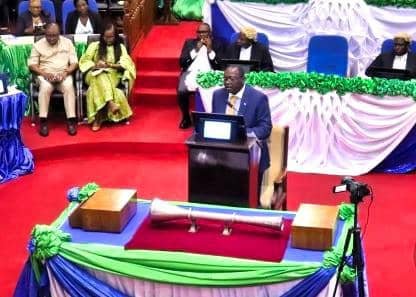
On Friday, November 28, Finance Minister Sheku Fantamadi Bangura presented the Appropriation Bill for the 2026 fiscal year, outlining a national budget firmly anchored on economic growth and the protection of vulnerable citizens. Delivered in Parliament, the budget speech emphasized economic stability, revenue mobilisation, and a strengthened social protection framework aimed at shielding low-income households from the pressures of a shifting economy.
The 2026 budget positions itself as both pro-growth and pro-people, with significant allocations targeting the poor, the elderly, and communities affected by addiction—signalling the Government of Sierra Leone’s commitment to inclusive and equitable development.

Central to this year’s fiscal plan is a major expansion of direct social support. Through the National Commission for Social Action (NaCSA), government will provide cash transfers to 20,000 extreme-poor households across the country. The initiative is designed to help vulnerable families meet essential needs such as food, school fees, and basic healthcare without sliding further into poverty.
“This is not just a line item; it is a lifeline,” noted a representative from the Budget Advocacy Network. “Putting money directly into the hands of those who need it most is one of the most effective ways to reduce immediate hardship and stimulate local economies.”
The budget also includes dedicated cash transfers for citizens aged 75 and above, ensuring that elderly Sierra Leoneans receive meaningful support to live with dignity in their later years.
In response to the alarming rise in drug abuse—particularly the destructive Kush epidemic—the government has allocated substantial resources to combat addiction through both treatment and emergency response. A total of NLe 6.0 million has been earmarked for the Ministry of Social Welfare to support the operations of drug rehabilitation centres nationwide.
“This funding is a crucial step towards treating addiction as the health crisis it is,” said a public health specialist. “It moves the needle from enforcement to rehabilitation, offering hope and a structured path to recovery for thousands of young people and their families.”
Complementing this intervention, the budget allocates an additional NLe 10.0 million to the National Public Health Agency to strengthen its response to Kush and other narcotics-related emergencies—reflecting a coordinated, multi-layered approach to the national drug crisis.
To cushion the cost-of-living impact of revenue measures, the government has incorporated several pro-poor tax exemptions. In a policy widely applauded by consumer groups, Liquid Petroleum Gas (LPG), cooking stoves, solar panels, and related accessories have been exempted from Goods and Services Tax (GST) and import duty. This exemption aims to reduce the cost of clean cooking and renewable energy solutions, particularly benefiting low-income households.
“This is a smart and compassionate policy,” noted an energy sector entrepreneur. “It makes clean energy more affordable, supports family budgets, reduces indoor air pollution from charcoal, and aligns with Sierra Leone’s climate commitments. It’s a win-win.”
By interweaving these social protection initiatives with broader economic reforms, the 2026 budget underscores the government’s belief that national development must be inclusive. The message is clear: Sierra Leone’s future prosperity depends on policies that uplift all its citizens—especially those most at risk of being left behind.