

By Amin Kef (Ranger)
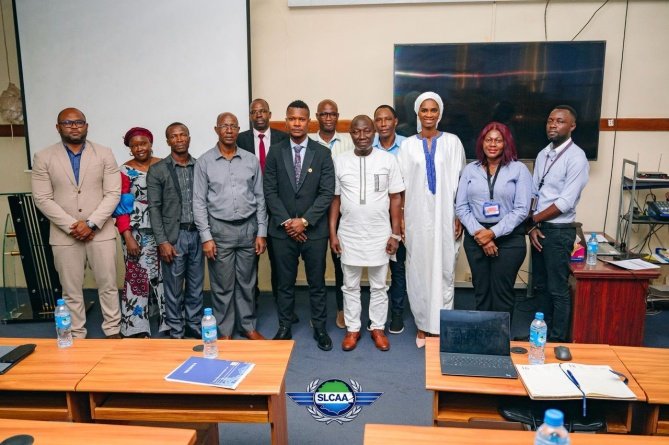
The Sierra Leone Civil Aviation Authority (SLCAA) has reaffirmed its commitment to strengthening aviation safety and security following the successful conclusion of the AFI-CES Technical Assistance Mission, a high-level intervention that has significantly enhanced regulatory oversight in Sierra Leone’s aviation sector.
Director General of SLCAA, Musayeroh Barrie, welcomed the outcome of the mission, noting that it marked a major milestone in aligning the country’s aviation security systems with international standards. She emphasized that, in collaboration with experts from the African Civil Aviation Commission, key Aviation Security (AVSEC) frameworks were strengthened to improve operational effectiveness and regulatory compliance.
“SLCAA welcomes the successful conclusion of the AFI-CES Technical Assistance Mission, which has strengthened oversight in Sierra Leone. In collaboration with AFCAC experts, key AVSEC frameworks were enhanced in line with international standards. We remain committed to implementing these outcomes,” Madam Musayeroh Barrie stated.
The mission complements the Authority’s recent efforts, including the successful completion of a three-day Aviation Security (AVSEC) Risk Matrix Review held from March 16 to 18, 2026, at Freetown International Airport. The exercise brought together critical stakeholders across the aviation and security sectors, including the Office of National Security, Republic of Sierra Leone Armed Forces, Sierra Leone Police, immigration authorities, airport operators and AVSEC service providers.
The collaborative review focused on reassessing emerging threats, identifying operational vulnerabilities and strengthening preparedness against evolving risks within the aviation ecosystem. At the end of the intensive sessions, participants developed and validated a harmonized 2026 Aviation Security Risk Matrix tailored specifically to the country’s main international gateway.
According to SLCAA officials, the updated framework introduces a dynamic, intelligence-led and risk-based approach to aviation security. It is designed to enhance proactive threat detection, improve coordinated responses and ensure efficient allocation of resources to areas of greatest need. The revised matrix is also expected to strengthen decision-making processes and elevate the overall effectiveness of security operations at the airport.
A key achievement of both the AFI-CES mission and the AVSEC review process is the strengthening of inter-agency collaboration. Improved coordination among security institutions is expected to enhance communication, intelligence sharing and joint operational responses, ultimately creating a more resilient aviation security architecture.
SLCAA further underscored that those initiatives are consistent with global best practices and international aviation standards. The Authority noted that ongoing reforms are part of a broader strategy aimed at modernizing Sierra Leone’s aviation sector and boosting international confidence in its air transport systems.
In recent years, SLCAA has continued to expand its technical capacity through strategic partnerships and targeted interventions. Those include the installation of modern security systems, enhanced inspection protocols and specialized training programmes for aviation personnel to ensure optimal operation and maintenance of critical equipment.
The Authority has also engaged in regional and international collaborations, including technical missions and capacity-building programmes designed to strengthen regulatory oversight and operational efficiency. Such engagements have reinforced Sierra Leone’s position within the global aviation community and contributed to safer and more efficient air navigation systems.
The successful conclusion of the AFI-CES Technical Assistance Mission, alongside the AVSEC Risk Matrix Review, represents a significant step forward in Sierra Leone’s aviation security journey. It highlights SLCAA’s sustained commitment to safeguarding the country’s airspace through proactive, intelligence-driven and internationally compliant measures, while laying a solid foundation for continued progress in the sector.