

By Amin Kef (Ranger)
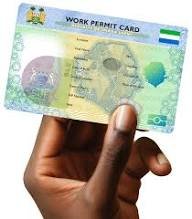
The Government of Sierra Leone has commenced full nationwide enforcement of the Biometric Residence and Work Permit Card regime, marking a major step in the country’s drive to modernize migration control, strengthen labour regulation and enhance national security.
The enforcement action, jointly led by the Ministry of Employment, Labour and Social Security and the Sierra Leone Immigration Department, follows the expiration of the transition period previously granted to non-nationals to replace their old paper-based permits with the new biometric cards.
Under the directive, which took legal effect on 1 April 2026, the biometric permit card now stands as the sole officially recognized document for residence and work authorization for all non-nationals living or working in Sierra Leone.
Authorities confirmed that compliance exercises are now being actively carried out nationwide, with verification teams deployed to airports, seaports, border crossings, workplaces and various field inspection points to ensure that all foreign nationals are in possession of valid biometric documentation.
The move signals Government’s determination to close loopholes associated with outdated paper permits, which officials say had become vulnerable to misuse, forgery and weak verification systems.
As part of the enforcement process, all non-nationals are required to produce their valid biometric residence and work permit cards whenever requested by immigration or labour officers. Officials warned that anyone found in violation of the directive risks facing administrative penalties, denial of immigration services, sanctions at border points and possible revocation of legal work or residency status.
Employers across Sierra Leone have also been placed under renewed legal obligation to ensure that every non-national within their workforce holds valid biometric authorization. Authorities stressed that hiring or retaining foreign workers without proper biometric documentation now constitutes a direct breach of the country’s labour and immigration laws.
To support smooth compliance, Government said service centers remain operational in Freetown, Bo, Kenema, Makeni, Kono and Port Loko, where trained staff are available to assist with applications, renewals and permit verification.
In addition to the physical offices, the Government continues to encourage applicants to utilize the official online unified permit platform, which has been introduced to simplify processing, reduce paperwork and improve transparency in immigration services.
Officials say the new system forms part of broader reforms aimed at creating a digitally secure, transparent and efficient migration management architecture that aligns with international best practices.
The nationwide enforcement exercise is expected to improve identity verification, enhance monitoring of foreign labour participation and strengthen institutional coordination between immigration and employment authorities.
With the grace period now officially concluded, Government is urging all affected individuals and employers to act swiftly to avoid sanctions, emphasizing that no further extension is expected.
The latest development underscores Sierra Leone’s growing commitment to modern border governance, stronger workforce regulation and the use of biometric technology to improve public administration.