
By Ibrahim Sesay
The Government of Sierra Leone has unveiled a major electricity sector reform plan that will see the operational management of the Electricity Distribution and Supply Authority (EDSA) transferred to a private sector operator before the end of 2026, as part of efforts to improve efficiency, strengthen revenue generation and guarantee more reliable power supply across the country.
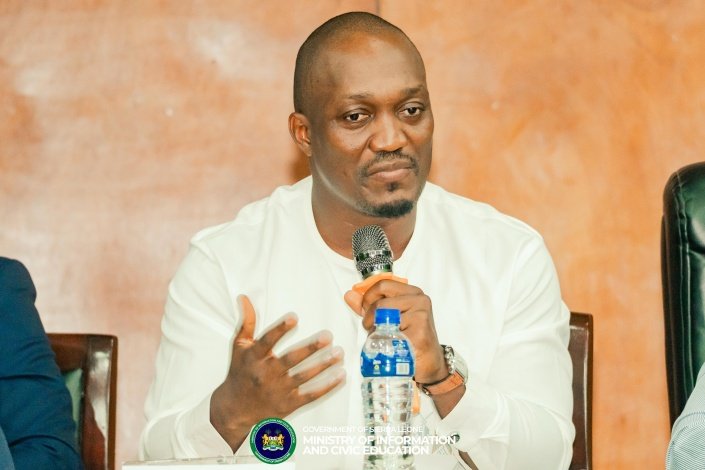
That disclosure was made by the Deputy Minister of Energy I, Edmund Nonie, during the Government’s weekly Press Briefing held at the Miatta Conference Centre on Tuesday, April 7, 2026, where he outlined a strategic roadmap aimed at addressing persistent inefficiencies that have long affected the country’s electricity distribution system.
According to the Deputy Minister, the move is not a sale of the state-owned electricity institution, but rather a management reform framework under which a competent private company will be contracted to oversee the day-to-day running of EDSA with strict performance targets.
He clarified that ownership of the institution will remain fully with the Government of Sierra Leone, while the private operator will bring in technical expertise, stronger management systems and results-driven mechanisms to tackle commercial losses, improve billing and collections and enhance customer service delivery nationwide.
Edmund Nonie stressed that the decision forms part of a broader public-private partnership strategy intended to restore financial discipline and operational credibility within the power sector, noting that the current structure has struggled under the weight of inefficiencies, leakages and weak cost recovery systems.
He particularly highlighted the financial burden associated with electricity supply in rural and underserved communities, where Government continues to subsidize power far beyond what is currently being recovered through revenue streams.
Despite the financial strain, he reaffirmed Government’s unwavering commitment to expanding electricity access throughout Sierra Leone, describing rural electrification as a key pillar of President Dr. Julius Maada Bio’s national development vision.
The Deputy Minister further assured citizens that by the end of President Bio’s tenure, Government remains focused on ensuring a more dependable, wider and sustainable electricity supply network capable of supporting households, businesses and public institutions.
As part of the transition process, he disclosed that EDSA has already begun collaborating with private sector institutions in specific operational areas, particularly debt recovery and revenue collection, with early signs of improvement already being recorded.
He explained that those targeted partnerships have started strengthening EDSA’s financial standing, enabling the institution to better meet its obligations to energy suppliers and reducing the risk of supply disruptions that previously stemmed from unpaid debts and contractual tensions.
In what appears to be an early validation of the reform direction, the Deputy Minister pointed out that recent months have not witnessed the kind of supplier shutdown threats that had previously become common within the sector, a development he attributed partly to improved financial engagements and private sector support mechanisms.
Government officials believe the full operational privatization model will introduce modern performance-based management systems, improve accountability, reduce both technical and commercial losses and significantly boost service delivery standards.
The planned reform is also expected to improve public confidence in the electricity sector by ensuring faster response to faults, better customer relations, stronger metering systems and more transparent billing structures.
Energy sector observers say the initiative marks one of the boldest reform measures undertaken in recent years and could become a turning point in Sierra Leone’s drive toward a stable and financially viable electricity distribution system.
With the end-of-2026 target now clearly set, expectations are rising that the partnership model could redefine the future of power supply management in Sierra Leone while keeping state ownership intact and safeguarding national strategic interests.