
By Ibrahim Sesay
Government Ministers and senior officials on the second day of the Civic Day Series in Karene District used the platform to provide residents with detailed updates on ongoing and planned Government programmes in education, trade, local governance and preparations for the 2026 population and housing census, reinforcing the Government’s commitment to direct civic engagement and inclusive development.
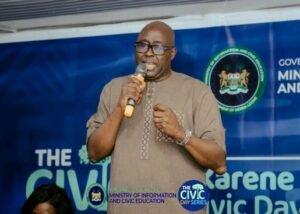
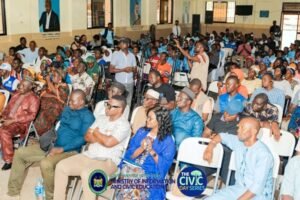
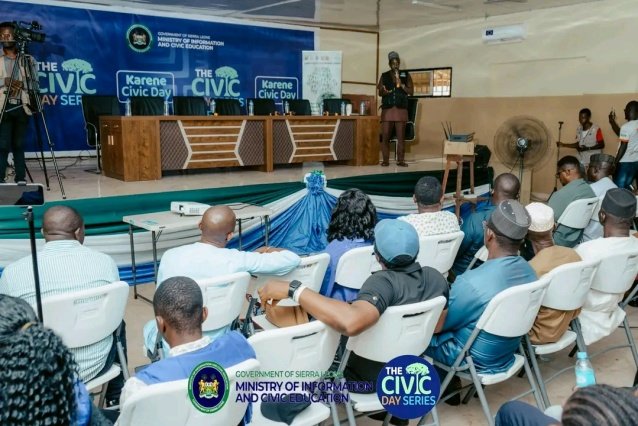
The engagement, organized by the Ministry of Information and Civic Education at the Karene District Council Hall in Kamakwie on 14 April, brought together Ministers, senior public officials and community stakeholders in a direct dialogue aimed at keeping citizens informed on national priorities and development interventions affecting their communities.
Addressing the gathering, Minister of Technical and Higher Education, Dr. Ramatulai Wurie, said the Government is placing strong emphasis on technical and vocational education as part of efforts to expand access to practical skills training nationwide. She disclosed that plans are underway to establish Government technical institutes in every district across Sierra Leone, with a long-term vision of upgrading them into community technical colleges designed to respond to local economic realities.
Dr. Ramatulai Wurie explained that courses to be offered in the proposed colleges would be carefully aligned with the socio-economic strengths and productive sectors of each district to ensure that training remains relevant to local development needs. She added that the Ministry has adopted a demand-driven model of education by engaging employers and industry players to identify the specific skills required in the labour market, thereby enabling graduates to transition more easily into meaningful employment.
She further revealed plans by the Government to transform the Ernest Bai Koroma University campus in Port Loko into the Ahmad Tejan Kabbah University for Education, Science and Technology, a move expected to further strengthen higher education opportunities and specialized academic training in the country.
Speaking on economic development initiatives, Minister of Trade and Industry, Alpha Ibrahim Sesay, said the Government is working closely with authorities in Karene District to secure 300 acres of land for a major livestock farming project. He noted that the district’s strong reputation in cattle rearing makes it a strategic location for such an investment, which he said is expected to significantly stimulate economic activity, create jobs and strengthen the local agricultural value chain.
On the issue of the cost of living, Alpha Ibrahim Sesay told residents that before the escalation of the ongoing Middle East conflict, the Government had made significant progress in stabilizing the prices of essential commodities. He stated that despite continued increases in global fuel prices, the Government has maintained subsidies on petrol and diesel in order to cushion the impact on citizens and keep transport and commodity costs within manageable levels.
He assured the people of Karene District that fuel prices would be adjusted downward as soon as international market prices begin to decline. In further outlining the Government’s industrial expansion plans, Alpha Ibrahim Sesay announced that two new flour factories and a cement factory are also expected to commence operations, a move aimed at reducing import dependence and strengthening domestic production capacity.
Providing updates on local governance reforms, Deputy Minister of Local Government and Community Affairs, Alfred Jamiru, disclosed that a draft report on redistricting has already been submitted to President Julius Maada Bio for consideration. He said the report recommends the creation of two new districts, Kpanguma in the east and Bandajuma in the south, as part of efforts to improve administrative efficiency and bring governance closer to the people.
Alfred Jamiru explained that Kpanguma District would comprise chiefdoms currently within Kailahun and Kenema districts, while Bandajuma District would include chiefdoms drawn from Bo and Pujehun districts. He added that the report also proposes the creation of two additional councils in the Western Area Rural District and one new council in the Western Area Urban District, stressing that the proposed council for Freetown is not intended to divide the capital but rather to improve service delivery and administrative effectiveness.
On the 2026 population census, Director of Communications at Statistics Sierra Leone, Samuel Ansumana, informed residents that the Government has shown strong ownership of the exercise by providing the bulk of the required funding. He noted that unlike the previous midterm census, when digital devices had to be borrowed from Kenya, the Government has now procured all the necessary equipment, including tablets and vehicles, to ensure a more efficient and credible process.
Samuel Ansumana encouraged residents of Karene District and Sierra Leone as a whole to actively participate in the census, describing it as a vital civic duty that directly supports national planning and development. He emphasized that reliable census data remains critical for effective policymaking, equitable resource allocation and the design of future development interventions.
He also assured the people of Karene that qualified applicants from the district who applied for census-related jobs would be fairly considered for recruitment as enumerators, a statement that was warmly welcomed by many residents at the engagement.
The Civic Day Series concluded with renewed calls for sustained dialogue between government and citizens as a pathway to stronger accountability, accelerated development and more informed public participation in national affairs.