
By Alvin Lansana Kargbo
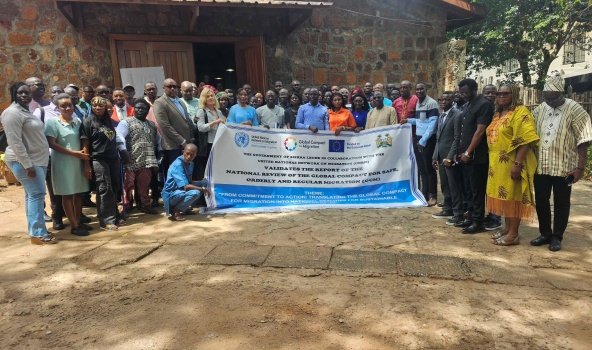
The Government of Sierra Leone, in collaboration with the United Nations Network on Migration, on Thursday 16 April 2026 validated the country’s National Review Report on the Global Compact for Safe, Orderly and Regular Migration during a high-level engagement held at Lac’s Villa on Kingharman Road in Freetown. The validation marked a significant milestone in the country’s efforts to strengthen migration governance through evidence-based policy planning, inclusive consultations and stronger institutional coordination.
The report offers a comprehensive national assessment of Sierra Leone’s progress in implementing the Global Compact for Safe, Orderly and Regular Migration. Built on evidence-based findings, extensive stakeholder consultations and alignment with national policy frameworks, it reviews achievements made so far, identifies existing gaps and sets out priority actions aimed at improving migration management systems across the country.
Providing an overview of the review process, Brima Bendu, Project Focal Point at the International Organization for Migration, explained that the exercise was intentionally designed as a structured, inclusive and nationally owned undertaking. He disclosed that the process unfolded in six key stages, beginning with a pre-baseline training on evidence-based reporting held in Johannesburg, South Africa, which brought together critical government institutions including the Ministry of Planning and Economic Development and Statistics Sierra Leone.
Brima Bendu further stated that a technical working group made up of statisticians, International Organization for Migration staff and consultants was subsequently established to guide the process and ensure effective cross-sector coordination. This was followed by extensive data mapping and desk reviews of key national frameworks, including the National Migration Policy, the National Labour Migration Policy and the GCM National Implementation Plan, all of which were benchmarked against the 23 objectives of the global compact.
He added that nationwide consultations were later conducted in Freetown, Bo and Makeni, bringing together migrants, border officials, women’s groups, migrant worker associations and private sector representatives. According to him, the resulting gap analysis measured Sierra Leone’s performance against the principles of the compact, revealing notable progress in areas such as diaspora engagement and border management, while also highlighting persistent challenges including limited disaggregated migration data, weak protection systems for vulnerable migrant workers and coordination gaps among implementing institutions.
Brima Bendu noted that the process culminated in the drafting of a zero report structured around the seven pillars of the National Implementation Plan, capturing major findings and setting out key recommendations to guide future policy actions and reforms.
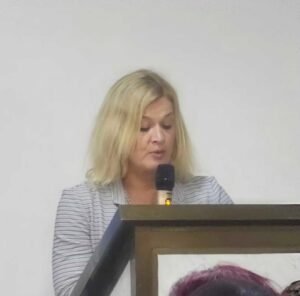
In her opening remarks, Pauline Macharia, Officer in Charge at the International Organization for Migration, described the validation as a critical step in accelerating implementation and deepening accountability. She emphasized that the review process goes far beyond a routine reporting obligation, representing instead Sierra Leone’s broader commitment to evidence-based action, inclusive governance and measurable impact.
Pauline Macharia recalled that Sierra Leone’s recognition as a Global Compact Champion Country in 2023 carries both prestige and responsibility, particularly as member states prepare for the 2026 International Migration Forum in New York. She stressed that the focus is now shifting from policy commitments to tangible outcomes that improve the lives of migrants and their families. She also highlighted the gains made since the launch of the National Implementation Plan and the establishment of coordination mechanisms in October 2025, while pointing to urgent priorities such as strengthening migration data systems and improving border management coordination.
Underscoring the human dimension of migration governance, Pauline Macharia revealed that in 2024 alone, the International Organization for Migration supported the return and reintegration of more than 2,000 stranded Sierra Leoneans. She reaffirmed the institution’s commitment, in its role as secretariat of the United Nations Network on Migration, to continue providing technical support through programmes backed by the European Union.
Speaking on behalf of the European Union, Els Mortier reiterated the bloc’s commitment to supporting Sierra Leone’s migration governance architecture through technical assistance under the Building Migration Partnerships programme. She noted that the initiative continues to strengthen stakeholder coordination, policy development and the mainstreaming of migration into national development planning.
Els Mortier further announced additional backing through a joint European Union and Ireland initiative focused on strengthening national registration and reporting systems, especially in the areas of return, protection and reintegration. She emphasized the need for a rights-based migration approach and highlighted ongoing efforts to tackle trafficking in persons and gender-based violence linked to migration vulnerabilities.
Representing civil society, Rev. Martha Priscilla Gbenga Chijozie stressed that the validation process must remain grounded in the lived experiences of migrants, including stranded Sierra Leoneans abroad, returnees and families affected by migration-related tragedies. She called for the report to adequately address migrant protection, sustainable reintegration, diaspora participation and the root causes driving irregular migration.
Rev. Martha Priscilla Gbenga Chijozie further advocated for stronger reintegration programmes that move beyond short-term assistance to include long-term psychosocial support, skills development and educational opportunities. She also called for policies that reduce remittance costs while creating more viable investment channels for Sierra Leoneans in the diaspora.
She emphasized the indispensable role of civil society in monitoring implementation, raising public awareness and promoting accountability, noting that effective migration governance can only succeed through sustained collaboration among government institutions, development partners and community-based actors.
The validated report is expected to serve as a strategic roadmap for Sierra Leone’s migration policies and programmes, strengthening coordinated national action while positioning the country to showcase measurable progress at the 2026 International Migration Forum in New York.