

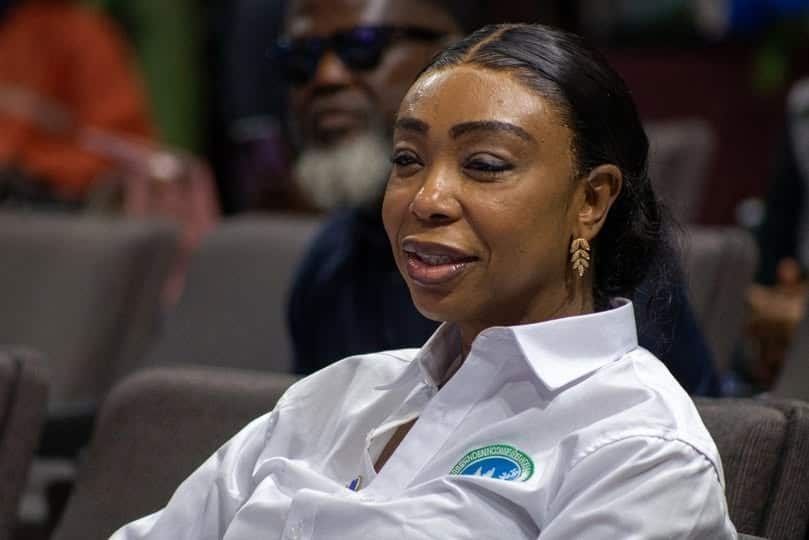
In a country where political differences have sometimes threatened national harmony, the importance of individuals who work tirelessly behind the scenes to promote understanding, reconciliation and peaceful coexistence cannot be overstated. Among those making a meaningful contribution to Sierra Leone’s peacebuilding journey is Hawa Sally Samai, Executive Secretary of the Independent Commission for Peace and National Cohesion (ICPNC), whose dedication, professionalism and commitment to constructive dialogue have helped strengthen the country’s ongoing efforts towards lasting peace.
Her contribution came into sharper national focus following the successful organisation of the National Unity and Social Cohesion Conference 2026, held on 26 and 27 October at the Bintumani Conference Centre in Freetown. The historic gathering brought together some of Sierra Leone’s most influential political figures, national institutions, civil society organisations, traditional and religious authorities and international development partners.
While public attention understandably centred on the speeches of prominent national leaders, the successful convening of such an important gathering also reflected months of institutional preparation, consultations, coordination and engagement. Hawa Sally Samai was among the key professionals helping to guide those processes through her leadership responsibilities at the ICPNC.
Her contribution illustrates an essential truth about peacebuilding: the people who help create the conditions for national dialogue are often just as important to the process as those who eventually address the nation from the podium.
For Madam Hawa Samai, the Bintumani Conference was not an isolated achievement. It represented another milestone in a continuing journey that has required patience, institutional discipline, diplomacy and the ability to engage stakeholders across political and social divides.
Following the political tensions surrounding Sierra Leone’s 2023 general elections, the ICPNC contributed to dialogue efforts that helped create the conditions for the Agreement for National Unity, signed in October 2023. The Commission subsequently remained involved in engagements associated with the Tripartite process, national stakeholder consultations and renewed discussions concerning outstanding recommendations of the Truth and Reconciliation Commission.
Throughout those developments, Hawa Sally Samai has worked alongside the Commission’s Board, professional staff, political stakeholders and development partners to support institutional engagement and maintain momentum towards reconciliation.
Her contribution is particularly significant because peacebuilding in a politically competitive environment demands more than administrative competence. It requires discretion, consistency, respect for differing opinions and a willingness to sustain conversations even when progress appears difficult.
Those qualities are essential to the work of an institution entrusted with promoting national cohesion.
The Bintumani Conference, organized under the theme, “From Commitment to Action: Rebuilding Trust, Strengthening National Unity and Advancing Social Cohesion,” provided a major opportunity to move beyond political declarations towards practical commitments capable of strengthening public confidence.
One of its most important outcomes was the adoption of the Freetown Declaration on National Unity and Social Cohesion 2026, which outlines measures to strengthen political cooperation, prevent conflict, promote inclusion and improve institutional accountability.
The Declaration proposes an Elders’ Forum involving current and former national leaders, stronger inter-party dialogue, a Code of Conduct for Peaceful Elections ahead of 2028 and improved conflict prevention and early-warning mechanisms.
It also establishes implementation timelines, including publication of the conference report within 30 days and development of a National Peace and Cohesion Action Framework within 90 days.
Those outcomes provide a concrete basis for evaluating the conference’s long-term significance and the institutional work undertaken by the ICPNC.
President Dr Julius Maada Bio, delivering his keynote address, reinforced the national importance of the gathering by calling for reconciliation, justice, accountability and a renewed commitment to peaceful coexistence. In a particularly significant moment, the President apologized on behalf of the State to victims and survivors of Sierra Leone’s civil war and called for renewed attention to reparations and outstanding Truth and Reconciliation Commission recommendations. He also reaffirmed his commitment to constitutional governance and a peaceful transfer of power in 2028. His participation and pronouncements gave the conference considerable national significance, reinforcing the importance of the institutional coordination undertaken by the ICPNC and professionals such as Hawa Sally Samai in creating opportunities for constructive engagement.
Former President Dr Ernest Bai Koroma also made an important contribution by emphasizing political tolerance, national responsibility and the need for leaders to place Sierra Leone’s collective interests above partisan considerations. His participation alongside President Bio demonstrated the value of continued engagement between political leaders who represent different political traditions. Dr Ernest Bai Koroma’s message that national leadership requires consultation, restraint and respect for political differences complemented the peacebuilding objectives pursued by the Commission. For Hawa Sally Samai and her colleagues, the participation of such influential national figures represented an encouraging outcome of the wider effort to sustain dialogue across political divides.
Vice President Dr Mohamed Juldeh Jalloh, who addressed the closing session, strengthened the conference’s significance by pledging Government support for implementing the Freetown Declaration. “As a government we support this declaration. We worked with the committee and we will make sure we support its implementation,” he assured participants. The Vice President also emphasized that sustainable peace requires effective institutions, inclusive governance, justice and opportunities for citizens to participate meaningfully in national development. His remarks reinforced the central argument that peace must produce practical benefits for ordinary Sierra Leoneans. The Government’s endorsement of the Declaration also placed renewed responsibility on the ICPNC and other institutions to ensure that the commitments receive sustained attention.
In her closing remarks, Hawa Sally Samai welcomed the Government’s commitment and expressed appreciation to the stakeholders whose collective efforts made the conference possible.
She acknowledged the guidance of the Commission’s Board, chaired by Rev. Professor Shodankeh Johnson, as well as the contributions of the National Moral Guarantors, traditional and religious leaders, civil society representatives, development partners and Commission staff.
Her acknowledgement of those contributions reflected an understanding that national peacebuilding cannot succeed through individual efforts alone.
Indeed, one of the strengths of Madam Hawa Sally Samai’s contribution is her work within a collaborative institutional framework that recognizes the importance of bringing different voices into the national conversation.
At a time when political rhetoric can easily deepen divisions, the ability to sustain engagement among stakeholders with competing interests is an important public service.
Yet recognition of her contribution should not obscure the challenges that remain.
Sierra Leone continues to face concerns involving political mistrust, economic exclusion, unresolved community disputes, access to justice and the implementation of previous national agreements.
The effectiveness of the Freetown Declaration will therefore depend on sustained political goodwill, adequate institutional resources, transparent monitoring and the willingness of responsible authorities to translate commitments into measurable results.
The ICPNC must also continue demonstrating independence, fairness and consistency in its engagement with political actors and communities.
These challenges make the work of Hawa Sally Samai and her colleagues even more relevant.
Her importance lies not merely in helping organize a successful national conference, but in contributing to the institutional continuity required to keep reconciliation efforts alive beyond major public events.
As Sierra Leone approaches the 2028 general elections and prepares to commemorate 25 years since the end of its civil war, the demand for credible peacebuilding institutions and responsible national leadership remains substantial.
The coming months will provide an important test of whether the commitments adopted at Bintumani can strengthen public trust, improve political cooperation and address grievances that continue to affect communities.
For Hawa Sally Samai, the successful conclusion of Bintumani 2026 represents a notable professional milestone and an opportunity to build upon the Commission’s existing work.
Her dedication deserves recognition, not because the country’s peacebuilding achievements belong to any one individual, but because sustained institutional progress depends on committed professionals who understand the importance of patience, consultation and national responsibility.
Behind the handshakes, the declarations and the powerful speeches are the difficult conversations that make national understanding possible. Hawa Sally Samai has helped keep those conversations moving.
And as Sierra Leone continues its journey towards lasting reconciliation, her contribution stands as a reminder that meaningful leadership is not always about occupying the centre of public attention. Sometimes, it is about ensuring that people with different opinions can continue sitting around the same table, listening to one another and working towards a common national future.
For Hawa Sally Samai, that is both the significance of her contribution and the responsibility that lies ahead.