
By Amin Kef (Ranger)
Sierra Leone’s media landscape has come under renewed scrutiny as the country joins the world to commemorate World Press Freedom Day on May 3, against the backdrop of a disturbing decline in global press freedom and a sharp drop in the nation’s standing in the 2026 World Press Freedom Index released by Reporters Without Borders.
The latest index paints a sobering picture of journalism across the world, indicating that press freedom has fallen to its lowest level in 25 years. More than half of the 180 countries assessed are now classified as operating under “difficult” or “very serious” conditions for journalism, reflecting growing threats to independent reporting, the expansion of restrictive laws, political hostility toward the media and the weakening economic foundations of news institutions.
Within that troubling global context, Sierra Leone’s performance has raised serious concern among journalists, media rights defenders and democratic governance advocates. According to the index, Sierra Leone dropped significantly in the global rankings, falling from a relatively strong position in 2025 to approximately 79th place in 2026, with its overall score declining to about 57 out of 100. The fall of more than 20 places represents a major setback for a country that had, in recent years, been widely regarded as one of West Africa’s promising examples of media reform.
Observers say the decline is largely linked to growing concerns over the safety of journalists. The country recorded a worrying drop in the safety indicator, reflecting increased incidents of threats, harassment and intimidation, particularly during politically sensitive periods. For many journalists covering governance, elections, corruption and accountability issues, the operating environment has become increasingly risky, raising fears that self-censorship could take deeper root if stronger protective measures are not urgently introduced.
This development comes despite Sierra Leone’s commendable progress in media law reform. The repeal of Part V of the Public Order Act of 1965, which criminalised libel, was celebrated in 2020 as a historic achievement that decriminalised defamation and opened a new chapter for freedom of expression. That reform significantly reduced the fear of arbitrary arrests and was widely seen as a bold democratic step by the Government.
However, the 2026 index underscores a hard truth: legal reform alone cannot guarantee press freedom. Without a safe, tolerant and economically viable environment for journalists and media houses, the gains achieved through progressive legislation remain fragile and vulnerable to reversal.
Economic pressure continues to weigh heavily on the media sector. Many news organisations in Sierra Leone operate under severe financial constraints, relying largely on advertising revenue from government, political actors or affiliated institutions. Such dependency creates vulnerabilities that can affect editorial independence and weaken the capacity of journalists to pursue critical or investigative reporting without fear of financial consequences.
The political climate has also influenced the media environment. The post-election atmosphere has been marked by heightened tension, increased scrutiny and pressure on journalists perceived to be critical of authority. Although Sierra Leone still maintains a vibrant and pluralistic media space, recent developments suggest a narrowing tolerance for dissenting voices and robust public-interest reporting.
In his message for World Press Freedom Day, United Nations Secretary-General António Guterres stressed the centrality of press freedom to all other freedoms. He stated that without press freedom, there can be no human rights, no sustainable development and no peace. He also highlighted the dangers faced by media workers across the world, including censorship, surveillance, legal harassment and death, while calling for stronger protection for journalists and a world where truth and those who speak it are safe.
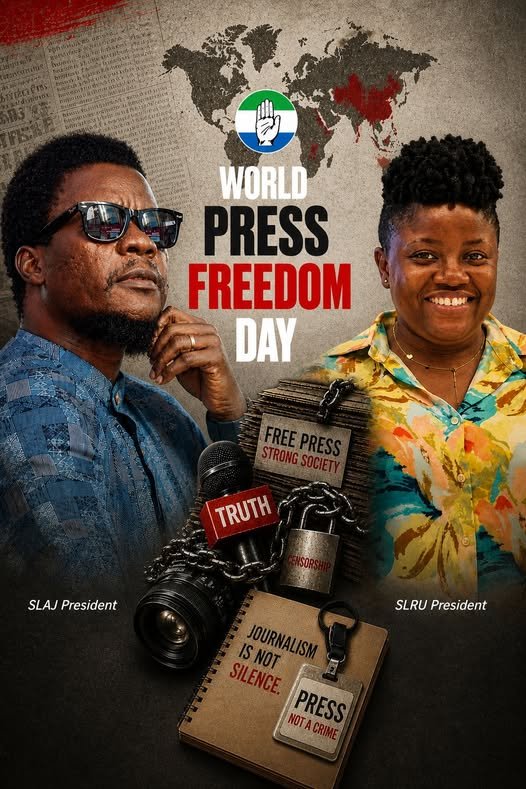
In Sierra Leone, the Sierra Leone Association of Journalists (SLAJ), led by its President, Alhaji Manika Kamara, has used the occasion to renew its call for stronger constitutional protection for press freedom. In a statement issued on Sunday, May 3, 2026, SLAJ said the findings of the World Press Freedom Index reinforce the urgent need for a standalone chapter in the Constitution of Sierra Leone that explicitly guarantees freedom of expression, press freedom and the safety and security of journalists and creatives.
SLAJ acknowledged that Sierra Leone has made notable progress over the past five years, particularly through the repeal of criminal libel. However, the association warned that those gains remain incomplete and fragile. It expressed concern over certain provisions in the Cybersecurity and Crime Act, especially Section 44(2), which has been criticised for its potential to criminalise legitimate journalistic expression and dissent in the digital space.
The association also raised concern over the Counter-Terrorism Act, noting that certain provisions could be misapplied in ways that restrict civic space and press freedom if not implemented with adequate safeguards. Beyond legislation, SLAJ said it is increasingly alarmed by rising digital threats, harassment and intimidation targeting journalists, especially those perceived as critical of authority.
Female journalists, according to SLAJ, continue to face gendered online abuse and coordinated attacks, creating a chilling effect on participation and expression within the media landscape. The association maintained that anchoring press freedom in the supreme law of the land would provide stronger and more enduring protection beyond political cycles and legislative ambiguities.
At the same time, SLAJ emphasised that strengthening the media ecosystem is a shared responsibility. It called for enhanced professional training, stronger ethical standards, continued investment in capacity building and improved mechanisms for self-regulation and accountability.
SLAJ further highlighted the importance of the National Fund for Public Interest Media (NaFPIM), describing it as a groundbreaking initiative designed to support independent public-interest journalism. The association commended the Government of Sierra Leone and partners including the International Fund for Public Interest Media, BBC Media Action and the Media Reform Coordinating Group for supporting the fund, while urging Government to fully honour its financial commitments to ensure its sustainability, independence and long-term impact.
The Sierra Leone Reporters Union (SLRU), led by President Yeanor Esther Kabia, also issued a strong World Press Freedom Day statement under the theme, “Shaping a Future at Peace: Promoting Press Freedom for Human Rights, Development and Security.” The union stressed that a free and independent press is indispensable to building peaceful societies, promoting development and protecting democratic values.
SLRU noted that no nation can meaningfully pursue peace, economic recovery or sustainable development where truth is suppressed and reporters operate under fear. It warned that misinformation, manipulation of information through emerging technologies, economic hardship and attacks on media credibility are placing independent journalism under severe strain globally and locally.
For Sierra Leone, the union said the challenge is especially relevant, as the country’s democratic journey depends on an informed public, electoral integrity, social cohesion and accountable governance. While acknowledging progress, SLRU said reporters still face intimidation, threats, poor working conditions, limited access to information and economic vulnerability.
Kabia reaffirmed the union’s commitment to defending the rights, welfare and professional dignity of reporters across the country, stressing that a free press is not an adversary of the state but a constructive partner in nation-building. The union called on Government, public institutions, the security sector and the general public to respect reporters and protect their lawful duties.
The 2026 World Press Freedom Index therefore serves as both a warning and an opportunity for Sierra Leone. The country has laid important foundations for a free press, but those foundations must now be strengthened through constitutional guarantees, safer working conditions, economic support, responsible journalism and genuine national commitment.
At a time when press freedom is under growing threat worldwide, Sierra Leone stands at a decisive crossroads. Whether the country reclaims its upward trajectory or continues to slide will depend on how urgently it protects journalists, defends truth and treats press freedom as a cornerstone of democracy, peace and national development.