

By Alvin Lansana Kargbo
The President and Chairman of the Sierra Leone Employers Federation, Kobi Walker, has called for urgent modernization of labour laws to address emerging challenges in the digital economy, warning that failure to act could leave workers vulnerable and unprotected.
Speaking at the National Labour Conference and Social Dialogue 2026 held on May 1, 2026 at the Miatta Conference Centre, Kobi Walker said the rapid evolution of digital technologies is fundamentally transforming employment structures, creating both opportunities and risks for Sierra Leone’s labour market.
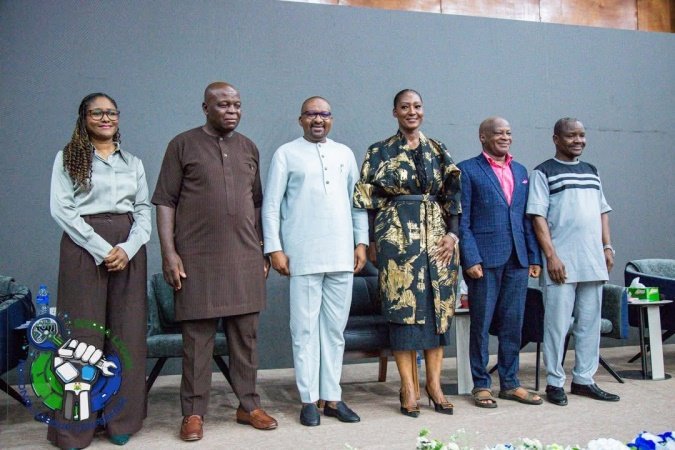
The two-day conference, convened by the Ministry of Employment, Labour and Social Security Sierra Leone in collaboration with SLEF and the Sierra Leone Labour Congress, brought together Government officials, employers, workers’ unions, development partners and digital innovators under the theme: “Challenges and Opportunities of Decent Work in the Digital Era.”
Kobi Walker commended the presence of Vice President Dr. Mohamed Juldeh Jalloh, noting that his participation underscored Government’s commitment to strengthening social dialogue and advancing labour reforms.
He highlighted that the global digital revolution, driven by automation, artificial intelligence and online platforms is reshaping how people work and how businesses operate. While those changes are opening new pathways for entrepreneurship and productivity, he warned they are also raising concerns about job security, skills gaps, informality and inequality.
“For Sierra Leone, this moment presents both a challenge and an opportunity,” Kobi Walker stated. “We must ensure that digital transformation does not deepen exclusion or leave workers behind, while also leveraging it to expand access to jobs and promote innovation.”
The SLEF President explained that digital employment now spans a wide range of activities including remote work, online freelancing, e-commerce, app-based transport and delivery services, digital marketing and software development. However, he noted that those emerging work models often blur the traditional employer-employee relationship.
“In many cases, workers are classified as independent contractors, yet platforms still control pricing, performance standards and access to customers,” he said, adding that such arrangements create uncertainty over legal responsibility and labour protection.
Kobi Walker further pointed to challenges in determining end-of-service benefits for workers engaged in non-traditional employment. He explained that irregular hours, fluctuating incomes and multiple short-term contracts make it difficult to calculate service duration, earnings and employer obligations.
To address those issues, he called for comprehensive reforms, including the recognition of digital work in national labour laws, the introduction of clear criteria for employment status based on economic reality and the adoption of digital systems for tracking contracts, earnings and working hours.
He also advocated for portable pension schemes, strengthened labour inspection mechanisms and sustained engagement among Government, employers and workers to shape inclusive labour policies.
“This conference comes at the right time,” Kobi Walker noted, emphasizing that discussions over the two-day event, including panel sessions, stakeholder engagements and a job fair, would help generate practical solutions for building a resilient and inclusive labour market.
He stressed the importance of broad participation, noting that the future of work requires collaboration among policymakers, businesses, workers’ unions, informal sector representatives and innovators.
Marking the significance of International Workers’ Day, Kobi Walker said the conference also serves as a reminder of the dignity of labour and the collective responsibility to create fair opportunities for all.
“The choices we make today will shape the labour market of tomorrow,” he said. “If we invest in skills, modernize policies and protect workers’ rights, we can turn today’s challenges into tomorrow’s opportunities.”
In a separate May Day message, Kobi Walker praised ongoing labour reforms led by the Ministry, including the Employment Act 2023, Work Permit Act 2023, Overseas Employment and Migrant Workers Act 2023 and the Trade Union and Industrial Relations Act 2024. He described those efforts as critical steps toward strengthening labour governance and improving workplace standards across Sierra Leone.
He concluded by urging stakeholders to ensure that discussions at the conference translate into tangible outcomes that promote decent work, empower workers and support national development in the digital era.