
By Amin Kef (Ranger)
Vice President of the Republic of Sierra Leone, Dr. Mohamed Juldeh Jalloh, has called for a bold transformation of the country’s mining sector, insisting that Sierra Leone’s vast mineral wealth must go beyond extraction and begin delivering meaningful jobs, infrastructure, industrial growth and sustainable prosperity for citizens.
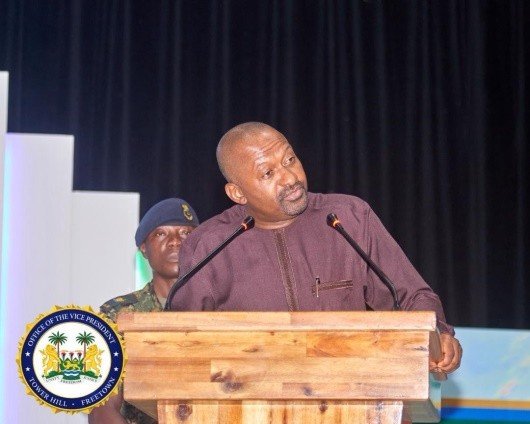
The Vice President made the call on Wednesday, 20 May 2026, while officially opening the Sierra Leone Mining Week 2026 and the 11th Ordinary Meeting of the African Diamond Producers Association (ADPA) Council of Ministers at the Freetown International Conference Centre, Bintumani, Aberdeen in Freetown.
The week-long conference, jointly organized by the Ministry of Mines and Mineral Resources and the National Minerals Agency (NMA), commenced on Tuesday, 19 May, with preliminary engagements and will conclude on Saturday, 23 May 2026. Held under the theme, “Our Mineral Resources: Responsible Mining, Value Multiplication and Shared Prosperity,” the gathering brought together Ministers, regulators, mining executives, investors, diplomats, development partners, Civil Society representatives, artisanal miners, students and technical experts from across Africa and beyond.
In his keynote address, Dr. Mohamed Juldeh Jalloh emphasized that Sierra Leone is prepared to govern its mineral resources “responsibly, ambitiously and in the interest of its people,” stressing that the country must transition from merely exporting raw materials to creating value and building sustainable economic growth.
The Vice President officially launched Sierra Leone’s National Strategy for Critical Minerals 2026–2031, describing it as a strategic roadmap aimed at positioning the country among Africa’s emerging leaders in critical mineral development, industrialization and value addition.
He disclosed that Sierra Leone possesses substantial deposits of lithium, cobalt, graphite, coltan, platinum group metals, rare earth elements, iron ore, diamonds and rutile, stressing that those resources should now be treated as strategic sovereign assets capable of transforming the national economy.
“These are not just minerals in the ground,” the Vice President stated. “They are sovereign assets, strategic assets and development assets.”
According to Dr. Mohamed Juldeh Jalloh, the National Strategy for Critical Minerals seeks to attract approximately US$2.5 billion in exploration and mining investments, establish three to five mineral processing plants, create about 45,000 direct and indirect jobs, train 15,000 skilled workers, generate roughly US$300 million in annual Government revenue and achieve approximately US$1.5 billion in export earnings from processed mineral products.
He maintained that Sierra Leone’s mining future must be built around transformation rather than continued dependence on exporting raw minerals.
“Mining must not merely generate exports. Mining must finance transformation,” he declared.
Dr. Mohamed Juldeh Jalloh stressed that mining wealth must support Sierra Leone’s Medium-Term National Development Plan and the Government’s “Big Five Game Changers,” including food security, youth employment, infrastructure, human capital development, technological advancement and stronger institutions.
The Vice President noted that one of the most pressing concerns repeatedly raised by ordinary Sierra Leoneans remains the question: “Where does the mining money go?”
He described the concern as patriotic rather than cynical, arguing that citizens deserve to see tangible benefits from the country’s mineral wealth through improved roads, schools, healthcare services, jobs, electricity and community development initiatives.
Providing context on the sector’s performance, Dr. Mohamed Juldeh Jalloh disclosed that Sierra Leone generated approximately US$1.12 billion in mineral exports in 2024, while Government revenue from the sector increased by 34 percent to about US$49.9 million.
Despite those gains, the Vice President acknowledged that major reforms remain necessary.
“From a billion-dollar export sector, less than five cents of every dollar reaches the national treasury,” he stated, describing the situation as evidence of “unfinished reform.”
According to him, declining international aid and shrinking development financing require Sierra Leone to increasingly depend on responsible management of its mineral resources to finance national development priorities.
He therefore stressed that mining revenue had become not only an economic matter but also a national development and security imperative.
To address concerns surrounding accountability and revenue leakages, Dr. Mohamed Juldeh Jalloh called for stronger production verification systems, improved digital monitoring technologies and enhanced independent Government capacity to verify mineral grades, export volumes, pricing and valuation systems.
“The answer is technology,” he emphasized, while warning that underreporting and transfer pricing continue depriving African countries of billions of dollars annually.
The Vice President also advocated for stronger and more balanced mining agreements capable of protecting Sierra Leone’s development interests while maintaining investor confidence.
He disclosed that Government is increasingly exploring strategic partnerships with institutions such as the African Finance Corporation and Afreximbank to support mining and infrastructure financing.
Referencing the FG Gold Baomahun US$330 million financing arrangement, Dr. Mohamed Juldeh Jalloh said credible partnerships and long-term financing models could unlock major investment opportunities in Sierra Leone’s extractive industry.
He further proposed moving beyond traditional royalty systems toward more innovative revenue mechanisms, including sovereign wealth arrangements, infrastructure-linked mining development and strategic equity participation.
The Vice President highlighted provisions under the Mines and Minerals Development Act 2022, which guarantees Government a 10 percent free-carried, non-dilutable equity interest in large-scale mining ventures, with room for negotiations up to 35 percent participation.
He stressed, however, that such state participation should be professionally managed through a dedicated mining investment structure rather than political arrangements.
On infrastructure development, Dr. Mohamed Juldeh Jalloh criticized the duplication of roads, railways, ports and energy facilities by individual mining companies, describing the practice as costly and disconnected from national development priorities.
He instead advocated for shared infrastructure systems capable of simultaneously supporting mining, agriculture, industrialization, trade and surrounding communities.
“A railway built for a mine should also create economic opportunities for communities,” he stated.
The Vice President additionally called for increased Sierra Leonean participation in technical and leadership positions within mining companies.
While noting that approximately 92 percent of the mining workforce is Sierra Leonean, he stressed that stronger efforts are needed to deepen skills transfer through university partnerships, technical institutes, vocational programmes and structured career development systems.
He also underscored the importance of formalizing artisanal mining, noting that over 120,000 Sierra Leoneans depend on the subsector for their livelihoods.
According to him, formalization efforts must include stronger environmental protection measures, legal market access, cooperative systems, digital registration and firm action against exploitative labour practices, especially child labour.
Concluding his keynote address, Dr. Mohamed Juldeh Jalloh challenged stakeholders to ensure that by Mining Week 2027, Sierra Leone records mining revenues exceeding US$100 million, operational mineral processing plants, stronger community development systems, improved infrastructure models and increased value addition across the sector.
“With these words,” the Vice President declared, “I officially open Sierra Leone Mining Week 2026, the 11th African Diamond Producers Association Council of Ministers Meeting and launch the National Strategy for Critical Minerals.”
Speaking earlier, Director General of the National Minerals Agency, Ing. Hadji Dabo, described the conference as a strategic platform for shaping the future of Africa’s mining sector and transforming mineral wealth into tangible prosperity.
He highlighted Sierra Leone’s continued commitment to responsible mineral governance through international frameworks, including the Kimberley Process, while acknowledging the participation of delegates from more than 30 countries.
Chairman of Parliament’s Committee on Mines and Mineral Resources, Saa Emerson Lamina, noted that mining remains one of Sierra Leone’s most significant economic sectors, contributing substantially to exports, Government revenue and national economic growth.
He praised reforms under the Mines and Minerals Act 2023, describing the legislation as a major breakthrough for transparency, accountability and stronger community participation in mining governance.
Minister of Mines and Mineral Resources, Julius Daniel Mattai, also emphasized that Sierra Leone’s mining future must be built on responsible governance, industrialization, value addition and shared prosperity.
He maintained that Sierra Leone remains “open for business, but not open for capture,” stressing Government’s commitment to attracting responsible investors willing to support long-term development, skills transfer and infrastructure growth.
Meanwhile, Chief Technical Officer of Leone Rock Metal Group, Salim Sillah, stated that Sierra Leone’s mining sector is currently witnessing one of its strongest periods of investment growth in over two decades, attributing the momentum to reforms in licensing systems, transparency and investor confidence.
Following the opening ceremony, the Vice President toured exhibition booths, including that of the Sierra Leone Road Safety Authority, where he commended Executive Director James Bagie Bio for improvements in service delivery and institutional reforms.
He urged the Authority to intensify efforts aimed at removing un-roadworthy heavy-duty trucks from Sierra Leone’s roads to reduce accidents nationwide.