Home Blog Page 1257

Another Reality TV launched by Zainab Sheriff

Zainab Sheriff

Zainab Sheriff C.E.O Zee Multimedia Zainab Sheriff has launched, The Zee Factor, a reality fashion and modelling competition. Zee Factor promises to be a reality show of drama, fashion, creativity and innovation. Sheriff says the show is a platform to promote local fashion.

The model say she will be using her skills, talents, experiences and exposure to make the program a success. Zainab Sheriff C.E.O Zee Multimedia Zee Factor will feature ten designers and 10 male and female models. The selection of the participants was done on an open and competitive manner.

Sheriff says her selection process was very inclusive as she was able to accommodate everyone regardless of their limitations. The show features a cross dresser and an albino model. Sierra Leone doesn’t often celebrate or include albinos in fashion and beauty. model’s and their designers At the launch of the show at Atlantic well known faces graced the red carpet.

China Nikki, winner of last year’s Big Sister was out in public for the first time in a long time. china Nickywinner of 2018 big sister reality TV show There will be 3 winners of the Zee Factor, each taking home 20 million Leones. Aminata Bangura, Miss World Sierra Leone will host the show. The public will be required to vote for their favourite participant. Sheriff has had quite the year.

There was the huge public fall over between herself Anthony Junior Navo, AYV, and Africell. Some might have thought, that that would have dampered her prospects but nothing seems to hold her down. Sheriff have moved on to new projects and remains focused on being a key part of Sierra Leone entertainment.

Zainab Sheriff is the owner of Zedzee Multimedia and modelling company. She is an actress, singer, model. She is listed amongst the 50 Most Influential young Sierra Leoneans. Last year she produced the wildly successful Big Sister Sierra Leone reality TV Show.

SLPP lays Premium on Building an Economy for the Digital Age

Sierra Leone's fifth president, Julius Maada Bio

A year after taking office as Sierra Leone’s fifth president, Julius Maada Bio believes his government is changing the country’s negative image. A retired brigadier general, Bio was briefly the leader of a military junta that handed power to a civilian elected leader in 1996. He was elected with 51.81 percent of the vote in a runoff in 2018. During a visit to the United States last month, he addressed the Harvard Kennedy School, toured the MIT Media Lab and met with business executives convened by the Corporate Council on Africa. During an all Africa interview, he outlined his rebranding strategy and described why he is prioritizing human capital development.

INTERVIEW
A year after taking office as Sierra Leone’s fifth president, Julius Maada Bio believes his government is changing the country’s negative image. A retired brigadier general, Bio was briefly the leader of a military junta that handed power to a civilian elected leader in 1996. He was elected with 51.81 percent of the vote in a runoff in 2018. During a visit to the United States last month, he addressed the Harvard Kennedy School, toured the MIT Media Lab and met with business executives convened by the Corporate Council on Africa. During an allAfrica interview, he outlined his rebranding strategy and described why he is prioritizing human capital development. Excerpts:

Peacebuilding in a post-conflict nation
Quite a lot of people still think Sierra Leone is a country ravaged by war, devastated by Ebola and a lot of other calamities. It was extremely difficult to restore peace after too many years of civil war. But we are a resilient nation, so we are doing everything to consolidate that peace and democracy. We are changing the narrative.
Sierra Leone is a place where democracy has taken hold. As a post-conflict nation, peace and national cohesion are very important. We want to stitch the country together, irrespective of region, irrespective of ethnic group.
We have decided to establish a commission designed to make sure that the different ethnic groups that live in Sierra Leone consider themselves as Sierra Leoneans. We are doing this because whenever there’s politics, bad politicians play the ethnic card, and that has been a divisive factor. We want to change that and make sure that we are one country and one people Nothing should divide us. We should stay together as a nation to be able to prosper and have a shared future.
Rebuilding the economy
We are working to create the enabling environment for a vibrant economy. We are working to make sure that there is a thriving private sector.
I pledged to provide leadership that is inclusive, I have demonstrated that with the National Development Plan that we just launched. All parties were involved in preparing the plan. Every facet of our society was involved – nearly two million people were consulted. That is the sort of society we want. We can’t afford to be divided. For us to make progress, we have to be united in purpose in order to get to the end that we have decided on.

After so many years of mining diamonds, gold and so many natural resources for which we have nothing to show, we want to concentrate on human capital development.
Human capital meaning food security, health security and education. I ardently believe that if we take care of the human being [and] invest in education, we can produce a population that is useful in the 21st century.
Prioritizing human development
We want to make Sierra Leone the champion of human capital development. When we talk about human capital, we are talking about food security, health and education – investment in all of those area. Already we’ve scaled up our investment in agriculture and health and education.
We are devoting 21% of our national budget on free education so that our kids can be competitive and educated. The system we are working on is not education as we have known it in the past. It is education that is fit for purpose in the 21st century. The world is a village. We want to make the curriculum relevant to the modern world, to produce a workforce that relates to the digital economy that we want to develop.
For healthcare, we have to create a system that can really deliver. When Ebola arrived, we were caught by surprise. We didn’t have the systems in place. We didn’t have the medical personal trained enough so we lost a lot of them, since the Ebola epidemic. We’ve been working to structure our healthcare system in such a way that should there be any occurrence of that nature, we can deal with it. Our maternal mortality rate is definitely too high. Also for the kids. We are working to reduce those numbers.
Role of women and war on gender violence
Women have been deprived of their rightful position for a very long time. They have cultural restrictions that prevent them from being equal partners. We are working to make sure that women are involved as equal partners. We should not consign them to the kitchen.
Because of the spate of sexual violence that has been going on in the country, I had to declare a state of emergency because I needed to attract enough attention to that menace, which we cannot allow to happen in our country. We need action from government. Our society really needs to know that that is not the way to go. We are escalating the activities down to the village level so that people know it is not acceptable.
The role of regional integration
Markets are very important, and in west Africa and across Africa, we are talking about opening up the borders for free movement of not only goods but also people. There’s a lot of effort going on the continental level. We have established the fact that investment and the trade can help us grow our economies. Not every economy is ready but we have to start it and everybody will rise to the occasion.
For a long time, we have depended on mineral resources. What I have set as a goal is to diversify into agriculture, fisheries, tourism so that we don’t put our eggs in one basket. That was what happened when we suffered seriously when price of commodities dropped. We’ve not been able to recover because we depended on iron ore as the main source of revenue for the country. We also have revamped revenue collection and we’ve been able to make a 30 percent increase in the past 11 months.
A welcoming ecosystem for investment
The role of the private sector is very important, and we are creating the enabling environment, an ecosystem that is inviting to make sure that genuine investors can come to Sierra Leon and have a decent return. And we give them the freedom to repatriate their profits. We are ready for business and we want you to come.

Pres. Bio under the Microscope

Sierra Leone’s President Julius Maada Bio

Sierra Leone’s President Julius Maada Bio marked the first year anniversary of his presidency with a visit to an orphanage in the capital Freetown, setting off a debate about the performance of his administration since April 2018.Bio on Thursday visited the Network for Children in Need Orphanage at Allen Town, a community situated in the extreme end of the capital, Freetown.
He used the platform to commit his government to ensuring no Sierra Leonean is left behind in his quest for development.
“Every child is important to this government. We are here to show you all that we love and value you,” Bio said.
He added: “We want to let you know that we recognise what you do and we are ready to support you. We know the challenges you face but we want you all to know that there is a brighter future ahead of you. I encourage you all to focus on your studies as with education you can achieve your full potentials.”
As always, Sierra Leoneans have been divided about the performance of President Bio who campaigned on the platform of uprooting corruption and indiscipline in governance.
While he seems to be doing good in that, with the arrest and trial of many former
government officials accused of corruption, his critics say he has failed in handling the bread and butter issues of the country.
The cost of living has gone up, amidst a weakening local currency, the Leone, against the US Dollar.
On April 4, 2018, Bio became president just hours after he was declared winner of a bitterly contested presidential elections.
His campaign promises had hinged on returning sanity to officialdom by battling corruption, improving the economy and setting Sierra Leone down the road to prosperity.
However, reining graft has left him at odds with social activists who say the human rights record of his administration is nothing to wirte home.
One of the leading civil society organizations in the country, Campaign for Good Governance (CGG), issued a statement in commemoration of the one-year anniversary of Bio’s ascendancy, raising concerns about civil liberties inspite of its good work over the past 12 months.
As expected, his supporters are sprinting top his defense, saying whatever hardship Sierra Leoneans have been going through since April 2018 has been the effect of the bad governance system of Bio’s predecessor, Ernest Bai Koroma.
Among other issues, CGG urged the government to use ongoing anti-corruption crusade to institute institutional reforms. It frowned at the overreliance on Executive Orders in addressing genuine concerns like the rise in sexual violence, as well as the unequitable distribution of national resources.
“In a multiparty environment, concentrating resources in specific areas invariably disadvantages opposition party strongholds, building synergy with local councils for better service delivery is therefore of essence. We call on government to ensure a fairer distribution of state resources,” the organization said in its statement.

Anti -Corruption Laws to be Amended

Sierra Leone’s Parliament has tabled a new bill seeking to amend the country’s anti-corruption laws.The Bill entitled: “The Anti-Corruption Amendment Act 2019”, seeks to amend the Anti-Corruption Act of 2008 and give the Anti-Corruption Commission (ACC) more powers to investigate and prosecute corrupt officials.
Specifically, the bill seeks to amend sections dealing with assets declarations, soliciting and obtaining undue advantage and other related matters, according to a statement from the Parliament.
The bill was on Thursday piloted in the House by the Deputy Attorney General and Minister of Justice, Abdulai Bangurah, who was quoted saying that the objects and reasons were to increase penalties, protection of witnesses and to provide the commissioner alternatives to addressing offences related to graft.
The ACC, which drafted the amended bill, said it is also designed to pre-empt corrupt officials thereby preventing corruption.
MPs on Thursday debated the bill before committing it to the Legislative Committee for further scrutiny.
Mr Sidie Mohamed Tunis, ruling SLPP MP and Leader of Government Business in the House, said the amended bill seeks to reduce corruption by 90 percent.
“The essence of the Bill is to make corruption expensive and painful, and on implementation it will reduce corruption by 80-90 percent like in Rwanda,” he said.
Mr Osman Timbo, opposition APC MP, who is also Acting Chairman of the Legislative Committee, praised the move but said it required further deliberations to iron out some of the issues proving contentious for the opposition.
The Legislative Committee is expected to thoroughly scrutinize the bill and then report on its findings to the House with recommendations of whether or not to approve it with or without changes.
Sierra Leone is ranked among the world’s most corrupt countries, according to the annual Transparency International Corruption Perception Index.
Corruption is thought to have contributed to the 1991-2002 civil war.
Therefore, the country started seriously fighting corruption following the end of the war, with the enactment of the Anti-Corruption Commission Act of 2000, under the late former President Ahmad Tejan Kabba.
The 2000 Act superseded the 1960 Prevention of Corruption Act, which was thought to be less effective in fighting graft.

Strike over Initiation Ban

Members of a secret society in Sierra Leone went on a rampage in the southeast of the country to protest a new ban on initiation rites prompted by deadly unrest, police said on Thursday.
Vowing to defy the ban, the assailants attacked the village of Liema, near the third city of Kenema, on Wednesday, storming the police station and freeing detainees, said police spokesperson Brima Kamara.
“They targeted peaceful citizens in Liema village chanting Poro songs and forcing the inhabitants to hide,” Kamara said, adding that they looted homes.
Poro societies – widespread in Sierra Leone and other West African countries – carry out initiation rites for boys involving ritual scarring during retreats in “sacred woods” that can last for several months.
The ban followed clashes on Monday near a site occupied by agricultural giant Socfin, which residents accused of trying to occupy land they say belongs to a local secret society.
Sierra Leone police said they had opened an investigation into two deaths during the clashes, which also left one of their officers injured.
In a separate incident, a secret society kidnapped nine people as they travelled to work for mining firm Sierra Rutile in Moriba, in the southwest of the country.
“We will go ahead with our secret society initiations because it‘s our tradition,” a member of the Poro society told AFP by telephone from Kenema, requesting anonymity.
More than 90% of Sierra Leoneans are thought to undergo such rites of passage.
Girls undergo a Bondo ritual, which follows a similar pattern but also involves female genital mutilation (FGM), a practice banned in many countries and condemned as potentially lethal by the World Health Organisation.
Sierra Leone has one of the highest rates of FGM in the world.

Sierra Leoneans calls for establishment of Diplomatic Mission

An umbrella organization of Sierra Leoneans in The Netherlands has appealed to the Sierra Leone government to fulfil years of promise to establish a diplomatic mission in the European country.The Sierra Leone Central Union (SLCU) said the absence of a mission as basic as a consulate means Sierra Leoneans have had to travel long distances to neighboring Belgium to seek immigration services.
SLCU is an amalgamation of about 14 organizations representing Sierra Leonean interests in The Netherlands.
It has an estimated 6000 documented members across the country, according to its executive.
Abdurahman Koroma, President of the organization, said for documented persons like him, it costs time and money to access consular services because they have to travel across borders.
It takes Koroma between two and three hours to get to Belgium.
“And that’s one of the hurdles as I have to abandon my job because it’s like a whole day project,” he said at a press conference in Freetown on Friday.
According to him, the experience is worst for the undocumented members of their population, who risk being arrested and detained if they happen to cross the path of the police outside their communities.
“They may want to get a certain document and there is the risk of meeting a policeman on the way which can lead to going to jail. It bothers them because they do not have money and have no vehicle to drive. They have to join public transport,” he added.
Netherlands is one of the countries with the largest Sierra Leonean populations outside the West African country, and it has been a major source of concern due to the high rate of immigration related problems facing the Sierra Leonean population there.
Many of the Sierra Leoneans living in The Netherlands went there during the eleven-year civil war.
Many of them who have been denied asylum face deportation.
And this has been a sticky point for relations between the two governments.
The Sierra Leone government has always argued that many of the people who are identified as Sierra Leoneans were in fact not Sierra Leoneans, claiming that they had accessed the country’s passports during the war.
SLCU has been championing the course for the establishment of a diplomatic mission for a large part of its 15-year existence.
Mr. Koroma said they had had promises from the previous government.
“We are appealing to this government to fulfill that promise,” he said.
SLCU was established in 2004 with the goal of promoting peace among Sierra Leoneans in the Netherlands and to embark on development projects back home.

Africell Is Not Treated Fairly…. Citizens Avers

Ministry of Finance’s Technical Audit Report launched last Tuesday April 2nd 2019 by the Minister of Finance, Jacob Jusu Saffa, has received fierce condemnation from members of the public for what they describe as an unfair treatment of the darling mobile operator of the nation. In their view, the audit report seems to be one-sided, as officials of the company and the former operators at NATCOM, who are au fait with what transpired, were not contacted to give their own side and ensure a balanced report.

The report which was developed by some fifty international and local auditors, accused the country’s Telecommunications Commission (NATCOM) of demonstrating unfair and unequal treatment to mobile phone operators on the same circumstances and the payment of fines.
According to investigations, it is understood that a good number of like-minded Sierra Leoneans have questioned the findings and recommendations of the report, describing it as one sided and bias, as the auditors did not talk to former NATCOM officials to get their own side of the story to ensure a well-balanced report. Some seasoned auditors have even questioned the methodology used by the audit team to arrive at their findings.
Section 10 of the Telecoms Act 2006, (as amended), makes the Commission completely independent in its operations. It is very clear in the Act that the Commission’s major responsibility among several others is to expand telecoms services to rural areas, which it executed very well, especially between March 2015 and March 2018.
According to documentary evidence seen, sometime in 2017, NATCOM received an executive clearance from the office of the President requesting the Commission to prevail on mobile phone companies to expand their network to the interior parts of Kenema, Falaba and Koinadugu districts. Our findings revealed that apart from the President’s instruction, the people also called on NATCOM to ensure the expansion of network to their areas.
In the light of this development, NATCOM decided to engage all GSM operators in the country. It was reliably learnt that one of the operators bluntly refused to comply.
However, documentary evidence has clearly proved that NATCOM contacted all GSM operators to know who was interested to complement government efforts in providing telecom services to the rural areas, unfortunately only Africell consented to work with the Commission in that direction.
Sources say that no shady deal was done in the whole process, contrary to the findings in the technical audit report. The company’s service to the nation has been widely acclaimed and subscribers say that the company is not only providing reliable communication service to the people, but it has alleviated their economic situation through its numerous promotions and support in education, agriculture, sports among others.

It is on record that Africell installed cell sites to the above mentioned areas as outlined in the agreement, which were commissioned by the previous administration in the presence of traditional leaders and several government functionaries.
NATCOM sources say that some of the documents can be traced at the ACC and if the audit team had taken time to contact the former administration, they would have got a clearer picture of the whole issue and will not come out with such a report. It was also disclosed that the commission never forced any mobile company against its will to contribute to UADF and that it also never applied different regulations to any special operator, contrary to the findings in the report.

Documentary evidence show that NATCOM requested all operators to expand their network to the most remote areas in the country, but it was only Africell that complied with that request. All what the commission did regarding the expansion of network in the four remote areas, was done in line with section 9 (1) and section 2 (1) of the telecom Act of 2006 as (amended).

Some social commentators say that Africell was not treated well by the Special Audit team. NATCOM sources say that the Company used its own resources to buy the equipment to connect the people to the global village. “If they have done a marvelous job, I think they should be commended rather than castigating them for a job well done” Mariama Sesay an Africell subscriber maintained. Thomas P Babadie, a seasoned Civil Society Activist stated that “Africell is now being crucified for doing the correct thing in line with their mandate of providing better services to the people including those in remote areas and such a situation will definitely discourage investors”. But not deterred by this matter, Company officials say they are more determined to move ahead and work with the government and people to get quality, affordable services.


Housemates Salone Takes Different Dimension

The nervousness among Housemates Salone TV Reality Show is apparent as the competition heightens. It is a show that is hotly debated in various quarters, on the Social Media with individuals expressing divergent views as to how the participants are faring on, whether it was justifiable to evict some of them and predictions churned out as to who will ultimately emerge as winner to take away the covetous Le100,000,000 star prize.
The ongoing Reality TV Show, which will end in two weeks’ time, is becoming tense, very interesting and captivating as the clock ticks every moment.
In reality, it seems as if the House is on fire as the noise within the four corners, caused by the Housemates, sometimes becomes somehow deafening. At times it becomes irritating to viewers but with the intermittent interjections of jokes and ‘blasting’ at each other with name-callings, it finally turns out to be funny especially when it is interjected with singing, playing of games, story-telling and all sorts of craziness.
The crux of the matter is that all the Housemates are really trying to be humorous, trying to be considered effectively using strong language and to be seen displaying nudity that should be very captivating.
The show, as the organizers ,Africa Young Voices (AYV) Media Empire and Africell Lintel Sierra Leone, planned it should be tilted towards youth empowerment providing the level playing field for expression of God given talents and at the same time affording them the opportunity for the acquisition of new skills. That is why the participants are taken through various activities to build up their confidence and transform them into individuals who have been inspired.
In the case of the Chief Executive Officer of AYV, Ambassador Anthony Navo, the dream and passion to empower young people and elevate them in society inspired him to establish the Empire from which many talented young people have benefitted and are still benefitting. There could be no surprise why he was recently awarded so prestigiously as an outstanding personality and entrepreneur.
With Africell, giving support to the young who have entrepreneurial potentials and talents whether in the music industry, sports, education has been part of their Social Corporate Responsibility.
So for the duo, AYV and Africell, to team up and present for the first time the Housemates Salone Reality TV Show geared towards youth empowerment such must not be a surprise anyone.
As the competition continues to build momentum lobbying by fans of the Housemates for members of the public to vote for participants of their choice on Africell No 5500 via text messages is becoming more and more intense. As a matter of fact the names of the Housemates and their tag numbers are displayed on the footage of AYV Television Channel 34 which is airing the Show on a daily basis.
Reaching its climax the public is eagerly looking forward to who will become the youngest millionaire that will emerge from the 2019 Housemates Salone Reality TV Show.
In a related development, it was disclosed that after 2019 Housemates Salone Reality TV Show, the leaders in media and communication, the Africa Young Voices (AYV) Media Empire and Africell Lintel Sierra Leone will be launching another bigger bomb code named Celebrity Housemate Salone 2019 (CHMSL). Le300 Million will be at stake for this next show that will be championed by the two communications giants.
Indeed, AYV and Africell are taking the entertainment industry to another level in this country.

NP Continues to Impress its Customers

It is strongly incontestable that the leading petroleum company in the country, National Petroleum- Sierra Leone Limited is highly known for being the first in the realm of customer care. This is indisputable when thorough cognizance is taken of how Management is very keen in optimizing customer satisfaction in its service delivery on different fronts.
Members of staff of the company are very mindful of the fact that it is the customer that comes first and therefore needs the utmost attention always ensuring that transactions are conducted under a congenial atmosphere that result into a win-win situation. For this brilliant and managerial initiative the company has been making positive headways positioning to stand tall among other business entities in this part of the world.
With a capable and result-oriented ‘Team NP’, working collaboratively and assiduously, where even the cleaner is regarded as highly relevant there is bound to be positive outcomes and the company has mastered this by ensuring that synergy is enhanced.
One admirable quality that NP-SL Ltd possesses is working tirelessly and effectively using its contacts with oil producing countries in order to ensure that there is timely purchase and delivery of petroleum products to avoid shortages. It goes without saying that fuel, for example, could be a political commodity in the sense that fluctuation in its price would make a Government likeable or unpopular. When the price goes up then people blame the Government for that but if it goes down it is kudos for the political administration.
Its timely importation of petroleum products has earned NP high commendations from various quarters simply because it helps to cushion unrest and other forms of disadvantageous effects one of which is increase in transport fares, increase in the prices of certain commodities. The pro-activeness of the company invariably has a direct impact on poverty reduction in variable ways.
Some who may not be aware of the fact that NP-SL Ltd is wholly owned by Sierra Leoneans vis-à-vis the visibility of the company and how it is remarkably striving could find it hard to believe that it a truly indigenous company.
However, that remains the plain truth when it is learnt that it was Sierra Leonean 35 workers formerly working for British Petroleum (BP) who pulled together their end of service benefits to purchase shares which were used to establish NP, which today is a success story of an indigenous company, having branches in various parts of the country and in other four West African countries namely Liberia, Guinea, Ivory Coast and The Gambia. The company’s operations right across the spectrum is contributing towards revenue generation and job creation for many.
With gas as one its marketable products it was thought wise to be producing gas cookers, popularly known as NP Gas, which could be access at their different filling stations. According to investigation conducted NP Gas is cooking-friendly, safe and long lasting. It is going at an affordable price and many are going for it.
When reference is made to Local Content, which by law is a Policy, then NP-SL Ltd stands tall within that realm as nearly all its members of staff are Sierra Leoneans thereby making use of local talents everywhere they are operating. The Local Content Policy is indeed an engine of growth and NP is making full use of it.
Without any iota of doubt NP-SL Ltd is growing taller and taller as time goes by.

Erstwhile APC Government Ministers to face Commissions of Inquiry

Justice Biobele Georgewill

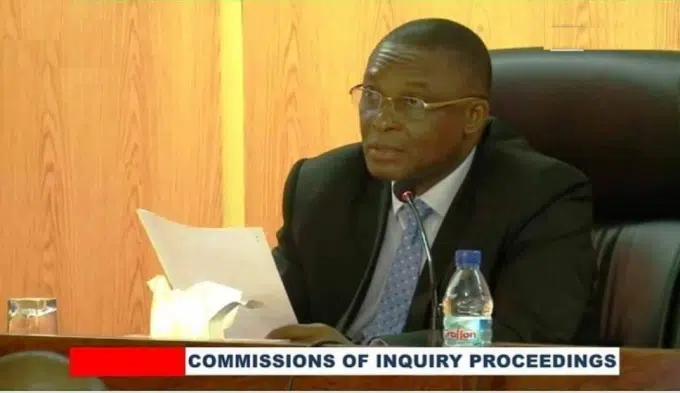
A notice released by the Secretariat in the Government Commissions of inquiry (COI) has issued a notice hearing to senior former Ministers in the Ministry of Mines and Mineral Resources in the Past Koroma Administration to appear before Justice Biobele Gorgewill Commission on Tuesday 8th April .
The former ministers include Alhaji B. Kanu, former Minister Mines and Marine Resources 2009, Alhaji Minkailu Mansaray former Minister of Mines and Marine resources 2010, Abdul Ignosis Koroma, former deputy Minister of Mines and Mr. Sahr Wonday (former Director General of National Mineral Agency) respectively.
‘’Take notice that the justice Biobele Georgewill Commission’s Of Inquiry will on the 8th Day of April be receiving testimonies from witnesses , whose testimonies are likely to touch and concern your conduct as persons of interest to the said commissions on issues pertaining to the Ministry of Mines and Marine Resources and the National Mineral Agency respectively,’’ the notice stated.
According to the notice from the Commissions of Inquiry Secretariat, the former senior government officials are requested to attend on the 8th April and to avail themselves with opportunity to cross examine the said witnesses on any of their testimonies that relates to their person.
It could be recalled that when President Bio assumed office he set up a Government Transition Team to look into the activities of past Koroma administration release the Government Transition Report (GTR) which recommended for a setting up of the COI.
Justice Biobele Georgewill visited Cockerill this morning where ambulances and motorbikes used for the Ebola response are still parked.

This on d spot visit is part of the Commission’s investigation into the Ebola fight.

Fmr Minister of Health Madina Rahman and Former NERC boss Paolo Conteh are the persons of interest in this case.

State Counsel- Lawyer Robin Mason and Defense Counsel – Lawyer Ady Macauley were present.