
Home Blog Page 59

To Prevent Cervical Cancer… Ministry of Health Announces Nationwide HPV Vaccination Drive for Girls Aged 11–18

By Foday Moriba Conteh

The Ministry of Health has announced the nationwide rollout of the National Multi-Age Cohort (MAC) HPV Vaccination Campaign, scheduled to begin today, Monday, 17th November 2025. This initiative marks a significant milestone in Sierra Leone’s ongoing efforts to eliminate cervical cancer, the second most common cancer among women of reproductive age in the country. The campaign, implemented through the Expanded Programme on Immunization (EPI), expands eligibility to girls aged 11 to 18 broadening coverage beyond the single-age cohort previously targeted.

Ahead of the official launch, the Ministry held a press briefing on Friday, 14th November 2025, at its Conference Hall in the Youyi Building, Freetown. The session aimed to equip media practitioners with accurate information to support nation-wide sensitization and public education efforts.

Deputy Medical Officer, Dr. Alie Wurie, emphasized that the engagement was intentionally scheduled before the campaign launch in order to strengthen public awareness. He acknowledged the media’s longstanding partnership in supporting public health delivery, noting that previous vaccination campaigns owed much of their success to timely and accurate reporting by journalists.

Dr. Alie Wurie explained that Sierra Leone has administered HPV vaccines for several years, with more than 168,000 girls vaccinated since the country began HPV immunization efforts in 2013. He described the HPV vaccine as one of the most effective tools in preventing cervical cancer and said that expanding the vaccination cohort represents a renewed commitment to protecting young girls.

He added that full technical details, including operational plans, vaccine delivery strategies and target population specifics would be explained by the EPI team. Dr. Alie Wurie encouraged the media to engage critically, ask questions and ensure clarity before disseminating information to the public. He praised journalists for their patience and reaffirmed the Ministry’s appreciation for their role in healthcare communication.

Representing the Ministry of Basic and Secondary School Education (MBSSE), Dr. Kuyateh delivered a statement on behalf of the Minister and Deputy Minister. He highlighted that the HPV MAC campaign chiefly targets school-going children, who constitute the largest portion of the 11–18 age bracket. Because most eligible girls are enrolled in primary, junior secondary and senior secondary schools, the MBSSE stands as the “largest stakeholder and beneficiary” of the campaign.

Dr. Kuyateh stressed that a successful vaccination campaign will lead to improvements in school enrollment, retention and academic performance. Healthy children, he said, are more likely to stay in school, achieve better results and contribute positively to society. He outlined the Ministry’s nationwide education structure, which includes Chief Education Officers, Directors, Deputy Directors, District Directors, over 380 School Quality Assurance Officers and thousands of school heads and teachers. This communication network is actively disseminating information to ensure nationwide awareness.

He assured the Ministry of Health that even the most remote communities have received information about the vaccination campaign. Dr. Kuyateh reiterated MBSSE’s readiness to collaborate fully, describing the initiative as a model of strong inter-ministerial cooperation.

Delivering a detailed overview of the campaign, Senior Public Health Sister, Margaret Kangbai, explained that cervical cancer remains a major public health concern, accounting for thousands of deaths worldwide and ranking as the second leading cause of death among women aged 15 to 45 in Sierra Leone. The HPV vaccine, she emphasized, is a critical preventive measure.

Sister Margaret Kangbai stated that the national HPV MAC campaign will run from 17th to 23rd November 2025. Unlike previous campaigns that targeted only 10-year-old girls, this year’s expanded cohort includes girls aged 11 to 18. The vaccine will be administered as a single dose for the general population, while immune compromised girls will receive two doses six months apart in coordination with HIV treatment services.

She clarified eligibility criteria: girls below 10 and above 18 will not be vaccinated; pregnant girls, those with severe illness and individuals with past allergic reactions to the vaccine are also excluded.

Operationally, the campaign will use the quadrivalent HPV vaccine providing protection against HPV types 6, 11, 16 and 18. It will be administered as a 0.5 ml intramuscular injection in the left upper arm. Delivery strategies include both school-based and community-based approaches. Schools, including primary, secondary, technical, vocational and tertiary institutions will serve as vaccination centers. Out-of-school girls will be targeted through community outreach, static health facilities, temporary fixed posts, mobile outreach sites, marketplaces, religious centers and lorry parks.

She emphasized that house-to-house vaccination will not occur due to the injectable nature of the vaccine. Vaccination teams will comprise three members: two vaccinators and one mobilizer, a model adopted based on lessons learned from previous campaigns. The activity will be supported by a four-level supervision system spanning team, district, regional and national levels to ensure compliance and efficiency.

Mop-up exercises will be conducted in districts that do not meet their targets during the seven-day campaign. Girls who miss the vaccination period will be allowed to receive the vaccine later at nearby health facilities.

Closing the briefing, Minister of Health II, Dr. Jalikatu Mustapha, reaffirmed the Government’s commitment to eliminating cervical cancer in Sierra Leone. She described the disease as highly preventable but persistently deadly, killing more than 70 percent of women diagnosed annually. She shared a personal story about losing her grandmother to cervical cancer 19 years ago, emphasizing her passion for leading the fight against the disease. She also revealed that the President has a personal connection to cervical cancer and has instructed the Ministry to intensify elimination efforts.

Dr. Jalikatu Mustapha highlighted significant progress made in HPV vaccination, screenin, and treatment. As of mid-2025, the country has achieved an 80 percent vaccination coverage rate among eligible girls. She also announced that 24 cervical cancer screening centers are now operational nationwide, with seven located in the Western Area. These centers provide same-day detection and treatment for pre-cancerous lesions, as well as surgical interventions for advanced cases.

She revealed that the upcoming MAC campaign targets about one million girls and that the Ministry has secured 1.3 million doses of the HPV vaccine to ensure full coverage. The Minister called on parents, communities and the media to help counter misinformation and encourage uptake, stressing that the vaccine is safe, effective and vital for saving lives.

She thanked Gavi and health partners for their support and officially confirmed Monday, 17th November 2025, as the launch date for what she described as an “extraordinary and life-saving campaign.”

Amnesty International Sierra Leone Trains Youth on Advocacy and Leadership

By Ibrahim Sesay

Amnesty International Sierra Leone (AISL) has launched a two-day youth empowerment and capacity-building training aimed at enhancing the advocacy and leadership skills of young people across the country. The training, which began on Thursday, November 13, 2025, at the AISL National Secretariat in Freetown, is being held under the theme: “From Knowledge to Action: Strengthening Youth Voices for Social and Environmental Change.”

In his opening address, Solomon M. Sogbandi, Executive Director of AISL, emphasized the importance of building the capacity of youth members to effectively address pressing social issues such as drug abuse, cyber security, gender equality and climate change.

“We believe that if you don’t empower your membership, they would not be able to know the issues and address them adequately,” Solomon M. Sogbandi noted. “The membership is the strength of the institution, so it’s our duty to train them to understand the issues and engage stakeholders at community, school or national levels.”

Solomon M. Sogbandi further highlighted that Amnesty International’s revised global strategy places stronger emphasis on youth engagement, describing young people as “key drivers of social transformation.” He encouraged participants to view themselves as leaders of today rather than the future, adding, “We have to look at what they can do now and how they can prepare themselves for leadership roles.”

Also speaking at the event, Jaiah Kaikai, Campaigns and Growth Officer at AISL, said the participants were selected from all regions of Sierra Leone to ensure inclusivity and representation.

“We have youth members drawn from the East, North South, and Western regions,” Jaiah Kaikai explained. “Amnesty International is a movement organization with a broad youth base and this training brings them together to strengthen their advocacy skills.”

He added that the goal of the program is to prepare participants to act as ambassadors in their respective communities, raising awareness on key national issues. “The youth constitute the bulk of this country’s population and using them as forerunners for advocacy could be the most effective approach,” he stressed.

The first day of the training featured a presentation by legal practitioner Christian M. B. Amara, who discussed the Cyber Security and Crime Act. He highlighted key components of the legislation, including legal safeguards, institutional frameworks and penalties for violations.

Participants expressed deep satisfaction with the day’s sessions, describing them as both practical and inspiring.

“I’ve learned that advocacy is not just about talking but about taking action and engaging the right stakeholders,” said Jeneba Kamara, a youth representative from the Eastern Region. “I’m now more confident to lead awareness efforts in my community, especially on drug abuse and women’s empowerment.”

Another participant, Issa Kanu, praised Amnesty International for its continued commitment to youth development, noting that such initiatives create opportunities for young leaders to influence positive change.

The training continued on Friday with sessions on Sierra Leone’s recent gender laws and related policy frameworks aimed at promoting equality and inclusion.

MCC 2026 Scorecard: Sierra Leone Records 71% in Anti-Corruption, 84% in Accountability

By Alvin Lansana Kargbo

Sierra Leone has once again demonstrated its firm commitment to integrity and good governance by maintaining an impressive performance in the Millennium Challenge Corporation (MCC) Scorecard. According to a press release issued by the Anti-Corruption Commission (ACC) on Thursday, 13th November 2025, the country scored 71 percent (71%) in the “Control of Corruption” indicator, marking its eighth consecutive year of excellence since 2018.

The latest MCC Scorecard, which was released on Wednesday, 12th November 2025, introduced a new “Government Accountability” indicator. Sierra Leone also excelled in this area, securing an outstanding 84 percent (84%); a testament to the nation’s consistent progress in strengthening transparency and institutional accountability.

A complementary press release from the Sierra Leone Compact Development Unit dated 12th November 2025 confirmed that “Sierra Leone’s $480 million Millennium Challenge Corporation (MCC) Compact remains firmly on track as the FY2026 Scorecard introduces new indicators and benchmarks to reflect evolving U.S. Government priorities.”

Commenting on the country’s stellar performance, ACC Commissioner Francis Ben Kaifala Esq. expressed immense satisfaction with Sierra Leone’s continued success:
“From a failed score of 49 percent in 2017, it is truly heartening and satisfying to see that the MCC Scorecard continues to reflect the outstanding work we have been doing for the past eight years to combat corruption. His Excellency, President Brigadier (Rtd.) Dr. Julius Maada Bio is the pioneer of these gains and I remain inspired by his strong Presidential Will in leading this national anti-corruption campaign. Our pledge is to continue working hard to instill integrity, accountability and transparency in the governance architecture of Sierra Leone, ensuring that the corrupt are held accountable.”

Regionally, Sierra Leone’s performance stands out within the Mano River Union and beyond. The country outperformed Guinea (53%) and Liberia (56%), as well as regional peers such as Nigeria (64%) and Kenya (42%) further solidifying its reputation as a leader in anti-corruption reforms in Africa.

The ACC reaffirmed its commitment to maintaining this trajectory of integrity and transparency, assuring citizens that it will remain resolute in its mission to combat corruption and uphold the public trust.

Sierra Leone Meets All 2026 Hajj Standards, Earns Commendation from Saudi Authorities

Sierra Leone has earned international commendation following its outstanding performance at the 5th Hajj Conference and Exhibition hosted by the Kingdom of Saudi Arabia’s Ministry of Hajj and Umrah Affairs under the theme: “From Makkah to the World.” The prestigious four-day event, held at the Jeddah Superdome, brought together over 150 countries, featuring 143 dialogue sessions and workshops aimed at improving the global Hajj experience through innovation and collaboration.

The annual conference served as a vital platform for policymakers, scholars and Hajj administrators to discuss emerging trends in travel management, health and safety, hospitality and digital transformation across the pilgrimage sector.

During the contracting session, Sierra Leone was recognized for meeting the 2026 Hajj operational benchmarks, securing an allocation of 3,500 pilgrim slots for the upcoming season. The Adviser to the Minister of Hajj and Umrah, Dr. Badr Muhammad Al Solami, lauded Sierra Leone’s remarkable progress, applauding the leadership and coordination of Alhaji Murtada Sesay, Chairman of the Presidential Taskforce on Hajj and His Excellency Mohammed Barrie, Sierra Leone’s Ambassador to Saudi Arabia.

Dr. Al Solami emphasized that Sierra Leone’s approach to Hajj organization exemplified excellence in planning, discipline and service delivery, urging other countries to emulate its model. His remarks drew wide applause from delegates and participants attending the high-level event.

Speaking at the closing ceremony, His Excellency Abdulfattah bin Suleiman Mashat, Saudi Arabia’s Deputy Minister of Hajj and Umrah, highlighted the achievements of the conference, including the unveiling of key initiatives aimed at improving coordination and efficiency in future Hajj operations. He also underscored the value of cross-sector collaboration in transportation, digital innovation, healthcare and hospitality management.

Sierra Leone’s recognition at this global forum underscores its unwavering commitment to improving the welfare and safety of its pilgrims while enhancing the credibility of its Hajj administration. The success also reflects the Government’s broader dedication to ensuring that Sierra Leone’s pilgrims experience a seamless and spiritually fulfilling journey to the Holy Land in 2026.

The 5th Hajj Conference and Exhibition reaffirmed Saudi Arabia’s continued leadership in coordinating the world’s largest religious gathering while highlighting Sierra Leone’s rising reputation as a well-organized and respected Hajj-participating nation.

Cyprus President Hails President Bio’s Global Leadership, Strengthens Ties with Sierra Leone

President Bio shaking hands with the President of Cyprus

His Excellency Nikos Christodoulides, President of the Republic of Cyprus, has lauded Sierra Leone’s President, His Excellency Julius Maada Bio, for his exemplary leadership at the United Nations Security Council (UNSC) and as Chairperson of the ECOWAS Authority. President Nikos Christodoulides reaffirmed his country’s commitment to strengthening bilateral and multilateral ties with Sierra Leone during a high-level meeting held on Thursday, 13th November 2025, in Nicosia, Cyprus.

The occasion marked a historic milestone the first-ever official visit of a sitting Sierra Leonean Head of State to Cyprus. President Nikos Christodoulides emphasized the shared historical legacy of both nations as former British colonies and underscored the importance of expanding cooperation into new strategic sectors.

He noted that while relations between Cyprus and Sierra Leone have remained cordial over the years, this visit signals a new era of enhanced collaboration in agriculture, fisheries, education, maritime affairs, cybersecurity and private sector investment. He also briefed President Bio on Cyprus’ upcoming six-month rotating Presidency of the Council of the European Union, beginning January 2026, pledging to leverage the position to deepen engagement between the EU, Sierra Leone and ECOWAS.

In his response, President Bio expressed gratitude for the warm hospitality accorded to him and his delegation, describing the visit as both “strategic and symbolic.” He commended the Government of Cyprus for awarding scholarships to Sierra Leonean students in 2022 and expressed hope for expanding such educational partnerships. The Sierra Leonean leader also presented his Government’s “Big Five Game Changers” agenda, outlining priority areas such as food security, human capital development, youth employment, technological advancement and public sector reform.

During the visit, three Memoranda of Understanding (MoUs) were signed between the two nations. Sierra Leone’s Minister of Foreign Affairs and International Cooperation, Alhaji Musa Timothy Kabba, and Cyprus’ Minister of Agriculture, Rural Development and Environment, Dr. Maria Panayiotou, represented their respective Governments during the signing ceremony.

President Bio later paid a courtesy visit to the Municipality of Nicosia, where he was received by Mayor Charalambos Prountzos and also visited the Cypriot House of Representatives, where he met with Ms. Annita Demetriou, the President of the House.

This landmark diplomatic engagement further cements Sierra Leone’s growing global partnerships under President Bio’s leadership and holds significant promise for enhanced cooperation between Africa and Europe, particularly as Cyprus assumes its pivotal EU Presidency role in 2026.

SLCAA Shuts Down Unlicensed Air Ticketing Agency in Freetown

By Amin Kef (Ranger)

The Sierra Leone Civil Aviation Authority (SLCAA) has announced the closure of Urban Travel and Tours, an air ticketing agency operating without a valid license. The enforcement action took place on Wednesday, 12th November 2025, at the agency’s office located at 1 Back Street, Freetown.

According to the SLCAA, the operation was conducted in line with the Sierra Leone Civil Aviation Act 2023, Section 15, which mandates the Authority to implement and enforce aviation regulations and to certify and regulate all air travel agencies operating within the country.

In its official statement, the SLCAA emphasized that Urban Travel and Tours was not duly licensed to offer air ticketing services, thereby violating national aviation regulations and international obligations under the Chicago Convention.

“The Authority shall be responsible for civil aviation in Sierra Leone and the implementation and enforcement of this Act and regulations made under it,” the statement read. It further highlighted that the SLCAA reserves the right to “certify and regulate air travel agencies.”

The Authority has strongly cautioned the public to refrain from conducting any business or official transaction with Urban Travel and Tours in relation to air ticketing services.

Reiterating its commitment to maintaining safety and integrity in the country’s aviation sector, the SLCAA assured the public that it will continue to ensure all aviation-related services operate in full compliance with established laws and standards.

ECSL Validates Electoral Inclusion Policy: NCPD, Youth Ministry & Partners Champion Equal Participation

By Ibrahim Sesay

The Electoral Commission for Sierra Leone (ECSL) on Thursday, 13th November 2025, held a validation session for its Electoral Inclusion Policy; a milestone initiative aimed at ensuring that all citizens, including Persons with Disabilities (PWDs), enjoy full and unhindered participation in the country’s democratic processes. The event brought together key stakeholders, including the National Commission for Persons with Disability (NCPD), the Ministry of Youth Affairs and the International Institute for Democracy and Electoral Assistance (International IDEA).

Chairman of the NCPD, Brima Abdulai Sheriff, in his keynote remarks, urged ECSL to go beyond symbolic gestures and create an environment that truly enables PWDs to exercise their franchise freely. He emphasized that accessibility in politics extends beyond physical structures like ramps and braille to include “open minds, inclusive systems and leadership opportunities.”

“Inclusion is not about asking for favors; it is about ensuring justice, equality, and good governance. Policies that exclude PWDs are not merely incomplete but unjust,” Brima Abdulai Sheriff asserted. He further noted that “true inclusion begins when policies see ability before disability and potential before limitation,” adding that “the true measure of a nation’s strength is not how it treats the powerful but how it empowers the excluded.”

He explained that the NCPD operates under its PRIDE Strategy, Policy, Resilience, Inclusion, Innovation, Dignity and Empowerment, to effectively deliver its mandate. Brima Abdulai Sheriff called on ECSL to ensure that the Electoral Inclusion Policy becomes a “living promise” translated into action through accessible voter education, barrier-free polling centers and equitable political representation. He pledged NCPD’s technical support to ECSL and commended International IDEA for its partnership in developing the policy.

ECSL’s Western Region Commissioner, Zainab Humu Moseray, stated that the validation exercise marked a critical step toward making Sierra Leone’s electoral processes more inclusive and equitable. “The purpose of this policy is to promote equal participation, representation and accessibility for all citizens, regardless of disability status,” she said.

Commissioner Zainab Humu Moseray reiterated ECSL’s commitment to guaranteeing equal rights and opportunities for women, youth, the elderly and persons with disabilities. “At ECSL, we believe inclusion is not just a principle; it is a promise; a promise that every voice counts, every vote matters and every citizen deserves an equal opportunity to shape our nation’s future,” she emphasized.

She highlighted that the policy aims to make elections more accessible through voter education in inclusive formats, improved polling station designs and assistive technologies. “Inclusion for PWDs strengthens our democracy and ensures that no one is left behind,” she concluded.

Minister of Youth Affairs, Ibrahim Sannoh, lauded ECSL and International IDEA for spearheading a transformative policy that prioritizes both youth and PWDs. “Young people constitute the largest segment of Sierra Leone’s population and their involvement in our democratic processes is essential and undeniable,” he said.

He acknowledged ongoing frustrations among youth regarding their perceived limited political participation but encouraged continuous dialogue to bridge the gap. “We must open honest and sustained dialogue with young people to shift attitudes away from violence toward peaceful participation,” Ibrahim Sannoh advised.

Drawing an analogy, the Minister urged youths to approach elections like football matches: “If your team doesn’t win, support the winning team and work together for the nation’s development,” he concluded.

The validation of ECSL’s Electoral Inclusion Policy represents a significant stride toward ensuring that every Sierra Leonean, regardless of physical ability, age or gender, has an equal opportunity to participate meaningfully in the democratic process.

SLAJ Strengthens Diplomatic Ties with Indian High Commission

SLAJ President, Alhaji Manika Kamara (right) shaking hands with the Indian High Commissioner after a strategic meeting

By Amin Kef (Ranger)

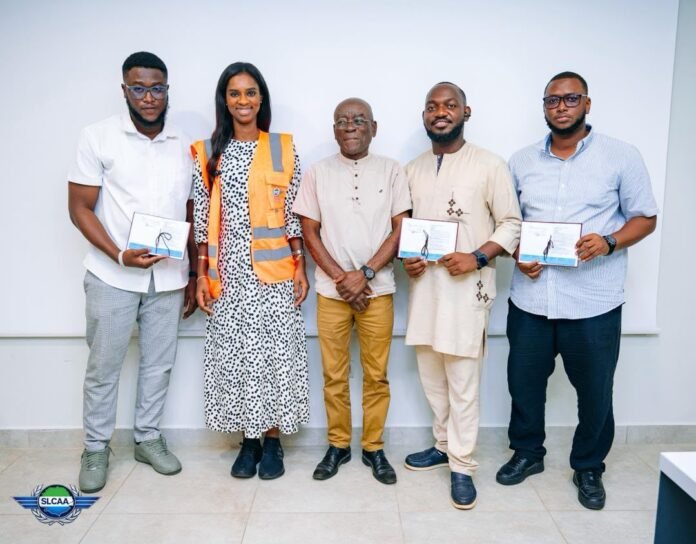
The National Executive of the Sierra Leone Association of Journalists (SLAJ) on Thursday, 13th November 2025, paid a courtesy call on the Indian High Commissioner to Sierra Leone, His Excellency Baisnab Charan Pradhan as part of the Association’s commitment to fostering strong partnerships with the diplomatic community.

Welcoming the delegation at the Indian High Commission, Ambassador Baisnab Charan Pradhan commended the role of the media in Sierra Leone, noting that the country has demonstrated commendable progress in upholding responsible and ethical journalism compared to many others. He expressed appreciation for the constructive engagement of journalists in national development and reaffirmed India’s readiness to continue supporting Sierra Leone’s socio-economic transformation.

Highlighting India’s longstanding relationship with Sierra Leone, the Ambassador recalled that several Sierra Leonean journalists have benefited from various study programs and professional training opportunities in India. He underscored that India remains a key development partner through investment, technology transfer and education.

Ambassador Baisnab Charan Pradhan disclosed that more Indian investors are expected in Sierra Leone to establish manufacturing companies that would create jobs and contribute significantly to the national economy. He cited examples of Indian-owned enterprises already producing quality building and household materials, including a recently established iron ore and roofing zinc factory and noted that another company is preparing to supply energy to the national grid. According to him, Sierra Leone’s peace and political stability remain strong incentives for further Indian investment.

In his remarks, SLAJ President, Alhaji Manika Kamara, thanked the High Commissioner for India’s continuous partnership and support. He described the relationship between SLAJ and the Indian High Commission as mutually beneficial and instrumental to media development in Sierra Leone.
He pointed out that the media sector urgently requires capacity building, particularly in digital reporting, investigative journalism, fact-checking and new media technologies. Alhaji Manika Kamara clarified that SLAJ is not a mouthpiece for the Government or the Opposition but a credible development partner dedicated to training journalists to deliver accurate and timely information to the public.

The SLAJ President appealed to the Ambassador to encourage Indian investors to explore opportunities in the media sector, such as investments in printing materials, broadcast equipment and digital platforms. He also called for more training opportunities for journalists in India to strengthen professionalism and promote media literacy.

Responding, Ambassador Baisnab Charan Pradhan expressed India’s willingness to support media exchange initiatives and journalism training programs. He encouraged SLAJ to submit a well-developed project proposal highlighting key areas for collaboration.

The visit, beyond being a diplomatic courtesy, marked a renewed commitment to deepening cooperation between the media and India’s diplomatic mission. Both sides reaffirmed their dedication to strengthening mutual understanding, promoting professional growth and fostering ethical journalism in Sierra Leone.

SLAJ executive together with Indian High Commissioner

NP (SL): The Indigenous Powerhouse Transforming Sierra Leone’s Downstream Petroleum Industry

By Amin Kef (Ranger)

NP (SL) Limited, Sierra Leone’s leading and wholly indigenous downstream petroleum company, continues to position itself as a cornerstone of national development through sustained innovation, exceptional service delivery and a strong commitment to safety and environmental responsibility. With a heritage spanning more than 70 years, the company has evolved into one of West Africa’s most trusted and professionally managed energy providers.

Founded in 1954 as the Atlantic West African Oil Company, the company later transitioned into British Petroleum Sierra Leone and subsequently into the Sierra Leone National Petroleum Company following significant Government ownership in 1984. Its full indigenization came in 1996 when the Government of Sierra Leone privatized its shareholding, paving the way for a new chapter driven by Sierra Leonean expertise, entrepreneurship and corporate leadership. This milestone set the foundation for the company’s rebranding in February 2011 to its current identity; NP (SL) Limited.

Today, NP (SL) operates under the leadership of Dr. Mohamed S. Kanu. Guided by its timeless slogan, “NP – Your Partner for Life,” the company has built an unmatched reputation anchored on reliability, quality service and customer-oriented solutions.

NP (SL) continues to deliver a wide range of petroleum products and energy solutions essential to the country’s socio-economic growth. These include gasoline, diesel, high-grade lubricants such as BP and Castrol and the increasingly popular NP Gas, a safe, environmentally certified Liquefied Petroleum Gas widely adopted by households and businesses. NP Gas has successfully contributed to cleaner energy use, reduced deforestation and improved kitchen safety in homes nationwide.

The company also leads the digital transformation of fuel payment systems through the NP Smart Card; a secure, cashless and transparent payment platform that enhances accountability and convenience. This innovative service has modernized fuel transactions and significantly improved customer experience across NP Filling Stations.

NP (SL) is one of the few companies in Sierra Leone to be certified under three international ISO standards:

  • ISO 9001 (Quality Management)
  • ISO 14001 (Environmental Management)
  • ISO 45001 (Occupational Health and Safety)

These certifications reflect the company’s rigorous adherence to global best practices and its commitment to quality service, environmental protection and a safe working environment for staff and customers.

Given the nature of petroleum products, NP (SL) prioritizes fire prevention and safety across all operational sites. The company has consistently supported the National Fire Force with essential infrastructure, including bore wells and standby generators, reinforcing national emergency preparedness and disaster management capacity.

NP (SL)’s remarkable growth has extended beyond Sierra Leone’s borders, with successful operations in Liberia, Guinea, Côte d’Ivoire and The Gambia. Across those countries, NP maintains a strict Local Content policy, ensuring that its workforce is made up entirely of nationals from each country of operation; promoting employment, skills transfer and economic empowerment.

Through expanded service coverage, NP (SL) has brought petroleum products closer to communities previously underserved, significantly reducing energy poverty while boosting trade, transportation and job creation. Its dedication to customer care has earned the company recognition as Sierra Leone’s Number One Customer Care Leader in the petroleum sector.

With its strong operational discipline, innovative services and commitment to national progress, NP (SL) continues to embody the vision set by its founders. Sierra Leone’s journey toward a more modern and resilient energy future continues to unfold and NP (SL) stands firmly at the center of that progress. The company remains a reliable national asset and a trusted partner, consistently living up to its promise as “Your Partner for Life.”