
By Ibrahim Sesay
The Road Maintenance Fund Administration (RMFA) has initiated the financing of a significant road rehabilitation project along the Bo–Yele–Matotoka corridor, a move expected to strengthen transportation links and stimulate economic activity across several regions of Sierra Leone.
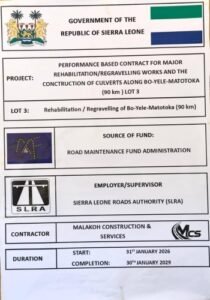
The project, which covers approximately 90 kilometres of roadway, involves comprehensive rehabilitation works including regravelling, culvert construction and other maintenance interventions designed to enhance road safety and accessibility. The corridor is regarded as a strategic route connecting communities and facilitating the movement of goods and people across key parts of the country.
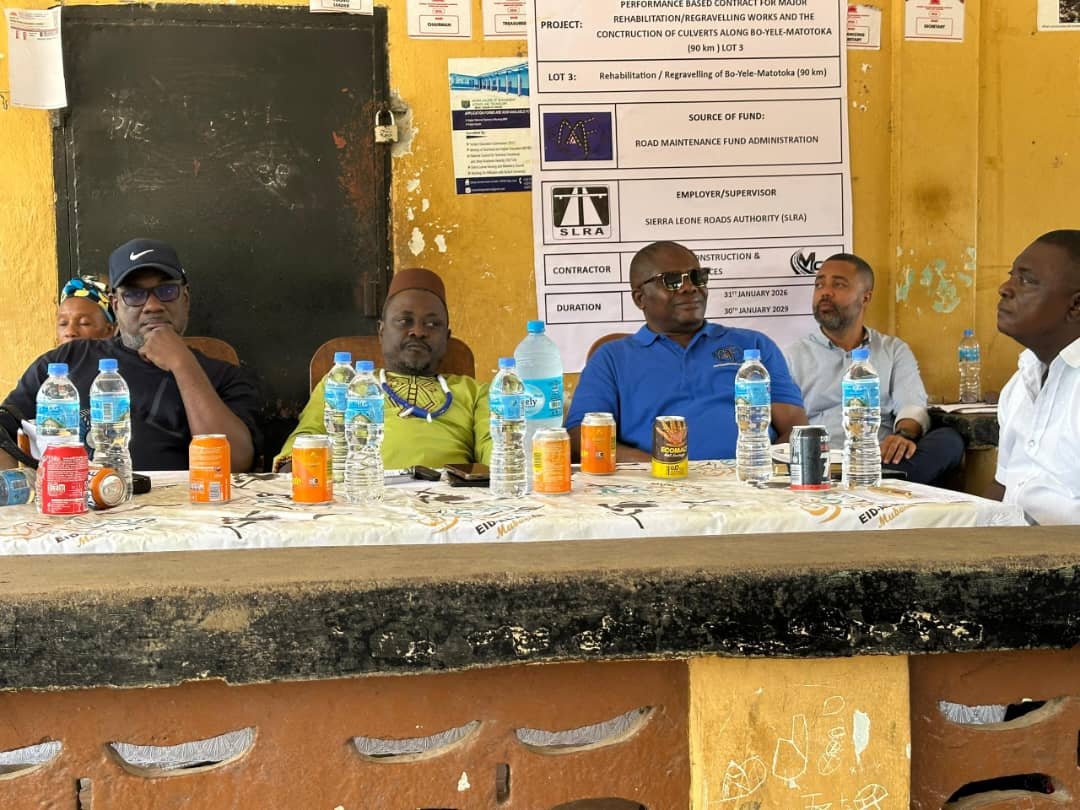
During the official handover ceremony marking the commencement of the project, the Chief Executive Officer of RMFA, Mohamed Kallon, emphasized that the intervention reflects the institution’s core mandate of ensuring sustainable financing for road maintenance nationwide. He noted that the rehabilitation works are fully funded through the national Road Fund, a pool of resources generated from contributions by Sierra Leoneans and dedicated specifically to maintaining the country’s road infrastructure.
Mohamed Kallon explained that improving the condition of major road corridors remains central to national development, as reliable road networks play a vital role in promoting trade, improving mobility and strengthening local economies.
“This project demonstrates our commitment to ensuring that the resources contributed by Sierra Leoneans through the Road Fund are used to maintain critical transport infrastructure that supports national connectivity and economic growth,” he said.
The RMFA CEO further disclosed that the rehabilitation has been structured under a Performance-Based Contract arrangement. Under that framework, contractors are required not only to carry out the rehabilitation works but also to maintain the road to specified quality standards for a period of three years. The approach, he explained, ensures sustained road quality while holding contractors accountable for the long-term performance of the infrastructure.
According to Mohamed Kallon, the Road Maintenance Fund Administration will work closely with the Sierra Leone Roads Authority (SLRA) to monitor implementation and ensure strict compliance with all contractual obligations and technical standards.
He also encouraged communities along the corridor to take an active role in monitoring the progress of the project, describing local residents as an important part of ensuring transparency and quality control.
“Community members are the first line of oversight. Their involvement helps guarantee that projects are implemented to the expected standards and completed within the agreed timelines,” he noted.
Mohamed Kallon further highlighted the economic significance of investing in road infrastructure, referencing studies by the World Bank which indicate that every dollar invested in road development can generate up to four dollars in broader economic benefits.
While RMFA is providing the financial resources for the rehabilitation, the Sierra Leone Roads Authority is responsible for supervising the project to ensure that construction standards are fully observed. The implementation of the works has been awarded to Malakoh Construction and Services, a contractor tasked with executing the project in line with the agreed performance requirements.
Local community leaders welcomed the initiative, describing the rehabilitation of the Bo–Yele–Matotoka corridor as a long-awaited development that will greatly improve mobility and access to essential services.
The Paramount Chief of the area commended the Government, RMFA and SLRA for responding to the needs of the communities, noting that improved road conditions would make it easier for farmers and traders to transport their goods to markets while also facilitating access to healthcare and other social services.
The rehabilitation of the Bo–Yele–Matotoka corridor forms part of RMFA’s wider efforts to support the development and maintenance of Sierra Leone’s road infrastructure.
Through sustained investment, effective monitoring and collaboration with key stakeholders, the institution continues to play a central role in strengthening the country’s transport network and advancing inclusive economic growth.