
The Government of President Julius Maada Bio has unveiled an ambitious blueprint aimed at transforming Lungi into a modern economic and diplomatic hub as part of a broader national redistricting initiative intended to strengthen local governance and improve public service delivery across Sierra Leone.
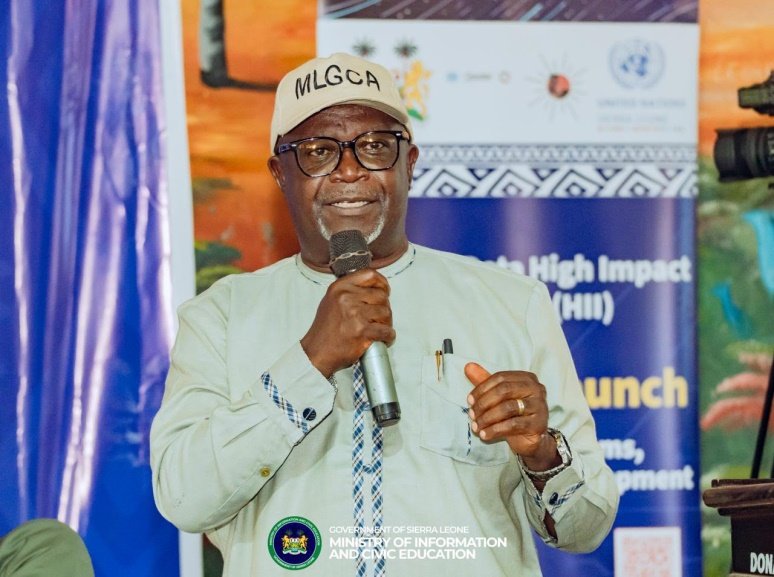
The proposed development plan, dubbed the “Lungi Gateway City”, was formally presented by the Minister of Local Government and Community Affairs, Tamba Lamina, during the Lungi Civic Day Series held on Tuesday, 19th May 2026, at St. Augustine School in Tintafor, Lungi.
Addressing local authorities, residents, traditional leaders and students, Minister Tamba Lamina disclosed details of the Proposed Lungi City Map, which outlines an expansive and structured master plan developed in collaboration with the Ministry of Planning and Housing. According to him, the initiative seeks to expand Lungi’s territorial boundaries across Kaffu Bullom and neighboring communities in a bid to eliminate unplanned urban expansion and create a well-organized modern city.
“The proposed Lungi City will cover a vast area,” Minister Tamba Lamina stated. “We are currently working on the mapping process. This will be a new city that we will manage together.”
The proposed city blueprint includes designated zones for schools, shopping malls, residential settlements and recreational facilities, reflecting Government’s vision to establish Lungi as a key center for economic growth and national development.
Government officials noted that the long-term development plan positions Lungi as a premier “Gateway City” and a designated Special Economic Zone expected to host major national infrastructure, including a new university, a National Conference Centre and the much-anticipated Lungi Bridge, which would directly connect the northern peninsula to Freetown.
Describing the vision behind the initiative, Minister Tamba Lamina emphasized that the transformation of Lungi is intended to position the city as a strategic destination for diplomacy, commerce and international travel.
“This will be a city of diplomacy, economic prosperity, commerce and travel,” he emphasized, adding that the initiative transcends political interests and instead reflects Government’s broader national development agenda.
“This is not about politics; this is about how we look at our country to ensure holistic development,” he said.
Beyond the Lungi transformation project, the Minister also shed light on Government’s wider national redistricting reforms, explaining that the initiative seeks to build upon Sierra Leone’s post-war decentralization framework introduced in 2004.
He noted that rapid population growth, particularly in the Western Area, has necessitated a second phase of administrative reorganization, pointing out that Freetown’s population has surged from approximately 400,000 residents decades ago to nearly 1.5 million people today.
According to him, Government is proposing the creation of two additional districts, Bandajuma and Kpanguma, as well as more local councils within the Western Urban and Western Rural districts to improve governance and bring services closer to citizens.
“We decided to embark on a second phase of reorganization to improve service delivery and ensure that the actual voices of the people are heard,” Minister Tamba Lamina explained.
He further revealed that the technical and consultative stages of the redistricting exercise have been completed and that the final report will soon be submitted to President Julius Maada Bio and the Attorney General before proceeding to Parliament as a statutory instrument.
Once approved through presidential proclamation, the Ministry of Finance is expected to allocate the necessary resources to operationalize the proposed districts and facilitate the realization of the modern Lungi Gateway City project, which Government believes will significantly contribute to national growth and economic prosperity.