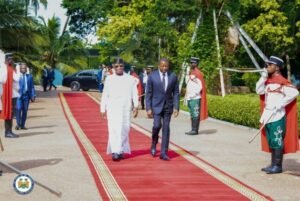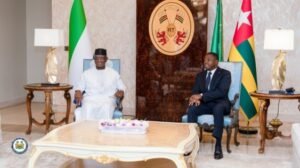

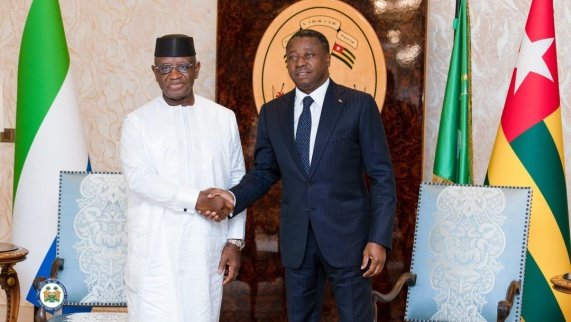
President Dr. Julius Maada Bio has urged African leaders to transform global crises into opportunities for continental renewal, calling on the continent to become an active architect of the emerging global order rather than a passive victim of geopolitical events.
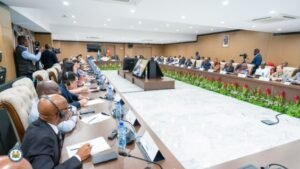
Speaking at the Extraordinary Conference of the African Political Alliance (APA) on Friday, 3 July 2026, in Lomé, Republic of Togo, President Bio delivered a far-reaching address under the theme: “Africa and the Middle East Crisis: Impacts, Challenges and Strategic Responses.” His speech outlined a strategic vision centred on economic transformation, stronger diplomatic coordination, enhanced security cooperation and institutional reform across Africa.
Addressing the impact of the ongoing Middle East crisis on African economies, President Bio observed that rising fuel prices, inflation, disrupted supply chains and declining investment flows have exposed the continent’s vulnerability to external shocks. He noted that those challenges underscore the urgent need for Africa to build resilient economies capable of withstanding global disruptions.
“The crisis in the Middle East is a stark reminder that, in today’s interconnected world, no region is insulated from the consequences of conflict,” President Bio said.
He stressed that while global events continue to affect Africa, the continent must remain focused on determining its own future.
“No external crisis can define Africa’s future. Only Africa can define Africa’s future,” he declared.
President Bio commended President Faure Gnassingbé of Togo for establishing the African Political Alliance, describing the platform as a significant step towards strengthening strategic dialogue and political coordination among African leaders. He said Africa requires more institutions capable of harmonizing the continent’s positions on global issues while advancing solutions driven by African leadership.
He further cautioned African nations against becoming entangled in geopolitical rivalries among global powers, emphasizing that the continent’s primary focus should remain on safeguarding peace, security and sustainable development through diplomacy, adherence to international law and negotiated solutions.
Drawing from Sierra Leone’s post-conflict recovery, President Bio highlighted reconciliation, inclusive governance and political dialogue as the foundations of lasting peace. He argued that military action alone cannot secure enduring stability, stressing that sustainable peace requires strong democratic institutions and inclusive leadership.
The ECOWAS Chairman devoted significant attention to Africa’s economic transformation, urging Governments to break away from the long-standing pattern of exporting raw materials while importing finished products. He called for the accelerated implementation of the African Continental Free Trade Area (AfCFTA), expansion of regional manufacturing, increased value addition, climate-smart agriculture, renewable energy development, improved infrastructure and greater investment in domestic productive sectors.
President Bio also challenged African Governments to prepare for the opportunities of the Fourth Industrial Revolution by investing heavily in education, digital infrastructure, innovation, scientific research and entrepreneurship. He noted that Africa’s youthful population remains one of the continent’s greatest strategic assets and should be equipped with the skills necessary to drive future economic growth.
On global governance, President Bio reiterated Africa’s longstanding demand for comprehensive reform of the United Nations Security Council in accordance with the Ezulwini Consensus and the Sirte Declaration. He argued that Africa, representing nearly one-fifth of the world’s population, deserves equitable representation in global decision-making institutions.
Speaking in his capacity as Chairman of the ECOWAS Authority of Heads of State and Government, President Bio reaffirmed the regional bloc’s commitment to promoting peace, democratic governance, regional integration and sustainable development across West Africa.
To strengthen Africa’s collective capacity to respond to emerging international challenges, he proposed the establishment of a permanent continental mechanism for geopolitical risk assessment and early warning. He also advocated for the adoption of a common African position on the Middle East crisis to enable the continent to engage international partners with a unified and coherent voice.
Concluding his address, President Bio challenged African leaders to view the current global uncertainty not merely as a threat but as an opportunity to accelerate industrialization, strengthen institutions and expand Africa’s influence in international affairs.
“The world is changing before our eyes,” he stated. “The question is not whether change will come. The question is whether Africa will shape that change or be shaped by it.”
Reinforcing the central message of his address, President Bio concluded by declaring:
“No external crisis can define Africa’s future. Only Africa can define Africa’s future.”