

The decision to temporarily suspend the collection of the US$25 Airport Security Fee at Freetown International Airport has triggered serious concerns over the country’s contractual obligations to Securiport (SL) Limited, with fears that the move could expose the Government to another substantial financial liability running into millions of United States dollars.
In a ministerial directive dated 1st July 2026, the Ministry of Internal Affairs instructed Securiport to suspend the collection of the Airport Security Fee from 6th July 2026 until December 2026 while the Government undertakes a comprehensive review of the contract and conducts a special audit. The Ministry argued that the existing manual cash collection system is cumbersome, inconvenient for passengers and inconsistent with modern airport operations.
However, documents relating to the original agreement and subsequent amendments raise significant legal and financial questions regarding the suspension.
According to the 2012 Agreement governing Securiport’s operations in Sierra Leone, the company financed and installed the country’s immigration security system on the understanding that it would recover its investment exclusively through the Airport Security Fee. The contract reportedly obliges the Government to enforce collection of the fee and compensate the company whenever Government’s actions prevent its collection.
Records further show that a similar interruption in fee collection in previous years resulted in a substantial financial dispute. That dispute was eventually settled after the Government agreed to pay US$12 million, representing a negotiated settlement of much larger accumulated liabilities arising from earlier contractual breaches.
Information available also indicates that Government already owes US$8 million under previous contractual obligations.
The Ministry has emphasized that the suspension is not intended to terminate the contract but rather to facilitate completion of an independent audit by the Audit Service Sierra Leone and allow authorities to redesign a more efficient collection system. However, Securiport has so far not be found wanting.
The directive also instructs Securiport to continue maintaining all technological infrastructure and passenger screening operations while collecting passenger statistics during the suspension period, including recording the amount of revenue that would ordinarily have been generated under normal operations. Such a directive, according to analysts is highly laughable because it is very inimical and gives the Government a huge financial burden.
Put in other words, contract documents suggest that requiring the company to continue operating without collecting its sole source of contractual revenue could significantly increase Government’s financial exposure.
One of the major issues emerging from the documents relates to the collection mechanism itself.
The Ministry’s directive attributes the suspension partly to the inconvenience associated with manual cash payments at the airport.
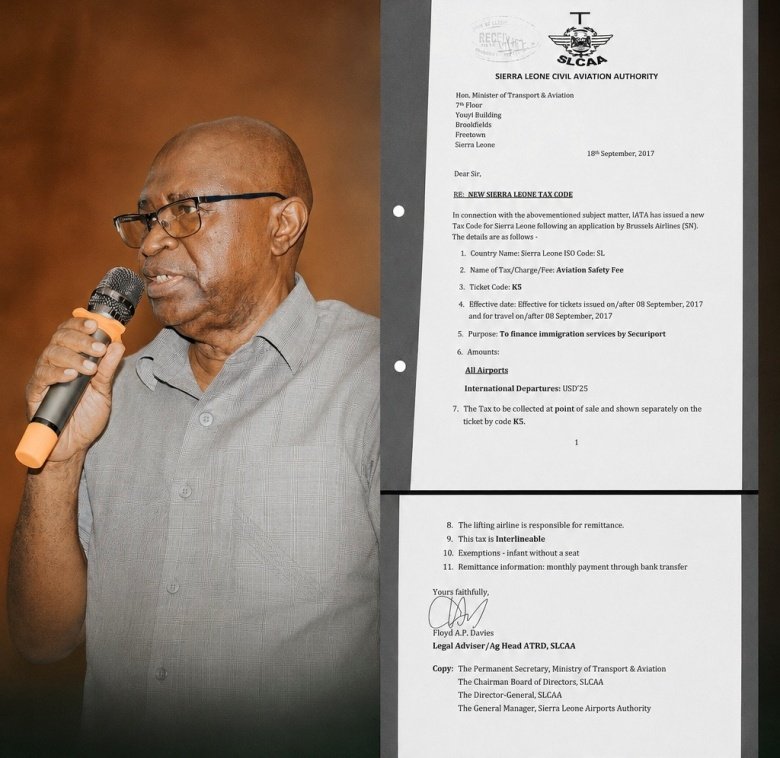
Ironically, an official correspondence dated 18 September 2017 confirms that the International Air Transport Association (IATA) approved Tax Code K5 specifically for Sierra Leone.
According to that document, the K5 Aviation Safety Fee became effective for tickets issued and travel undertaken from 8 September 2017.
The arrangement provided that:
- The fee would be collected automatically at the point of ticket purchase.
- The US$25 charge would appear separately on airline tickets.
- Airlines would be responsible for remitting the proceeds.
- The purpose of the tax was to finance immigration services provided by Securiport.
Those records appear to indicate that an internationally recognized airline ticket collection mechanism was already in place.
The existence of the K5 code has now generated fresh questions over how the Airport Security Fee has been administered since 2017.
Industry observers are asking whether airlines have consistently applied the K5 code, whether the revenues generated under that mechanism were properly remitted in accordance with the established procedures, and, if the automated collection system was operational, why passengers continued making manual cash payments at the airport? Was it that the money generated was siphoned by few people?
According to analysts, those questions may become central to the ongoing special audit mentioned by the Ministry.
Contract documents further indicate that previous amendments gave Government additional time to migrate fully to airline ticket collection while offering technical assistance to implement the system.
Despite those arrangements, manual collection reportedly continued for years.
Legal observers note that if Government suspends the fee while simultaneously requiring Securiport to continue operating, maintaining its technology and processing passengers, the company may be entitled under the contract to seek compensation for revenue that would otherwise have been collected during the suspension period.
Through investigation it was learnt that the company is also reportedly seeking confirmation that Government will honour any revenue lost during the suspension period, settle outstanding contractual obligations and complete implementation of the airline ticket collection mechanism before the suspension expires.
The development has also attracted attention because Securiport is a United States-owned company, raising concerns among some analysts that any prolonged contractual dispute could have wider implications for investor confidence and potentially affect aspects of Sierra Leone’s commercial relations with U.S. businesses.
While no official indication has been made by either Government or U.S. authorities regarding any diplomatic consequences, legal experts caution that disputes involving foreign investors are closely watched by the international business community and could influence perceptions of Sierra Leone’s commitment to contractual certainty.
With the special audit now underway and the suspension set to take effect on 6 July, attention will focus on whether the Government can complete its review, clarify the status of the K5 airline ticket collection system, address outstanding contractual obligations and avoid the accumulation of another costly financial settlement similar to the US$12 million previously paid following earlier contractual disputes.