

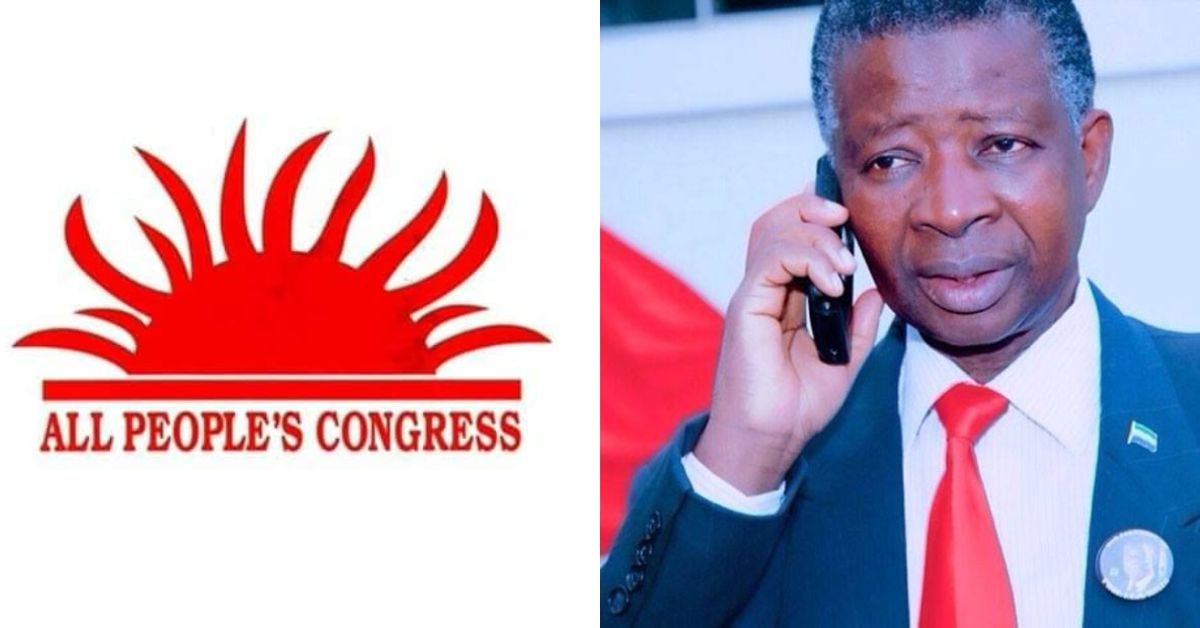
Cornelius Oguntola Melvin Deveaux, a politician, journalist and political commentator who previously served as the National Publicity Secretary of the main opposition All People’s Congress (APC) and as Sierra Leone’s Deputy Minister of Information and Communications, has called for sweeping amendments to the APC’s March 2022 Constitution, arguing that the Party’s current challenges stem not from individual leaders or administrative shortcomings but from structural weaknesses embedded in its governing document.
According to Deveaux, the ongoing controversies surrounding the expiration of the three-year tenure of National Officers, the Political Parties Regulation Commission’s (PPRC) six-month extension of that tenure, the inability to convene a National Delegates Conference (NDC), and recurring governance disputes all point to fundamental constitutional deficiencies that require urgent attention.
He maintained that the constitutional shortcomings, coupled with petitions delaying lower-level elections and administrative challenges within the National Secretariat and the Internal Elections Management Committee (IEMC), have stalled the APC’s internal democratic processes and raised concerns among many Sierra Leoneans about the Party’s preparedness to govern in 2028.
Deveaux warned that unless the identified deficiencies are addressed at the next National Delegates Conference, the Party will continue to face internal instability, governance paralysis and recurring legitimacy disputes.
He identified what he described as six major structural flaws in the APC Constitution.
The first, he explained, concerns the Constitution’s interpretation of “Special and Emergency Situations.” He argued that while the document recognizes external emergencies such as war, epidemics and coups, it fails to recognize internal governance breakdowns, including disputes over delegate accreditation, legal injunctions and administrative paralysis. According to him, this omission has left the Party without a lawful mechanism to respond when its own structures fail, thereby creating constitutional uncertainty and institutional instability.
The second flaw, he said, is the Constitution’s silence on extending the tenure of National Officers when the National Delegates Conference cannot be convened. He argued that the absence of such provisions created the vacuum that led to the PPRC’s intervention through a six-month extension and its reported intention to hand over the Party’s affairs to the Leader of the Parliamentary Group, actions he contends are not provided for in the APC Constitution.
To address this, Deveaux proposed empowering the National Advisory Committee (NAC) to grant limited tenure extensions during clearly defined emergency circumstances. Should those extensions expire, he suggested that temporary authority be vested in the Elders’ Council for a specified period to preserve continuity and democratic legitimacy.
The third issue, according to Deveaux, relates to what he described as the contradiction between the expiration of the tenure of National Officers and their formal dissolution. While Article 52 establishes a fixed three-year mandate, Article 17 assigns the National Delegates Conference the responsibility of dissolving and reconstituting National Officers. He argued that this creates a governance vacuum whenever the NDC cannot be convened before the expiration of the officers’ mandate.
To eliminate that ambiguity, he proposed that the Constitution require the National Delegates Conference to be held within ninety days before the expiration of the officers’ tenure while also incorporating lawful mechanisms for temporary extensions and transitional authority where necessary.
Deveaux also raised concerns about Article 47, which governs the offices of National Leader and Deputy National Leader. He argued that the Constitution links party leadership too closely to presidential candidacy by making the flagbearer the National Leader only while serving as the Party’s presidential candidate or upon winning national office.
He maintained that such a framework weakens leadership continuity following electoral defeats and creates uncertainty within the Party. He further criticized the provision allowing an appointed Deputy National Leader to assume leadership despite not being elected by the National Delegates Conference. To strengthen accountability, he proposed that both the National Leader and Deputy National Leader should be elected by delegates for fixed terms.
Addressing the fifth constitutional concern, Deveaux said the Constitution creates overlapping responsibilities between the National Chairman and the National Leader by designating the Chairman as the Party’s Chief Executive Officer without clearly distinguishing administrative functions from political leadership. He also pointed to the absence of clear succession procedures for deputy offices, except that of the Deputy National Chairman, warning that the resulting uncertainty could destabilize Party operations whenever vacancies occur.
He recommended redefining the National Chairman’s responsibilities as purely administrative while maintaining the National Leader as the Party’s political head. He also proposed empowering the National Advisory Committee to appoint the runner-up from the most recent election to fill deputy vacancies.
The sixth and final flaw identified by Deveaux concerns the Internal Elections Management Committee. He argued that the Constitution creates a circular dependency by requiring the IEMC to conduct internal elections while also stipulating that its members be elected during the National Delegates Conference they are expected to administer.
According to him, this arrangement undermines the Committee’s credibility, contributes to procedural delays and creates uncertainty over the legitimacy of internal electoral processes. He proposed that the Constitution be amended to require the election of IEMC officials well before lower-level elections commence, ensuring that the Committee is fully constituted before undertaking its responsibilities.
Deveaux concluded that the six constitutional deficiencies collectively explain the APC’s recurring internal governance challenges and democratic setbacks. He stressed that the proposed amendments are intended not merely to revise the Constitution but to strengthen institutional continuity, enhance accountability and restore democratic legitimacy within the Party.
He urged delegates at the next National Delegates Conference to go beyond electing new National Officers and instead undertake comprehensive constitutional reforms that would position the APC as a stronger and more stable political party capable of governing Sierra Leone in 2028 and beyond.