

By Amin Kef (Ranger)
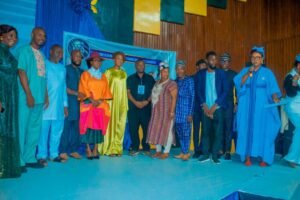
The Sierra Leone Film Industry Labour and Marketing Guild (SL Film Guild) officially launched its National Strategic Development Plan 2026–2030 on Friday, June 19, 2026, at the Miatta Conference Centre in Freetown, marking what industry leaders described as a historic turning point for the country’s creative sector.
The event, held under the theme “Building a Sustainable Creative Economy Through Film,” brought together government officials, development partners, filmmakers, creative professionals, representatives of trade unions, diplomats, and international guests to witness the unveiling of a comprehensive roadmap aimed at transforming Sierra Leone’s film industry into a major contributor to national development.
Serving as Grand Chief Launcher, First Lady of the Republic of Sierra Leone and President of the Organization of African First Ladies for Development (OAFLAD), Dr. Fatima Maada Bio, reaffirmed her commitment to the growth of the film industry. Drawing on her experience as an actress, scriptwriter, and storyteller, she highlighted the sector’s importance in creating employment opportunities, preserving culture, and contributing to economic growth.
Dr. Fatima Maada Bio acknowledged the challenges facing filmmakers, including limited opportunities, inadequate institutional support, and coordination difficulties. However, she expressed confidence that with persistence, education, collaboration, and professional standards, the industry could achieve sustainable growth.
She called on policymakers and development partners to invest in the sector and urged filmmakers to produce content that reflects Sierra Leone’s history, culture, and aspirations. The First Lady also announced her intention to support outstanding local scripts that tell authentic Sierra Leonean stories, emphasizing that Africans should be the primary narrators of their own experiences.
Speaking on behalf of SL Film Guild Chairman Daramy A. Kabba, Acting Chairman Mohamed Alarini Bah described the launch as the most significant milestone in the Guild’s eighteen-year history. He said the occasion represented more than the unveiling of a strategic document, noting that it was a declaration that the film industry should be recognized as a serious national development sector deserving institutional support and professional recognition.
Bah traced the history of the Guild to the 2008 National Film Workshop and the landmark White Paper, “Putting Sierra Leone in the Picture.” He explained that the Guild was officially registered as a trade union in 2012 after years of advocacy and collaboration with international labour organizations and national institutions. According to him, the launch of the Strategic Development Plan represents the Guild’s second major historic achievement.
The Acting Chairman outlined the Guild’s mandate, which includes protecting the welfare of film professionals, coordinating labour and marketing activities, advocating policy reforms, enforcing professional standards, and creating pathways for sustainable employment in the creative sector.
He further revealed that the Strategic Development Plan is built around five key pillars: Governance and Institutional Development; Human Capital and Screen Skills Transformation; Film Production, Financing and Creative Enterprise Development; Infrastructure, Distribution and Market Development; and Intellectual Property Protection, Cultural Promotion and Global Partnerships.
Among the plan’s targets are the certification of 3,000 film professionals, the establishment of a National Film Fund, the creation of a National Film Village and Creative Production Hub, the implementation of a single-window permit system for film productions, and the promotion of Sierra Leonean content on international streaming platforms. The Guild also aims to position Sierra Leone as a recognized West African screen economy by 2030.
Delivering an address on “Building a Sustainable Economy Through Film and Entertainment,” film stakeholder Brima Abdulai Sheriff described the creative industry as a powerful economic force capable of generating employment, attracting investment, and driving economic diversification. He noted that global creative industries contribute trillions of dollars annually and support millions of jobs, particularly among young people.
Sheriff emphasized that Sierra Leone possesses the talent, cultural heritage, and stories needed to build a thriving creative economy. He estimated that nearly 500,000 young Sierra Leoneans are directly or indirectly involved in various aspects of the film and entertainment value chain, including acting, directing, editing, music production, digital content creation, and event management.
He called for deliberate investment, strong institutional leadership, and greater unity within the industry, stressing that sustainable growth requires policy support, financing mechanisms, skills development, and strategic planning. He also pledged to provide pro bono support to the Guild through advocacy, partnership development, and institutional guidance.
The launch ceremony featured keynote addresses, presentations on the Strategic Development Plan, certificate presentations, networking sessions, and media engagements. Participants were encouraged to work collectively toward implementing the ambitious roadmap and strengthening the creative sector’s contribution to national development.
Following the event, the SL Film Guild Secretariat issued a formal statement thanking stakeholders for their support. Special appreciation was extended to First Lady Dr. Fatima Maada Bio for accepting the role of Grand Chief Launcher and for her continued commitment to the creative arts. The Secretariat also acknowledged Dr. Kadijatu Grace Kamara for delivering the keynote address, the Ministry of Information and Civic Education, development partners, media organizations, professional guilds, and members of the organizing committee for contributing to the success of the launch.
The occasion also attracted regional participation, including a delegation from Liberia led by Liberia Movie Union President Abdul-Karim Sheriff. The delegation met with Sierra Leonean stakeholders and attended the launch ceremony. During his remarks, Sheriff called for stronger collaboration between the film industries of Liberia and Sierra Leone, emphasizing the importance of leveraging the Mano River Union framework to promote cultural exchange, economic cooperation, and positive national narratives.
Organizers described the launch of the National Strategic Development Plan 2026–2030 as the beginning of a new chapter for Sierra Leone’s film industry, one aimed at transforming creativity into a sustainable economic sector capable of creating jobs, attracting investment, and showcasing Sierra Leonean stories to the world.