

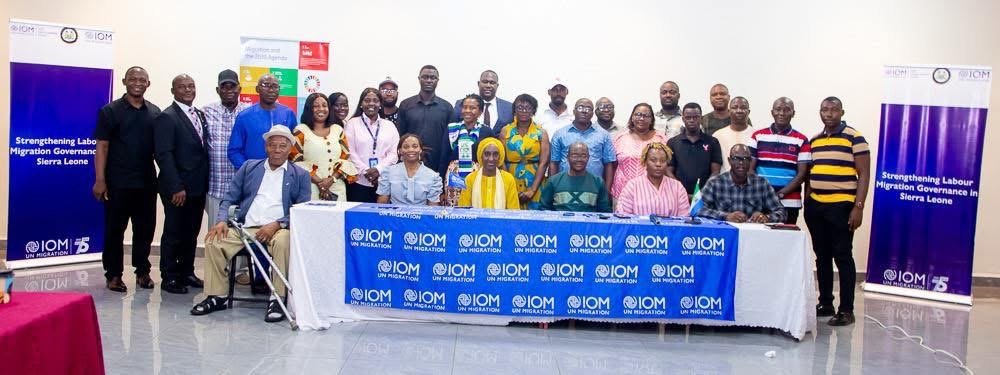
The Ministry of Employment, Labour and Social Security, in collaboration with its Tripartite Partners and the International Organization for Migration (IOM), on Thursday, 21st May 2026, inaugurated a National Technical Committee aimed at strengthening labour migration governance in Sierra Leone. The initiative seeks to transition the country from fragmented and reactive migration responses to a more coordinated, rights-based and regulated system designed to protect citizens from trafficking, exploitation and unsafe migration practices.
Delivering the keynote address during the inauguration ceremony, the Deputy Minister of Employment, Labour and Social Security, Lansana M. Dumbuya, underscored the growing significance of labour migration in the global economy while highlighting its impact on Sierra Leone’s development.
He disclosed that global remittances reached an estimated USD 905 billion in 2024, with Sierra Leone receiving approximately USD 293 million in 2023, accounting for between 4.6% and 6.1% of the country’s Gross Domestic Product (GDP). According to him, while labour migration presents economic opportunities, ineffective management poses significant risks to citizens and national development.
Lansana M. Dumbuya cautioned that poorly managed migration systems could result in serious challenges, including irregular migration, human trafficking, migrant smuggling, exploitation of workers and the proliferation of unregistered recruitment agencies. He further referenced reports of Sierra Leoneans stranded in transit and destination countries, alongside recent cases of deaths linked to dangerous irregular migration routes.
Speaking at the event, the Chief of Mission of the International Organization for Migration, Isata Khan, described the inauguration of the Technical Committee as a critical milestone in transforming labour migration governance in Sierra Leone from a reactive system to one that is rights-based and development-oriented.
She explained that the initiative would focus on strengthening policy and legal frameworks, improving institutional coordination and enhancing the protection of migrant workers’ rights. Isata Khan further noted that the project would support ethical recruitment systems, pre-departure orientation programmes for migrant workers and nationwide awareness campaigns on the dangers associated with irregular migration.
Representing the Sierra Leone Labour Congress, Emmanuel Kamara Esq highlighted previous efforts undertaken by stakeholders to improve labour migration governance, including reforms to the Anti-Human Trafficking and Migrant Smuggling Act of 2022. He emphasized the importance of sustained collaboration among stakeholders to ensure effective migration management.
A representative of the Sierra Leone Employers’ Federation, Evette Kargbo, stressed the urgent need for improved labour migration governance, enhanced data management systems and stronger protections for migrant workers, particularly women and low-skilled workers who remain highly vulnerable to exploitation.
Also speaking, the Director of Policy, Planning and Research, Ahmed Bobor Brima, acknowledged persistent challenges facing Sierra Leone, including forced labour, exploitation by unregulated recruiters and weak reintegration mechanisms for returnees.
Ahmed Bobor Brima stated that the newly inaugurated Technical Committee would support the implementation of the revised National Labour Migration Policy, strengthen oversight and regulation of recruitment agencies and develop systems for migrant worker data management and reintegration support.
The inauguration of the National Technical Committee marks a significant step in Sierra Leone’s efforts to promote safe, orderly and regular migration, with stakeholders reaffirming their commitment to protecting the rights, welfare and dignity of migrant workers while addressing the root causes of irregular migration.