
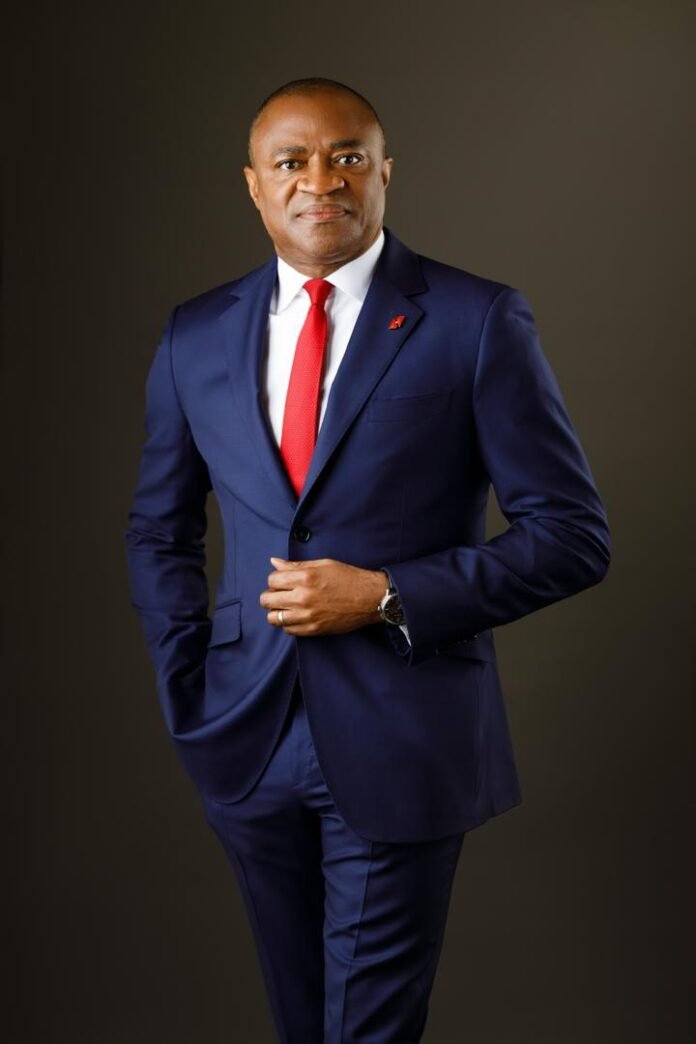
UBA Group senior Executives recently concluded the Group’s Half Year Business Review. Held at global headquarters in Lagos Nigeria, Group Managing Director/CEO, Oliver Alawuba, brought together Executives responsible for UBA’s twenty-four countries of operation.
It was an opportunity to restate the Group’s Pan-African strategy and commitment to further expanding the Group’s coverage across high potential markets across Africa, while also deepening its operations in its existing twenty African presence markets. With over 51.7% of Group revenues from ex Nigerian operations, UBA’s journey to being Africa’s most diversified financial services group was clearly in evidence.
The international strategic intent reinforces with the Group’s intention to deliver innovative financial solutions to its fast-growing global customer base. The strategy demonstrates UBA’s unique position as Africa’s global bank and ability to leverage growth opportunities in emerging and leading African markets.
The Group commenced its Pan African journey, with its entry into Ghana in 2004, followed by rapid expansion into 18 additional African markets. Today, as a resilient and future-focused institution, UBA continues to push boundaries by connecting Africa to the world and the world to Africa.
Oliver Alawuba highlighted the Group’s expansion plans, disclosing that the Group is excited about the vast opportunities that the new markets present, a testament to UBA Group’s confidence in the African economy, providing world-class banking services that meet the continent’s evolving needs.
“UBA’s vision is clear – we are building a truly global institution anchored in Africa, but serving customers across continents. Further strategic expansion positions us to unlock new opportunities, support intra-Africa trade and deliver world-class banking experiences wherever our clients choose to do business,” Oliver Alawuba said.
“In Europe, UBA has operations in the United Kingdom and upgrading its license in France, expanding its capacity to serve cross-border trade, investment flows and the African diaspora, complementing our over 40-year presence in NY. These moves signal a clear message of UBA’s intent to reshape the competitive landscape”, Oliver Alawuba further said.
As part of the Group’s plan to expand its global presence, UBA, in January, announced plans to open operations in Saudi Arabia.
Operating in twenty African countries and the United Kingdom, the United States of America, France and the United Arab Emirates, UBA provides retail, commercial and institutional banking services, leading financial inclusion and implementing cutting edge technology. United Bank for Africa is one of the largest employers in the financial sector on the African continent, with 25,000 employees’ group wide and serving over 45 million customers globally.




ECSL Independence Hinges on Implementing EU and Tripartite Committee Recommendations
Commentary by Foday Moriba Conteh
As President Julius Maada Bio prepares to appoint the next Chief Electoral Commissioner and by extension other commissioners of the Electoral Commission for Sierra Leone (ECSL), it is vital that the process reflects not just constitutional procedures but also responds to the growing national and international calls for reform. The credibility and transparency of future elections and by extension, the health of our democracy depend significantly on the manner in which these appointments are made.
Following the 2023 General Elections, which were widely observed by both local and international missions, the European Union Election Observation Mission (EU EOM) issued a comprehensive report. It acknowledged Sierra Leoneans’ strong commitment to democracy but raised serious concerns about the transparency of the electoral process, especially during the tabulation of results. Voter trust, already fragile, was further eroded by statistical inconsistencies and the threats directed at independent observers.
In its report, the EU EOM specifically highlighted the appointment process of ECSL commissioners as one of the contributing factors undermining public confidence. The current system, which allows the President to appoint commissioners after consulting political party leaders and receiving parliamentary approval, is widely seen as insufficiently inclusive and lacking transparency. Opposition parties and Civil Society Organizations have long criticized it for compromising the independence of the ECSL.
Key Recommendations by the EU EOM:
These recommendations are in full alignment with the findings and proposals of the Tripartite Committee established by the Government and the All People’s Congress (APC) under the National Unity Agreement. The committee, tasked with electoral and constitutional review, similarly proposed a more inclusive and merit-based process for appointing ECSL commissioners to restore trust in the institution.
The President’s forthcoming appointments present a critical opportunity to demonstrate leadership, transparency and democratic maturity. Implementing those recommendations especially those regarding the Search and Nominating Committee would mark a bold departure from politicized appointments and would send a strong message that Sierra Leone is committed to strengthening electoral integrity.
Furthermore, these reforms resonate with regional and international standards, including the African Charter on Democracy, Elections and Governance, the ICCPR and the ECOWAS Protocol, all of which emphasize the need for independent and impartial electoral bodies.
If Sierra Leone is to deepen its democratic gains and prepare for future peaceful and credible elections, the President must take those recommendations seriously. The appointment of a new Chief Electoral Commissioner should not merely follow constitutional formalities but should be anchored in reform, inclusivity, merit and public trust.
By adopting the EU and Tripartite Committee’s proposals, President Bio has an opportunity to build a legacy of electoral reform and to lay the foundation for more credible, inclusive and peaceful elections in 2028 and beyond. The time for reform is now.