Home Blog Page 189

A Royal Union: Celebrating the Regal Wedding of Prince Joseph Ahene & Deputy Minister Kadijatu Grace Kamara

The families of His Royal Highness Joseph Ahene and Ms. Kadijatu Grace Kamara, Deputy Minister of Tourism and Cultural Affairs are delighted to announce the upcoming wedding of their beloved children.

In a ceremony that promises elegance, tradition and grace, Mr. Ahene and Ms. Kamara will be joined in holy matrimony in a two-day royal celebration:

  • Traditional Engagement: Friday, 27th June 2025
  • White Wedding Ceremony: Saturday, 28th June 2025

This majestic union marks the beginning of a shared life rooted in love, respect and unity. Family, friends and well-wishers are cordially invited to witness and celebrate this unforgettable occasion.

Let us come together to honor love, culture and commitment. It’s a Royal Affair!

No Room for Bribes: SLCAA Sets New Standards at Freetown International Airport

Madam Musayeroh Barrie, Director General of the Sierra Leone Civil Aviation Authority (SLCAA)

By Amin Kef (Ranger)

In a groundbreaking step to promote transparency and improve the passenger experience, authorities at the Freetown International Airport have officially declared the facility a “No-Bribe Zone.” This announcement is part of broader reforms being implemented under the leadership of Madam Musayeroh Barrie, Director General of the Sierra Leone Civil Aviation Authority (SLCAA), whose tenure has brought a new era of credibility and growth to the country’s aviation sector.

Passengers using the Freetown International Airport are now urged to report any form of harassment, including demands for unofficial payments or unprofessional conduct, to the designated information desk within the terminal. The move is intended to foster a safe, professional and corruption-free environment for both local and international travelers.

“The declaration of the airport as a no-bribe zone reflects our commitment to integrity and international service standards,” said an airport official. “This is not a symbolic gesture; clear reporting procedures and partnerships with oversight institutions like the Anti-Corruption Commission (ACC) are already in place to ensure enforcement.”

This policy comes as Sierra Leone seeks to rebrand its image globally and attract more tourism and investment. Bribery and harassment at ports of entry have long been challenges in several developing countries, but the SLCAA, under Madam Musayeroh Barrie’s guidance, is taking strong action to reverse that trend.

Meanwhile, Madam Musayeroh Barrie has been widely recognized for transforming Sierra Leone’s aviation sector through a range of strategic reforms. One of the most significant accomplishments under her leadership was the country’s improved performance in the International Civil Aviation Organization (ICAO) Universal Safety Oversight Audit, where Sierra Leone scored 74.22% in 2023, exceeding the Abuja safety target of 60%. That progress places the country on the path to being removed from the European Union Aviation Safety List, a move that would allow Sierra Leonean carriers to access European airspace freely.

The SLCAA has also been ranked the second-best performing agency under the Ministry of Transport and Aviation for 2025, a recognition of its efficiency, vision and national alignment. In the same year, Madam Musayeroh Barrie signed a new Management Performance Contract with the Ministry, outlining clear targets in safety oversight, international partnerships and operational excellence.

In expanding Sierra Leone’s global aviation footprint, Madam Musayeroh Barrie has signed Bilateral Air Service Agreements with countries including Saudi Arabia and Cameroon, while negotiations continue with the UK, Italy, Ethiopia and Malaysia. She also led discussions during President Julius Maada Bio’s state visit to Egypt, resulting in plans for direct Freetown–Cairo flights.

Notably, Madam Musayeroh Barrie has launched technical training programs, sending Sierra Leone’s first airworthiness inspectors to Italy under a partnership with the Italian Civil Aviation Authority (ENAC). On the infrastructure front, the SLCAA has supported upgrades at Freetown International Airport, including a modern car park, fire and rescue services and a 24-hour power supply.

With her leadership widely praised both nationally and internationally, Madam Musayeroh Barrie stands out as a reform-driven public servant. Her bold actions continue to elevate Sierra Leone’s aviation sector; making the skies safer and the airport more welcoming for all.

Professor Juana Paul Moiwo Outlines Visionary Research Agenda for Njala University

In a compelling and insightful interview held on June 19, 2025 at the University Secretariat, Professor Juana Paul Moiwo, Director of Research and Development at Njala University, shared his inspiring academic journey and articulated a bold strategic vision to transform the university into a research powerhouse in West Africa.

Professor Juana Paul Moiwo, a highly accomplished academic with significant international exposure, recounted his eight-year tenure at the prestigious Chinese Academy of Sciences, China’s premier research institution. “I worked with the Chinese Academy of Sciences, the highest research body in China,” he said, noting that the experience profoundly shaped his research philosophy and instilled in him a relentless commitment to academic rigor and innovation.

Returning to Sierra Leone in 2015, Professor Juana Paul Moiwo joined Njala University as a Lecturer I in the Department of Agricultural Engineering. His dedication to excellence and mentorship swiftly distinguished him among peers, leading to rapid promotions. By 2025, he had attained the rank of Associate Professor, earning the country’s highest evaluation score, a milestone that underscored his scholarly contributions and leadership.

His impact, however, extends beyond academia. In 2018, Professor Juana Paul Moiwo was appointed Dean of the School of Technology, where he introduced sweeping reforms to strengthen academic programming, foster interdisciplinary research and modernize the school’s curriculum. Under his leadership, the school emphasized practical innovation and established robust academic collaborations, both locally and internationally.

In 2022, he assumed the role of Director of Research and Development, placing him at the helm of Njala University’s research strategy. Since then, Professor Juana Paul Moiwo has focused on securing research funding, cultivating international partnerships and nurturing a culture of high-impact research. His overarching vision is to elevate Njala University into a recognized center of research excellence across the sub-region.

Central to this vision is the implementation of the SPIRAL GROWTH MODEL, a dynamic framework that drives sustained development through iterative progress. The model begins with the establishment of a compelling VISION, followed by defining a practical MISSION, formulating an effective METHOD and ultimately delivering measurable RESULTS. Each cycle builds on the accomplishments of the previous, generating upward momentum for continuous growth and innovation.

“This model is not just theoretical. It is responsive to the evolving needs of our institution and the broader national agenda,” Professor Juana Paul Moiwo emphasized. “Each new mission draws upon the success of the last, making progress organic and sustainable.”

He also highlighted the need for systemic support to fully realize this ambitious agenda. Calling on the university administration, Government and development partners, Professor Juana Paul Moiwo urged for increased investment in young researchers and the provision of enabling environments conducive to innovation and academic excellence.

“We must empower our scholars, particularly the next generation, with the resources and opportunities to contribute meaningfully to Sierra Leone’s development through research,” he stressed.

Njala University’s journey toward becoming a leading center of academic inquiry and innovation is being shaped by the vision of Professor Juana Paul Moiwo; a vision grounded in experience, driven by strategy and inspired by a firm belief in the transformative power of research.

Sierra Leone and Guinea Strengthen ICT Ties with High-Speed Fibre Network Agreement

Marking a major stride toward advancing regional connectivity and digital market integration, the Republic of Sierra Leone and the Republic of Guinea have signed a landmark Fibre Optic Interconnection Agreement aimed at enhancing cross-border data exchange and reducing internet costs.

The agreement, signed on June 17, 2025, in Conakry, Republic of Guinea, between Leoncom (Sierra Leone) and the Backbone Management Society (Société de Gestion de la Backbone Nationale de Guinée – SOGEB), forms part of a broader bilateral telecommunications cooperation pact between the two nations. It is designed to strengthen digital infrastructure, lower transit and broadband costs for telecom operators and users, and increase national network resilience through infrastructure redundancy.

“This agreement marks a key step for the Republic of Guinea, aligning with the Government’s vision of an open and interconnected national backbone,” said Mohamed Kourouma, Director of Société de Gestion de la Backbone Nationale de Guinée (SOGEB). “This will benefit operators, businesses and citizens of both countries.”

The interconnection point is strategically located at Pamelap, a major border town linking the Republic of Sierra Leone and the Republic of Guinea. Initial transmission capacity has been set at 42.5 Gbps, with plans to expand to 100 Gbps by 2026. The infrastructure, based on fibre optic cables, will utilize secure IP/MPLS protocols to ensure high-speed, reliable and secure data communication.

Foday Rado Yokie, Chief Executive Officer of Leoncom (Sierra Leone), emphasized the transformative potential of the agreement: “The collaboration with Société de Gestion de la Backbone Nationale de Guinée (SOGEB) will accelerate access to high-speed internet in the Republic of Sierra Leone while promoting economic exchanges with the Republic of Guinea.”

The initiative aligns with regional goals championed by the Economic Community of West African States (ECOWAS) and the African Union to deepen digital integration and connectivity across West Africa. It also forms a critical part of the Guinea-Sierra Leone Digital Pact 2024, which aims to harmonize digital markets and services between the Republic of Sierra Leone and the Republic of Guinea.

Nouhan Traoré, Secretary General of the Ministry of Posts, Telecommunications and the Digital Economy of the Republic of Guinea, noted, “This project is a critical step in realizing our shared digital future. It supports not only infrastructure development but also inclusive access to digital tools and services.”

The impact of the agreement is expected to be wide-reaching. For telecommunications providers such as Orange and MTN, the project promises reduced international data transit costs. Businesses and public institutions stand to benefit from improved bandwidth and lower latency, which will enhance operations through cloud computing, Voice over Internet Protocol (VoIP) services and digital transformation initiatives. Border communities are also expected to gain improved access to essential services such as e-health and e-learning.

Implementation will begin with the deployment of redundant infrastructure to guarantee uninterrupted service delivery across the interconnection point. Discussions are already underway to extend the fibre optic network into the Republic of Liberia as part of a broader effort to build a resilient, region-wide digital ecosystem.

This landmark agreement underscores the shared commitment of the Republic of Sierra Leone and the Republic of Guinea to foster digital development, economic growth and regional integration through modern Information and Communication Technology (ICT) infrastructure.


NRA Exposes Internal Collusion in Attempted Government Revenue Diversion

The National Revenue Authority (NRA) has announced the launch of a sweeping investigation into a suspected revenue diversion plot involving a network of internal staff, commercial bank tellers and external collaborators. The revelation, disclosed in a public notice issued on June 20, 2025, has prompted strong institutional and legal measures aimed at ensuring accountability and reforming internal systems.

According to the statement, the NRA leadership has uncovered what it described as a “concerning scheme” designed to divert Government revenue through collusion between certain NRA employees and unpatriotic actors, including individuals within the banking sector.

In response, Commissioner-General Jeneba Kpaka-Bangura has initiated a full-scale internal inquiry and has formally referred the matter to the Criminal Investigations Department (CID) of the Sierra Leone Police. Several suspects are already assisting investigators with ongoing inquiries. Simultaneously, all commercial banks have been notified and are cooperating with the investigation.

“No stone will be left unturned,” the NRA emphasized in its release. “The Authority is fully committed to identifying and holding accountable individuals, internal or external, found complicit in this breach of public trust.”

Beyond immediate investigative steps, the NRA is conducting a comprehensive review of its internal control systems and processes. The review is expected to inform a set of reforms aimed at strengthening revenue protection mechanisms and rebuilding public confidence in tax administration.

To prevent further abuse and ensure compliance, the Authority reminded all taxpayers of the following directives:

  • Cash payments to the NRA must not exceed Fifty Thousand New Leones (NLe 50,000.00).
  • Payments exceeding this amount must be made through crossed cheques or official electronic channels directly into the designated Government Revenue Account.

Failure to comply, the NRA warned, will attract firm sanctions, including the suspension of clearance privileges and legal action where appropriate.

The Authority reaffirmed its commitment to its core mandate of assessing, collecting and accounting for Government revenues. It urged the public to remain vigilant and report any suspicious activity through official NRA communication channels.

“The NRA will continue to lead by example,” the statement concluded, “by rooting out corruption and ensuring transparency and accountability at all levels of our operations.”

Kenema Residents Applaud Historic Presidential Townhall for Advancing Participatory Democracy

Residents of Kenema have lauded the recently concluded Presidential Townhall held on June 16 and 17, 2025, describing it as a landmark moment in Sierra Leone’s democratic journey and a true example of participatory governance.

Citizens who attended the two-day event at the Eastern Provincial Headquarters praised the inclusive platform that brought nearly the entire cabinet face-to-face with the electorate, an occurrence they hailed as unprecedented in the country’s history.

Although President Julius Maada Bio was unavoidably absent due to unforeseen circumstances, Chief Minister, Dr. David Moinina Sengeh, ably represented him. Together with a full slate of cabinet ministers, David Moinina Sengeh fielded a broad range of direct, unscreened questions from members of the public. The event gave residents a rare opportunity to engage top Government officials in an open and unfiltered dialogue.

Kicking off the Townhall, the Chief Minister responded to citizen-submitted questions gathered through various online platforms coordinated by the Ministry of Information and Civic Education. Minister Chernor A. Bah, who moderated the session, raised critical issues such as the Feed Salone initiative, national inclusivity, the Free Quality Education program, child protection, the Safe Motherhood Bill, the Tripartite Committee recommendations, redistricting and MPOX, among others.

The event later transitioned into a dynamic panel discussion, during which all attending cabinet ministers took turns addressing public concerns and explaining the workings of their respective ministries. The level of access and interaction, observers say, set a new benchmark for Government transparency and civic engagement in Sierra Leone.

“This is the first time we have witnessed such openness from Government officials in this country,” remarked one Kenema resident. “It shows that our voices matter.”

President Bio, widely recognized for his democratic reforms, was praised by many attendees for creating the enabling environment that fosters such high-level citizen engagement. Since taking office, the President has emphasized inclusivity as a cornerstone of his governance philosophy; a vision clearly reflected in the Townhall proceedings.

The Ministry of Information and Civic Education also received commendation for organizing the event and ensuring citizens were not only spectators but active participants in the national dialogue.

Residents urged the Government to institutionalize similar engagements across the country, emphasizing that regular, transparent communication helps build public trust and equips citizens to make informed decisions.

As part of the Townhall activities, a quiz and debate competition was held among secondary schools on June 16 to commemorate the Day of the African Child; an initiative that added an educational and youthful dimension to the broader civic conversation.

The Presidential Townhall in Kenema has been hailed as a milestone in deepening democracy, giving hope to many that such engagements will become a permanent feature of governance in Sierra Leone.


As Freetown Faces Blackout, KKY’s Strategy Faces Criticism

By Francess Wright

Freetown, Sierra Leone’s bustling capital and economic nerve center, is grappling with an intensifying power crisis that has left homes, businesses, hospitals and public institutions struggling to function. The city is experiencing widespread epileptic power supply, with many neighborhoods plunged into darkness for days on end. What began as a frustrating inconvenience has now become a full-blown emergency, exposing deep cracks in the country’s energy management and severely testing public patience.

The situation has deteriorated rapidly following the drastic reduction in electricity generation by Turkish Karpowership, Sierra Leone’s primary independent power supplier. The cutback, reportedly due to unpaid Government obligations, has triggered long and unpredictable blackouts across the capital. Some communities report over one hundred hours of continuous power outage, forcing residents and businesses to adapt to worsening conditions with no clear end in sight.

In the heart of the Central Business District, business owners are feeling the strain. Many rely on generators to stay afloat, but soaring fuel costs have made that option increasingly unaffordable. Restaurants are discarding spoiled food, tailors cannot meet client deadlines and offices are cutting hours to manage costs. Hotels such as Atlantic Lumley, Bintumani Medrie and The Hub report that operations are near collapse. Without reliable electricity, they cannot provide basic services like air conditioning, water heating and laundry. Guests are cancelling stays, and staff fear job losses if the situation persists.

Adding to the public’s anxiety is the perceived lack of consistent communication from authorities. Until recently, the Electricity Distribution and Supply Authority (EDSA) had offered little public explanation for the worsening power situation. However, in a press release dated June 21, 2025, EDSA finally acknowledged the issue, citing emergency maintenance and the commissioning of a new substation along the CLSG-Transco line as key factors behind the reduced supply. According to the release, this activity will disrupt electricity distribution in Kenema, Bo, Kono and Freetown for a period of three weeks.

To cushion the impact, EDSA announced a Power Purchase Agreement with neighboring Guinea to boost supply during this period. The Authority also stated it is working to ensure fair distribution of available power and minimize disruptions through planned load shedding and the use of alternative energy sources. While the update brings some clarity, it has done little to ease public frustration over the lack of timely information and sustainable long-term planning.

The timing of the crisis has also sparked renewed criticism of Dr. Kandeh Kolleh Yumkella, Presidential Adviser on Energy, who earlier assured citizens that the Government had learned from past missteps and adopted a more resilient energy strategy. But with the reality on the ground growing more dire, many now question whether Dr. Yumkella misjudged the complexity of the problem or lacked the support necessary to implement meaningful reforms.

Meanwhile, the Government continues to press forward with high-profile infrastructure deals, including the recently announced Lungi Bridge project. While such initiatives promise long-term benefits, critics argue that basic services like electricity should take precedence. For many Sierra Leoneans, this is no longer just about electricity, it is about national priorities and leadership focus. What value is a bridge when communities cannot power their homes, preserve food or keep businesses running?

The current crisis has highlighted the urgency of reforming Sierra Leone’s energy sector. Overreliance on a single foreign supplier, poor infrastructure maintenance and underinvestment in renewable sources like solar and hydropower has left the country vulnerable. Despite having abundant natural resources, Sierra Leone has yet to fully harness its potential to build a stable, affordable and independent energy system.

Darkness continues to envelop Freetown and with it grows the people’s call for change. They want light. They demand answers. They are calling for leadership that delivers. Until those calls are answered, the capital will remain a symbol of unrealized promise, fading hope and the urgent need for real power; not just in the wires above but in the decisions made below.


U.S. Company Acrow Signs Landmark Deal to Construct Lungi Bridge in Sierra Leone

By Amin Kef (Ranger)

In a historic move toward advancing Sierra Leone’s infrastructure, the Government of Sierra Leone has officially signed a Memorandum of Understanding (MoU) with U.S.-based bridge engineering giant, Acrow, for the financing and construction of the long-awaited Lungi Bridge. The agreement, signed on June 19, 2025, was witnessed by U.S. Ambassador to Sierra Leone, Bryan Hunt, and marked a major milestone in the nation’s development journey.

“This marks a major step forward in delivering on President Bio’s vision for infrastructure, access, and national transformation,” said Chief Minister Dr. David Moinina Sengeh during the high-level signing ceremony held in Freetown. Dr. David Moinina Sengeh , who played a central role in facilitating the agreement, hailed the partnership as a bold leap forward in addressing one of Sierra Leone’s most pressing infrastructural challenges. “The Lungi Bridge has long been a symbol of aspiration for our people,” he added. “Today, we are turning that aspiration into action.”

The project will follow a Build-Own-Operate-Transfer (BOOT) model, requiring no direct financial outlay from the Government of Sierra Leone. Under this model, Acrow will finance, construct, own and operate the bridge for a defined period before transferring ownership to the Government.

U.S. Ambassador Bryan Hunt expressed strong support for the project, describing it as a catalyst for sustainable economic development and enhanced bilateral cooperation. “This partnership marks a new era of cooperation and reflects our shared commitment to infrastructure-led growth,” Ambassador Bryan Hunt stated.

Paul Sullivan, President of International Business at Acrow, noted that the company brings over 70 years of global experience and has worked in more than 150 countries, including over 40 in Africa. He emphasized Acrow’s commitment to delivering top-tier American engineering, technology and project management to Sierra Leone.

The proposed bridge will serve as a critical link between Sierra Leone’s capital, Freetown and Lungi International Airport, located in the Port Loko District. Currently, travelers rely on ferries, boats or a long detour via road to access the airport; a challenge that hampers efficiency, trade, tourism and emergency logistics.

Once completed, the bridge is expected to drastically reduce travel time, improve safety, stimulate economic activity and enhance Sierra Leone’s regional and international connectivity. Acrow’s involvement brings American expertise to the table, with a reputation for delivering durable and innovative infrastructure in complex environments. The BOOT arrangement also ensures long-term sustainability, aligning investor interest with ongoing maintenance and operational excellence.

Present at the signing were the Minister of Finance, the Minister of Works and Public Assets, the Deputy Minister of Lands and representatives from the National Investment Board. The MoU represents a key step in advancing President Julius Maada Bio’s Big Five Game Changers, with infrastructure positioned as a foundation for economic development and inclusive growth.

The United States Government reaffirmed its commitment to supporting the success of the Lungi Bridge initiative, emphasizing its strategic importance to both nations.

The Lungi Bridge has remained a top national priority since it was first proposed and its realization has been a central pledge of President Julius Maada Bio’s administration. Although critics have pointed to delays since the promise was made during the 2018 campaign, this MoU signals renewed momentum and international backing. President Bio, who in 2022 cited funding constraints as a major obstacle to implementation, is now poised to fulfill what many consider a legacy-defining commitment.

With preparations nearing the groundbreaking stage, the project is poised to create hundreds of local jobs, showcase the potential of public-private partnerships, and establish a new standard for strategic infrastructure development across West Africa.

High Commission of India in Freetown Celebrates 11th International Day of Yoga

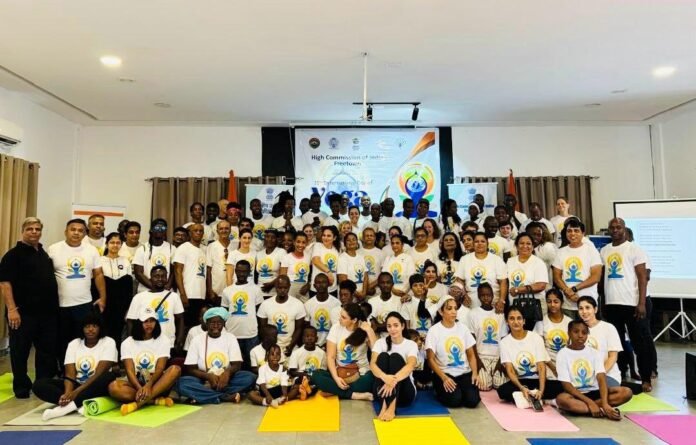
The High Commission of India in Sierra Leone celebrated the 11th International Day of Yoga with great enthusiasm at Sierra Palms Resort in Freetown on Saturday, June 21, 2025. The event was held under the global theme for this year: “Yoga for One Earth, One Health,” emphasizing the ancient practice’s role in fostering holistic well-being and environmental harmony.

The event highlighted the growing acceptance and enthusiasm for yoga across Sierra Leone, reflecting the shared values and people-to-people connections that underpin the warm friendship between the two nations.

Speaking at the event, the High Commissioner of India, Shri Baisnab Charan Pradhan, expressed delight at the increasing number of yoga practitioners in Sierra Leone, cutting across age groups, professions and backgrounds. From schools and health centres to public parks, yoga is being embraced as a means of improving physical, mental and emotional well-being. The practice not only promotes individual health but also contributes to building more harmonious and resilient communities.

The celebration reaffirmed the importance of yoga as a tool for unity, peace and holistic wellness. The occasion served as a testament to the strengthening India-Sierra Leone partnership, marked by mutual respect, development cooperation and cultural exchange. The High Commissioner also emphasized that such shared initiatives help foster understanding and solidarity between the peoples of both nations.

Following the formal address, a yoga session was held under the expert guidance of instructors, Edward Kekura, Ms. Diya and other local yoga teachers, following the Common Yoga Protocol. The session also featured a short meditation segment led by members of the Brahmakumaris spiritual organization.

The event was organized in partnership with prominent local yoga institutions such as The Art of Living, Brahmakumaris, ThisIsYoga and Diya Yoga and Fitness Studio. It drew enthusiastic participation from members of the diplomatic community, the Indian diaspora and local residents, reflecting yoga’s wide appeal across different segments of society.

The celebration received generous support from several community partners, including Vinod Khatumal, SV Electricals, Satguru Travels, Jaidev Stores, Kayhira and Veronica Travels, whose contributions added to the success of the event.

The occasion once again underscored the universal relevance of yoga as a practice that transcends cultural and geographical boundaries, fostering holistic health and well-being at both individual and community levels.


ECSL Presents 2024 Report to President Bio, Highlights Achievements and Challenges

President Dr. Julius Maada Bio has reaffirmed his commitment to democratic consolidation and institutional reforms following the official presentation of the 2024 Annual Report of the Electoral Commission for Sierra Leone (ECSL). The report was handed over by the Chief Electoral Commissioner and Chairman, Mohamed K. Konneh, during a formal ceremony on Thursday July 19, 2025 at State House in Freetown.

The comprehensive report, presented in accordance with Section 32(12) of the 1991 Constitution, outlines the Commission’s activities, milestones, financial performance and challenges throughout the final year of the 2020–2024 Electoral Cycle Strategic Plan.

In his presentation, Mohamed K. Konneh praised the Government’s consistent support for the Commission’s independence and impartiality. He acknowledged President Bio’s critical role in enabling ECSL to carry out its constitutional responsibilities without interference, emphasizing that such democratic leadership has strengthened public confidence in the electoral process.

Highlighting key achievements, the Chief Electoral Commissioner pointed to the successful implementation of the Proportional Representation (PR) system. “The PR system, introduced upon the Commission’s recommendation and endorsed through your directive, Your Excellency, has been a pivotal step toward inclusive governance,” he stated. “It allowed us to meet the 30% gender quota for women in elective office, ensured peaceful elections and expanded voter participation across the country.”

Mohamed K. Konneh further reported that the 2023 general elections were widely acknowledged as free, fair and transparent. He stressed that the PR system helped minimize electoral tension and reduced public expenditure, saving the Government over NLe19 million by filling 14 parliamentary and council vacancies through party list nominations, thereby avoiding costly by-elections and potential post-election conflict.

Describing 2024 as a year of consolidation, Mohamed K. Konneh noted that the ECSL has been actively reviewing its strategies and strengthening internal systems in preparation for the next electoral cycle (2025–2029). He reaffirmed the Commission’s commitment to professionalism, transparency and collaboration with stakeholders to preserve electoral integrity.

In response, President Bio thanked the ECSL leadership and staff for their dedicated service and commended them for conducting an election that truly reflected the will of the people. “Managing elections in our region is a formidable task, yet you did so with dignity and transparency. Your work will stand the test of time,” the President said.

The Head of State reiterated his belief in democratic governance and expressed deep personal interest in electoral reforms. “I vigorously campaigned across this nation to win the people’s mandate. From that experience, I understand the importance of a credible electoral system and feel morally obligated to support its review,” President Bio stated.

He pledged to thoroughly review the ECSL’s 2024 Annual Report alongside other critical documents, including the report of the Tripartite Committee and the Independent Management and Functional Review of the Commission. These, he said, would form the basis for a comprehensive approach to electoral reform.

“I am fully committed to implementing the reform recommendations in accordance with the law. Every action we take will be guided by the Constitution and aimed at strengthening our democratic institutions,” President Bio concluded.

The event marked a significant step in Sierra Leone’s democratic journey, as the Government and electoral body continue to work collaboratively to enhance electoral transparency, inclusivity and credibility in future elections.