


By Abubakarr Harding
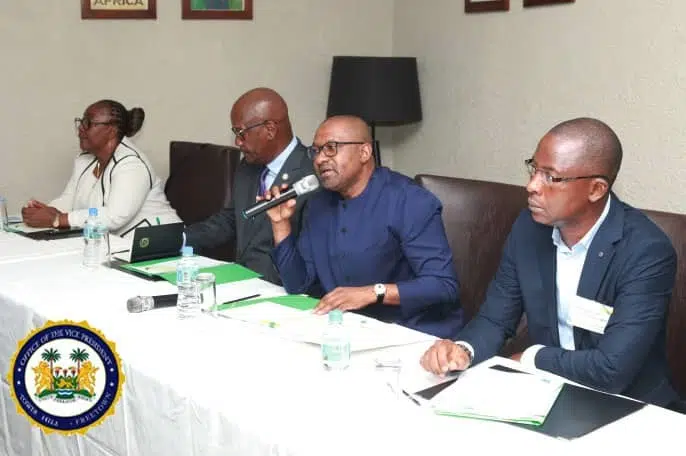
Sierra Leone has taken another giant step towards enhancing the digital space in the country with the signing of a historic Memorandum of Understanding (MoU) between the Ministry of Information and Communications and Smart Africa Digital Academy (SADA). The signing ceremony took place on Tuesday, April 4, 2023, at the Ministry of Foreign Affairs at Tower Hill.
The event was organized to launch the Smart Africa Digital Academy and to speak to their joint commitment in ensuring that people have access to digital technologies and making sure that they have connectivity within the nation.
In his welcome address, the Deputy Minister of Information and Communications, Solomon Jamiru Esq, expressed his delight for embarking on a journey with SADA adding how the Ministry would not let this opportunity slip away but would ensure that they utilize it to the fullest to achieve the desired outcome.
The Deputy Minister also stated that much of what was crystallized was anchored on the privacy and vision of President Julius Maada Bio, who gave specific instructions to the Minister to ensure that they build a digitally inclusive society.
It must be noted that the Information Minister, Mohamed Rahman Swarray has been rolling out that vision, and the MoU signed with SADA is a significant step towards achieving that.
The Deputy Minister emphasized that the African Union’s digital transformation for 2020 to 2030 urges all of Africa to ensure that people on the continent have access to at least 6 gigabytes per second of internet speed in a safe and secured manner.
He also noted that the African Free Trade Content Area offers prospects that will not be profitable in the future if Africa does not take steps to actualize it underscoring that the philosophy drives Smart Africa.
The Director-General and Chief Executive Officer of Smart Africa, Lacina Kone, stated that he met the Minister at the UN General Assembly in July and also in Paris. He added that the Minister had been asking him to come to Sierra Leone whenever they meet. Mr. Kone emphasized that Smart Africa was at the service of Sierra Leone and not the other way round. He noted that the digital future of Africa is promising for the development of digital skills and crucial for social and economic growth on the continent.
Kone stressed the need to transform Africa into a single digital market, saying that to be transformed, one must be informed. He added that statistics show that about 5% of the jobs by 2030 have not been created. He emphasized that the partner continents in the Global South have the youngest populations, making it imperative to equip their citizens with different digital skills.
By 2030, approximately 230 million jobs in Africa will require digital skills. The statistics show that Africa needs to create 22 million new jobs every year from now to 2030.
According to Kone, basic digital skills are essential for entering the workforce to ensure that African citizens are ready for the future of digital jobs. They must have the necessary digital skills and must act promptly to prepare them for successful socio-economic development. Policymakers must alert people to the latest advanced knowledge to create a behavior environment for policymaking in digital transformation.
Kone concluded by announcing the formal model to bridge the critical digital skills gap in the country and support Sierra Leone’s digital ecosystem in a rapidly evolving digital environment.
The climax of the event was the signing of the MoU.





As Only 3 Parties Fit for 2023 Elections… No Political Street Rallies
By Amin Kef (Ranger)
Confirmed reports from the Political Parties Regulation Commission (PPRC) indicates that only three registered political parties have satisfied all the criteria needed to contest in the June 24, 2023 elections. The report states further that these parties are the ruling Sierra Leone People’s Party (SLPP), the main opposition All People’s Congress (APC) and the National Grand Coalition (NGC).
But as was being expressed by majority of Sierra Leoneans that the coming elections could turn out violent and are therefore calling on Election Management Bodies (EMBs) to ban street political rallies as these can be fore-runners to full-blown violence on Election Day – June 24, the Political Parties Regulation Commission (PPRC) has finally let the cat out of the bag, that unless political parties display maturity, responsibility and care in managing their respective political street rallies, the PPRC will have no option other than to ban ALL political street rallies.
It is no hidden fact that whenever it comes to elections and election campaigns, that is the time when violence is unleashed between and among political party rivals and unfortunately it is the innocent people who have no hands in the affairs of the political parties that are rallying are the ones who ultimately suffer. And most times, they have no recompense for whatever they suffer at the hands of supporters of political parties taking part in rallies.
It is against this background that even though it is being mooted that the Executives of both the SLPP and APC are busy accusing each other of being afraid of political street rallies because it would show which party truly has the numbers to win the June 24 elections, the PPRC has come out strong to caution them.
But if we should critically look at the prevailing circumstances and the fact that rallies haven’t even been declared open and already the two main political parties are having disagreements about which has the bigger crowd, then the fears of Sierra Leoneans that the run-up to the elections could be violent and even the elections are justified and the PPRC can go ahead to declare a ban on all political street rallies across the country.
Maybe political parties can resort to holding meetings in secure areas with police protection. This could be a better, safer, more secure and more acceptable option to especially those people that have no business with political rallies but fall victims.