


By Foday Moriba Conteh
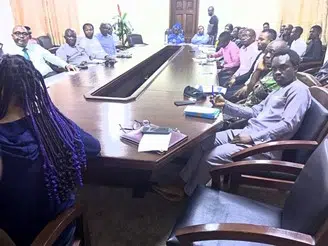
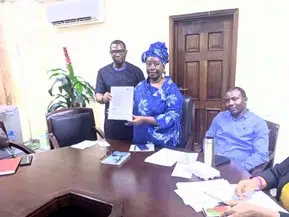
The Africell Impact Foundation, in collaboration with the Ministry of Technical and Higher Education and in partnership with the London School of Economics and Political Science, has organized a one-day training event aimed at enhancing the skills and knowledge of 30 selected students and faculty members from six universities across Sierra Leone. The training, with focus on Innovation and Entrepreneurship took place on Wednesday, October 25, 2023, at the Multi-Purpose Hall on Fourah Bay College Campus in Freetown.
In his address, the Deputy Minister of Technical and Higher Education, Sarjoh Aziz-Kamara, commended Africell Impact Foundation for organizing the training for Students and Faculty Heads from various universities.
He said Africell as a company, through its Corporate Social Responsibility, has been supporting innovation, community development etc, further commending the company’s strides towards transforming the educational landscape in the country in order to regain its position for global competitiveness.
The Deputy Minister stated that the country has a glorious history almost spanning over 200 years of Higher Education which started at the Fourah Bay College, University of Sierra Leone, adding how significant progress has been made but said not good enough to fit into the 21st century industrial revolution.
He described the training as very important towards supporting the ongoing educational transformation in the country as it will form the basis for closer collaboration that will support the country’s vision for higher educational excellence and global competitiveness.
Sarjoh Aziz-Kamara said the training has also equipped participants with the necessary skills, innovation and entrepreneurship of which he encouraged participants to use the tools and apply the methods they have learnt saying they will help them leverage leadership, innovation and entrepreneurship.
Laura Jane Silverman, the Head of LSE Generate, representing the London School of Economics and Political Science, explained LSE’s extensive expertise in economics, law, management and politics. According to her, LSE Generate, is a hub for innovation and entrepreneurship that is dedicated to empowering emerging leaders with the skills and knowledge required for success.
She pointed out that the partnership between Africell and LSE Generate seeks to deliver high-quality professional training to students and faculty members.
The Africell Group Communications Director, Sam Williams, said students from universities mainly focus on gaining knowledge from books by taking lectures and writing exams, adding that the purpose of the training is to teach students and faculty heads soft skills they need in order to succeed in the modern workplace or to start a business.
He highlighted that one of the priorities of Africell’s work in Sierra Leone is to deliver social impacts in the field of education of which they brought experts from the London School of Economics and Political Science to offer knowledge and expertise to students in the country.
Sam Williams said they want it to be an ongoing program underscoring how they are expecting the London School of Economics and Political Science to come back next year and open the program maybe to include school children in addition to university students.
He said the training focused on leadership, innovation and entrepreneurship geared towards building the capacity of students and faculty members on the various topics.
One of the trainees, Marian F. Kargbo, a student from the Milton Margai Technical University expressed her gratitude to Africell Impact Foundation, the Ministry of Technical and Higher Education, and the London School of Economics and Political Science for providing such a valuable training.
She shared her insights gained during the leadership portion of the training, emphasizing the importance of active listening for effective leadership.
Marian pledged to apply the skills and knowledge she has acquired to make a positive impact.




Global Cooperation Reaches New Heights at Third Belt and Road Forum
By Amin Kef (Ranger)
The Third Belt and Road Forum for International Cooperation (BRF) marked a significant milestone in global cooperation as it celebrated the 10th anniversary of the Belt and Road Initiative (BRI). Held from October 17 to 18 in Beijing, China, the forum bore the theme: “High-Quality Belt and Road Cooperation: Together for Common Development and Prosperity,” reflecting a commitment to fostering unity, win-win outcomes and development on a global scale.
The BRF showcased an ambitious vision for realizing global modernization, a goal shared by all nations. Over the past decade, the BRI has successfully executed more than 3,000 cooperation projects, attracting nearly USD 1 trillion in global investments, and uplifting 40 million people out of poverty. It has also accelerated the modernization efforts of many developing countries. During the forum, President Xi Jinping announced further market access expansion for digital and other products, deepened reforms in state-owned enterprises, digital economy, intellectual property and Government procurement, along with entering into free trade agreements and investment protection treaties with more countries. This aims to unlock the potential of China’s vast market for the world.
The Forum conveyed a resounding message of unity, cooperation, openness, and mutual benefit. It emphasized that humankind shares a common future, and win-win cooperation is the path to success for initiatives benefiting all. The event witnessed over 10,000 registered representatives from 151 countries and 41 international organizations, reaffirming the global appeal and influence of Belt and Road cooperation. It was a clear signal to the world that unity, cooperation, openness, and mutual gain are preferable to division, confrontation, isolation, or zero-sum thinking. Amidst profound global changes and challenges, Belt and Road cooperation stands as a stabilizing force.
Action was a defining feature of the forum, with an emphasis on tangible outcomes. President Xi Jinping outlined eight major steps to support high-quality Belt and Road cooperation, covering multidimensional connectivity, green development, scientific and technological innovation, practical cooperation, people-to-people exchanges, and institution-building. The forum yielded 458 outcomes, including crucial cooperation initiatives, institutional arrangements, and specific targets. These commitments include providing 100,000 training opportunities on green development by 2030 and establishing 100 joint laboratories. Furthermore, China Development Bank and the Export-Import Bank of China will establish RMB 350 billion financing windows, with an additional RMB 80 billion injected into the Silk Road Fund.
This emphasis on concrete action underscores the commitment to global growth and shared development. As the world enters a new decade, China, along with the international community, including Sierra Leone, stands poised to build on this progress, summing up experiences, drawing blueprints, forging consensus, and advancing the Belt and Road’s high-quality development for the benefit of all.
The Third Belt and Road Forum has ushered in a new era of global cooperation, setting a course towards a more prosperous and interconnected world.