Home Blog Page 63

Cowbell Wraps Up Preliminary Stage of 2025 ‘Kapu Sens’ Inter-School Quiz Competition

Senior secondary pupils participating at Cowbell's inter-school quiz competition

By Foday Moriba Conteh

Cowbell, one of Sierra Leone’s most trusted dairy brands under Premium Divine Trading Company Limited, an agent of Promasidor, has successfully concluded the preliminary stage of its annual Cowbell “Kapu Sens” Inter-School Quiz Competition. The event, themed: “Nurturing the Spirit of Patriotism Through Civic Education,” was held on Saturday, November 8, 2025, at the historic Albert Academy on Berry Street in Freetown.

This year’s competition drew participation from 32 secondary schools across the Western Urban and Rural districts. After several rounds of intense intellectual exchanges, 16 schools advanced to the next stage, which will take place on November 14th and 15th, 2025, at the Multi-Purpose Hall, Fourah Bay College (FBC).

Now in its third edition, the Cowbell Kapu Sens Challenge continues to strengthen the values of academic excellence, discipline, patriotism and civic responsibility among young Sierra Leoneans.

In his opening remarks, Philip Kanu, Marketing Lead at Premium Divine Trading Limited, described the competition as more than a test of knowledge but a platform for cultivating responsible citizenship and unity among young people.

“This annual event is not just a quiz competition; it is a celebration of knowledge, unity and the patriotic values that bind us together as a nation,” Philip Kanu said.
“We believe in the power of education as the cornerstone of our nation’s future, and we are thrilled to see 32 schools come together to showcase their intellect, teamwork and love for country.”

Philip Kanu outlined the structure of the competition as a three-stage process designed to test not only academic prowess but also civic awareness:

  • Round One: 32 schools competed, with 16 progressing to the next round.
  • Round Two: The remaining schools will battle for a place in the top eight.
  • Semi-Finals and Finals: The final eight will vie for the national championship title.

He emphasized that while prizes and recognition are motivating, the competition’s deeper purpose lies in inspiring patriotism and community-minded leadership among the nation’s youth.

“Each question you answer, each discussion you engage in and every friendship you form here contributes to your growth as informed and responsible citizens,” he said.

Philip Kanu reaffirmed Premium Divine’s commitment to supporting education and youth development as an integral part of nation-building.

“National development is a shared responsibility. It should be inclusive of everyone, especially young people who are the future leaders,” he added.
“Our contribution to national development is to encourage youth to take an active role in their communities rather than simply relying on Government interventions.”

Beyond the competition, Philip Kanu also underscored Cowbell’s role in promoting good health and nutrition through its fortified milk products. He explained that Cowbell milk, enriched with essential nutrients such as protein, calcium and vitamins A, B9, C, D, E, and K, collectively branded as “Vitarich,” supports both mental and physical growth.

“At Cowbell, we are committed to enriching minds and nourishing dreams,” he said, referencing the brand’s long-standing slogan. “We encourage Sierra Leoneans to continue supporting Cowbell products as we continue to invest in education and the health of our young people.”

Philip Kanu concluded by expressing gratitude to educators, parents and partners who continue to make the competition possible. He reaffirmed the company’s long-term commitment to empowering Sierra Leone’s next generation of leaders through learning and civic engagement.

Representing the Deputy Minister I of the Ministry of Basic and Senior Secondary Education (MBSSE), Alpha Bangura, Acting Director of School Quality Assurance Management and Resources, praised Cowbell and its partners for creating a platform that nurtures academic discipline and positive citizenship.

“The theme for this year’s challenge could not be more relevant. True patriotism is not just about loving our country in words; it is about acting responsibly, upholding integrity, and making choices that uplift our communities and our nation,” Alpha Bangura said.

Drawing from his personal journey, Alpha Bangura shared how he overcame challenges in his youth to rise through education. Having attended Sierra Leone Muslim Congress Primary School and later Ahmadiyya Muslim Secondary School, he recounted how he resisted negative influences such as drug abuse, focusing instead on education and hard work.

“Many of my peers were drawn into drugs but I made a decision early on to stay focused on my goals,” he said. “It was not easy, but consistency, humility, hard work and integrity guided me, and those same values have brought me this far. Your background does not define your future; your choices do.”

He used the platform to urge students to resist peer pressure and substance abuse, a growing problem among the country’s youth.

“As future leaders, you must take a stand and be ambassadors in the campaign against harmful drugs in our schools and communities. Protecting your health, your mind and your future is part of your civic responsibility,” Alpha Bangura emphasized.

He commended teachers and organizers for their tireless effort and dedication in mentoring the students, acknowledging that organizing such an event requires patience, passion and commitment.

“To the sponsors, I say thank you for investing in the next generation. And to the students, remember that winning is not just about answering questions correctly, true success is about being disciplined, responsible and patriotic citizens who will one day make Sierra Leone proud,” he concluded.

Ansumana Keita, Chief Patriot of the Patriotic Advocacy Network, commended Premium Divine Trading Company and Promasidor for their continued investment in the educational sector.

He described the initiative as “a unique blend of intellectual competition and moral instruction,” designed to foster national consciousness and civic engagement among young people.

“This competition is crucial in strengthening pupils’ understanding of the rights and responsibilities of citizenship,” Ansumana Keita said.
“We live in a time when patriotism seems to be fading among the youth. Through this platform we are reigniting that sense of national duty and pride.”

Ansumana Keita emphasized that the focus on civic education and patriotism is not accidental but a deliberate effort to cultivate critical thinking, discipline and respect for the nation’s democratic values. He encouraged all participants to share their newfound knowledge about patriotism with their peers to build a culture of civic responsibility in their communities.

“When young people understand their role in society, they become part of the solution to our national challenges,” Ansumana Keita added.

Among the qualifying schools advancing to the Round of 16, there was an overwhelming sense of pride and determination, pupils expressed confidence in their school performance and preparedness for the next round.

ICPNC Opens Third Annual Strategic Retreat in Kono

By Ibrahim Sesay

The Independent Commission for Peace and National Cohesion (ICPNC) on Sunday officially opened its Third Annual Strategic Retreat in Kono District, gathering Board members, Management, staff, traditional leaders and national partners to review progress and refine strategies for sustaining peace across Sierra Leone. The retreat is being held under the theme: “Our Pathway to Peace 2030.”

The ceremony commenced with interfaith prayers led by Francis Patterson and Foday Momoh Kanu, symbolizing unity and shared commitment among Christian and Muslim communities. Paramount Chief Fasuluku Sonsiama III, who also serves as an ICPNC Board Member, welcomed participants to Kono, describing the district as a land of hospitality and urging active engagement throughout the retreat.

A peace-themed musical performance by Francis Patterson added a reflective and uplifting note to the day’s proceedings.

Delivering the declaration of purpose, Executive Secretary Madam Hawa Sally Samai highlighted the retreat’s significance in consolidating the Commission’s achievements and addressing challenges that affect national harmony. She reaffirmed ICPNC’s commitment to building a peaceful and cohesive Sierra Leone, urging participants to approach the sessions with professionalism, collaboration and a sense of duty.

Madam Samai emphasized that the theme :“Our Pathway to Peace 2030” should serve as a guiding framework for the Commission’s long-term strategy, noting that members of the Commission are “architects of the peace pathway whose work will influence future generations.”

The retreat’s first panel discussion, moderated by Board Member Ms. Valnora Edwin, focused on consolidating peace and national unity. Panelists included Aruna Lumeh of Fourah Bay College,  Joseph Ben Kaifala of the Relics and Monuments Commission, and Dr. Mamoud Tarawally of International IDEA. Discussions centred on the six pillars of ICPNC’s 2021–2024 Strategic Plan, the importance of peace education, the revival of national values and the institutionalization of a national remembrance day to reflect on the civil war’s lessons.

Dr. Tarawally underscored that peace and governance are inseparable, stressing the need for equitable distribution of state resources and institutional independence to maintain public trust. Ms. Edwin, in her concluding remarks, cautioned against tribalism and urged citizens to adopt responsible communication as a tool for unity.

The second panel, moderated by Madam Samai, explored the Commission’s legal mandate and responsibilities.  Lyton Olubunmi Rolcolt Denis Jones, Parliamentary Counsel in the Office of the Solicitor-General, explained that the ICPNC derives its authority from the 1991 Constitution and the ICPNC Act of 2021, which empowers it to prevent and resolve conflicts, promote reconciliation and investigate grievances with powers akin to those of the High Court.

Furay Musa, Director of the Public Sector Reform Unit, acknowledged the Commission’s advisory role to the President and its contribution to governance reforms designed to consolidate peace and strengthen national cohesion.

Day One concluded with an interactive session marked by rich exchanges of ideas from participants. The retreat continues in Kono as the Commission works toward developing a strategic roadmap for peace and unity leading up to 2030.

Marampa Mines Donates $150,000 to Support Sierra Leone Women’s Premier League

SLFA president Babadi Kamara (left) receiving cheque from Marampa Mines Limited to support Sierra Leone Women’s Premier League

By Foday Moriba Conteh

In a groundbreaking show of corporate support for women’s sports, Marampa Mines Limited (MML) has donated $150,000 to the Sierra Leone Football Association (SLFA) in support of the Sierra Leone Women’s Premier League (SLWPL). The contribution marks the largest corporate sponsorship ever made toward women’s football in the country.

The cheque presentation ceremony held on Saturday 8th November, 2025 at SLFA Headquarters on Kingtom in Freetown, brought together representatives from the mining company, SLFA Executives, government officials, and members of the sporting community. The donation underscores MML’s growing commitment to empowering women, youth and community development beyond its mining operations.

Delivering remarks at the event, Craig Dean, Chairman of Marampa Mines Limited, said the company’s decision to support the Women’s Premier League reflects its broader mission of social impact, inclusion and national development.

“I am a strong believer in the power of God and in the importance of giving back,” Craig Dean said. “It’s by the Lord’s grace that we are here and one of the reasons I am proud to put this money forward is to support the young women of Sierra Leone who are working hard to excel in football.”

He also acknowledged the collaborative effort of his Management team, emphasizing that success in both business and sports depends on teamwork. “Just like in football, everything depends on the team. Without a team, we are nothing,” he said. “I’m grateful to have strong leaders around me, both at Marampa and within our group, who share this vision of empowering women through sport.”

Craig Dean highlighted Marampa Mines’ continued investment in Sierra Leone, noting that together with its parent company, Gerald Group, they have committed over $500 million to the country’s economy through mining and infrastructure development.

He explained that while many sectors sought corporate sponsorship, the request to support women’s football particularly resonated with him and his team.

“Everyone wants us to sponsor something,” Craig Dean remarked. “But when it came to supporting the Women’s Premier League, I couldn’t say no. Empowering women is one of the most important things to me personally and to Marampa Mines as a company.”

Craig Dean disclosed that women currently make up one-third of the Marampa Mines workforce; a milestone the company has maintained for nearly two years, an uncommon achievement in the mining sector globally.

“Mining is not an easy sector for women but we believe in transforming skill sets and creating opportunities,” he said. “Empowering women and youth is central to the kind of progress we want to see in Sierra Leone.”

He added that the company’s investment in the Women’s Premier League aligns with the Government’s vision for gender equality and youth empowerment and also reflects Marampa Mines’ long-term commitment to Sierra Leone.

“I love this country deeply. When I invest here, I am personally happy,” he said. “This $150,000 contribution is not small money it’s a significant step toward strengthening the league and giving our young women a chance to shine.”

Craig Dean praised SLFA President Babadi Kamara for his leadership and vision, noting that it took strong advocacy from Babadi and his team to convince Marampa Mines that the funds would be used effectively to support women’s football.

He emphasized that the sponsorship was not intended as a one-off gesture but as part of a long-term partnership aimed at strengthening women’s football in Sierra Leone.

Craig Dean expressed confidence that the partnership between Marampa Mines and SLFA would go beyond financial support to include mentorship, logistical backing and moral encouragement for female athletes nationwide.

“We’ll be there for you when you need support not just financial but moral and technical,” he assured. “Let’s make this work and build something truly special for women’s football in Sierra Leone.”

In his response, SLFA President Babadi Kamara expressed deep appreciation to Marampa Mines for what he described as a “historic moment for women’s football in Sierra Leone.”

He noted that the donation would go a long way in covering operational costs, player welfare and logistics for the Women’s Premier League’s ongoing season, which has already drawn nationwide attention for its competitiveness and professionalism.

Babadi Kamara said partnership is more than financial support; it symbolizes women’s empowerment and national unity highlighting the recent victories of the Sierra Leone U17 and Senior Women’s National Teams at the 2025 WAFU Women’s Championships.

“This contribution is a game-changer,” he said. “It shows that the private sector is beginning to recognize the potential and importance of investing in women’s sports. On behalf of the football family and the entire nation, we say thank you to Marampa Mines.”

Babadi Kamara added that the SLFA remains committed to ensuring full accountability and transparency in how the funds are used, promising that every dollar will directly benefit the development of women’s football.

Minister of Sports, Augusta James-Teima, praised the partnership as a shining example of how the private sector can drive sports development. “Marampa Mines is not only here to mine resources but to help build Sierra Leone,” she remarked.

In a heartfelt gesture, Sarah Bangura, captain of Sierra Queens and FC Kallon, expressed gratitude on behalf of the players, thanking President Babadi Kamara and Marampa Mines for their unwavering support. The partnership is expected to elevate the SL Women’s Premier League, empower female athletes and inspire the next generation of women footballers across Sierra Leone.
The $150,000 sponsorship sets a new benchmark for corporate involvement in women’s sports in Sierra Leone. It also comes at a time when SLFA is expanding its focus on gender inclusion and youth development, positioning the Women’s Premier League as a flagship competition for empowerment and equality.

Mayor Yvonne Aki-Sawyerr Challenges Local Government Ministry Over “Unfair” Transfer Directive

Her Worship Yvonne Aki-Sawyerr showing document to journalists during FCC's press conference

By Foday Moriba Conteh

The Mayor of Freetown, Her Worship Yvonne Aki-Sawyerr, OBE, has openly challenged the Ministry of Local Government and Community Affairs over what she described as an “unfair and politically motivated transfer directive” that targets key administrative and professional staff of the Freetown City Council (FCC).

Speaking at a well-attended Press Conference held on Monday 10th November, 2025 at the Freetown City Hall on Wallace Johnson Street, the Mayor expressed deep concern about the Ministry’s recent decision to order mass transfers of staff across local councils nationwide including the sudden removal of experienced personnel from the FCC. She described the directive as “ill-timed, disruptive and detrimental to effective service delivery.”

According to Mayor Aki-Sawyerr, the transfers come at a critical time when the council is finalizing its 2025 budget, transitioning to a new financial management system and rolling out key urban development projects under the “Transform Freetown” initiative. She argued that such drastic changes in the council’s human resource structure could delay project implementation and weaken accountability mechanisms.

“We recognize the authority of the Local Government Service Commission to conduct lawful staff transfers,” the Mayor said. “However, the timing, scope and manner of this directive raise serious questions about intent. It appears to be a calculated effort to destabilize the Freetown City Council at a time when we are delivering essential services to residents.”

The Mayor also commented on the Chief Administrator of the Freetown City Council, accusing him of “consistent non-cooperation and administrative sabotage.” She claimed that his unilateral decisions, including delays in approving payments and failure to properly coordinate council departments, have undermined the council’s financial performance.

“The Chief Administrator’s conduct has not only breached established procedures but has also significantly affected our ability to meet revenue targets and ensure transparency,” she said. “We cannot continue to function effectively under a system where politics overrides professionalism.”

Mayor Aki-Sawyerr concluded her statement by reaffirming her administration’s commitment to transparency, accountability and community-driven development. She urged the Government to uphold the spirit of decentralization enshrined in the Local Government Act of 2004, which empowers councils to operate independently in the interest of their constituents.

“My loyalty remains with the people of Freetown,” she said firmly. “We will continue to serve our residents with integrity and ensure that no political interference derails the progress we have made together.”

Mayor Yvonne Aki-Sawyerr emphasized that while the FCC is not opposed to staff transfers, such actions must adhere to established due process. She referred to the Ministry of Local Government and Community Affairs’ Press Release dated November 4, 2025, titled: “Minister of Local Government directs implementation of Council Staff Transfers, urges end to stagnation,” clarifying that the Council strongly objects to the transfer of its Finance Officer.

According to the Mayor, the proposed transfer is ill-timed, coming at a critical period when the Council is finalizing its 2026 budget and simultaneously serving as the only Local Council piloting the complex Public Financial Management (PFM) Smart System. She further disclosed that tensions have persisted between the Council’s elected officials and the Chief Administrator, Raman Tom Farmar, citing his lack of cooperation. The Mayor confirmed that she had officially written to the Local Government Service Commission requesting his transfer.

Mayor Yvonne Aki-Sawyerr also lamented the financial constraints facing the Council, revealing that since the start of 2025, the Government has only released the final quarter of the 2024 allocation to Local Councils. This, she said, has significantly hampered service delivery and ongoing development initiatives.

Meanwhile, several councillors present at the event voiced similar frustrations, including Councilor Zainab Conteh, who raised serious concerns about what she described as sustained intimidation and victimization in her official capacity as Chief Councilor, a position to which she was unanimously elected by her fellow councilors.

According to Chief Councilor Zainab Conteh, during a recent official meeting at the Freetown City Council, the Minister of Local Government and Community Affairs arrived with an entourage and questioned her authority to act in the capacity of Mayor, asking whether she was “not afraid” to do so and to use the title Chief Councilor. She described the remark as “deeply disrespectful and intimidating,” particularly as it was made in the presence of several male officials.

Chief Councilor Zainab Conteh also cited remarks made by the Chief Administrator (CA) of the Council on Radio Democracy 98.1 FM, where he reportedly described her as “ignorant” and “without understanding of council matters.” She said this public denigration, along with the Minister’s earlier comments, reflects “a troubling pattern of institutional intimidation and gender undermining.”

Further, she revealed that a letter from the Chief Administrator to the Mayor has formally challenged the legitimacy of her position as Chief Councilor and Acting Mayor; a role she said was established through a council vote. The Minister, according to her, has since written to the Mayor requesting a response to the CA’s complaint, which she believes “effectively sides with the administrative authority over the collective will of the council.”

Chief Councilor Zainab Conteh emphasized that her position is not unique to Freetown but a recognized administrative practice within other local councils, including Kenema City Council and the Western Area Rural District Council (WARD-C).

“This repeated singling out and public questioning of my authority as a woman in leadership is not only an act of political intimidation but also a direct affront to the principles of gender equity and women’s political participation,” she said.

She appealed for solidarity and institutional support from women’s organizations, governance advocates and political actors to ensure that no woman in elected office faces “intimidation, ridicule or administrative obstruction” for performing her duties.

Chief Councilor Zainab Conteh reaffirmed her commitment to serve the people of Freetown “with integrity and diligence,” adding that the struggle for women’s equal participation in governance “must remain a shared national priority.”

Indian Community Supports Youth-Led “Rise Salone” Initiative to Support Vulnerable Families

Indian Community in Sierra Leone donates bags of rice to youth-led initiative

By Foday Moriba Conteh

A passionate group of high school pupils under the banner ‘Rise Salone’, a youth-led community initiative, have received a generous donation of 35 bags of rice (25kg each) from the Indian Community in Sierra Leone in support of their Basket Brigade Project. The donation ceremony took place at the Choithrams Office on Rawdon Street in Freetown.

The Basket Brigade Project is a charitable initiative aimed at providing essential supplies to 100 vulnerable families through Family Support Donation Baskets. Each basket is carefully curated with food and hygiene items such as rice, cooking oil, tea, milk powder, bar soap, sugar, salt and other daily necessities enough to sustain a family of four to six members for up to three weeks. The initiative promotes dignity, compassion and collective action in addressing community needs.

Handing over the donation, Harish Agnani, representing the Indian Community, explained that the gesture was inspired by the India Community’s recent cultural festivals and their desire to give back to the local community after learning of RISE’s charitable efforts. “We learned that these pupils are carrying out charity work to support local communities, and we decided to assist them in their efforts,” Harish Agnani said.

He emphasized that the initiative forms part of the Indian Community’s long-standing commitment to social welfare in Sierra Leone including medical and educational support. “We believe that this initiative, led by young people, will have a great impact on the lives of local families,” he added.

Harish Agnani revealed that the group’s goal is to help more than 100 families with food items that will contribute to their sustainability. “So far, approximately NLe 100,000 has been raised to purchase additional supplies,” he revealed adding that their initial goal was to support 100 families but with the commitment of the young people they are confident that even more families will benefit further encouraging others to join the movement.

Receiving the gesture, Nitish Vijay, Co-Founder of Rise Salone, expressed gratitude for the partnership and highlighted the project’s purpose:

“The Family Support Donation Baskets are designed to provide essential supplies to families in need of not just food but dignity and hope. Each basket contains rice, cooking oil, tea, milk powder, bar soap, sugar, salt and other daily essentials to support a family of four to six members for up to three weeks,” he said.

Rise Salone, founded by Aarav Saini, Nitish Vijay, Hanine Swaid and Amina Ismail, is a 100% student-led initiative driven by compassion, education and community action. The group’s mission is to Re-shape, Impact, Strengthen and Empower (R.I.S.E) communities by helping families rise above challenges and build resilience.

“Our generation has the power to make a difference,” Nitish Vijay added. “We believe that age should never be a barrier to creating positive change.”

He said that through projects like the Basket Brigade, Rise Salone continues to demonstrate that young people can lead meaningful efforts to fight hunger, strengthen families and inspire kindness across Sierra Leone.
Fellow Rise Salone Co-founder, Aarav Saini, expressed deep gratitude for the donation. “We are truly thankful for this support and promise to continue working hard to help families in need,” Saini said.

She stated that as students they realized that many people in Sierra Leone need help. ‘We came together to support those in dire need,” Aarav Saini explained, noting that their efforts are focused on assisting vulnerable communities across the country.

Aarav Saini concluded, “We want to show that compassion and teamwork can make a real difference.”

The ceremony concluded with a symbolic handover of the donated food items, marking a partnership dedicated to alleviating hunger and inspiring a new generation of humanitarian action in Sierra Leone.

Vice President Presents Digital Kits to Modern Elementary and St. Joseph’s Primary Schools

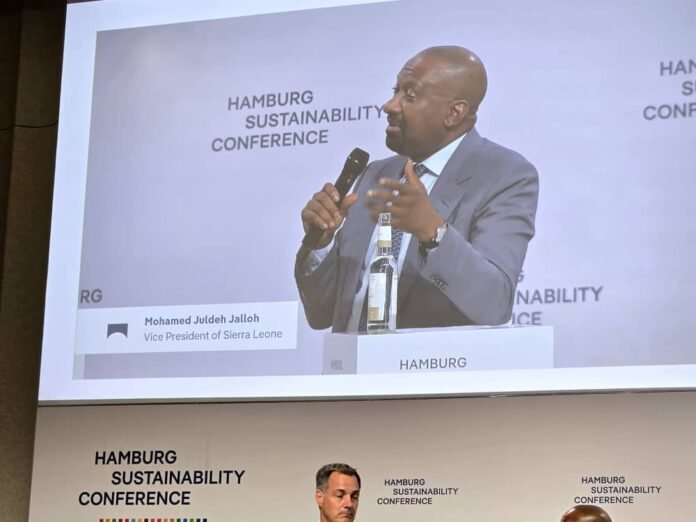
Vice President, Dr. Mohamed Juldeh Jalloh addressing beneficiaries at St Joseph Primary School after receiving digital learning kit donated by Orange Foundation

By Amin Kef (Ranger)

Sierra Leone’s Vice President, Dr. Mohamed Juldeh Jalloh, on Tuesday, November 11, 2025, delivered inspiring remarks at two Freetown-based institutions, Modern Elementary Primary School and St. Joseph’s Primary School during ceremonies marking the presentation of digital learning kits donated by the Orange Foundation under its nationwide Digital Learning Initiative.

The Vice President clarified that the donation was made by the Orange Foundation, which had invited him to nominate two schools, one public and one private to benefit from the initiative that complements the Government of Sierra Leone’s Free Quality Education programme.

At Modern Elementary Primary School, Vice President Dr. Mohamed Juldeh Jalloh described the occasion as a significant milestone in the school’s journey. He praised the proprietress, Mrs. Ellen Keili, for her exemplary leadership and dedication over three decades, noting that the school’s consistent record of academic excellence and commitment to nurturing young learners influenced his choice. “When the Orange Foundation asked me to select two schools to benefit from their digital learning initiative, I chose Modern Elementary because of its inspiring journey, the commitment of its teachers, and the extraordinary efforts of its proprietors,” he stated.

He emphasized that the initiative aligns with the vision of His Excellency President Dr. Julius Maada Bio, who has placed education at the heart of his administration’s Human Capital Development agenda. “As a Government, we believe education is the most powerful pathway to development. When we invest in human capital, we invest in the prosperity of our country and our people,” he affirmed.

The Vice President extended gratitude to the Chief Executive Officer and management of the Orange Foundation for their continued partnership with Government in promoting digital inclusion in schools nationwide. As part of his personal gesture, he presented two iPads to the best-performing pupils—one boy and one girl—and urged them to use the devices responsibly for educational purposes. His remarks were met with laughter and applause as he humorously reminded pupils that “these devices are meant for learning, not entertainment.”

He also distributed chocolates as an early Christmas gift and pledged both his personal and official commitment to support digital learning at Modern Elementary in the coming year.

Later in the day, Dr. Jalloh visited St. Joseph’s Primary School, where he delivered another heartfelt address celebrating the institution’s rich legacy of excellence. He explained that his decision to select St. Joseph’s stemmed from its long and distinguished history of service to education and nation-building. “When I was given the opportunity to select two schools to benefit from this important donation of digital learning equipment, I had no hesitation in nominating St. Joseph’s Primary School. I chose your school because of its long and distinguished history — a journey defined by decades of service, dedication, and the countless children you have educated and inspired across this nation,” he said.

The Vice President commended the school’s leadership and staff for their enduring contribution to shaping generations of Sierra Leonean children. He reiterated Government’s unwavering commitment to strengthening the education sector, stressing that digital learning is now a necessity in today’s world. “Through partnerships like this one with Orange Sierra Leone, we are integrating technology into learning and preparing our children for the demands of the modern world,” he added.

Dr. Jalloh also commended the Orange Foundation for supporting 39 schools nationwide and announced that 15 more institutions will soon benefit from the initiative. As a gesture of encouragement, he presented two iPads to the top-performing pupils of St. Joseph’s Primary School, urging them to embrace digital tools for academic growth. “Let me encourage you to make good use of these digital tools. They are meant to enhance your learning experience, broaden your knowledge, and help you embrace the digital age with confidence,” he advised.

He described St. Joseph’s as a school close to his heart, situated near his office, and promised to continue supporting it whenever opportunities arise. “This school is very dear to me; it is located just a few hundred meters from my office, and I consider you my neighbors. Because of that closeness, you can be assured that I will continue to think of St. Joseph’s whenever opportunities for educational support arise,” he said warmly.

Vice President Dr. Mohamed Juldeh Jalloh concluded by reaffirming his support to both schools and the broader educational vision of President Bio, pledging that the Government will continue to advance digital learning as part of its national transformation agenda.

The ceremonies were attended by Minister of Basic and Senior Secondary Education, Mr. Conrad Sackey, and Director General of the Orange Foundation, Mrs. Annie Wonnie-Katta, both of whom praised the Vice President’s leadership and commitment to education.

The events were widely lauded as vivid demonstrations of the productive partnership between Government and the private sector in building a digitally empowered generation of Sierra Leonean learners.

Teachers as well as pupils displaying the donated digital kit
Teachers and pupils of Modern Elementary pose for picture with VP Juldeh Jalloh

Orange Sierra Leone Discontinues Kolat Offer Over Sustainability and Quality Issues

Orange Sierra Leone
Orange Sierra Leone

When Orange Sierra Leone launched its Kolat unlimited data bundle in May 2024, it quickly became the talk of the town. For just Le60, customers could browse, stream and download without worrying about limits. For many Sierra Leoneans, it was a breakthrough in affordable internet access; a taste of digital freedom.

But behind the excitement, a quiet storm was brewing inside the country’s largest mobile network. The same offer that won public admiration was silently straining the company’s finances and testing the limits of its network infrastructure.

Within months of launch, internet traffic on the Orange network skyrocketed by more than 80%. Data consumption shot up faster than anyone predicted. Yet, the revenue from those subscriptions did not follow the same trajectory. According to Orange Sierra Leone, data income grew at a rate five times slower than network traffic, creating a serious imbalance between use and profit.

The company explained that less than 3% of its subscribers were using the unlimited bundle but that small fraction consumed a disproportionately large share of bandwidth. Some users reportedly went as far as using multiple Kolat subscriptions, guzzling up to one terabyte of data each month. “It was not sustainable,” a senior technical officer admitted. “We were spending heavily to buy international bandwidth in dollars, but the returns were minimal.”

The heavy consumption soon began affecting everyone else on the network. Speeds dropped, connections froze and users in densely populated areas experienced consistent slowdowns. Even with over 2,800 cell sites upgraded to 4G and 46 new ones built across the country, the network was stretched to its limit.

Orange Sierra Leone increased its international bandwidth from 27 Gbps to 41.5 Gbps, a massive investment, but the pressure from a few high-usage customers continued to erode overall service quality. “We reached a point where we had to make a choice: keep a few users happy or maintain service quality for millions,” an internal memo reportedly stated.

Before pulling the plug, Orange followed due process. The company discussed the technical and financial implications and waited for the green light. Officials confirmed that the decision to discontinue the Kolat plan was fully compliant with national telecommunications regulations.

The withdrawal of the Le60 unlimited bundle sparked public concern over possible price increases. Orange, however, clarified that no such hike was made. Affordable options remain available, including the Le15 daily, Le40 three-day and Le100 weekly data bundles; all unchanged in cost.

In fact, a comparative study showed that Sierra Leone enjoys some of the lowest data costs in Africa. At about $0.10 (Le2.4) per megabyte, local rates are far below the continental average, which ranges between $1 and $5 per megabyte.

Orange Sierra Leone didn’t take its customers by surprise. The company announced the Kolat bundle’s withdrawal two weeks in advance through SMS alerts, radio, television and social media posts. Customers were encouraged to switch to other bundles before the change took effect.

In the end, the decision wasn’t about profit alone. It was about preserving network integrity and fairness. The unlimited model, while appealing, had begun to harm the digital ecosystem that millions relied on daily; students attending online classes, businesses processing payments and families staying connected.

Orange Sierra Leone has pledged to continue investing in infrastructure and innovation. “Our focus is on sustainable connectivity; affordable, reliable and accessible to all,” the company said in a statement.

The story of Kolat is a reflection of a global truth: in the digital age, even the most generous offers come with hidden costs. For Orange Sierra Leone, ending the bundle was not a retreat it; was a necessary reset to ensure that the country’s digital future remains fast, fair and sustainable.


Telecom Giants Seek Constructive Engagement as Parliament Reviews Data Promotion Order

By Amin Kef (Ranger)

The Parliament of Sierra Leone has temporarily suspended its earlier directive ordering mobile network operators Africell and Orange Sierra Leone to reinstate their data promotions within 24 hours, following appeals from both companies citing technical and operational challenges.

During a follow-up engagement, representatives from the two leading telecoms explained that the abrupt reversal of data packages could cause significant system disruptions and affect ongoing service improvements. They assured lawmakers of their continued commitment to providing affordable, reliable and high-quality digital connectivity for Sierra Leoneans.

Parliament has since agreed to hold another hearing to further examine the issues raised by the mobile companies, ensuring that decisions are made in a balanced and informed manner that benefit both consumers and service providers.

The earlier 24-hour order, issued on Friday, November 7, 2025, came amid public outcry over recent data price adjustments. However, industry experts have noted that the changes were influenced by global inflation, foreign exchange volatility and the rising cost of network maintenance and energy, which have impacted telecom operations nationwide.

Africell and Orange have consistently played a central role in Sierra Leone’s digital development, investing heavily in infrastructure, local employment and innovative services such as mobile money and e-learning platforms. Both companies reaffirmed their commitment to supporting Government efforts in expanding digital inclusion while ensuring long-term sustainability.

Observers say Parliament’s decision to pause the directive demonstrates a mature and cooperative approach to resolving regulatory and consumer challenges. Many believe that sustained dialogue between regulators, policymakers and the private sector will foster a fairer, more transparent and competitive telecommunications environment for all Sierra Leoneans.

Both Africell and Orange remain focused on delivering greater value to their millions of subscribers, expanding service coverage and strengthening Sierra Leone’s standing as one of West Africa’s fastest-growing digital economies amid the ongoing debate.

United Pentecostal Church International Commemorates 50 Years of Spiritual Leadership

Members of United Pentecostal Church International (UPCI) celebrates its 50th anniversary

The United Pentecostal Church International (UPCI) is celebrating its 50th anniversary this week with a week-long conference that honors five decades of spiritual leadership, evangelism and community service across Sierra Leone and beyond.

The commemoration officially commenced on Wednesday, November 5, 2025, at the church’s headquarters on Cookle Bay in Freetown. The event brought together church leaders, members and distinguished guests to reflect on the UPCI’s remarkable journey and chart a renewed vision for the future of its mission.

The roots of the United Pentecostal Church in Sierra Leone trace back to the early 1970s when Reverend Okeefe, an American missionary, first arrived in Liberia before traveling to Sierra Leone. His goal was to establish a Bible college and a church, working in partnership with Sierra Leoneans who shared his vision.

In Liberia, Reverend Okeefe met Saidu Jalloh, a Sierra Leonean who soon became his close associate. Together, they journeyed to Freetown, where they began their ministry.  Pastor Saidu Jalloh later became the first Sierra Leonean convert and an instrumental figure in the early church-planting movement.

Their ministry began at Juba Hill, with Pastor Jalloh serving as Dean of the Bible College and Treasurer of the mission. Working alongside young men such as Gassim, who later moved to England and Egerton Jones, who also pursued studies abroad, they laid the groundwork for what would become one of Sierra Leone’s enduring Pentecostal institutions.

Despite early progress, the church later faced internal disputes that required the intervention of both the Sierra Leone Council of Churches (CCSL) and the courts. A subsequent court ruling temporarily suspended several UPCI assemblies, leaving only the Aberdeen Road branch, which operated on a family compound, to continue uninterrupted.

During this turbulent period, new congregations emerged in areas such as Bendembu, Dwazak Farm and Gory Street, ensuring the church’s survival and continued outreach.

Under the leadership of Pastor Katie M. E. Leden, the UPCI entered a new era of growth. New church structures were constructed in Calaba Town, Lumley, Aberdeen and Tengbeh Town. Leadership transitions also strengthened the church’s foundation, with Pastor Jalloh overseeing the Western Area and Pastor Malie leading efforts in Makeni.

This phase of expansion and renewal positioned the UPCI as a leading force in Sierra Leone’s Pentecostal community, blending spiritual guidance with social outreach.

During the anniversary celebration, Bishop Dr. Rashid Turay, General Superintendent of UPCI Sierra Leone, welcomed guests and expressed gratitude to God for five decades of ministry. He described the milestone as a moment of thanksgiving and reflection on the church’s endurance through trials such as civil war and the Ebola epidemic.

“This is a great time in God’s presence,” Bishop Turay declared. “We thank God for 50 years of unwavering faith, for our lands and properties, and for the countless lives transformed through our ministry.”

He highlighted the church’s contributions to community development, education, and spiritual empowerment, emphasizing that the anniversary was not only a celebration of the past but also a call to greater service.

Reverend Randy Adama, Africa Regional Director of UPCI, paid glowing tribute to the church’s founding fathers. He described the golden jubilee as a time of rejoicing, renewal, and liberty, urging members to embrace the true biblical significance of the number fifty—a symbol of freedom and restoration.

“This is a season of jubilee,” Reverend Adama said. “We must thank God for the dedication and vision of our founders and remain steadfast in our mission to spread the gospel despite the moral challenges facing our world.”

He also called on the church to rise as a moral compass for society, particularly amid growing issues such as drug abuse, same-sex marriage, and abortion, stressing that the church must play an active role in protecting the next generation.

In his goodwill message, Bishop Akintayo Sam-Jolly, President of the Pentecostal Fellowship of Sierra Leone, commended the UPCI for its remarkable contributions over the past fifty years. He attributed the church’s success to God’s grace and the steadfast faith of its members.

“Fifty years of ministry is no small achievement,” Bishop Sam-Jolly noted. “It is God’s grace that has brought you this far. But even as we celebrate, we must remain vigilant. The moral and spiritual fabric of our nation needs strengthening, and the church must lead that transformation.”

He urged the UPCI to continue partnering with other Christian institutions to address social and moral challenges and to empower young people to live purposeful lives grounded in faith and service.

As the United Pentecostal Church International marks its 50th anniversary, the week-long celebration stands as both a testament to endurance and a call to renewal.

From humble beginnings at Juba Hill to a nationwide network of congregations, the UPCI’s legacy reflects unwavering faith, community service, and a commitment to shaping lives through the power of the gospel.

With renewed purpose, the church now looks ahead to the next fifty years determined to deepen its spiritual impact, expand its outreach, and continue serving as a beacon of hope in Sierra Leone and beyond.

Healthcare on Wheels: Mobile Clinic Aims to Assist Kush Victims

The Ministry of Health, in collaboration with the Ministry of Youth Affairs, has launched an innovative “Hospitals on Wheels” initiative to deliver essential medical assistance to victims of the ongoing Kush crisis. The program seeks to bring healthcare services directly to affected communities, ensuring that no one is left behind.

The official launch took place on Saturday, November 8, 2025, at the Youyi Building Car Park in Freetown, marking a new approach to community-based healthcare delivery in Sierra Leone.

Speaking to journalists about the initiative, Dr. Yeabu Kargbo, Medical Superintendent and Manager of the Hospitals on Wheels Program, explained that the mobile clinics are designed to provide free medical services to youth impacted by Kush abuse. She revealed that the clinics will be staffed by specialists from Saint Michael’s Hospital in Lakka and will initially operate at youth farms in Hastings.

According to Dr. Yeabu Kargbo, the program aligns closely with Sustainable Development Goal 3 (Good Health and Well-being), which aims to ensure healthy lives and promote well-being for all. By taking healthcare directly to vulnerable groups, she noted, the initiative helps reduce health disparities and advance equitable access to medical services.

Dr. Yeabu Kargbo disclosed that the program is being implemented in collaboration with the Ministry of Youth Affairs and supported by funding from the United Nations Population Fund (UNFPA). She recounted that two months earlier, the Minister of Youth Affairs had approached her to explore ways of providing free healthcare to youth affected by Kush addiction ;a call that led to swift action.

She recalled providing emergency healthcare to Kush victims at both the SLPP and APC party offices in Freetown, an experience that highlighted the urgent need for mobile health services during crises.

“Our team is ready to respond to cases beyond emergencies, including trauma and wound care,” Dr. Yeabu Kargbo stated. “We have six medical doctors deployed at various locations and we aim to treat at least 500 victims during this initial phase.”

She further emphasized that many of the affected youth are battling substance use disorders, stressing that they should not be criminalized but rather treated with dignity and compassion. She assured that the medical team is well-prepared to provide follow-up care, especially for wound management and that they have adequate supplies of essential medicines to support recovery.

Ahmed Kamara, Component Manager at the Ministry of Youth Affairs, described the initiative as a joint national response to the growing health crisis among young people. He explained that while the Ministry of Health provides transportation and medical supplies, the Ministry of Youth Affairs is responsible for organizing the outreach and mobilizing communities.

The Component Manager noted that the program remains a top priority for the Minister of Youth Affairs, who is committed to ensuring that it is sustained and expanded to reach more affected individuals. As a mental health specialist himself, Ahmed Kamara joined the mobile clinic team to deliver free psychosocial and mental health support to victims.

“This is not just about treatment; it’s about hope, rehabilitation and giving our young people a second chance,” he said.

The Hospitals on Wheels initiative represents a critical intervention in Sierra Leone’s ongoing effort to address the human and social impact of the Kush epidemic. By combining medical care, mental health support and community engagement, the program underscores the Government’s determination to promote healing, recovery, and resilience among affected youth.