Home Blog Page 778

Japanese Foreign Affairs Ministry Engages Media Practitioners in Online Meeting

By Amin Kef Sesay

The Tokyo International Conference on African Development (TICAD)  held an online Press Briefing on the 16th March 2022 with over 60 journalists from 30 countries across Africa to inform them about the forthcoming Ministerial online meeting slated for the 26th-27th March 2022 and the TICAD 8 Conference to be held in August on the 27th and 28th August 2022.

It must be noted that TICAD is a summit-level international conference on Africa’s development initiated by Japan in 1993 as a multilateral international conference to address development issues in Africa co-organized by the Government of Japan, UN, UNDP, World Bank, and AUC.

The Deputy Director General, Department of Africa Affairs in the Japanese Ministry of Foreign Affairs intimated that Japan has led the forum with its history of over a quarter-century to promote African development while respecting Africa’s ownership.

He continued that the main objectives of the Ministerial meeting is to discuss priority issues on African development at Ministerial level to a view to looking ahead to TICAD 8.

The Deputy Director General further maintained that the Ministerial meeting is also to set out a pathway for African development with an emphasis on “people” and “quality growth”, as well as call for international cooperation.

He also added that it is also to strengthen the bilateral relationships with African countries and share the priorities of Japan’s diplomacy with them such as the realization of a “Free and Open Indo-Pacific” and addressing development finance issues.

“Participants will discuss Africa’s development based on three pillars which are economy, society and peace/stability,” he informed adding how the participants for the Ministerial Meeting will comprise the Government of Japan, 50 African countries, TICAD co-organizers and Union Commission.

The Deputy Director General revealed that they will be looking ahead of the post COVID-19 era adding that the format of the forthcoming TICAD 8 will be determined in due course taking into account such factors as the situation surrounding COVID-19.

Vice President of the Japan International Cooperation Agency (JICA) pointed out that the organization was established in 2003, with an Head Quarter in Tokyo, 96 Overseas Offices and 15 Domestic Offices.

He continued that JICA has executed different projects in all African countries like the Initiative for Food and Nutrition Security in Africa (IFNA), a framework of collaboration to accelerate the implementation of food and nutrition security policies in all African countries with it partners.

“The organization’s effort to assure learning opportunity for children under a project called “School for all” is to improve access to quality education through school management with ownership and participation of communities,” he highlighted mentioning that their Project known as NINJA (Next Innovation with Japan) is to create ecosystems to foster African entrepreneurs who can resolve social issues among many other good works that JICA had been executing in African countries.

He mentioned that at TICAD 7, which was held in Yokohama in August 2919, private companies were recognized as official partners for the first time and the Public-Private Business Dialogue between Japan and Africa was held in the plenary session. The Government of Japan supports Japanese companies’ projects in Africa by making the most use of ODA, he added.

“Japan announced ‘TICAD-7: Japan’s Contributions for Africa’ which included measures to provide support using ODA,” he stated.

It was further highlighted that Africa is important to Japan because it has the largest regional group in the United Nations maintaining that out of 193 member States 54 are in Africa, that it is a continent with enormous potential , has an annual average economic growth rate of approximately 5% in the Sub-Saharan region from 2001-2021, predicted to become a market for more than 2.5 billion people, a quarter of the world’s population, has wealth of minerals and energy resources being extracted  as new technology develops.

The online meeting was climaxed by a question and answer session with the moderators ensuring that appropriate answers were provided to the probing questions certain participants forwarded.

Africa’s rural communities will be the hardest hit by plastic pollution

Amponsem, Founder of the Green Africa Youth Organisation and Afri-Plastics Challenge judge

Plastic waste in Africa is not just an urban issue, but also a rural one. Rural communities are almost always heavily dependent on natural resources, such as water and arable land, to make a living. These resources are being irrevocably contaminated with plastic waste, the impact of which is often underestimated.

Sub-Saharan Africa produces over 17 million tonnes of waste annually, with only 12% of plastic waste being recycled. The rest finds its way into landfills, streets and waterways. In rural areas, much of the plastic waste is burnt, largely because most rural areas have no rubbish collection or recycling facilities available.

Plastic disposed of in this way releases toxins into the environment, killing life on land and in water, and contaminating previously fertile land. Most governments in Africa do not have the resources to police this behavior but do acknowledge the issue and are often very willing to collaborate to find relevant solutions.

The biggest challenge facing Africa is the fact that for millions, putting food on the table for their families is their single biggest concern. This has been further exacerbated by the Covid-19 pandemic with many people losing their source of income. We need to work together to demonstrate the extent of the risk, as it will have an impact on the livelihoods of farmers and other informal workers – as well as the overall value chain keeping economies alive.

With the population growing and the middle class expanding, plastic waste will soon become Africa’s biggest risk, coupled with the overall climate change crisis facing the continent.

As the waste volumes increase, individuals have seen opportunities to collect waste and sell it to recyclers. While this may make a dent in the waste problem, it raises questions around dignity, health and safety. Many of these waste pickers are women and young girls, who venture into unsafe areas and pick through waste without protective clothing.

Africans have started to take up the challenge to clean up their communities. In rural Ghana, communities have long reused discarded plastic containers; for example, reusing them as packaging for cleaning supplies for sale, storage of oil, and other non-consumable products.

In Rwanda, the government has mandated a monthly clean-up called Umuganda – a national holiday acknowledged on the last Saturday of every month. This has received global praise for the incredible impact it has made and instilled a real sense of ‘community’. However, the reality is that this initiative is not the norm.

To address a rural plastic waste crisis before it drives communities into poverty and urbanisation, we need innovators, influencers and industry to educate and enable people to embrace the ‘reduce, reuse and recycle’ mindset.

Across Africa, innovators are focusing their efforts on addressing the plastic waste crisis. The Afri-Plastics Challenge, which is currently underway, has identified numerous initiatives working to combat waste in new ways.

For example, the Recycling Scheme for Women and Youth Empowerment (RESWAYE) in Lagos State, Nigeria, is a buy-back initiative that aims to empower women and the youth through the collection and recycling of plastic waste.

Mega Gas in Kenya converts unsorted plastic waste into clean and affordable cooking gas through a patented process, and in the Democratic Republic of Congo, the Full Development Agency (FDA) is recycling plastic waste into products, including paving tiles for parking lots, sidewalks, and gardens in the city of Bukavu.

In the West African nation of Togo, Green Industry Plast collects, sorts, and recycles plastic waste into building materials, tables, benches, and plastic objects. These organised efforts take the plastic waste and reuse a great deal further, but ultimately recycling is not enough: we need a two-fold approach, looking at both how to reduce waste, and what to do with existing waste. It is crucial that the plastic deluge is addressed at its source.

These efforts could not have come at a better time. United Nations negotiators meeting at UNEA 5.2 have agreed on a roadmap for a global plastic treaty that would address plastic production and design, according to a draft resolution, which is a major step to agreeing on an ambitious deal. A draft resolution, entitled “End plastic pollution: Towards an internationally legally binding instrument”, states that the treaty should address “the full life cycle of plastic”, meaning production and design, as well as waste.

Most efforts across Africa are still in the plastic waste management phase because waste is highly visible. Too few are focusing on how to reduce the amount of plastic in use before the waste problem emerges.

This means influencing consumer demand and consumption as well as product package innovations is the crucial next step to being successful in tackling plastic waste. It is up to community leaders, African influencers, and the captains of industry to promote a ‘reduce, reuse and recycle’ mindset.

Industry need not wait for changing consumer demand to step up: manufacturers must proactively develop environmentally friendly alternatives to single-use plastic. The issue arises about job losses, and this highlights the need for the public and private sectors to find innovative solutions while retaining jobs and fuelling growth with new opportunities.

In Ghana, water is typically sold in plastic sachets in the streets. People prefer to carry reusable water bottles, but there are seldom taps available where they can refill their bottles. As such, they must resort to buying the sachets. There is a simple solution: portable water tanks can be installed across key locations so that people can refill their own reusable water bottles.

It is about changing perceptions and implementing easy-to-use solutions that are practical for individual markets.

Africa has a young and vibrant population made up of innovators capable of overcoming the plastic waste issue and broader climate change challenges. Initiatives such as the Afri-Plastics Challenge is critical to constantly reminding people about the negative impact plastic waste is having on their cities and rural communities.

We need to focus beyond waste management and start changing consumer attitudes and put pressure on both the public and private sectors to play their part.

-ENDS-


Addressing Oil Marketing Companies… VP Juldeh Jalloh Reveals Govt’s Consideration to Subsidize Fuel Pump Price

Fuel Pump Price.JPG

By Amin Kef Sesay

Vice President Dr Mohamed Juldeh Jalloh has on the 21stMarch 2022  met with representatives of oil/petroleum marketing companies in the country, at his Tower Hill Office, to reason with them to make petroleum products available to the public within the stipulated prices.

Also in attendance were the Petroleum Regulatory Agency (PRA) Chief Executive, Dr Brima Baluwa Koroma, representatives of the Office of National Security (ONS), the Secretary to Vice President Barba Fortune and other Government functionaries.

The Vice President informed all those present that there is the need to take stock of the stabilization measures rolled out last week in light of the global fuel disruptions caused by the current crises in Ukraine.

He furthered how the Government will continue to support the OMC to secure products and enhance fuel stock, including subsidizing pump price and establishing a fuel fund to guarantee access to necessary foreign exchange to buy products.

According to him the Government of Sierra Leone, through the leadership of President Maada Bio, would consider subsidizing fuel pump price and as well establishing a fuel fund to guarantee access to necessary Foreign Exchange to buy product.

Housemates Salone Season 3 Audition Replay Comes Up on the 26th & 27th March 2022

By Amin Kef Sesay

The second replay of Housemates Salone Season 3 will take place on the 26th and 27th March 2022 on   Channel 33 @ 9 PM, Channel 34 @ 10 PM and DStv Channel 399 @ 9 PM as well as on AfriRadio 103.5FM @ 9 PM.

Members of the public are encouraged to watch keenly how the different applicants who are yearning to become Housemates performed during the audition process, which featured both home based and diaspora based applicants who showcased themselves online.

For those who watched the first replay on the 18th and 20th March 202 no one can deny the fact that he or she did not laugh at any given point in time as the applicants were trying hard to impress the judges. Some were nervous, others were in high spirits, some murdered the Queens Language and some even Greek not to talk about Rastafarians. If it is to find a scale to weigh the quantum of laughter then there could be none to be found in the country.

It must be underscored that the rationale behind showing the replays is geared towards giving the viewers an opportunity to see firsthand the performances of the various aspirants who went through audition.

After the show of the replay on the 26th and 27th March 2022, on the following Monday, the 28th March 2022  the organizers of the Reality TV Show will publicly announce the names of Fifty-Two (52) aspirants or applicants among those who went through the audition process.

Out of those Fifty-Two aspirants, the organizers will then proceed to looking for the best Twenty (20) or Twenty-Two (22) who should enter the House. How is that going to be achieved?

A voting process will be made known to members of the public to actively participate in order to choose the required aforementioned number of Housemates.

It must again be noted that at any given time from now, the voting process link will be communicated to be done via Africell-SL.  As stated by the organizers from what members of the public have seen during the replays the ‘Yagba’ in terms of making the right choices will  then commence and if  that is logically done then we will be assured of a very thrilling Reality TV Show.

What in actual fact is up for grabs by the contestants, in the ongoing Reality TV Show, is the winning prize of Two Hundred and Fifty Million Leones (Le250M) plus undertaking a round trip to Dubai. That besides, every day spent in the House qualifies each Housemate to earn One Hundred Thousand Leones (Le100, 000).

Cautioning Against any Untoward Action…   NP-SL CEO Encourages Fuel Retailers to Constructively Engage Management

National Petroleum Sierra Leone Limited (NP-SL Ltd).jpg

By Amin Kef Sesay

 During a certification ceremony held recently by the National Petroleum Sierra Leone Limited (NP-SL Ltd) to show appreciation to Dealers, Resellers and Contractors the Chief Executive Officer of the petroleum importing and marketing company, Ambassador Kobi Walker informed the audience that the company lost Le15 billion in the first 11 days of March (1st to 11th March) and Le40 billion between January and end February 2022 due to the fuel crisis and they don’t know when diesel will be available.

He continued by attributing such to a number of factors ranging from difficulty to access foreign exchange, the effects of COVID-19 and the ongoing war between Russia and Ukraine. He underscored that 56% of the world supply of petroleum products is derived from Russia and because of the ongoing war the debilitating effects are felt worldwide.

“Since Sierra Leone is a net importer of petroleum products like some other countries we are in a difficult situation and it is the wish of many to see an end to the war for normalcy to prevail,” he stated.

Ambassador Kobi Walker categorically stated that as far as he knows NP-SL Ltd does not have a Trade Union highlighting how the relationship between the company and the different categories of retailers is purely based on mutual understanding and borders on engagements to deal with certain emerging situations but stressed that there is no binding contractual agreement that binds the two. He maintained that they as retailers have the liberty to do business with the company or not.

“This rumour that some retailers want to stage a strike action against the company is something that is not tenable and is not applicable,” he intimated adding that engaging Management on any thorny issue could be the only option.

It must be noted that NP-SL Ltd was established by 35 Sierra Leoneans as an indigenous petroleum importing and marketing company. Over the years the company has grown exponentially due to sound Managerial initiatives and strategies. Individuals interested in marketing these petroleum products have partnered with the company to construct and commission Filling Stations, bearing the NP brand name, in different parts of the country and get their supplies of petroleum products.

Based on the way the employees at the various Filling Stations are treating members of the public with mutual respect that transact businesses with the company in terms of delivering qualitative services has earned the company the respectable name or accolade of 1st for Customer Care.

Besides, the edifice of the Filling Stations built are so attractive and painted in yellow and green, some with mini marts where mini shopping could be done and for customers to briefly rest in cozy and accommodating places endears many to them.

However, the high quality of its products, has also contributed greatly in the growth of the company as evident in the ever-growing demand for Castrol Oil.

NP-SL Ltd is among the few indigenous companies operating in the country that places high premium on enhancing the country’s Local Content Policy. In that direction it is foremost in making it a laid down rule that only Sierra Leoneans must be considered for employment as opposed to foreigners unless in rare situations which is only applicable to certain contractual agreements Such has helped many to secure jobs and rise through the ranks over the years.

The company, in line with matching with technology ,introduced the use of a Smart Card widely known as NP Smart Card which is a Card with memory chip imbedded that can be credited with money and debited when it is used during the purchase of fuel. The holder only slots the loaded card into the space on the pumping machine after commanding the amount of fuel to be pumped and the exact amount is discharged with the card ready for another recharge to be used for the next purchase. It has been acknowledged that it is a safe, cashless way of conducting transactions assuring greater security and budgetary adjustments.

Added to NP Smart Card is the NP Gas which is a cooking gadget that has been guaranteed of giving optimal output as it is environmentally certified, is of high precision and the gas used for refilling purpose could be accessed at Filling Stations. They are manufactured in different sizes, sold at NP-SL Filling Stations and by authorized dealers.

Though Sierra Leone is where the parent company is located, however, it has branches in neighbouring Guinea, Liberia, Ivory Coast and The Gambia.

It could be concluded that these are indeed trying times for Oil Marketing Companies in this country with the ongoing Russian and Ukraine conflict. At this point in time it is but prudent for Government to strategize with these companies in order to find workable solutions to continue having petroleum products in the country otherwise the economic dislocations might become very telling.

Francis Ben Kaifala Completes His Tenure as NACIWA’s President

Francis Ben Kaifala.jpg

By Esther Wright

Sierra Leone’s Anti-Corruption Chief, Francis Ben Kaifala has ended his tenure as President of the Network of National Anti-Corruption Institutions in West Africa (NACIWA) at the organization’s 5th Annual General Assembly at Transcorp Hilton Hotel in Abuja, Nigeria, on the 21st and 22nd March 2022.

His appointment which came in 2019 at the institution’s general assembly in Lomé, Togo, was informed by his radical and revolutionary efforts in the fight against corruption, coupled with his aggressive reforms in the anti- graft campaign, that continue to yield steady and unimaginable results.  Commissioner Kaifala, whilst he served as the President of NACIWA, provided the desired leadership to the Network in advancing its core mandates of collaboration, policy harmonization, assets recovery and seizure, borderless investigations, among others.

These monumental and enormous successes of Sierra Leone’s war on corruption under Francis’ leadership has redefined the trajectory of the Network, with the fight against corruption taking centre stage in the Sub-region’s socio-political discourse.

It could be recalled that in 2021, Commissioner Francis Ben Kaifala was overwhelmingly elected to serve as a distinguished Board Member, on the African Union Advisory Board on Corruption (AUABC), with a view to more strategically contribute to the fight against corruption at the continental level.

“I step aside to give more attention to the continued Anti-Corruption effort in Sierra Leone and my role in the African Union Advisory Board on Corruption (AUABC)”, Commissioner Kaifala wrote in one of his social media posts to mark the end of his outstanding tenure, as he handed over the mantle of NAWICA leadership to his successor Abdulrasheed Bawa, Head of the Economic and Financial Crimes Commission (EFCC) of Nigeria.

Sierra Leone remains very proud of the remarkable gains and imprints of Commissioner Ben Kaifala, who was appointed by His Excellency, The President, Brigadier (Rtd.) Dr. Julius Maada Bio to lead his primary commitment to waging war on corruption in Sierra Leone for the betterment of the country and its people.

APC Determined To Kick Against Boundary Delimitation

All People's Congress Party.jpg
Amb. Dr. Alhaji Osman Foday Yansaneh National Secretary General – APC

By Amin Kef Sesay

The Acting Publicity Secretary of the main opposition All People’s Congress Party has declared that APC will kick against any attempt by the Elections Commission of Sierra Leone to do boundary delimitation ahead of the national elections scheduled for May and June 2023.

Whilst stating that APC welcomes announcement of the dates for the various elections and also happy that they fall within the laws of the country in continued efforts to strengthen the country’s democracy, Sidi Yayah Tunis said they view boundary delimitation suspiciously.

He maintained that given the election timeline and strategic plan announced by ECSL was not even supposed to have mentioned boundary delimitation which he said takes place every five or seven years with its implementation leaning on the upper limit of seven years, which should be 2024.

It is not acceptable now to conduct free, fair, acceptable elections, he said.

Registration of voters ,he said, starts in September this year, with the number of voting centers having been increased by 10 percent from 3,300 to 3,600. He pointed out that boundary delimitation takes time – at least one year. The APC publicity went on to ask where it will be done.

He further stated that Government should not interfere in the work of ECSL. The data collected for Mid-term Census that was conducted by Statistics-Sierra Leone has a lot of controversy and that many people did not take part in it to make its results credible and acceptable.

Thus, he said, using it as the basis for boundary delimitation would cause controversy and chaos.

Stating that ECSL is doubted, Tunis said that looking at them closely; APC hopes that they will not continue with the exercise as, according to Tunis, it will not augur well for democracy and peace.

You do not just get up and do boundary delimitation, he reiterated, asking, where is the prototype of where it will happen?

He added that ECSL should not do its work based on what the Government wants but to serve the country so that peace and stability remain. He added that its conduct will be a hindrance to the election and a hindrance to peace and quiet.

ECSL ,he said, should work transparently and fairly in the interest of this country. Nothing from SSL’s mid-term census data, Tunis said, will be acceptable.

Meanwhile, APC are of the conviction that two districts have been created by the Government in the South-East as a means of encroaching into the 2023 electoral process.

We are not going to accept anything that comes from that (SSL) data, an APC international spokesperson also said.

APC Expresses Dissatisfaction with NEC’s Plan for Boundary Delimitation

National Electoral Commission of Sierra Leone.jpg

By Millicent Mannah

The Acting Publicity Secretary of the APC, Sidie Yahya Tunis, said on 98.1 Good Morning Show on 22 March 2022 that on behalf of his party they are happy about the announcement of the election date. However he stated that they are displeased with the boundary delimitation NEC wants to conduct.

He maintained that as a party they have always been stressing that they stay within the confines of the laws of the country and they should ensure that as stakeholders and citizens of this country, they should continue to strengthen democracy that the entire world has been admiring them for.

The Acting Publicity Secretary stated that the National Electoral Commission of Sierra Leone was not supposed to talk about boundary delimitation, furthering that their responsibility is to conduct elections which should be done in a manner in which it will be acceptable by all.

He maintained that it is not proper for NEC to talk about boundary delimitation now, explaining that the timeline NEC set for themselves in the strategic plan that was communicated to political parties for boundary delimitation was 2024, which means it was the upper limit they took according to the law which says 5 or 7 years.

He averred that since he has been following up on elections boundary delimitations they have been taking the upper limit stating that already NEC has given the date for the starting of voters registration in September, and that they have increased centres by 10% from 3,300 to about 3,630 centres where registration and voting will take place.

Tunis said that NEC told them that they are prepared in case the Government asks them to conduct boundary delimitation. He continued that boundary delimitation is not something that is done in one or two months, as it requires lot of preparation which sometimes span even over a year.

He furthered that the Government should not interfere with anything that concerns the National Electoral Commission, continuing that NEC should not also base their work by what the Government says.

He added that they want to use the census statistics that was done by Statistics Sierra Leone that the bulk of Sierra Leoneans did not participate in to conduct the boundary delimitation.

He stressed that the census statistics is not credible and majority of Sierra Leoneans would not trust the outcome of the result, as many people were not counted adding that this will invite chaos and controversies.

Sidie said they are looking at them closely and that they hope that their idea about boundary delimitation will not be continued, stating that it will not be good for our democracy and for the peace and tranquility of the country, particularly now that they are approaching elections.

He maintained that if the boundary delimitation is conducted it will be an hindrance to the outcome of the forth coming election, continuing that it will even undermine the peace and stability of the country.

He affirmed that NEC should not just throw anything at the people as their responsibility is to the people and not to themselves, adding that, such was the reason they made them the Electoral Commission of the country.

Lastly, he said the outcome of the result of the Mid Term Census will not be acceptable as it has lot of controversies surrounding it as the bulk of the people were not counted.

Institute of Governance Reform Scrutinizes Audit Integrity In Sierra Leone

Institute of Governance Reform.png

By Amin Kef Sesay

The Institute of Governance Reform on Tuesday 22nd March, 2022 published a critical perspective on Audit Uptake and Integrity in Sierra Leone from the period 2015-2020.

IGR said that considering this growing public interest in the audit, they took a deep dive into ASSL’s records from 2015 to 2020 to understand the progress made in the uptake of audit recommendations.

Their brief documents the level of effort by the ACC and oversight committees in the previous and current Parliament towards audit compliance.

The main sources of information for the brief were the annual Audit Reports 2015 – 2020, annual budgets, official records and key informant interviews with staff of the ASSL, the ACC, Public Accounts Committee of Parliament and local CSOs.

IGR compiled four categories of audit recommendations that informed this brief: financial accounting, procurement procedures, performance management and internal controls.

In its Summary Findings, IGR reported that in total, 2,655 audit recommendations were produced by the Audit Service Sierra Leone (ASSL) for all Ministries, Departments and Agencies (MDAs) and local councils for the six-year period covered – 2015-2020. Only 38% of audit recommendations were implemented in the last six years.
Ministries of Transport and Aviation (60%); Foreign Affairs (46%); Public Works and Assets (45%); and Sports (45%) were the most compliant with audit recommendations.
Ministry of Basic and Secondary Education (MBSSE) was the least compliant for the six-year period with only 22% of its 60 recommendations implemented.

No recommendation was implemented by the Ministry in 2017 contributing to a huge backlog of unimplemented recommendations. However, MBSSE made a remarkable turnaround in 2020, implementing 50% (2nd highest) of its recommendations for that year.
The five top local councils that were more compliant with audit recommendations are: Bonthe District Council; Kailahun District Council; Falaba District Council; Kono District Council; and Kenema District Council.

On the Way Forward, IGR recommended the following:
1. To improve public financial management (PFM) oversight, Government of Sierra Leone (GoSL) should consider institutionalizing the tracking of audit compliance by developing a digital tracker for all MDAs to see in real time the progress they are making to address their designated audit recommendations. Ministry of Finance (MoF) could consider expanding its Opendatasl.gov.sl portal to include updates on audit compliance.

2. In addition to popularizing audit reports, CSOs should consider providing in-depth analysis and shadow reporting which can take the form of expenditure tracking, fiduciary risk analysis of key sectors and service delivery tracking.
3. To increase audit uptake, we recommend a two-pronged approach:

(a) incentivize champions of audit compliance to do more. Example, individuals in Ministries such as Transport and Aviation should be recognized through a national awards programme for their consistent progress in audit compliance. And

(b), take punitive action against public officials who fail to implement audit recommendations or submit supporting documents during audits, in a timely manner.
4. The ACC, AGR said, is doing a commendable job in recovering cash loss but more needs to be done to block the systemic leakages cited in annual audits that continue to provide a conducive environment for corruption to occur.

5. Political parties, it said, should take responsibility for ensuring that the Councils they control are compliant with audit recommendations and minimize fiduciary risk.
6. Stakeholders should work towards settling the current audit dispute out of court, lower the rhetoric among the interested parties and promote genuine conversations on audit integrity and uptake of recommendations.

During NFM 3 Project Implementation… 1000 Lactating and Pregnant Women Benefit from AMNet Donation

Advocacy Movement Network (AMNet).jpg

By Foday Moriba Conteh

In a bid to promote behavior change targeting women of child bearing age and men in communities within the Western Area Urban and Rural Districts in the country, one of the vibrant Non-Governmental Organizations that is currently operating in the country, the Advocacy Movement Network (AMNet) on Tuesday 15thMarch, 2022 commenced its field day event on malaria prevention and control within the two districts.

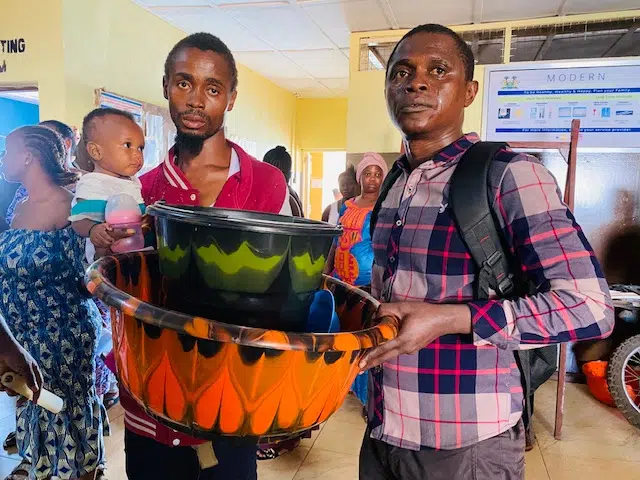
The field day event on malaria prevention and control is part of the organization’s implementation of the NFM 3 Projects that is funded by Global Fund through Catholic Services. During the implementation of the project, 1000 lactating and pregnant women with the Western Area and Rural benefited from the Advocacy Movement Network (AMNet) donation of Rubber Buckets and Bowls, Spoons, Cups, Plates & Soap.

The project is implemented in 9 Community Health Centres (CHU) which includes Tombo, Murray Town, Dwarzack, Rokupa, Wellington, Thompson Bay, Rokel, Kossoh Town, Waterloo 5/5 and Kissy Town within the Western Area Urban and Rural District. As of Tuesday 22nd March 2022 the Advocacy Movement Network (AMNet) had implemented the project in 7 Community Health Centres (CHU) with some remaining communities that will be targeted by the organization.

Speaking to this medium, Brima Conteh, the Program Manager for the NFM 3Project said that the project is funded by Global Fund through the Catholic Relief Services of which they entered into an agreement with the Advocacy Movement Network (AMNet), a local Non-Governmental Organization to fight AIDS, Tuberculosis and Malaria and for the implementation of a program entitled Strengthening Support to Communities towards Elimination of Malaria, TB and HIV/AIDS in Sierra Leone.

He added that the NFM3 project is a continuation of the NFM2 which has four components (Malaria, Tuberculosis, HIV and RSSH) and that the project primarily focuses on scaling up and continuing high impact interventions that were implemented in the NFM2 phase.

The Program Manager maintained that the project includes a strong focus on community level activities which demand creation for disease services through integrated Information, Education and Communication/Behavioral change communication (IEC/BCC) activities is one of it pillars, furthering that the project also includes the scaling up of a strong Community Based Monitoring (CBM) component.

“The selected communities-based monitors will perform an independent watchdog function of effective delivery of health services like (HIV, TB and malaria) at the health facilities and serve as linkages with their communities. This project also includes community based disease surveillance for malaria and TB,” he revealed.

He pointed out that as part of the implementation of the project AMNet organized a 5 day field day on malaria prevention  of which the organization targeted 7 communities control within the Western Area Urban and Rural District in the country, stating that the field day activity targeted 1000 women of child bearing age and men at community level.

The Program Manager disclosed that the project is geared towards the promotion of behavior change targeting women of child bearing age and men at the community, which is to ensure women and men receive the required support for adequate action, efficiency for sustained behavior change for the time uptake of IPTp, IPTi with LLIN use within the community and household.

They concluded by stating that at the end of the project the organization aims at creating an enabling environment in the community for sustained behavior change on Malaria, Tuberculosis, HIV and RSSH.

Speaking on behalf of Community Health Centres (CHU) that benefitted, the State Enrolled Community Health Nurse at the Murray Town Community Health Centre , Nanah Panda commend the move by the Advocacy Movement Network (AMNet) towards the implementation of the NFM3 project which she described as a timely intervention towards raising awareness on Malaria, Tuberculosis, HIV and RSSH among lactating and pregnant women, community youths.

She maintained that the move by the organization will help towards motivating lactating and pregnant women to access their Community Health Centres (CHU) within their localities, adding that in most cases these women sometimes refuse to visit the Centres but with the awareness and donation made by the organization such will definitely serve as a motivation to them and even other women who have not been visiting their Community Health Centres (CHU) within their communities.

Isatu Sesay, one of the beneficiaries, also applauded the Advocacy Movement Network (AMNet) for the kind gesture, adding that during the sensitization process by the organization she has been schooled on the elimination of Malaria, TB etc. within their various communities.

She further assured all that as women they will ensure they put into practice what they have learnt in order to eliminate Malaria in their community.