Home Blog Page 801

China Nicky Discovered Living Roughly in Ghana

China Nicky.jpg

By Amin Kef Sesay

In a Press Release dated 1st February 2022 and issued by the High Commission of the Republic of Sierra Leone in Accra, Ghana and signed by the Information Attaché, Princetta Christiana Williams, it was highlighted that to inform the general public and with reference to a correspondence from a Campaign Group, “Where is China Nicki Campaign” dated 23rd January 2022, addressed to the High Commissioner of the Republic of Sierra Leone in Accra, certain things related to her have been discovered.

According to the Press Release, upon receipt of the letter, the High Commission launched an investigation geared towards searching for Haja Mariama Kamara commonly known as China Nicky, who won the 2018 Reality TV Show dubbed as Big Sister Salone which was the maiden edition.

It continued that after series of investigation, the Commission finally got her contact and was able to locate her although she was discovered to be in a scuffle with three (3) men amongst which were two Ghanaians and a Sierra Leonean named Pious Augustine Sheriff with passport number ER312153, whom had earlier been seen on a group video call asking Haja to drop the call.

The said Pious Augustine Sheriff travelled to Accra, Ghana on the 26th January, 2022 onboard Kenya Airways with a one-way ticket. The tussle, the Release stated was as a result of her rejection of filming her without her consent, which the other guys were doing.

It continued that the High Commission intervened, got her separated from the three guys on Saturday 29th January, 2022 whereby China Nicky was invited on Monday 31st January, 2022 during which she declined to be granted any interview in respect of how she left the shores of Sierra Leone got to other countries and finally landed in the Republic of Ghana, but promised to do so in due course.

The High Commission concluded that the matter is under investigation with the Ghana Police and Immigration Departments  and promised to update the public as and when things unfold.

New Executive Director of SLRSA Takes Office, Promises to Increase the Quality of Road Safety

Sierra Leone Road Safety Authority.jpg

By Foday Moriba Conteh

Management of the Sierra Leone Road Safety Authority on the 31st January 2022 heartily welcomed Reverend Smart K. Senessie as the new Executive Director of the Authority.

That came in the wake of his appointment by President Bio on the 11th January 2022 replacing Ibrahim Sannoh, the erstwhile Executive Director.

James Baggie Bio, the substantive Deputy Executive Director, expressed delight in  welcoming the new Executive Director, stating how he looks forward to enjoying a very cordial working relationship with him.

James Bio informed all present how the SLRSA is a family working towards eliminating the many sad stories on our roads. He admonished all heads of Departments and Units, as well as the general staff to be very cooperative with the new Executive Director.

Reverend Smart K. Senesie, in his brief statement, conveyed how he was very elated to have been appointed by His Excellency President Dr. Julius Maada Bio to serve in the capacity as Executive Director of SLRSA. He thanked James Baggie Bio and the entire Management and Staff for their tireless efforts in ensuring that the Authority strives towards diligently achieving its mandate.

Prior to his appointment, he served as Chairman of the  Board of Directors of the Sierra Leone Road Maintenance Fund Administration (SLRMFA), Director of Mission and Development at United Methodist Church of Sierra Leone, and also worked with the Department for International Development (DFID), the National Commission for Social Action (NaCSA) among others.

Reverend Smart K. Senesie comes with a wealth of experience in International Relations, Public Administration, and International Financial Management.

He assured that he would work with everyone in the institution, the Sierra Leone Police, and all relevant stakeholders to advance the safety of road users and the entire population of the country.

Rainbo Initiative, SLAWIJ Train 35 Journalists on Ethical Reporting of SGBV Cases

Sierra Leone Association of Women in Journalism (SLAWIJ) .png

By Mary Kabay

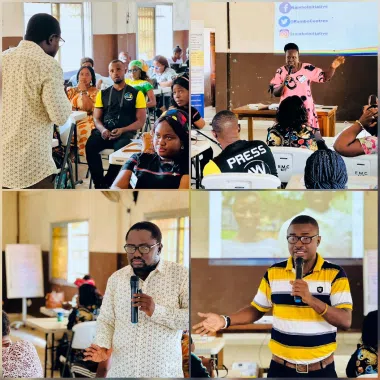
The Rainbo Initiative in collaboration with the Sierra Leone Association of Women in Journalism (SLAWIJ) held a one-day training for media practitioners held at the Ebenezer Hall in Freetown, on the theme: “The Role of the Media in Reporting Sexual and Gender-Based Violence (SGBV)”.

It is an acceptable fact that despite various efforts made by the media to raise awareness on Sexual and Gender Based Violence in the country, there are scores of sexual abuses and violence perpetrated cases that go unreported.  In some cases, critical information of survivors is exposed by the media, thereby worsening stigma and discrimination against survivors in their communities.

Against such a gloomy and abysmal backdrop, the Rainbow Initiative in partnership with SLAWIJ engaged 35 print and electronic media journalists on the ethical principles of reporting SGBV for one day.

Daniel Kantor, Executive Director of the Rainbo Initiative disclosed how the training is aimed at targeting female and male journalists that have been reporting SGBV cases. He continued that it has been noted that when reporting such cases journalists do not pay attention to the confidentiality of the victims, thereby maintaining that they deemed it important to organize the training to ensure that they report professionally and also with the objective of reminding them about their roles and responsibilities as well as ensuring that everyone contributes in the fight against SGBV.

He expressed the view that the 35 beneficiaries of the training will replicate what they have learnt so far in order to guide them amplify and raise the awareness on Sexual and Gender Based Violence without undermining any confidential rules and ensuring the protection of the survivors.

He also revealed that the Rainbow Initiative and the Sierra Leone Association of Women in Journalism have established a mechanism to monitor journalists who go through the training.

Kantor, in making a comparative analysis between the 2020 and 2021 data stated how there was a slight decrease in terms of reporting cases at the Rainbo Center, but said the data was still high as last year there were over 3,292,000 reported cases were as the 2020 data reported 3,548,000 cases out of which 75% of the data featured children within the age brackets of 5-12. He stated that such clearly shows that the report related to adults is very poor due to stigmatization stressing how society’s perception is contributing greatly towards that.

He called for concerted effort in combating SGBV underscoring how the community, media, and CSOs contributions are vital in the fight.

Human Rights Commission to Probe Law Enforcement Officers on Acts of Violations

Human Rights Commission of Sierra Leone.jpg

By Amin Kef Sesay

The Vice Chairman of the Human Rights Commission of Sierra Leone, Victor I. Lansana ESQ, has on the 31st January 2022 informed a cross section of  members of the Fourth Estate that the Commission will soon institute a public inquiry into the conducts of law enforcement officials across the country relating to allegations of human Rights violations.

During the Press briefing, the Vice Chairman of the Commission, Victor I. Lansana, disclosed that they have monitored, received and documented many allegations of human rights violations by law enforcement officials especially in the maintenance of Public Order of which the Commission has decided to institute a public inquiry.

He added that the scope of the Public Inquiry will be for seven years starting from 2015-2021.

The Human Rights Commission Vice Chair disclosed that the issues that will determine the inquiry are surrounded around the following; whether law enforcement officials used disproportionate force in the execution of their duties contrary to the UN Guiding Principles of the use of force and fire Arms; whether there were loss of lives and grievous bodily harm resulting from excessive use of force by law enforcement officials contrary to Section 16 of the 1991 constitution; whether law enforcement officials lost their lives or sustain grievous bodily harm in the hands  of members of the public while carrying their lawful duties contrary to Section 16 of the constitution among other reasons.

The Vice Chairman of the Commission also intimated that the inquiry will be divided into three phases which is the pre-inquiry stage which  will start from January-March for preparation of data collection, collection of further data on alleged human rights violations among others. Phase two of the inquiry will commence from April-May of which three panels will be sitting in different locations, Western Area, North-West and the South-East.

Phase three of the inquiry, which will commence from June to August, will deal with collation of evidence and analysis, Report produced and disseminated, strategic engagement with law enforcement agencies, and ensure that the recommendations are fully implemented.

“Members of the public are hereby invited to participate in the inquiry by providing information that will be useful in determining the issues before the panel. This information should be presented in the form of written memoranda either by individuals or groups of individuals or interested organization,” he welcomed inputs.

Victor Lansana also furthered that any person, institution or organization that wish to be named as an interested party in the inquiry, should make an application to be so named within a period of one month after the publication of the public notice. He concluded by sending a strong worded warning that any  falsification of documents and/or misleading information provided for the purposes of the inquiry will lead to punitive measures as provided for by the HRCSL complaint rules.

On the Constitutional Review Process… ILRAJ’s Position Paper on Government’s White Paper Identifies Grey Areas

For Fiscal Year 2020... NRA Clears NMA of Wrongly Withholding Le15.9B of Revenue Generated By Amin Kef Sesay It could recalled that the Auditor General’s Report of 2020 named the National Minerals Agency (NMA) as one of the Government agencies that could not account for a certain amount of public funds it generated during the period when the audit was conducted thereby portraying the institution as one that was not accountable and transparent. However, the Internal Controls and Audit Department of the National Revenue Authority (NRA) has come up with a contrary view. The NRA Internal Controls and Audit Department noted that the National Minerals Agency (NMA) failed to pay some components of their revenue, totalling Le 15.9 billion into the Consolidated Revenue Fund during 2020. It further disclosed that in contravention of Section 45 of the Public Financial Management Regulations of 2018, those revenues were not collected by the National Revenue Authority as they were not disclosed in the NRA cash analysis regarding NMA. Importantly, the NRA claims that the Finance Act of 2017, Section 35 stipulates that the National Minerals Agency Act, 2012 is amended by repealing and replacing Section 18 with the following new Section-18 which now stipulates that all revenues collected by or due to the Agency shall be paid into a Special Treasury Account of the Consolidated Fund provided that the following revenues shall not be paid into the special Treasury Account of the Consolidated Fund- (a) monies accruing to the Agency in the course of its operations (b) minerals and trading rights application fees (c) monitoring fees and precious mineral valuation fees, and (d) regulatory fees, fines and other monetary sanctions imposed by the Agency. It continued that notwithstanding the provisions in the above Act, the Fiscal Management and Control Act 2017 that came into effect 1 July 2017 overrides the above for agencies that should withhold special funds. Such confirms the NMA Management’s response to the 2020 Auditor General’s Report that Section 18 of NMA Act 2012 makes provision for all revenues to be paid to the Special Treasury Account or the Consolidated Revenue Fund (CRF) but the Finance Act 2017 repealed that Section 18 of the NMA Act 2012 giving the agency powers to withhold certain funds it collects. Clearly stated was that the Executive Order number 1 that came out in 2018 enforced the Fiscal Management and Control Act 2017 and so therefore, the NMA can withhold fees specified in the Finance Act 2017. Therefore, the Internal Controls and Audit Department of the National Revenue Authority (NRA) therefore stated that the Le 15.9 billion Leones are funds not collected by the NRA but the National Minerals Agency (NMA). In as much as the NRA was trying to justify that it did not collect the said amount it indirectly exonerates the NMA of any wrong doing by referencing the requisite legal provision.

By Amin Kef Sesay

In a Position Paper released by the Institute for Legal Research and Advocacy for Justice (ILRAJ) bordering on the “Report on the Review of the 2017 Government White Paper on the Constitution of Sierra Leone, 1991 (Act No.6 of 1991)” ,that was published on the 13th January, 2022, the rights based entity commended the Government for incorporating certain recommendations and at the same time stated  actions or clauses that should have been or must be incorporated in the White Paper.

On the whole, the ILRAJ stated that it welcomes the Government White Paper and noted that it is a significant improvement from the one issued by the previous Government.

It however urges Government to do its utmost to ensure that the outcomes and recommendations are legitimate and broadly accepted, whilst trusting that Government will take its comments in good faith as they (ILRAJ) look forward to the public consultations and deliberations and the roadmap for implementing the recommendations as some of the amendments are entrenched provisions in the Constitution.

Among many observations made, ILRAJ noted that Government accepted the following CRC’s recommendations to wit:

To incorporate principles of human dignity and equality into the fundamental principles of State policy in Chapter 2 of the 1991 constitution,

To direct its policy towards ensuring adequate medical and health facilities for all persons without qualifying it to “regard to the resources of the State,”

To prohibit discrimination, to provide free quality education, to include civic education and entrepreneurship among the State’s educational objectives,

To promote national culture, citizens to respect the national currency and national pledge which are accepted by ILRAJ

However, ILRAJ says it is disappointed that the Government decided to retain Section 14 of the 1991 Constitution, which ensures that the rights conferred in Chapter 2 of the Constitution, such as the right to health, education, etc. are not legal rights, and citizens cannot take legal action if Government fails to provide them.

According to the ILRAJ such will seriously limit citizens’ rights to seek redress and make these rights merely aspirations adding that where there is a violation of the economic, social and cultural rights, there is no mechanism for redress.

ILRAJ is also of the humble view that the rights stated in Chapter 2 of the 1991 Constitution should be enforceable maintaining that the CRC mentioned that these rights are enforceable in other African countries such as Kenya, South Africa and Uganda.

According to ILRAJ, making them enforceable will ensure that Sierra Leone complies with international obligations. In some instances, in its report Government states that it will follow best practices in other countries. However, ILRAJ argues that we must not be selective and cite international best practices only when it suits our decision.

The rights based entity further maintains that with the greatest respect to the Government, the Constitution is the supreme authority and law of the country and it takes precedence over all other laws and legislation.

Thus, because there is detailed legislation dealing with the media does not mean freedom of the press and its independence cannot be dealt with in the Constitution.

ILRAJ noted that it is important to guarantee and secure those rights suggesting that a breach of those rights in the Constitution could be taken directly to the highest court of the land, i.e., the Supreme Court. Thus, ILRAJ is urging the Government to reconsider its position on that issue and include a new chapter in the Constitution.

On the recognition and protection of the fundamental human rights and freedoms of the individual, ILRAJ noted that under that heading, the following recommendations were accepted:

To rename Chapter 3 The Recognition, Protection and Promotion of Human Rights and Freedoms of the individual’,

To abolish the Death Penalty,

To reduce detention periods from ten days to seven days in cases of capital offences and from seventy-two hours to forty-eight hours in the case of other offences,

To compensate and/or apologize to persons unlawfully arrested and detained,

To subject the protection of fundamental rights to National Security.

Furthermore, ILRAJ welcomes the Government’s acceptance of the recommendation to draft a new Section 27 of the 1991 Constitution to provide for gender inclusivity, protection from discrimination and promotion of the rights and empowerment of women in line with the Government’s policy.

The ILRAJ is now urging the Government to accept the draft new Section submitted by the CRC, which includes the following provisions:

“(1)Every person is equal before the law and has the right to equal protection and benefit of the law.

(2) Equality includes full and equal enjoyment of all rights and fundamental freedoms.

(3) Women and men have the right to equal treatment, including the right to equal opportunities in political, economic, cultural and social spheres.

ILRAJ calls on the Government to review its decision not to add new chapters relating to the right to the environment, the right of the aged, persons with disability and the rights of the child in the Constitution whilst reiterating their view that the Constitution is the supreme law of land and those rights are very important to be included in the Constitution.

The rights based organization says it is delighted that Government accepted the recommendation to draft a new chapter on citizenship in the Constitution “as citizenship is very vital in the Government structure of the State and therefore needs to be clearly defined in the most important legislation – the Constitution.”

In addition, ILRAJ also called for Sections 75 & 76 of the Constitution to be replaced “to enable citizens by naturalization to hold Public Office and Elected offices, except that of the presidency,” for Citizenship by birth to be enlarged to include every person born in or outside Sierra Leone before April 27th, 1991, one of whose parents was born in Sierra Leone and for citizenship by marriage to be granted if a person has been married to a citizen for at least five years.”

On the issue of ‘Supreme Executive Authority’, ILRAJ says it is disappointed that the Government believes that replacing the phrase “supreme executive authority” with “chief executive” is a puerile attempt at undermining the President’s constitutional authority.

The rights based institution noted that in its manifesto, the SLPP stated, “A presidency that is powerful beyond the limits of democratic governance is dangerous for any democracy. Sierra Leone can ill afford an elected autocrat in our presidency…The last 10 years of APC rule has left Sierra Leoneans stunned by the unlimited and unbridled use of “Executive Power.” State governance has been treated by President Ernest Bai Koroma as if there are no constitutional injunctions or limitations under the 1991 Constitution.” The SLPP, according to the ILRAJ, committed to avoiding the reckless use of supreme executive authority and so-called orders from above.

On appointment of Judges, ILRAJ noted that Government rejected the proposed amendment to Section 135(4) of the Constitution of Sierra Leone.

ILRAJ says it strongly believes that the procedure for the appointment of judges must be open and transparent furthering how vacancies must be advertised to provide equal access to all, there must be an open interview process which includes public participation and appointment by the President and approval by Parliament must be only the candidates that have gone through that process. According to ILRAJ, the procedure is currently being used in Kenya and they believe that Sierra Leone should adopt the same.

Whilst ILRAJ strongly commend Government for accepting the CRC’s recommendation to abolish the death penalty, they called for a draft of a New Section 27, not to derogate from fundamental human rights to life, the prohibition of torture, the principles of legality, freedom of thought conscience and religion during a State of emergency, and to have a dedicated chapter in the Constitution dealing with citizenship.


NP-SL Is Poised to Ensure Easy Access To Qualitative Petroleum Products

National Petroleum –Sierra Leone Limited (NP-SL Ltd).jpg

By Amin Kef Sesay

The National Petroleum –Sierra Leone Limited (NP-SL Ltd) has been regarded as a well-positioned institution within the realm of being a very pro-active institution that is always poised to pragmatically put concrete arrangements in place to ensure that the populace in this country gain access to qualitative petroleum products ranging from petrol, diesel, gas to lubricants, including the ever highly demanded Castrol lubricant oil that has been rated to be a very good for the efficient  lubrication of various engines.

NP-SL is indeed poised to continue to avail its numerous customers with qualitative products that the company markets.

The company has in its employ, a workforce as well as distributors that market its various petroleum products. As far as it has been established, this laid down policy which the company is implementing to the letter, is complementing the efforts of the Government to deepen development.

Today, it is now non-existent for individuals to complain that when they are in the process of procuring petroleum products, pump attendants cheat them in terms of not getting their money’s worth. The simple reason is because the Shareholders and Management of the company were indeed very business savvy to procure modern calibrated pumping machines which were installed at their various selling points and are very capable of churning out the exact quantity of what is demanded and the price to be paid. In this regard the company has bagged the covetous commendation of, “1st For Customer Care”.

During a random countrywide survey conducted over a period of time targeting a large percentage of customers of the National Petroleum-Sierra Leone Limited (NP-SL Ltd), with the avowed objective of sounding their views on the operations of the company in the country, the methodology utilized bordered on asking random questions in order to get their candid views.

When quizzed on how they view the way the company treats its numerous customers across the country, most of the respondents warmly reacted by stating that the Shareholders and Management of  the company are doing extremely well in the direction of effective service delivery and giving utmost satisfaction to customers.

Abdul Aziz Koroma, a renowned Social Commentator, maintained that when it comes to customer care, NP-SL Ltd is second to none within the business landscape of this country.

“From what I so far learnt in order to conduct sales in a very transparent manner and to give customers their money’s worth, the Shareholders of the company decided to procure and install modern calibrated pumping machines at their various Filling Stations that are capable to pump the exact quantity of fuel, at the same time display the price and quantity,” he pointed out, adding that to even think that the pump attendants are cheating customers could only be a mere figment of one’s imagination, as anything like that is farfetched.

A Development Specialist of long standing intimated that for the country’s economy to grow sustainably it is but important to deepen local content further arguing that it is only when we make meaningful use of both our human and natural resources that development could transpire.

“Instead of depending on the importation of certain consumable items and foreign expatriates, it is but very significant and cost effective to make use of what we have at hand to produce goods and services,” Andrew Soluku, an Economist averred, also stating that for NP-SL Ltd to make it a laid down policy and put into practice to offer employment exclusively to Sierra Leoneans is indeed laudable and no mean feat.

He further underscored that by offering jobs to Sierra Leoneans is a way of empowering the citizenry to take care of daily responsibilities and live improved standards of living.

“I really doff my hat to the Shareholders of the company for actualizing such a high sense of patriotism,” he expressed admiration.

A vast majority of those interviewed revealed that they are using NP Gas for cooking purpose, maintaining that it is very efficient and environmentally friendly. The NP Gas that they referred to is a cooking device which is manufactured in different cylinder sizes and sold at affordable prices at the company’s Filling Stations. “I discovered that this device is very fast in terms of performance and is now going like hot cakes, as many are now going for it, especially when the gas that is used to refill it could be easily secured at various Filling Stations ,” Memunatu Forna, a business woman selling cooking utensils on Sani Abacha Street informed.

With regards the use of NP Smart Card, it is one that is now in vogue. Some personalities who are using it said they find it very useful and a convenient way of purchasing petroleum products. They added that they always ensure their NP Smart Cards are credited to be used to purchase fuel, be it petrol or diesel. “Sometimes I don’t have to go through the hassle of going to the Bank on a busy Friday afternoon to withdraw cash just for the purpose of purchasing fuel that will last throughout the weekend. I do procure petrol by using my Smart Card and it is working perfectly well,” Musa Kalokoh, an Engineer told one of our reporters.

Momodu Fofana stated that the company is really growing by leaps and bounds. “For NP-SL Ltd to successfully establish branches in neighbouring Guinea, Liberia, Ivory Coast and The Gambia is indeed no mean feat, especially when cognizance is taken of the fact that these branches are operating vibrantly,” he pointed out.

From what was so far gathered throughout the conducted random survey, it can be safely concluded that NP-SL Ltd is indeed a living testimony of a successful and thriving business entity that is contributing significantly to the socio-economic development of the nation and worthy of emulation.

Ensuring Healthy Growth & Development… Nutribom Oats Flavour Recommended for Babies Aged 6 Months+

Nutribom Oats Flavour.jpg

By Esther Wright

Nutribom Oats Flavour is an excellent everyday food source ideal for a healthy balanced diet for babies from six months of age which ensures their healthy growth and development. Nutribom contains important vitamins such as iron; vitamins A, C & D and zinc to name a few and is easy to digest as well as easy to prepare. Nutribom Oats Flavour is the perfect daily complementary food for your baby.

Nutribom Oats Flavour – (350g) for babies aged 6 months+, Rich in vitamins and iron and contains all the important nutrients for your child’s growth. Easy to prepare, using lukewarm water.

Having a baby is one of the happiest moments of any parents’ life of which Nutribom wants to be part of that amazing life experience.

The best of ingredients have been selected to provide balanced and delicious meals in Nutribom Oats Flavour which is the perfect daily supplementary food for your baby.

Contact Emkay Store SL LTD, the Sole Distributor of Nutribom Infant Cereal and many products which include: Nurtilac, Nutrilon and H&H infant formulas (Cornmilk and Cereal for infants), confectioneries (inclusive of items for children’s birthday parties), rice, Olinda (pure Ceylon tea, green tea and slim tea), Flavoured tea – ginger etc.

For wholesale and retail locate Emkay Store SL Ltd at No. 12 Sani Abacha Street, Freetown, Sierra Leone or call +23288 604-402.

SLURC Celebrates 4 years of Implementing its KNOW Project

Sierra Leone Urban Research Centre (SLURC).png

By Millicent Senava Mannah

The Sierra Leone Urban Research Centre (SLURC), in collaboration with the Bartlett Development Planning Unit, has celebrated four years of rolling out its KNOW project in Freetown, one that is geared towards delivering transformative research and capacity- building for innovation in policy and planning to produce more equal cities. The event was held at the Family Kingdom Resort on Aberdeen Beach in Freetown.

Giving an overview of the Project, the Executive Director of SLURC, Dr. Joseph M. Macarthy, disclosed that Knowledge in Action for Urban Quality (KNOW) is a four-year research programme tackling global inequality, led by The Bartlett Development Planning Unit (DPU), UCL.

He continued that the programme seeks to deliver transformative research and capacity–building for innovation in policy and planning to produce more equal cities.

He maintained that the programme works with local partners in Sierra Leone, Uganda and Tanzania in Africa, in Cuba, Peru, Costa Rica, and Colombia in Latin America; and in India, Thailand, Vietnam, Indonesia and Myanmar in Asia.

The Executive Director of SLURC explained that as part of the project their organization has built on the previous experience of developing Community Action Area Plans (CAAP) in Dwarzack and Cockle Bay.

He furthered that in each of those settlements, their institution in collaboration with local residents and other organizations have developed an Informal Settlement Profile to bring out community needs and aspirations, combining activities that involve capacity building, participatory research, and conventional qualitative and quantitative methods.

He continued that, a third of the CAAP and Settlement Profile have been produced for the settlement of Portee- Rokupa.

Dr. Joseph highlighted the challenges of planning in Freetown, which according to him are; rapid population increase, inadequate access to secure land for housing, pressure for housing with poor and insanitary conditions, unplanned growth as well as poor and inadequate services,

The Director further mentioned sprawling and explosion of informal settlements, severe shortage in knowledge about conditions in slums, lack of capacity of the different stakeholders dealing with the urban challenge as part of the problems to deal with.

He revealed how SLURC has set up, in collaboration with the Freetown City Council, FEDURP and CODOHSAPA a City Learning Platform (CiLP) which is a space for learning, sharing and relationship building among urban stakeholders.

Dr. Joseph stated how they have so far consolidated several Community Learning Platforms (CoLPs) representing informal settlement residents to address issues of recognition and participation of the urban poor in planning discourses in the city.

He informed that to close the KNOW project in Freetown, the event will bring together various stakeholders, including policy makers from the Ministry of Lands, Housing and Country Planning, Ministry of Western Region and the Freetown City Council, I/NGOs, Academia and representatives from CODOHSAPA and community members of Freetown’s informal settlements to discuss the impact and legacy of the research and the Community Action Area Plans in research, policy and practice. Furthermore, SLURC staff and community facilitators will reflect on their shared work and how the activities supported by the KNOW project have highlighted pathways to achieving urban equality in Freetown.

The Director of Research and Training at SLURC and Lecturer at the Institute of Geography and Development Studies at Njala University, Braima Koroma, defined urban equality as, a city that ensures equitable access to income and services for all citizens in a sustainable manner.

He continued that, a city and urban citizenry recognizes different social identities and the environment in the way it co-produces knowledge, plans, manages and operates.

“An urban citizenry prioritises mutual support and care, and actively engages individually and collectively in nurturing the civic character of the city,” Mr. Koroma said.

The National Chairman,  Federation of Urban and Rural Poor (FEDURP), Yirah O. Conteh said they are calling on the Government to involve them in the planning and structuring of  communities, since it is limited in that area because of  man power.

The event was climaxed with the presentation of statements by representatives from different organisations, Local and Central Government institutions and a ‘City Exhibition’ of the KNOW project was done.

Sharing his Government’s Achievements…   President Bio Dines with Foreign Diplomats & Development Partners

Foreign Diplomats.jpg

By Esther Wright

President Dr Julius Maada Bio has on the 27th January, 2022 shared his Government’s success stories and overall development agenda with the diplomatic community and development partners in-country at a formal dinner.

Welcoming the guests at the Lodge, Madam First Lady Fatima Bio thanked members of the diplomatic community and development partners for gracing the occasion, saying that the event was a way of networking, thanking, and celebrating them for their individual and collective roles in the development of the country.

“Thank you very much for your attendance. I hope that 2022 will be fruitful and a good year for us all,” she noted.

United Nations Resident Coordinator in Sierra Leone, Dr Babatunde A. Ahonsi, said they were extremely grateful for the initiative of having a formal dinner with the international community and development partners. He noted that that was indicative of the importance that President Bio had placed on sustaining the friendly and warm relations that Sierra Leone had maintained with them.

He further stated that they acknowledged the important and proactive role that Sierra Leone had played in many international fora, chiefly the United Nations, Africa Union, ECOWAS, the G7Plus, of which Sierra Leone is a founding member and the current Chair, and the SDG 16Plus Forum among many others.

“I will not be able to name all of them, but I want to take this opportunity to highlight the most recent appointments of Justice Miatta Samba to the International Criminal Court and of the First Lady, Mrs. Fatima Maada Bio, to the Advisory Board of the Division for Multilateral Diplomacy of the United Nations Institute for Training and Research (UNITAR). I would like to use this opportunity to congratulate both Justice Miatta Samba and HE the First Lady on their appointments,” he noted

Dr Ahonsi also stated that Sierra Leone had always demonstrated a strong commitment to multilateralism and to the implementation of the 2030 Agenda and the SDGs, noting that President Bio should be praised for the efforts dedicated to the advancement of human capital development, especially through an inclusive education policy.

He also cited the early steps made by the Government to put in place all necessary measures to prevent the spread of COVID-19 in the country and make it register one of the lowest rates of confirmed COVID-19 cases and associated deaths in the world. He emphasized that those measures did not only prove effective in mitigating the spread of the pandemic but also in building up the emergency response capacity of the health system with support from international partners, including the UN Country Team.

Sierra Leone’s Chief Minister, Jacob Jusu Saffa, thanked development partners for attending the dinner organized by the Government, saying that they had consistently enacted concrete and well-meaning policies that aligned with the foreign policy objectives of the country.

He added that the goal is to ensure that the Government derives maximum utility from their friends and partners, engage in meaningful partnerships at the bilateral and multilateral levels, but most importantly to engage with key stakeholders from the diplomatic community as well as donor partners in the country for a mutually beneficial relationship.

“Your Excellency, Madam First Lady, our distinguished friends, our gathering here tonight further speaks of our commitment to revitalize engagement with the diplomatic and donor community. This has indeed yielded positive outcomes. Through this effort, we have been able to progress on a number of pertinent global issues such as effective management of resources in the fight against the Covid-19 pandemic, for which valuable, significant, and timely support was received from your countries.

“Let me, therefore, on behalf of His Excellency the President, extend my heartfelt appreciation to you and through you to the Government and people of your individual countries for the ongoing support towards the Government and people of Sierra Leone in this regard,” he concluded.

In his statement, His Excellency President Julius Maada Bio started by assuring his Government’s commitment to further enhancing mutual understanding, perceptions, and trust with development partners, adding that they believe those were germane to sustainable and productive relations among countries and institutions.

“We believe that with mutual cooperation and respect among our country and friendly nations and partners, our aspiration and hard work towards achieving the Sustainable Development Goals for our citizens is possible. We will, therefore, seek to increase our global diplomatic footprint by seeking to deepen and broaden cooperation with existing friends while also making new friends and working with new partners across the globe.

“We have been working to consolidate and enrich our democracy and we have undertaken a significant and unprecedented number of institutional, governance, and rights reforms to that end. We are the fourth most peaceful country in Africa and we lead regional indices for our fight against corruption, investments in human capital development, expanding gender empowerment and representation, fostering democratic freedoms, and protecting and promoting the rights of persons,” he said.

He added that they were seeking to expand trade and economic relations and were, therefore, offering a resource-rich, predictable, and inviting investment ecosystem where all investments were guaranteed protection and promotion.

“Excellencies, ladies and gentlemen, Sierra Leone believes that it can contribute its fair share to dialogues on global and regional peace and development. In that spirit, Sierra Leone has received the mandate of the ECOWAS community as the sole candidate for a seat at the United Nations Security Council in the non-permanent category

“Clearly, Excellencies, distinguished ladies and gentlemen, our bid tells a powerful story – that Sierra Leone is a successful case of post-war reconstruction and peacebuilding; — that in peace, the voices of small nations matter at the highest global levels of conversations and decision-making because only those small nations can best articulate their experiences and concerns.

“This dinner celebrates you, the professionals. I want to thank you once more for everything you do in helping us navigate our complex world, in promoting good governance and trade, in fostering cultural understanding and mutual respect, and in pursuing peace and prosperity for all,” he concluded.

The Best Way To Decongest Our Prisons… Use Alternate Dispute Resolution Widely For Minor Cases

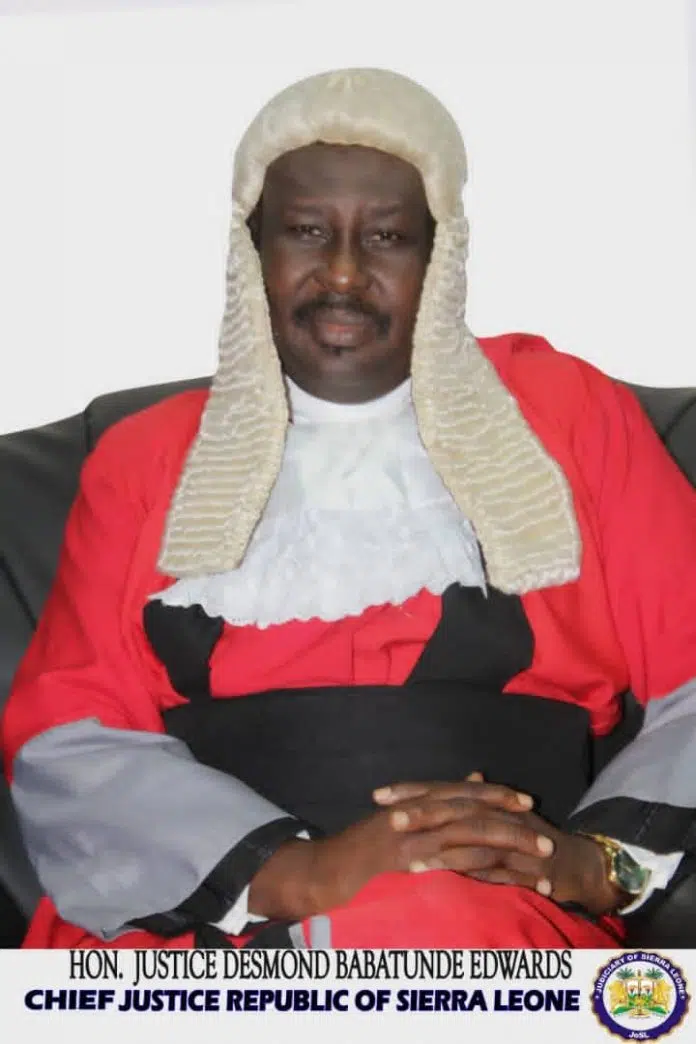
Honourable Chief Justice, His Lordship Justice Desmond Babatunde Edwards

By Amin Kef Sesay

The Sierra Leone Judiciary under the leadership of Chief Justice Babatunde Edwards will this week hold sessions across the country aimed at decongesting our heavily overcrowded prisons.

In which light, it can be recalled that the Sierra Leone Correctional Services Report into the 29 April riot at Pademba Road Correctional Centre found that 400% overcrowding, staff shortages, and the severe COVID-19 restrictions imposed on detainees were key causes.

As prison populations increase, detainees and officers are faced with an unprecedented risk to their health, in overcrowded and unsanitary facilities, which also creates serious security issues and breaches of basic human rights.  As such, the World Health Organization, the UN High Commissioner on Human Rights and the African Commission on Human and People’s Rights have all called on Governments to release detainees so as to reduce overcrowding.

Most affected by congestion in prisons are: Suspects without people to guarantee bail for them, Pregnant women and women with children in detention ,at risk populations, such as elderly prisoners or those with underlying health issues, those held in pre-trial who have not been convicted of any offence, individuals sentenced for minor, low risk offences, particularly those who have six months or less remaining of their sentence to serve

These according to international human rights advocates should immediately be considered for release through use of various measures such as bail, early release, deferred/ suspended sentences or Presidential pardons.

Our courts can only be friendly when the adjudication process is expeditious, devoid of unnecessary expense and ensures that as far as possible, all matters in dispute between parties are completely, effectively and finally determined and the multiplicity of proceedings concerning such matters are avoided.

Liberal minded lawyers and Magistrates and jurists who believe in the quick delivery of justice maintain that the ADR will help a lot in ending the painful excesses of delayed justice delivery, as it will free the courts as it is less expensive, brings unity and confidentiality in the process.

Thus, the judicial system as a matter of urgency should incorporate Alternate Dispute Resolution structures in police stations and courts countrywide in settling some disputes to help decongest the prisons and reduce pressure on the judicial service.

Use of ADR can reduce the workload on the courts and help decongest prisons by over 50%.It is an initiative that must be supported in our quest to ensure more non-custodial sentences, thus making sure that the congestion of our prisons is actually managed. By so doing, serious criminal cases are the ones that the courts will deal with. That will also allow for speedy trials and justice delivery will also be enhanced.

The ADR is nothing new since even in our traditional system, we always want to settle our differences home. It has a long history even in the Bible where it admonishes that we settle matters quickly with one’s adversaries and settle differences even when it is going to court. So it is important for us to adopt ADR into our judicial system.

One big benefit of ADR is that it is quicker and cheaper than going to court. Thus, mediation can be much cheaper than taking legal action in a court which may drag on for so many years and once the process prolongs, more resources are committed to ensure that the issue at hand is followed to its conclusive end.

Another advantage of choosing ADR to court system is that going to court can risk making a bad situation worse.

Making our courts user-friendly, through the use of ADR makes room for alternative dispute resolution as a sure way to settling disputes without delaying. A court with civil jurisdiction and its officers can promote reconciliation, encourage and facilitate the settlement of disputes in an amicable manner between and among persons over whom the court has jurisdiction.

Fact is, even the High Court (Civil Procedure) Rules and the Courts Act prescribe amicable resolution of cases before the courts as the most innovative way by which justice can be done to disputants without delay.