
Home Blog Page 831

NP-SL Ltd’s Premium on Maximizing Customer Care Paying Huge Dividends

National Petroleum Sierra Leone Limited (NP-SL Ltd).jpg

By Amin Kef Sesay

The National Petroleum-Sierra Leone Limited (NP-SL Ltd) is currently a very reliable source of drawing inspiration by indigenes that have big dreams of coming together to establish a company which they may want to see grow exponentially into becoming a towering business entity. Without any gainsaying, there are many useful lessons that aspiring entrepreneurs could learn from NP-SL which would definitely serve as a roadmap to navigate through the business landscape in order to crystallize their dreams into reality.

The company was founded decades ago by thirty-five Sierra Leoneans who were erstwhile employees of the British Petroleum Company which decided to fold up and sell its shares to the Government of Sierra Leone. Based on technical advice, the Government also decided to sell its shares and the 35 former workers bought those shares to set up what became known as the National Petroleum-SL Ltd. It must be highlighted at this juncture that the company is a private-owned business entity and the Government has no hands in it, does not decide how it is operated and grappling with challenges.

One of the underlying factors that have been noted for the meteoric rise of the company could be attributed to the selflessness of its shareholders. These ambitious Sierra Leoneans were so dedicated to the cause of catapulting their “baby” to higher height to such an extent that they put all their best initiatives into play that culminated into the company becoming a formidable force to reckon with.

These fine business initiatives were well implemented to the letter which led to the realization of fruitful dividends. Selflessness, in this context, could mean putting aside ego, working with a collective sense of purpose, brushing aside deceit, greed and ready to give as well as take. This could be the first Lesson.

The next lesson borders around enhancing customer care with the avowed objective of giving optimum satisfaction. The Shareholders and various Management teams harnessed this so well to an extent that they have succeeded in broadening their customer base. As far as they are concerned it is the interests of customers which are paramount and therefore everything must be done to ensure that those interests are given due consideration whenever decisions are taken to push the company forward.

It is in this regard that the shareholders decided to go in for modern calibrated pumping machines which are capable of churning out the right quantity of fuel that a buyer puts in for as well as displaying the price. These machines make fuel transactions become very transparent, thereby giving customers satisfaction and confidence that they are deriving their monies worth.

Within that realm, the Shareholders also thought it prudent to introduce NP Smart Card which is now in vogue. This Smart Card can be used to purchase fuel, petrol and diesel, with ease avoiding the hassle of having to be rushing to the banks to re intermittently withdrawing monies for the purpose of purchasing fuel. The card could be credited with a certain amount of money and whenever transaction transpires the amount utilized is debited. Its greatest advantage is that it avails the holder of the Smart Card the opportunity to programme or budget him or herself to purchase fuel on a periodic basis.

NP Gas is now going like hot cakes on the market. It is a cooker which has been proven to be very effective in terms of performance. Manufactured in different cylinder sizes it has been attested to be environmentally friendly in terms of less gaseous emissions that could pose health risks. NP Gas can be secured at all the leading Filing Stations of the company and its authorized dealers.

With all these attractive offers, there is a lesson that enhancing customer care, is very key to the growth of any business enterprise. Aspiring entrepreneurs could learn from this.

What also has been identified as a good business initiative which the company has mastered so effectively has to do with promoting the country’s Local Content Policy. The intent of this policy is geared towards ensuring that we make proper use of our local resources, human as well as material, in the production chain.  It is against such a backdrop that the company limits employment opportunities to qualified Sierra Leoneans instead of bringing over expatriates to perform tasks that could be better done by indigenes. Knowing that they are employed by an indigenous company such gives the employees the sense of ownership and the extra motivation to give their best to the company.

Another Lesson: Make use of local resources which could be cost effective instead of spending much to use expatriates just for the sake of showing off. Besides, monies, in the forms of salaries and end of service benefits are retained and not taken out of the country. It gives any company operating with such a policy a nationalistic flavour.

To give back to society, in the form of Corporate Social Responsibility, brings with it respectability and integrity. It is very important to be in a position to always assist residents in communities where a business entity operates or to the country as a whole.

NP-SL Ltd has been very consistent in that regard as it manifested when the company donated One Billion Leones to the Government of Sierra Leone as a complementary move to assist the latter in its strides to combat COVID-19. Apart from this, the company has been supporting various humanitarian causes as long as such assistances will cascade to impact meaningfully on the less privileged in society.

From all what have been said so far, it could be seen that NP-SL Ltd has valuable lessons which aspiring entrepreneurs could imbibe and infuse in their activities if fruitful dividends must be realized. Indeed, NP-SL Ltd is really a source of inspiration and a reservoir of good business initiatives.

Chinese Embassy & Medical Teams Provide Essential Medical Supplies

Chinese Ambassador Hu Zhangliang and his wife Mme. Zhou Min

For Treatment of Burn Victims…

As Sierra Leoneans started to mourn for those who lost their lives in the fire disaster at Wellington and condolence messages poured by various entities and individuals, the Chinese Embassy and Chinese Medical Teams in Sierra Leone donated urgently-needed medical supplies to help relieve the pain caused by the fuel tanker explosion.

Chinese medical teams

H.E. Chinese Ambassador Hu Zhangliang and his wife Mme. Zhou Min on the 7th November 2021 visited Connaught Hospital in Freetown and, on behalf of the Chinese Embassy and the Chinese medical teams in Sierra Leone, donated urgently needed medical supplies including 8 hospital beds, 35 folder beds, 10,000 surgical masks, 1,000 KN95 masks, 30 bottles of medical alcohol, 60 bottles of metronidazole injection, 100 bottles of levofloxacin hydrochloride and sodium chloride injection, 300 bottles of ceftriaxone sodium for injection, 2000 pairs surgical gloves, 40 bottles of hand disinfectant and so on.

The donation was meant to support the Sierra Leonean Government and people’s efforts to rescue and relieve the disaster caused by the fuel tanker explosion after a collision with another vehicle on the night of November 5, 2021, in Wellington.

The donation was received by Retired Lt. General Brima Sesay, Director of the National Disaster Management Agency (NDMA), Dr. Vandi, Director of Hospitals and Emergency Service from the Ministry of Health and Sanitation, and Dr. Kabba, Head of Connaught Hospital.

Ambassador Hu expressed deep condolences and sincere sympathies to the victims of the disaster and their families and conveyed the concern and care of the Chinese Government and People.

He wished Sierra Leone, especially those directly affected by the disaster, to be strong and recover from the difficulty soon. Ambassador Hu also said that the Chinese Embassy in Sierra Leone would provide 500 million Leones cash support to NDMA. He said that the China CDC team, the Chinese Military Medical Expert Group, and the Chinese Doctors team in Sierra Leone stand ready to participate in the treatment of the survivors.

Mr. Brima Sesay, Dr. Vandy, Dr. Kabba, and others thanked Ambassador Hu for the timely donation, noting that it demonstrated the long-standing friendship between the two countries and peoples.

Orange-SL Sympathizes with Fire Victims, Providing them Water & Food

A cross section of Orange-Sierra Leone Directors

At Connaught & 34 Military Hospitals…

In the wake of the fire accident that occurred at PMB Wellington, claiming the lives of many and leaving others with injuries, one of the telecommunications service providers, Orange-Sierra Leone, has expressed profound sympathy relating to the said incident.

A cross-section of Orange-Sierra Leone Directors, Senior Management, and staff visited Connaught and 34 Military Hospitals, donating water and food supplies to the victims of the Wellington tanker explosion accident and the brave doctors and medical personnel treating them.

The Acting Chief Executive Officer, Haffie Haffner, shared condolences on behalf of CEO, Aminata Kane Ndiaye. She commended the medical teams for their tireless work, maintaining that since the beginning of COVID-19 in 2019, they have been pushed to the limit but never ceased in their duties.

Orange-Sierra Leone Foundation Director, Jestina, Betts expressed her sadness for the terrible accident and praised the composure and effort of the medical personnel. She informed those present that all throughout this week the Foundation shall be providing supplies to the hospitals for the staff and victims, as their commitment to alleviating some of the pressure after the terrible accident.

It was learned that the telecommunications company will dedicate this week to ensuring their daily presence is felt in the lives of those suffering because of the tanker explosion.

#OSL #OSLF #BecauseWeCare

Water and food supplies
A cross section of Orange-Sierra Leone Directors

Judiciary Conducts One Day Training in Bo for 121 Jurors

Judiciary Conducts One Day Training in Bo for 121 Jurors

The Judiciary of Sierra Leone through the Judicial and Legal Training Institute (JLTI) has on the 3rd November 2021 conducted a one-day orientation programme for one hundred and twenty-one (121) jurors with support from the United Nations Development Program (UNDP),

The jurors that were oriented came from Bo, Kenema, Kailahun, Pujehun, Moyamba and Mattru Jong.

Dilating on the origin and purposes of the jury system, one of the Supreme Court judges, Hon. Justice Alusine Sesay (JSC) said the jury system is an inherited legal system from the United Kingdom. He revealed that jurors are judges as well, but are judges of the facts, noting that their roles in the dispensation of criminal justice cannot be overemphasized.

He said jurors should be upright in ensuring that justice is dispensed without fear or favour.

“Every accused person is required under jury trial to be tried by their peers and the principal role and purpose of jurors is to deliver justice,” said Justice Alusine Sesay.

Hon. Justice Sesay continued that the abolishment of the death penalty poses threats to the jury system, reiterating that notwithstanding the threat, the jury system is still in the law books of Sierra Leone and also functional in other countries.

He said a criminal trial is very delicate, stressful and difficult as it involves the taking of one’s life and therefore processes and procedures should be effectively and accurately followed.

He continued, “one of the processes is oath-taking, after putting the charges to the accused, he will then take the plea, opening addresses, calling of witnesses, closing address by the prosecution.”

The defence, he went on, “will present a no-case submission, if it comes up, the judge has to rule as to whether there is a case or not, if there is a case, it will move to close remarks and summing up before verdict is passed by the jurors.”

He told them to note that the opening statement by the prosecution is not evidence but a means of introducing the case before them.

Speaking on the empanelling of jurors, Hon. Justice Alusine Sesay said the 1991 Constitution makes provision for jurors to be above the age of eighteen years. Apart from the age limit, he said someone who is not of sound mind should not be empanelled.

He said the accused has the right to reject anyone three times without being asked, adding that any further rejection, the accused person is required to give reasons for his or her rejection.

Commenting on ‘summing up,’ Hon. Justice Alusine Sesay said this is the moment judges give their directions and therefore urged them to be attentive whilst serving in that capacity as a juror.

While presenting on several topics including empanelling of jurors, Court of Appeal Judge, Hon. Justice Manfred M. Sesay(JA) said in every community, there are bad and good people and equally so, there are some people who are always committing heinous offences such as murder, treason and robbery with aggravation among others. According to him, these offences require jury services.

He said the criminal justice system is concerned with the protection of the rights of peaceful people. He besought the jurors not to judge accused persons because they refused to say something in court.

He reminded them that the aphorism, “silence means consent” is not applicable in court.

He said for an accused to be guilty, the prosecution must prove its case beyond reasonable doubt and that should be done through convincing evidence presented in court. He said the verdicts given by jurors should be based on the evidence and not on public views shared on social media or discussed in social groups.

Justice Monfred Sesay said jurors have right to cross-examine the accused or a witness in court, adding that same should be done through the foreman.

He went further to say that people whose roles are very vital to the public such as medical doctors, paramount chiefs, mayors, teachers in public schools, bank managers and police officers shouldn’t be empanelled as jurors.

On his part, Hon. Justice Reginald Fynn (JA) said ethics is all about doing what is right and as jurors, they must know what they stand for and should always stand for what is right.

He encouraged them to be role models, noting that they are part of the Judiciary and their key responsibility is to ensure effective justice delivery.

Hon. Justice Fynn told the participants that they are expected to be independent, impartial, confidential and above serve with integrity. He said integrity goes far beyond being honest.

He said if any of these attributes is absent in any juror, the credibility of the Judiciary will be undermined.

He warned them to be careful on the use of social media, stating that issues discussed in the ‘deliberations room’ should not be discussed in any WhatsApp group not even with their husbands or wives and children.

“If you are in a group where a particular matter in which you are serving as a juror are discussed, ask the admin to remove you from the group for the moment and later rejoin,” Justice Fynn admonished.

He called on them to desist from corruption and its related offences, describing it as a triable offence.

In her presentation on the topic, “Administration and Management and Summoning of Jurors, Preparation and Settlement of Jurors’ list”, the Master and Master of the High Court of Sierra Leone, Elaine Thomas-Archibald Esq., said jurors should neither discuss evidence out of court nor out of the deliberation room.

She implored them not to have any association or affiliation that will hinder the delivery of justice or affect the outcomes of the verdict and admonished them to always be in court.

Elaine Thomas-Archibald Esq revealed that the Government of Sierra Leone has provided financial support in ensuring that jurors are effective in their work.

She revealed that a sitting fee or stipend is now appreciable and only jurors that are regular are entitled to those funds.

The Master and Registrar appealed to them to refuse any influence from anyone in the interest of fair justice.

“Let me stress this, any juror who fails to sign the attendance list is not entitled to a fee that is paid at the end of every session,” she said.

The orientation was climaxed with a Mock Session and the same will be replicated in Makeni.

Sierra Leone & United Arab Emirates Agree to Cooperate on Labour Issues

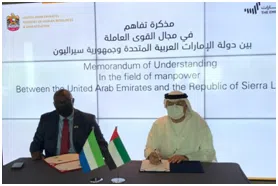
Memorandum of Understanding signed between the Governments of the United Arab Emirates and the Republic of Sierra Leone

A Memorandum of Understanding was signed between the Governments of the United Arab Emirates and the Republic of Sierra Leone that will allow close cooperation between the two countries in the field of manpower.

The MoU aimed to enhance the existing friendly relations through cooperation in the field of manpower to promote mutual benefits and guide an institutional partnership between the two countries. The document demanded the creation of a joint committee to implement, monitor, and evaluate its provisions.

The two parties also agreed to cooperate to ensure sound and effective administration of the contract cycle through relevant technical and human resource development cooperation and regulation of recruitment in accordance with fairness, transparency and mutual benefits.

During the signing ceremony at the EXPO Village in Dubai, UAE Minister of Human Resources and Emiratisation, His Excellency Dr. Abdulrahman Al Awar, said they were happy for the move and added that they were looking forward to practicalizing the details of the MoU.

Sierra Leone’s Ambassador to the UAE, Rashid Sesay, who signed on behalf of the Government of Sierra Leone, said the event was historical as it marked the fruition of a long journey and expressed commitment on their part to implement the provisions of the document.

Shortly after the signing ceremony, the UAE Minister of Human Resources was taken on a conducted tour of the Sierra Leone Pavilion at the EXPO 2020 Dubai. He was accompanied in honor by Ambassador Rashid Sesay.

Health Bill Reaches Legislative Committee Stage for Further Scrutiny

Deputy Minister of Health and Sanitation, Dr. Anthony Sandi

Parliament on the 4th November 2021 intensively debated and committed a Bill entitled: “The Health Professions Act, 2020”, to the Legislative Committee for further scrutiny.

The said Bill is seeking to provide for the establishment of the Allied Health Professions Council, to provide for the regulation including the registration of Allied Health Professions and Allied Health facilities and for other related matters.

Deputy Minister of Health and Sanitation, Dr. Anthony Sandi in presenting the Bill, observed that it was piloted by the previous Government as a private member’s motion, passed into law by Parliament, but the former President did not sign it into law in respect of additional inputs and further deliberations.

He furthered how the intention of the Bill is to effectively monitor the conduct of the profession, regulate the health sector, and inspect medical training institutions to guarantee sustainability.

Chairman of the Parliamentary Health Committee, Hon. Moses B. Jorkie recalled how the Bill was initially piloted as a private member’s bill that was enacted by Parliament, but the former President did not sign it into law given further consultations.

Speaking on the benefits of the Bill, he praised the Minister of Health for making tremendous efforts to improve the medical sector in the country.

Deputy Opposition Whip, Hon. Catherine Zainab Tarawally thanked the Minister for piloting the Bill and spoke on the importance of Community Health Officers (CHOs), whom she said were working for the direct interest of the country.

Chief Whip of Parliament, Hon. Dickson Rogers spoke on the need for the improvement of the health sector, more so for regulating the conduct of CHOs in the country.

Hon. Dr. Abdulai Sesay applauded the Bill and agreed that CHOs and other health officers should be regulated for the benefit of the country.

Recognizing the efforts of the Minister of Health and CHOs, and given the country’s population statistics, Independent MP, Hon. Shaikh M. Sama said per doctor to patients ratio was 1 doctor to 23,000 patients in Sierra Leone and 1 doctor to 10,000 patients in Senegal with a population of 16 million as opposed to Sierra Leone’s 7 million; adding the country has more resources than Senegal.

Hon. Joseph Williams-Lamin spoke on the timeliness and also spoke on its importance for the development of the health sector in the country.

Calling on the House to critically look into the Bill, Hon. Abdul Karim Kamara recalled how it was passed in the last Parliament as a private member’s bill, and that the former President did not sign it into law in light of further consultations.

Hon. Hafiju Maada Kanja commended the Minister for showing commitment to the Bill and said that it would help lab technicians and CHOs to perform their duties with confidence.

Hon. James Ozan Tholley described the Bill as non-controversial and called on MPs to support the Bill, given limited doctors in the country and that CHOs were complementing the work of doctors especially in rural communities.

Hon. Musa Fofanah said CHOs were very important and that Parliament should recognize their work by passing the Bill into law.

Hon. PC Bai Kurr Kanagbaro Sanka III spoke on the need for trained and qualified doctors to support the work of CHOs in rural areas.

Rounding, Leader of the Opposition, Hon. Chernor Bah supported the Bill and spoke on its importance for the development of the health sector in the country.

Concluding, Acting Leader of Government Business, Hon. Bashiru Silikie thanked MPs for their invaluable contributions in support of the Bill which he described as non-controversial. He said the Bill would not only regulate CHOs but health facilities also. He called on the Legislative Committee to do justice to the Bill for it to stand the test of time.

Reducing Inequality

OXFAM 2021 Report
OXFAM 2021 Report

A Commentary By Ranger

The OXFAM 2021 Report on inequality and poverty in Sierra Leone revealed that the richest 1 percent of the population accounts for about 45 percent of national income while the poorest 50 percent accounts for only about 15 percent.

Along which line, the 10th Sustainable Development Goal (SDG10) aims to reduce, by 2030, inequalities based on income, sex, age, disability, sexual orientation, race, class, ethnicity, religion, and opportunity.

Reducing these social and economic inequalities within and among countries is not only key to ensuring that no one is left behind, it is also a necessary condition for sustainable poverty reduction and social cohesion.

Inequality is a major obstacle to sustainable economic growth. It is a major threat to democracy, social cohesion, and peaceful and resilient societies.

Unlike poverty — a characteristic that can be defined at the individual level — inequality is a relational concept that refers to differences between individuals or groups and covers various dimensions:

Economic inequality mainly refers to differences in economic outcomes, such as in income, consumption, or wealth.

Economic inequality also has negative impacts on other types of inequality and health outcomes, such as life expectancy or nutrition status.

Social inequality refers to differences in social outcomes (such as in education or employment), or to differences in social status or position. Social and economic inequalities are strongly connected.

In terms of social inequality, women in rural areas are still up to 3 times more likely to die while giving birth than women living in urban centers. Children born into poverty are almost twice as likely to die before the age of 5 as those from wealthier families.

The concept of political inequality refers to unequal influence over decisions made by political bodies, and the unequal outcomes of those decisions. It is closely related to differences in the distribution of political resources, which can lead to the exclusion of particular groups from participating in political processes.

Environmental inequality is also closely connected to social and economic inequality. It is used to indicate an unequal distribution of environmental risks and hazards (e.g. air or water pollution) and inequitable access to natural resources and other ecosystem services (e.g. land, parks and freshwater) between different social groups.

In many parts of the world, inequality remains a major concern. Many of the countries with the highest levels of income inequality (economic inequality) are in Latin America and Sub-Saharan Africa. While only 1% of the world’s population controls more than 50% of its wealth, 800 million people in the world live in extreme poverty. Over 75% of people in the developing world live in countries where income is more unequally distributed than in the 1990s.

To reduce inequality, we must understand its causes and consequences, which can be complex and deeply rooted in social, economic, political, and environmental systems and resources. The EU’s approach is therefore multifold. They support actions to: empower women and create opportunities for youth and disadvantaged communities, increase economic inclusion and create decent work and higher incomes, enhance social services and ensure access to social protection, facilitate safe migration and mobility and tackle irregular migration, foster pro-poor fiscal policies and develop fair and transparent tax systems, encourage domestic resource mobilization and stimulate public and private sector development

The Research facility on inequalities is an initiative of the European Commission, implemented by the French development agency AFD (Agence française de développement). It seeks to enhance knowledge and understanding of economic and social inequalities to better respond to this complex development challenge.

The EU has participated in the Consultative Group to Assist the Poor, a global initiative to accelerate financial inclusion in partner countries.

In terms of supporting the rights of persons with disabilities, the EU-funded Bridging the Gap project carries out actions to increase the inclusion of persons with disabilities at both the international and country level.

The EU Emergency Trust Fund for Africa, launched in 2015, has allowed the EU and its member countries to work with African partners faster and with more flexibility to foster long-term stability. It addresses the root causes of destabilization, forced displacement and irregular migration across 3 regions of Africa: the Sahel and Lake Chad, the Horn of Africa and the North of Africa.

The reduction of inequality is a clear EU priority: both internally, as enshrined in EU treaties and reflected in the European Pillar of Social Rights, and externally, as the European Consensus on development makes it a priority of EU development cooperation policy to eradicate poverty, tackle discrimination and inequality, and make sure no one is left behind.

Reducing inequality is also rooted in the EU’s commitments to promote and protect human rights, as the principles of non-discrimination and equality are complementing the principles of international human rights law.

Reducing inequality resonates throughout other SDGs; such as ending poverty and hunger (SDG1 and SDG2), good health and wellbeing (SDG3), quality education (SDG4), gender equality (SDG5), clean water and sanitation (SDG6), affordable and clean energy (SDG7), decent work and economic growth (SDG8), resilient infrastructures and inclusive industrialization (SDG9) as well as more inclusive cities (SDG11) and sustainable ecosystems (SDG15).

At COP26…   Sierra Leone Falls within Top 20 of 95 Country Policies for Climate Education

Dr. David Sengeh, Minister of Basic and Senior Secondary Education, informed the world during the COP26

Dr. David Sengeh, the highly commended Minister of Basic and Senior Secondary Education, informed the world during the COP26 that his team at the Ministry is working relentlessly on making education on climate change accessible to all categories of pupils from primary right through secondary.

He made that disclosure in a discussion forum with some climate change leaders and activists, informing them that there has already been the inclusion of climate education and environment on the basic education curriculum, and work is now being advanced to make it present also in the secondary curriculum. He also mentioned that a  focus on climate and gender is a Government priority enhanced by a recent cabinet decision.

The Minister further revealed that his team is currently working on developing a five-year Education Sector Plan (ESP) which starts next year and is aimed at improving education service delivery.

During the discussion, he promised to get to his team as soon as possible to include a section on climate action in the ESP using a comprehensive whole school and society approach thereby enabling the country to commit to climate action through resilience, response, climate justice, and science.

Dr. Sengeh further elaborated on the fact that so many actors (both State and non-state actors) have been called upon to play a role within the sector, as well as going across the country to engage citizens in their roles to climate action. He reiterated that if the action plan must be responsive, it has to include other key players within the governance structure such, as the Ministry of Environment, Commission on Civic Education, Teacher Training institutions, and the Disaster Management Agency among others.

This comes up as Sierra Leone scored within the top 20 of 95 country policies analyzed for climate education ambition. Sierra Leone is 1 of less than 12 countries whose NDC highlights the importance of climate change education & among a handful of nations that positions children & youth as a priority group.

Trade Committee Pays Four-Day Visit to Business Producing Entities

Trade Committee Pays Four-Day Visit to Business Producing Entities

A four-day visitation to business-producing entities was undertaken by the Parliamentary Committee on Trade and Industry, chaired by Hon. Veronica K. Sesay with a view to ascertaining their level of compliance in respect of safety standards, export quality in the cocoa industry, and their successes and challenges in that regard came to an end on the 1st November 2021.

Hon. Veronica K. Sesay speaking on the need for oversight by Parliament said it was their first visit to producing companies to understand their operations in light of quality controls and procedures that were being used for export purposes.

At the Sierra Leone Produce Marketing Company in Kenema, following a visitation to the cocoa storage facilities, the Regional Manager of SLPMC, Ibrahim Turay spoke about their roles and responsibilities and their successes and challenges; adding their trucks were no longer working, save for one, lack of access to trading capital to buy cocoa and to run community stores were some of the challenges affecting their operations.

On their successes, he said SLPMC had received its Organic Certificate from ECOCERT and that the Company was exporting cocoa to the EU market from whom they were receiving additional premium payment, part of which was being shared among farmers.

At Taha Amin Skaikay Cocoa and Coffee Stores, its CEO, Amin Skaikay spoke about his role in the marketing sector and thanked MPs for the visit; adding what they had done in respect of corporate social responsibility.

At the Cocoa and Coffee Central Warehouse Mass Factory, its CEO, Mohamed Nassa gave an overview of their operations to MPs in respect of the juice factory, water and cocoa manufacturing, and production activities in that part of the country including their successes and challenges during the course of their operations.

At the Produce Monitoring Board, its Regional Manager, Mohamed Kallon spoke about the good relationship that had existed between the Board and the Produce Marketing Companies in the Region and informed MPs that the companies were in compliance with the established rules and regulations in the trading sector. He also said that the Produce Monitoring Board had established community block farms to enhance agriculture productivity and had also created demonstration sites for farmers in rural areas.

The Committee also visited Saad Group, Ngolaibu Cocoa Farmers Association, and Punjab Trading Center and inspected their facilities, and discussed issues including safety and sanitation.

To Cascade Knowledge Gained… IOM Concludes Training of Trainers Workshop on Migration for Teachers in Bo

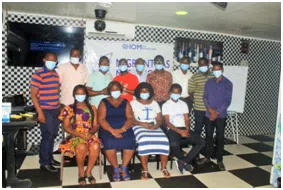
IOM Concludes Training of Trainers Workshop on Migration for Teachers in Bo

By Alfred Fornah

A Training of Trainers (TOT) Workshop for teachers on Migration was rolled out from the 26th to the 28th October 2021 by the International Organization for Migration (IOM) in Bo, Southern Sierra Leone.

Aimed at building the capacity of teachers to understand migration issues the training will be followed by a Quiz Competition on migration for four senior secondary schools in Bo District.

It was the understanding that the teachers who attended the TOT will provide mentorship for pupils that will represent their schools in the first phase of the Inter-Secondary School Quiz Competition on Migration scheduled to take place this month.

The teachers were also encouraged to raise awareness about the dangers of irregular migration and safe migration pathways among pupils in their respective schools.

“Education without pathways may increase the propensity for irregular migration. Therefore, it is important for young students to understand the link between education, development, and migration; that if well-managed, migration will be beneficial for young people and communities. This is what we want to raise awareness about through this activity by collaborating with teachers,” said Brima Bendu, National Focal Point, Migrant as Messengers Project at IOM Sierra Leone.

Education has always been one of the cornerstones of development. In the context of Migration, it provides skills to facilitate movement. Also, schools can play an important role in addressing irregular migration, especially among school pupils.

Taha Conteh who represented the Ahmadiyya Muslim Senior Secondary School in the training noted the importance of the workshop and affirmed his commitment to the initiative. “The exercise is very useful, I have learned a lot of things regarding safe and regular migration,” Conteh said. “Migration is good for both the host country and the country of destination if it is done orderly,” he added.

Fatmata Koroma is another training participant from the Queen of the Rosary School in Bo. For her, the training provided a broad insight into migration dynamics in West Africa, and the challenges young people faced when they embark on ‘backway’ journeys to Europe. “I have learned a lot about migration, and knowledge gained will be cascaded to pupils in our school,” she said.

The training was made possible through a collaboration between the Migrant as Messengers Project funded by the Foreign Ministry of the Netherlands and the IOM’s Technical Education and Vocational Training Project supported by the Government of Japan.

The School engagement initiative is being delivered by IOM in collaboration with the West Africa Youth Lead Advocacy Network, Peace Building, Education, Health Science, Governance and Democracy, Socio-Economic Development (WAYNPEED), and the Pleasant Children’s Foundation.