
Home Blog Page 835

Asking: “Have the Heavens Fallen?”   Media Guru Looks at One Year after Repeal of Criminal & Seditious Libel Laws

By: Francis Sowa, Lecturer and Media Freedom Advocate

 It is exactly one year since President Julius Maada Bio officially assented to the Public Order (Amendment Act) 2020. That landmark ceremony happened on the 28th October, 2020 after several years of advocacy for the repeal of the law. It followed another historic day in Parliament when on the 23rd July 2020, the House unanimously repealed the criminal and seditious libel law provisions. The giant that stood on the neck of the media fraternity and industry was finally killed. The House on the same day passed into law the bill entitled Independent Media Commission Act, 2020. On that day, journalists almost became MPs- scrutinizing the Bills together with the actual Honourable Members.

Tears of joy were literarily shed. Thanks again to President Julius Maada Bio, Parliament, Minister of Information and Communication, Mohamed Rahman Swaray, Sierra Leone Association of Journalists (SLAJ), Independent Media Commission (IMC), United Development Programme (UNDP), National Endowment for Democracy (NED), Media Foundation for West Africa (MFWA), Media Reform Coordinating Group (MRCG) and hosts of Civil Society Organisations for the different roles they played during the process.

Many SLAJ Presidents fought for it, but it happened under the tenure of somebody I call one of the ‘blessed and luckiest’ men on earth- Ahmed Sahid Nasralla (De Monk). He scored a penalty with an almost empty goal after a not too easy dribbling by former Presidents Umaru Fofana, Kelvin Lewis and others. Even ‘VAR’ could not contest the goal; the referee (Parliament) made no clear and obvious error in awarding the penalty and allowing the goal. The game was over. The celebration ended. It was now about life and practice of journalism after the historic repeal.

The concern

The major hue and cry before the repeal was that there would be reckless journalism thereafter; metaphorically the ‘heavens would fall’ after the repeal. Those who held that view about the media in Sierra Leone (and I must say that there were many) sounded like what Former British Prime Minister, Tony Blair, said about the British media in one of his farewell speeches on 12 June 2007: “The fear of missing out means today’s media more than ever before, hunts in a pack… it is like a feral beast, just tearing people and reputations to bits…. The final consequence of all this is that it is rare today to find balance in the media.” In fact to ma ke matters worse, Blair in the same speech referred to long-gone British Prime Minister, Stanley Baldwin, as having said: ‘Power without responsibility being the prerogative of the harlot through the ages.’ Those who shared those views cannot be out rightly dismissed; they may have legitimate concerns.

 But what has happened in the last one year?

The media institutions have continued to practice their trade/professions in an encouraging manner. I cannot say that the media institutions have performed excellently in the last one year. We have not got 100% excellent publications and broadcasts. It does not happen anywhere in the world. But there is an indication that a good number of them are moving towards the path of professionalism.

There have certainly been stories that do not conform to ethical standards. However, SLAJ and the IMC are taking actions to improve the quality of journalism. The IMC Complaints Committee continues to look at the breaches of the Media Code of Practice while SLAJ has revamped its Disciplinary Committee to enforce its Code of Ethics.

What has not happened, but should happen?

The repeal of the law is expected to create an enabling environment for media practitioners and civil society activists to hold government accountable and promote good democratic governance. The repeal is supposed to open up the media space by attracting investments in journalism. That is yet to fully happen, but there are signs that the sector will continue to attract the necessary investments. President Bio promised at the signing ceremony that “My Government will also support an investment conference on the media with a view to supporting enhanced private sector investments in the media.” That is yet to happen.

But steps are being taken to organise the conference as the MRCG which I lead is part of both the Steering and Technical Committees of the conference. The media need private sector investments. There is no way the media can perform better in the post libel era with the kind of infrastructure, equipment and financial resources they have currently. International organisations like the United Nations offices, the British High Commission, United States Embassy and Irish Aid in Sierra Leone should not just stop at calling for media freedom, but should also support capacity building for institutions and journalists.

The IMC, the media regulator, has not been given the needed resources to roll out its programmes after the post repeal. The Commission lacks the necessary pieces of equipment, effective modern media monitoring tools and the mobility (vehicles and motorbikes), offices and the required number of staff to do its work. The government and international organizations must provide the technical, logistical and financial supports to the Commission.

There is also a need to look at and review the civil libel provisions in the Defamation Ordinance, Act No. 32 of 1961 to ensure that it provides adequate defenses that protect media freedom.

What should the media do?

As media practitioners, we should turn the searchlight to ourselves; improve on the quality of our work; be professional; and admit and correct mistakes when they occur. Let us remember the words of Prof. Timothy Garton Ash of the Reuters Institute as we do our work.  He said: ”…I believe that journalists should continue to see it as an important part of their mission to ‘speak truth to power.’ But when journalism itself has become such a power, it also needs truth spoken to it.” (The Guardian, November 16, 2006). This is where self- regulation comes in.

In conclusion, let our media breathe. Open up the media space and provide the necessary support. No doubt certain things may go wrong along the way, but the heavens will not fall. Let us continue to promote media freedom and responsible practice anchored on self-regulation. Happy one year anniversary as the official signing of the Public Order (Amendment) Act of 2020 took place on the 28th October, 2020.

In Kenema…   Rokel Bank MD Explicates the Algorithm of Success to Information and Management Students

By Amin Kef Sesay

The scene is set at the Kenema Information, Commutation Technology and Management College (KICTAMC) and the main cast is a crowd of students, academics and extras who are residents of Bockarie Bay Street in Simbeck Community of Kenema.

The key protagonist is Sierra Leone’s highly acclaimed motivational speaker, preacher, consummate banker and Managing Director of the Rokel Commercial Bank, Dr Walton Ekundayoh Gilpin.  The erudite MD was in Kenema to teach and preach what a student of the KICTAMC aptly described as the “Algorithm of Success.” But Gilpin himself had not titled his presentation as such. Rather, he had simplified his motivational lecture with the title; “Creating Your Tomorrow” – an attempt to provide penultimate information on clear pathways one can follow to become successful and meaningful citizens of Sierra Leone.

Elegantly cladded in jeans suit with dark glasses, Gilpin instantly created the impression of a man on a mission – a mission to change mindsets and behavioral patterns of his compatriots. He took the mic to explain how our attitudes can determine our altitudes – or how we behave and interact with our immediate surroundings can influence how far we go in life. Gilpin told the students they own the key to their own success and must therefore be bold and brave and taking risks.

“The future depends on how you want it to be but a positive mindset determines and help you master your own destiny…I went through my own steps in life to be where I am today,” he said.

For Gilpin, “The only disability in life is a bad attitude but dealing with a bad attitude is the biggest challenge”.

Diversifying your interests and ensuring you nurture self-control and remove irrelevancies to avoid what he described as “systematic abandonment” was among the many tips he concluded his talk on, amidst uncontrollable applause from a vividly excited student audience.

The Kenema lecture follows another motivational speaking session to Secondary School students organized by the Empower Girls Advocacy Group at the Christian in Action Church in Freetown.

Gilpin’s motivational speaking sessions in Freetown and around the country have also provided a ready-made platform for the aggressive marketing program of the Rokel Commercial Bank.

EU Election Follow-Up Mission Disappointed Over Government’s Non-Compliance

By Foday Moriba Conteh

During a Press Conference held on Friday 29thOctober 2021at the New Brookfields Hotel in Freetown, the Chief of Mission, Member of the European Parliament, who also doubles as the Head of the EU Election Follow-up Mission, Hon. Norbert Neuser, revealed that they are in the country to undertake a technical assessment of the state of implementation of the 29 recommendations put forward by the EU Election Observation Mission way back in 2018 adding how the effective implementation of those recommendations would enhance the credibility, inclusiveness and transparency of Sierra Leone’s 2023 elections.

He said the purpose of their mission is to engage with various stakeholders including the Government, Civil Society Organizations, Political Parties, Electoral Management and Regulatory bodies in order to gather and collate their views on the on-going electoral reform processes further maintaining that they are not on an election observation mission also disclosing how they did not observe the recent bye-elections, nor are they in the country to observe the forthcoming ones to be conducted in two weeks’ time.

He pointed out that in order to implement the recommendations, 9 constitutional amendments would be needed but said none of them would require a referendum but he, however, underscored that 21 legislative changes would be necessary and that some of the recommendations could be addressed through administrative policies.

“An overall recommendation in 2018 was that the new Parliament and Government should resume the Constitutional Review Process. However, three years after, the need to reactivate the Constitutional Review process still remains,” he emphasized.

He said they are aware that a White Paper is eagerly awaited, but pinpointed that Constitutional change requires cross party consensus and compromise in order for such to be successful and durable adding how public participation is also needed.

Hon. Norbert Neuser suggested that timely disclosure of the White Paper is a precondition for an effective, transparent and accountable process and for re-engaging all stakeholders.

He noted that there is a clear consensus on many issues including that there should be a fixed date for future elections and suggesting that the issue is to turn the discussion into law in time for the elections in 2023.

“The Mission has been told that there is a significant decrease in trust in the essential bodies which play integral roles in the forthcoming elections. These include the Judiciary, NEC, PPRC and the Police. Our findings are that these institutions’ reputations are less trusted than is needed. But further, our assessment is that there are real grounds for concern in the ways in which these bodies have administered recent bye-elections,” he stated.

He maintained that in 2018, the EU Election Observation Mission recommended the improvement of results and reconciliation forms ,the timely publication of detailed tally procedures and the publication of disaggregated results by polling stations of which he said the Election Follow-up Mission is encouraging the National Electoral Commission to engage with all electoral stakeholders to address those issues with a view to restore confidence in the electoral management bodies and strengthen both the transparency and integrity of the electoral process.

He revealed that the Mid-Term Census is unprecedented; the stated reason for it is highly contested and the use of an optional census to provide data which might be used to change electoral boundaries shortly before an election is not conducive to the political atmosphere or good electoral practice, adding that the Mission repeats its recommendation that the voter register should be automatically produced from the civil register, which would save money and time. “We have not seen evidence that sufficient progress has been made on this important issue,” he lamented.

“The Mission welcomes that a Bill was formally introduced in Parliament this month that has the stated aim of increasing women’s participation in public and political life. However, the consultation process in preparing the draft was lacking. We share the hopes of many in Sierra Leone that a meaningful consultation process and clear re-drafting of the Bill will, in combination with political parties own internal policies, result in at least 30% of MPs being women in 2023,” he appreciated and expressed hope.

He ended by stating that while there remain several issues of concern; there is still time remaining to address many of those issues and that they recommend that the powers in the Constitution be exercised with restraint and in the spirit of democratic compromise, not by “winner takes all”.

NP-SL Ltd is a Testament of Exemplary & Sober Indigenous Customer-Friendly Investment

By Amin Kef Sesay

The leading indigenous oriented petroleum marketing company in the country and beyond, the National Petroleum Sierra Leone Limited (NP-SL Ltd) is progressively expanding its operations as evident in the recent commissioning of new Filling Stations in different parts of the country.

Being a dependable or reliable business entity that has over the years demonstrated shrewdness and efficiency in the importation and marketing of various petroleum products among which we have diesel, petrol, gas, lubricants like Castrol Oil as well as other products, NP-SL Ltd has become a household name and many have reposed confidence in it for its timeliness and orderliness.

It is against such a backdrop that, on a frequent basis, certain savvy business individuals do not hesitate to partner or collaborate with NP-SL Ltd to open up Filling Stations in different parts of the country, places where hitherto it was extremely difficult to access those petroleum products. Such collaborations are bordered on mutual trust and the objective of not only maximizing profits but to meaningfully contribute to overall national development.

When cognizance is taken of the fact that the opening of new Filling Stations provides employment opportunities for the jobless then one comes to the realization that NP-SL Ltd is indeed making a meaningful contribution in the reduction of unemployment.

Looking at it from the perspective that youth unemployment is a real social malaise that most times leads to high crime rates then the fantastic moves made by the company in the area of creating job opportunities are indeed worthy to be celebrated. To take it a little bit further, creating job opportunities is another way of reducing poverty in the country.

One way in which the Government derives revenue is through internal mobilization of funds and one channel is via the imposition of various forms of tax. Business entities are bound by law to pay taxes to the National Revenue Authority (NRA). Filling Stations fall within that bracket and by extension they are large tax payers. Those taxes paid are in return utilized by Government to provide basic amenities for the populace and fund other development projects.

NP-SL Ltd has etched its name in the sands of time as a company which does not compromise customer care and it is in that regard, long time ago, the company bagged the prestigious accolade of being 1st for Customer Care.

Management of the company is of the firm conviction that giving utmost satisfaction to its numerous customers right across the country is very imperative. The company has in all its Filling Stations calibrated pumping machines which pump the exact amount of fuel requested for and display the price at the same time.

It is on record that the company markets cookers which are known as NP Gas, manufactured in different cylinder sizes. They are environmentally friendly, easy to refill with gas that can be secured at the company’s Filling Stations where NP Gas could also be accessed.

To simplify transactions, the company introduced the NP Smart Card which could be used to purchase fuel without using physical cash. As long as the NP Smart Card has credit in it such could be used to buy fuel at certain Filling Stations. It is a quick, safe and a secured way of conducting transactions which many have lauded the company for.

NP-SL Ltd is one company that long ago made it a laid down policy of predominantly employing indigenes everywhere it is operating. This policy is in sync with the country’s Local Content Policy which the company continues to uphold.

Note that the company is also operating in neighbouring Guinea, Liberia, Ivory Coast and The Gambia.

It can be safely anchored that indeed NP-SL Ltd’s expansionist drive is largely driven by competent and efficient Management initiatives. One thing which is indisputably incontestable is the fact that the company is making steady progress within the petroleum landscape of the country.

As President Adama Barrow Commends… Pavi Fort Undertakes 50 km Road Construction Project in The Gambia

By Amin Kef Sesay

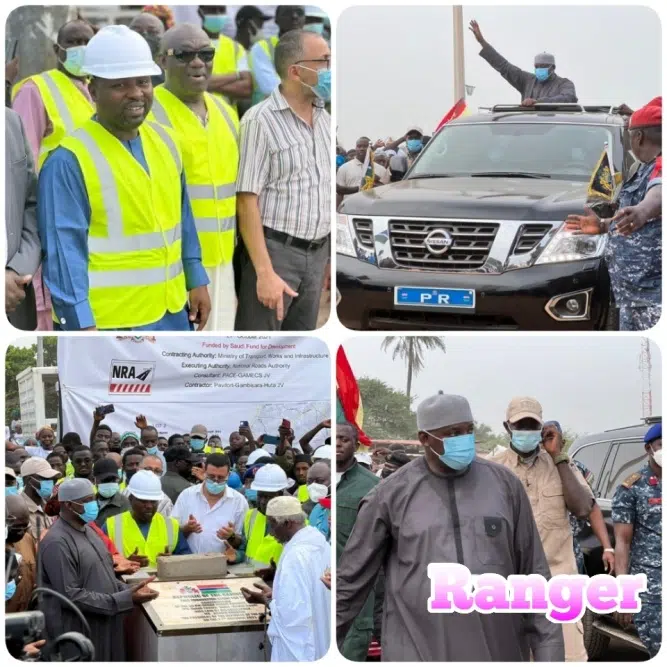
The Chairman and Chief Executive Officer of Pavi Fort Road Construction Company, Alimu Sanu Barrie, was on the 28th October 2021 sitting comfortable among other contractors ,who inter alia won a road construction contract, in Banjul The Gambia, to witness an important watershed in the infrastructural development of the West African State, that which has to do with the laying of the foundation stone by President Adama Barrow for the construction of a 50 kilometre OIC Urban Roads Project.

Indeed, it was a brighter and carnival-like day in Greater Banjul as hundreds and hundreds of Gambians, with some foreigners among them, converged at the venue in Brufut, within the Greater Banjul Area and the West Coast Region, to see history in the making. People from different walks of life were in a jubilant mood, singing and dancing to traditional drumming for what many considered as a positive move by the Barrow-led Government although there were certain dissenting expressed opinions on Social Media that the roads project is not a top national priority in comparison to other felt needs. However, in any democratic political dispensation such is obvious as all cannot toe the same line at the same time.

During the commencement of the program, which was moderated by the Minister of Transport, Bai Lamin Jobbe, representatives of the host community, Brufut, welcomed President Barrow, the Vice President and all to their community to witness another important occasion which has to do with development. They endorsed their unflinching support for the project and pledged to do all within their reach to see its successful implementation up to completion stage.

The Chief Executive Officer of the Organization of Islamic Cooperation (OIC) Secretariat in The Gambia, Yankuba Dibba, in his statement disclosed how the Secretariat was established to mobilize resources, identify and implement key infrastructural projects in preparation of  the 14th Summit of Heads of State and Government  of the OIC. “However, due to the COVID-19 outbreak and certain bureaucratic red tapism it was postponed to April 2022,” he further revealed adding how they are delighted to have weathered  the storm disclosing that the forthcoming OIC Summit to be held in 2022 will be the 15th Summit .

Yankuba Dibba said the Secretariat will leave no stone unturned in order to make The Gambia proud. He said due to the proliferation of vehicles and expansion in human activities there is now the need for an overhaul of the country’s infrastructure to match up with contemporary trends.

“Though this road construction will definitely pose inconveniences for some yet I am craving for maximum cooperation with the contractors because at the end of the day after completion traffic congestion will be considerably reduced,” the OIC Secretariat CEO assured.

Transport Minister of The Gambia, Bai Lamin Jobbe, informed the audience that the urban roads project is a long-awaited one adding how it neatly falls under the Government’s National Development Plan.  “This project will be implemented against two backdrops, one which has to do with enhancing infrastructural development and as well in preparation for the hosting of the OIC Conference next year,” he told a jubilant crowd that responded with deafening applauses adding that the roads will be constructed into two carriages each with solar-powered streetlights, proper drainages, a parking lot and other facilities.

“When completed the benefits will be immense which include reducing the travelling time, minimize carbon monoxide emissions and bring varying economic benefits to the nation among others,” he stated greeted by a thunderous chanting  by the crowd, “We want Barrow, We don’t need old Pa” followed by  a cacophony  of cheering.

The Minister appealed for all to work closely with the contractors for the timely and qualitative completion of the road project. He then extended thanks to the Saudi Development Fund for funding the project and residents of the community where the project is implemented for their support and cooperation.

In his keynote address, President of The Gambia, Adama Barrow said it is with great pleasure and hope for a better Gambia for all that he is joining them to lay the foundation stone for a fifty-kilometre Urban Roads Project in the West Coast Region and Kanifing Municipality. He welcomed all to the auspicious occasion, furthering how it is “another major milestone in the development process of the necessary infrastructure for the successful hosting of the OIC Summit in 2022”.

The President told the  jubilant crowd that the development of,  “these busy roads will solve the difficulties of schoolchildren, patients, business persons and the numerous commuters who struggle daily to board the few vehicles that ply these congested areas”.

He continued that, “Through such projects, access to schools, hospitals and other social amenities and services will be enhanced gradually throughout the country.” The President intimated that the 50KM road will have 45% asphalt pavement and 5% concrete pavement. He added that when completed, the project will vitally expand the country’s urban road network to accommodate the increasing volume of road traffic, address the need for more effective road safety measures and set up an efficient drainage system within the Greater Banjul Area.

President Barrow disclosed that the project duration is 14 months and that twenty (20) roads will be constructed which will constitute the 50km Roads Project.

The President underscored that t is obvious that the construction of good roads, where they are needed most, can boost commercial engagements and improve the image of urban settings.

He congratulated the contractors for winning the contract and the OIC Secretariat for the efforts they are making to host a successful summit come 2022.

Highpoint of the occasion was the President laying the Foundation Stone.

It will be recalled that two contractors won the bidding competition for the implementation of the 50KM road project. They are SSTP-CSE –Al Fahd Company JV for Lot1 and Pavi Fort –Gambisara-Huta JV for Lot 2. The latter is a Sierra Leonean Company with reputable road construction credentials.

In an exclusive interview by the author, Amin Kef, aka Ranger, who is the Publisher and Managing Editor of The Calabash Newspaper, who specifically travelled to The Gambia to primarily to witness the event, the Chairman and Chief Executive Officer of Pavi Fort Roads Construction Company, Alimu Sanu Barrie, stated that the company is in top gear to deliver on its mandate. According to him the company’s equipment and workforce are well positioned and ready to go into full action.

He revealed that because of the 14 months duration of the Project, Pavi Fort commenced light work before the laying of the foundation stone ceremony was held which, he said, shows the level of preparedness and commitment to fulfill its obligation.  “This is a litmus test and I as well as my team are totally committed to deliver qualitative works within the stipulated completion date,” he assured adding that establishing a flourishing operation of the company in the ECOWAS sub-region is effectively in progress, with business activities currently going on in Sierra Leone, Gambia and Guinea.

He disclosed that the company is also fully registered in Liberia and Ghana and will continue to explore investment opportunities in the region

Alimu Sanu Barrie also revealed that he  has over twenty-five years of entrepreneurial experience in the execution of large-scale development projects adding how the company has of late  invested a lot  in the areas of procuring  heavy-duty machinery, Logistics management, estate development, Quarrying, building and road construction.

“It is high time to make the whole world know that Sierra Leoneans can compete in roads construction at the sub-regional as well as the global level and that is exactly what Pavi Fort has proven in winning a roads project contract in The Gambia and we are proud of flying high the Green, White and Blue flag of Sierra Leone,” he concluded.

NRA Concludes 3-Days Training Program for Large Taxpayers on Use of the ECR

By Theresa Kef Sesay

In order to broaden the knowledge of taxpayers on the Electronic Cash Register (ECR) System, as a fiscal invoicing system, which includes hardware, a certified Invoicing System (CIS), a sales data controller (SDC) and software for receiving, recording, analyzing, formatting, transmitting, storing, and monitoring fiscal data, the National Revenue Authority (NRA) recently engaged stakeholders in a three days training program.

The NRA Assistant Commissioner of Design and Monitoring, David A. Lansana, noted that the Electronic Cash Register (ECR) is highly important and has been useful to many since March, with 5000 units available and over on the market.

He went on to inform taxpayers  about the importance of the machine, which, according to him,  is used to track sales at all times, provide quick access to goods and services within two days and has resulted in a rapid shift from manual to automated processes.

Despite the expression of certain apprehensions, he claimed that ECR machines will not cost taxpayers a penny disclosing that the NRA is responsible for maintenance, regardless of location or cost.

Fatmata Kargbo, Releasing Officer, Bollore Transport and Logistics, stated they like the ECR System since it simplifies their work and automatically deducts all taxes once the amount is entered into the system. She went on to emphasize that confidentiality is a primary priority and that no one can simply hack the system, particularly with codes or passwords.
She advised everyone to strive to get an ECR machine because it makes their work much easier and more reliable.

The ECR machine, according to Mohamed Kallon, is responsible for the fiscal receipt, which includes the NRA logo, QR code, taxpayer name, and TIN number, as well as the SDC signature.

He, however, stated that according to Section 58 of the ECR Regulation 2021, the taxpayer is required to install, implement, and operate the Electronic Cash Register in accordance with that regulation and others.  Mohamed Kallon also stated that taxpayers are required by law to use the NRA GST machine for all transactions, as stated in the 2020 Finance Act Section 34.

That system, he said,  is in charge of automating all GST taxes, which means moving all GST receipts through an ECR machine disclosing how it cannot be used by two different businesses at the same time.

During the three days of training for taxpayers to know more about the regulations of the ECR system, NRA trained over 50 taxpayers on a weekly basis for them to know how to operate the ECR system monthly.

Taxpayers were reassured that the system will not impose more burden on them and will minimize compliance costs.

JFK & Partners Call on Chief Electoral Commissioner Rescue the Impugned Image of NEC

By Amin Kef Sesay

In a letter dated the 25th October 2021 by Joseph Fitzgerald Kamara, Esq JFK & Partners addressed to Mohammed K. Konneh Chief Electoral Commissioner of the National Electoral Commission (NEC) copying the Attorney-General & Minister of Justice and the Secretary General of the All People’s Congress (APC) Party, Amb Dr. Osman Foday Yansaneh it was stated that they have been consulted and their services retained by the Secretary-General, Amb. Dr Osman Foday Yansaneh, on behalf of the All People’s Congress to challenge and petition the declared results of the Local Council Elections, for Ward 155, Constituency 046 in the Koinadugu District.

It was further highlighted that the Chief Electoral Commissioner may recall that on the 2nd October 2021, pursuant to Section 33 of the Constitution of Sierra Leone, Act No. 6 of 1991, the National Electoral Commission (“NEC”), conducted Local Council elections for Ward 155, Constituency 046, aforesaid.

JFK and Partners stated that their instructions are that the tallying process for the election for Ward 155 commenced peacefully, all the entries were verified without incident, until it came to the last entry for Station one (1) MCA Primary School, Fumbakoro, where it was detected that the NEC ICT team made an inaccurate /and or fraudulent entry, inconsistent with the particulars on NEC’s Results Reconciliation Form (“RRF”).

It was pointed out that the inaccurate entry was in respect of the total number of votes cast in favour of Kalie Thoronka (“SLPP”). Stated was that instead of entering 049, as recorded in the RRF Form, 149 was purportedly entered intentionally, to give numerical advantage to the said Kalie Thoronka  (“SLPP”), thereby resulting in an extra 100 votes in his favor.

The Lawyers stated that quite astonishingly, on the 5th October 2021, the Acting Regional Commissioner North, Edmond Alpha, declared Kalie Thoronka, of the SLPP, winner of the Ward 155 election.

It continued that not surprisingly, the APC Accredited Agents, Dr. Richard Konteh and Dr. Kaifallah Marrah, present at the Wellington Tallying Center, raised objections to the discrepancy on the RRF Forms and NEC’s entry and NEC officials conducting the tallying processes were promptly notified.

According to JFK & Partners, duplicate copies of the RRFs which had the same figures as the original copies in the custody of NEC, were produced for verification and examination.

They furthered that a formal demand was made to the NEC officials, insisting that the inaccurate entries be reversed and properly entered, to reflect the true figures contained in the RRFs.

However, they stated, the protestation by the APC accredited agents and the production of duplicate RRFs to back the claim of inaccurate entries, fell on deaf ears, as the Acting Commissioner North,  Edmond Alpha, dismissed and overrule the objections, and suggested that complaints be forwarded to the National Electoral Commission.

“You will further recall, that the Secretary-General of the APC, Amb. Dr. Alhaji Foday Yansaneh aforesaid, wrote a letter to your good-self, vehemently protesting against the provisional results, and that the NEC ICT team, manipulated and entered the wrong figures, giving undue advantage to the SLPP candidate,” JFK & Partners reminded but said regrettably, notwithstanding the letter of the Secretary-General and protestations from the APC, he, Mohamed K. Konneh, Chief Electoral Commissioner, proceeded to announce the final results naming the SLPP candidate, Kallie Thoronka, as the winner of the 2nd October 2021, Bye election for the vacant Council seat in Ward 155, Koinadugu District, without any further probe.

According to them, their  Petition is anchored on the grounds that the conduct of the 2021 Local Council Bye elections, Ward 155, Constituency 046, Koinadugu District, violated the principles of a free and fair election, as well as, the electoral processes, electoral laws and regulations provided for in the Public Elections Act, 2012, notably the improper practice of NEC Electoral staff, to deliberately alter the entry on the RRF Form, by converting 049 to 149.

JFK & Partners say in the light of the above, they urge that NEC do the needful and publish in the Sierra Leone Gazette, the accurate results of 2021 Local Council Bye elections, Ward 155, Constituency 046, Koinadugu District, as required by law, and being cognizant of Sections 139 and 140 of the Public Elections Act 2012.

They continued by saying needless to say, timing is of the essence, as the reputational risk facing the National Electoral Commission, is on the brink.

JFK & Partners concluded that the onus is on the shoulders of Mohammed Konneh, to rescue the impugned image and preserve the inalienable right of the people, to choose their leaders.

President Bio’s Re-definition of The Role of Universities as Development Partners

By Amin Kef Sesay

What in essence President Bio told the Court of the new Eastern Technical College in Kenema city last weekend was that in the 21st century, our Universities must shift to playing a new role as development partners in order to legitimize their existence, increase their relevance, boost their links to society, the economy and leverage development.

In other words, universities must move from status symbols to instruments of national development.

In its link to development, our universities should play a partnership role that is advisory, involving researching and disseminating information to Government and society and producing graduates with relevant skills, knowledge and the right disposition to make meaningful contributions to society and the economy.

This redefined role requires our universities and colleges to perform some specific functions.

  1. Identifying societal needs and aspirations – Our universities must be able to assess and identify the political, economic and social needs and aspirations of the societies in which they are embedded. Such information should be used for three main purposes: (1) designing academic courses and programs; (2) conducting empirical research; (3) sharing information with Government and other development institutions.

Once the process of assessment has been appropriately performed, certain academic programs and courses should be eliminated as irrelevant and new ones developed to replace them.

In accordance with this function, academic courses and programs imported from outside must be carefully tweaked and adapted into an African social, political and economic environment. Along which line, this is what President Bio said in Kenema:

In November 2020, at the Milton Margai College of Education and Technology, I argued that by investing in workforce development and equipping our labour force with the requisite skillset, we could rapidly unlock the great potential of this nation.

I have also argued that practice-oriented technical training and entrepreneurship are immeasurably more valuable and relevant to national development than a classical education as we have known it since 1827.

The “Pappay you borbordaeya” culture where university graduates scramble for scanty public sector jobs must be replaced with a new “can-do” entrepreneurial and innovation mindset.  That is the mindset that will create jobs, create wealth, and grow the economy of this nation. We need innovators, highly trained teachers, nurses and healthcare personnel, skilled technicians, and persons with skill sets who will transform the economy of this nation.

At this new University, I am informed that there will be a Faculty of Business Enterprise and Entrepreneurship Studies; a Faculty of Vocational and Skills Development Studies; a Faculty of Pure and Applied Sciences; a Faculty of Engineering and Innovation; a Faculty of Development Agriculture and Natural Resource Management, a Faculty of Health Sciences and Disaster Management Studies, and last and definitely not least, a Faculty of Education.

The scope covers translational sciences and innovation, healthcare service training and delivery, engineering, agriculture and agribusiness, natural resource management, disaster management, entrepreneurship, and teacher training and development.

This is education that develops human capital, creates and drives a new kind of knowledge-based economy, and nurtures opportunity and creates private sector jobs. Ours is a growing economy with great potential and only well-trained people can drive that development. In a week, I will be at COP26 to discuss how we can contend with climate change, build resilience, and create a green economy. That new economy requires new skill sets. Those skill sets can be quickly developed within a technical university.

100 Years of Achievements of the Communist Party of China – Xi Jinping Thought on Diplomacy -Interview with Chinese Ambassador to Sierra Leone – H. E. Hu Zhangliang

By Amin Kef Sesay

Chinese Ambassador to Sierra Leone, H. E. Hu Zhangliang in the fourth episode of his erudite presentation on the centenary of the Communist Party of China (CPC), elaborated on the impact of Xi Jinping  Thought on Diplomacy on the development of China and the world.

Ambassador Hu stated that since the 18th National Congress of the CPC, the CPC Central Committee, with General Secretary Xi Jinping at the core, has launched a series of major theoretical and practical innovations in China’s diplomatic work, and has thus formed the Xi Jinping Thought on Diplomacy.

This Thought has given clear answers to what kind of world and what type of international relations China should promote, what kind of foreign policy best serves China, and how China is to conduct diplomacy in the new era.

Ambassador Hu averred that Xi Jinping Thought on Diplomacy has ten core principles, which spell out the historical mission and the overall objectives of China’s diplomatic work in the new era and set out the policies and principles that must be upheld. The key points of these principles are: strengthening the Party’s leadership over China’s foreign affairs; pursuing major-country diplomacy with distinctive Chinese features; building a global community with a shared future to safeguard world peace and promote common development; pursuing the Belt and Road Initiative (BRI) under the principle of extensive consultation and joint contribution to benefit all; pursuing peaceful development on the basis of mutual respect and win-win cooperation; steering the reform of the global governance system under the principle of fairness and justice; upholding China’s national sovereignty, security and development interests as its core and non-negotiable position.

Ambassador Hu furthered that, being an integral component of Xi Jinping Thought on Socialism with Chinese Characteristics for a New Era, Xi Jinping Thought on Diplomacy has been the guidelines of China’s major-country diplomacy with Chinese characteristics. This important thought encapsulates the latest achievement of Marxism on the diplomatic front in the 21st century. It applies the Marxist stand, viewpoint and method in a scientific manner, and seeks to combine theory with practice. It carries forward and elevates the fine tradition of the Chinese culture by proposing building a community with a shared future for mankind. This proposal epitomizes long-cherished Chinese vision of promoting “common good” and “universal peace”.

This thought enriches the diplomatic theories of New China by putting forward the important principles of “amity, sincerity, mutual benefit and inclusiveness” toward the neighboring region, and “sincerity, real results, amity and good faith” toward Africa and other developing countries etc.. It improves on and transcends traditional theories of international relations by opposing notions such as “might makes right” and “zero-sum game”, and calling for a new type of international relations featuring mutual respect, fairness, justice and win-win cooperation.

A very recent manifestation of this important thought, Ambassador Hu said, is the Global Development Initiative proposed by President Xi Jinping at the General Debate of the 76th Session of the United Nations General Assembly. That Initiative calls on the international community to accelerate implementation of the 2030 SDGs for more robust, greener and more balanced global development, and foster a global community of development with a shared future. It embraces the people-centered core concept and takes development as the master key to addressing all problems.

It calls on enhancing practical cooperation and responding to the dynamics and urgent needs of global development. It identifies poverty alleviation, food security, fighting against COVID-19 and provision of vaccines, financing for development, climate change and green development, industrialization, digital economy, and connectivity as priority areas of global development. It also advocates the spirit of open and inclusive partnership, forming synergy with other initiatives including the Belt and Road Initiative, Agenda 2063 of the African Union, and the New Partnership for Africa’s Development. It will build consensus and pool together the strengths of multilateral cooperation mechanisms such as the UN, the G20 and BRICS as well as various sub-regional and regional platforms.

Ambassador Hu pointed that all members of the Chinese diplomatic service have followed the guidance of Xi Jinping Thought on Diplomacy and have made historic achievements. They have been actively building a global network of partnerships to advance China’s diplomatic agenda in a comprehensive, multilevel, multifaceted way and making friends across the world. They have been proactively advancing the Belt and Road cooperation, making it the world’s biggest platform for mutually beneficial international cooperation.

They have been spearheading the reform of the global governance system, upholding true multilateralism, and making globalization more inclusive and balanced and the international order fairer and more equitable.They have been making every effort to support international cooperation in the fight against COVID-19, and promoting the building of a global community of health for all.

Guided by Xi Jinping Thought on Diplomacy, China will remain committed to the path of peaceful development, continue to advance cooperation for win-win results, stand firm in upholding the existing international system, and get ready to shoulder more international responsibilities. By doing this, China will strive to create a better external environment for its national rejuvenation and make new and greater contributions to world peace and human progress, Ambassador Hu concluded.

Chief Executive Director of NaWEM Says Past WASSCE was Marred by Malpractices

By Foday Moriba Conteh

Chief Executive Director of the National Watch for Examination Malpractice (NaWEM), Pastor Richmond Theophilus Cole, has condemned the just concluded West Africa Senior Secondary Certificate Examination (WASSCE) that was conducted by the West Africa Examination Council (WAEC) on the grounds of massive examination malpractices.

He mentioned that Education in Sierra Leone has drastically declined over the couple of decades.

“We have no value in our certificates issued all because students could no longer defend what they have acquired from various institutions or universities,” he lamented adding how the free and quality education cannot reflect itself if we are not corrupt free from examination malpractices.

He stated that Sierra Leone was once called the “Athens of West Africa” but today all have been lost because of illegalities and bad practices.

The Chief Executive Director furthered that examination malpractices within the Sierra Leone educational system are widely discussed as cankerworms that pose great threats to the veracity of educational qualifications.

He continued that they are major challenges to examination bodies, the Government of Sierra Leone, schools, administrators and parents.

According to him, examination is the measurement of proficiency in knowledge and skills, either in oral or written forms, and the evaluation of the adequacy of these properties possessed by candidates.

According to him an examination is the pivot around which the whole educational system revolves hence the need for the intervention of the National Watch for Examination Malpractice (NaWEM).

The Chief Executive Director said that many of the irregular and inconsistent behaviour or misconduct relating to examinations came at an alarming rate in the last three decades and the worse that happened was during the just concluded West Africa Senior Secondary Certificate Examination (WASSCE). He stated that exam malpractices are becoming uncontrollable if measures are not put in place.

He lamented that it is really disheartening to see those that are not expected to fully involve into examination malpractices do so  and  for others it is considered as a way of enriching themselves.

The Chief Executive Director said during a conducted tour and with reports coming from supervisors across the country they have identified centers, with evidences at hand, that were engaged in massive exam malpractices in the just concluded WASSCE examination. He said that information will be submitted to the Minister of Basic and Senior Secondary Education, the Commissioner of the Anti – Corruption Commission, the West Africa Examination Council to take drastic action.

He said 70% of examination centers they visited were fully involved in examination malpractices. Invigilators and other officials conducting the examination were helping the students with materials that are relevant and relating to the particular subjects taken on a particular day. He said in some instances the students gave amounts of money for them to be helped.

He furthered that students were allowed to use their mobile phones, officials were in the habit of printing out question papers and do the answer on them at a price for those who can afford.

“A particular subject that should be taken by the students will be out a day before the conduct of the examination,” he bemoaned maintaining that the National Watch for Examination Malpractice (NaWEM) is strongly against examination malpractices and is poised to eradicate them from the educational system in order to restore the lost academic glory in Sierra Leone.

The Chief Executive Director said the hue and cry about examination malpractices, which take place at all levels of the Sierra Leone educational system, is nothing but a reflection of a corrupt society.

He said the society is one which celebrates mediocrity and views cheating as being smart adding how the society does not want to know how an individual achieves success. In actual fact, according to him, examination malpractice is a catalyst to corruption in society.

Pastor Richmond Theophilus Cole expressed the view that if examination malpractices continue quality education will be difficult to achieve and will lead to unqualified graduates that will create little impact based on what they learnt.

He suggested that there should be proper monitoring of the conduct of every public examination and massive sensitization against examination malpractices must be intensified.