
Home Blog Page 934

Ministry of Gender & Partners Conclude 2 Days National Women’s Conference

By Foday Moriba Conteh

As part of its strides towards the empowerment of women in the country, the Ministry of Gender and Children Affairs in partnership with 50/50 Group & Women’s Forum Sierra Leone and with support from the European Union has on Friday 19th March, 2021 concluded a two days National Women’s Conference on the theme: “Promoting Gender Equality and Women’s Empowerment in Sierra Leone”. The event was held at New Brookfields Hotel in Freetown.

The National Women’s Conference gathered 200 women drawn from all districts and across diverse social, economic and political backgrounds to discuss several priorities identified in the Gender Equality and Women’s Empowerment Policy adopted by the Government of Sierra Leone.

Speaking on women’s participation in political life, Deputy EU Ambassador ,Jamila El Assaidi, said that the discussions are very timely in the context of the revival of the Constitutional Review, adding that the Government of Sierra Leone has made commitments to introduce provisions in the Constitution to ensure that a minimum percentage of women can get elected and that all political players should rally around the right proposals that will allow effective increase of women’s representation in elected positions.

She added that the EU is very proud to collaborate with the 50/50 Group and Search for Common Ground on the “Empowering Women to be Effective Political Actors in Sierra Leone” project, a 36 month EU-funded initiative aimed at improving the capacity and confidence of women interested in pursuing a political career.

Since the start of the project, 225 women have demonstrated their intention to run for public office and 131 have registered with their political parties ahead of the next local council, parliamentary and presidential elections.

She noted that EU remains firmly committed to ensure that women and girls are free from violence, stereotypes, have opportunities to thrive and to lead.

Jamila said  the international theme this year to gather around International Women’s Day was #ChooseToChallenge expressing hope that discussions chosen will be geared towards challenging each other to transform word into action, intention into result, hope into reality.

Irish Ambassador, Lesley Ní Bhriain, said the COVID-19 context had greatly affected women and that it is critical to take steps without delay to advance gender equality and address structural inequalities. She underlined the importance of local organisations in the process.

Minister of Foreign Affairs, Nabeela Tunis, called the adoption of the GEWE policy a landmark for gender renaissance in Sierra Leone and its implementation an important opportunity to address injustices in the country, building on existing political will and social mobilisation.

Minister of Gender and Children’s Affairs, Manty Tarawally underlined the importance of adequate funding and active involvement of all relevant Ministries for a quick implementation of the GEWE policy.

She noted that there has been some commitment and policies by Government in addressing issues of women in the country but said all these have been lip services saying without no implementation.

It was against such a backdrop that she called on Government to ensure that these policies are implemented which will address challenges faced by women across the country.

Delivering her statement, a representative of the 50/50 Group, Aisha Fofana Ibrahim, expressed appreciation to the Ministry of Gender and Children’s Affairs for partnering with them to host such a seminal conference.

She noted that empowering women for political and other forms of leadership is what they do exceptionally well at 50/50 and as such they are excited and grateful that after  prolonged advocacy they now have a Gender Equality and Women’s empowerment policy saying they are expecting a related Act that will help to enhance women’s political participation and ensure gender equality and women’s empowerment at all levels.

Aisha Fofana Ibrahim furthered that, however, as they continue to encourage women to step up to leadership positions in this misogynistic society, they are disheartened and enraged by the reality that some women in leadership are intimidated, bullied and attacked just for doing their jobs which she described as unacceptable and should not be tolerated.

Giving her keynote address, Justice of Supreme Court of Sierra Leone, Hon. Justice Miatta Samba, congratulated the Ministry of Gender and Children’s Affairs and partners for the first ever National Women’s Conference on the theme “Promoting Gender Equality and Women’s Empowerment in Sierra Leone”.

She noted that the conference gives women the opportunity to meet as women in society in order to collectively put their ideas and resources together to ensure effective implementation of the gender equality and women’s empowerment policy launched by His Excellency President Dr. Julius Maada Bio in December last year.

She revealed that the establishment of the Women’s Economic and Development Fund for Women as anticipated in the GEWE policy is a laudable venture, adding that she is informed that the Ministry and partners are working on an affirmative action bill that will contribute to the empowerment of women.

During Launch of Strategic Plan 2021-2025… EU Ambassador Calls for Environmental Protection

By Amin Kef Sesay

During the ceremony for the launch of the Conservation Trust Fund’s strategic Plan 2021-2025 on the 18th March 2021 the European Union Ambassador to Sierra Leone, Tom Vens ,stated that the Conservation Trust Fund, together with the National Protected Area Authority, was established in 2012 to promote the conservation of biodiversity and at the same time improve the sustainable use of natural resources and the overall environmental management in the National Parks and Protected Areas.

He highlighted that Sierra Leone is endowed with considerable natural assets, which make the country so beautiful and so unique from an environmental point of view.

Tom Vens maintained that many are equally aware that the economy of Sierra Leone is almost entirely dependent on its natural resources, as the vast majority of the population rely on the exploitation of land and marine resources for employment, income generation and food production.

He said it is therefore crucial that the natural capital is preserved, in order for Sierra Leone to continue receiving the ecosystem services, such as clean water, clean air and a sustainable supply of food and energy, which make life and the life of future generations possible.

The EU Ambassador noted that  it does not require a great deal of imagination to understand the effect on the supply of drinkable water to Freetown from the Guma dam, should the deforestation in the Western Area Peninsula National Park continue unchecked.

“There is also increasing evidence that balanced and sustainable ecosystems are essential to improve the resilience of the population to the adverse effects of climate change,” he stated adding that the effect of rising sea levels on the coastal communities of Sierra Leone could be catastrophic, should the destruction of the mangrove forests continue at the same rate we are experiencing today.

He said Sierra Leone has approximately 600,000 hectares of land designated as National Park or other forms of protected areas which according to him is a remarkable 9% of the total land area of the country.

“The forest cover is a direct indicator of the health status of natural landscapes, and a good proxy indicator of the human management of ecosystems,” he revealed lamenting that unfortunately, the Tree Cover index for Sierra Leone has sharply decreased over the past years.

In 2018, the Director of Environment informed the public that less than 5% of the original forests is left in the country, mainly in isolated reserves on top of mountains and hillside.

The latest national forest inventory was carried out in 1975. As a result, there is lack of scientific data on the real forest cover. However, there is sufficient and compelling evidence of widespread forest degradation, such as the case of Tonkolili forest, one of the largest primary forest of Sierra Leone, which has now been reduced to only a small and fragmented area.

A recent statement from the Ministry of Lands, Housing and Country Planning has confirmed that extended deforestation is also taking place in and around the Western Area Peninsula National Park, mainly driven by illegal construction and firewood harvesting activities.

An effective defence of the environment meanwhile starts from the national parks and other areas that are protected by law.

One of the EU’s first contributions to environmental protection in Sierra Leone was made several years ago to what today has become the Tacugama Chimpanzee Sanctuary, followed by a project for the Gola Forest in 2007.

More recently, Tom Vens said, they provided institutional support to the Environmental Protection Agency, to the National Protected Areas Authority and the Forestry Division in the Ministry of Agriculture.

He said they also supported the Reduction of Emissions from Deforestation and forest degradation programme, also called REDD+.

EU support to the Tacugama sanctuary and the Gola National Park which he pointed out can be considered as success stories, and provide a model for elsewhere.

The EU Ambassador said in particular, the Gola National Park is probably the first and only initiative in Sierra Leone that, still today, is able to raise funds from its ecosystem services by selling carbon credits to the market.

Tom Vens intimated that only a few days ago, he  launched a short training course for journalists, so they can improve their contribution to the much-needed public awareness with more and better reporting on biodiversity and environmental issues.

“I am now happy to announce that our engagement will increase in the days to come, as we are planning to award a grant contract from a regional programme in support to Sierra Leone and Guinea for the trans-frontier park of Outamba Kilimi,” he revealed.

The tasks ahead, he said, are very challenging.

“Government authorities need to ensure that the legal framework for environmental protection is reviewed, updated and adequately enforced,” he suggested.

With reference to the deforestation that is taking place in the Western Peninsula Park, Tom Vens said  it is plausible that if illegal and unregulated housing is prevented, the demand by the construction industry for poles and saw timber would be reduced stating that as a result, tree harvesting from the national park would also decrease.

According to him another challenge in terms of legal and regulatory framework is to ensure that all relevant institutions have clear roles and responsibilities around environmental issues, without overlapping mandates.

“Law enforcement should not be blind to the different roles played by the various actors along the supply chain, from logging to processing, transportation and final marketing, and in a way that is proportionate to the economic gains from illegal activities by the actors,” he averred.

He said law enforcement on its own may not be sufficient as there is need to ensure that local communities in and around the National Parks and Protected Areas have access to sources of income that are an alternative to the unsustainable use of natural resources.

The EU Ambassador noted that it is also essential that all relevant authorities closely collaborate with civil society organisations, especially at grassroots level, in order to mainstream environmental issues and make the population better aware that a forest that is preserved and well managed can provide much more benefits, in the medium and long term, compared that a forest that is cut down and destroyed.

He said that message is very important, especially to the young generations, and should be disseminated at very early stage of the educational cycle.

“Sierra Leone’s approach to biodiversity and environmental protection is well aligned with the European Green Deal, which lays the foundation of our external cooperation policy and which will constitute one of the main pillars of our future partnership with Sierra Leone,” he stated.

Tom Vens revealed that the design and implementation of a future European Green Deal with Sierra Leone will offer clear opportunities for a renewed dialogue and actions on environment, biodiversity and climate change.

“We are therefore ready to work together on a clear road map of interventions and a set of tangible results that could be used by all Ministries and Agencies that have the authority and responsibility over the protection of the environment, in close collaboration with civil society organisations and other development partners,” he stated.

He further said they are also ready to collaborate with the country’s quest for securing a reliable flow of financial resources, which is much needed for all the environmental programmes to be implemented successfully and in a sustainable way.

Legal Link Demands Passage of a Comprehensive Whistle-blower Legislation

By Amin Kef Sesay

In a Media Update dated 18th March, 2021 issued by Legal Link it was pointed out that the recent sacking of Joseph Sannoh, Executive Director of Heal Salone and the incessant bashing, intimidation and ferocious verbal attacks against Lara Taylor Pearce, Auditor General of Sierra Leone, Honourable Tawa Conteh, Member of Parliament and Chernor Bah of the Africanist Press emanating from State and non – State actors over  their tenacity, effrontery and audacity to expose corruption within high places in Sierra Leone underscores the need for a comprehensive Whistle-blower legislation that will fully protect and reward corruption whistle-blowers in the country.

According to Legal Link it is now clear as crystal that the piece meal provisions on whistle-blower protection under the ACC Act of 2008 are not only myopic, outdated, moribund and incomprehensive but can no longer serve the intended purpose.”

Concluding, Legal Link called on the ACC to push for a separate and comprehensive whistle-blower protection law to guarantee the full protection of Whistle-blowers in the country.

The Jury Is Out… Oversight Bodies should be free from political interference

Auditor General, Lara Taylor-Pearce

By Amin Kef Sesay

With people such as the former Attorney General JFK, Lawyer Basita Michael and the leader of the National Grand Coalition party having come out openly to affirm that the Auditor General should be free from any form of political interference in the performance of her duty, The Calabash would like to harp on the importance of the country having independent regulatory and oversight institutions in the promotion of democracy and accountability.

Regulatory and oversight institutions are public bodies that are constitutionally created to be politically neutral and independent from the three branches of Government.

Their purpose is to ensure public integrity, as well as improve the quality and resilience of democratic governance.

Typical independent regulatory and oversight institutions found in modern constitutions include:

  • Public service commissions, responsible for ensuring the integrity, impartiality and professionalism of the civil service
  • Electoral commissions, electoral tribunals or other electoral management or electoral justice bodies which are responsible for ensuring the impartial management of elections
  • Judicial service commissions, judicial appointments commissions or supreme councils of the judiciary, responsible for nominating judges and sometimes for supervising judicial ethics and conduct
  • Ombudsmen, responsible for investigating citizens’ complaints against the administration, and sometimes initiating investigations
  • An auditor-general, courts of accounts or other supreme audit institution, responsible for auditing public accounts and ensuring financial integrity
  • Anti-corruption commission (or public ethics commission), responsible for enforcing ethical standards in public life and preventing or investigating corruption
  • Human rights commissions, to monitor and promote the enforcement of human rights
  • Gender equality/women’s commissions, which assess policies from a gender perspective, promote gender equality and protect the rights of women
  • Some countries have minorities’ commissions, which assess the impact of government policies on ethnic, religious, cultural or linguistic minorities, or protect the rights of those minorities

Some questions relating to the independence of these bodies include:

Which institutions are needed?

How they should be appointed?

How should their independence and neutrality be protected?

How they should be held accountable?

What should the constitution say about their mandate, powers and duties and what should be left to ordinary law?

The term ‘independent regulatory and oversight institutions’ emphasizes the politically and institutionally independent nature of these institutions, together with their regulatory and oversight (rather than executive, legislative or judicial) functions.

RELEVANCE

Independent regulatory and oversight institutions—if properly established, empowered, resourced and trusted—can help to improve the quality of governance, strengthen the rule of law, encourage transparency and accountability, prevent corruption and ultimately reinforce both the quality and the resilience of democracy.

They do this either by insulating certain types of State activity (such as civil service appointments or the holding of elections) from partisan politics or by providing a dedicated mechanism for publicly scrutinizing and reporting on other types of State activity (such as enforcing human rights or gender equality).

However, these institutions are not a panacea. Serious questions remain as to their effectiveness in practice, especially in new democracies.

They might lack the necessary funds, resources, staff and expertise to do their jobs properly. They might suffer from a lack of leadership and integrity, failing to take their duties seriously—adopting a passive and minimal interpretation of their role, taking bribes, acting in a partisan manner or otherwise undermining their own position and legitimacy.

It is possible to guard against such tendencies by carefully designing these institutions to ensure they have a clear constitutional mandate, secure sources of funding and suitably balanced appointment and tenure mechanisms.

Yet it is pragmatic to have realistic expectations. Even the best constitutional rules cannot completely protect these institutions in the absence of good leadership and supportive norms, values and public ethics.

Another consideration is that an over-reliance on independent regulatory and oversight institutions may encourage a tendency to address essentially political problems in a depoliticized, technocratic way.

When these institutions cease to be ‘watchdogs’ or guardians of procedural propriety and instead adopt an activist, policymaking role, they may erode the legitimate function of partisan politics and diminish the ability of elected representatives to resolve important public issues. This can damage democratic legitimacy and accountability.

Finally, these institutions have associated costs, including salaries, allowances and office expenses. These costs can place unnecessarily heavy demands on the national budget, especially for a country like ours with limited financial resources.

It is also difficult to appoint people of the necessary standing, character and qualifications. Solutions include keeping such institutions relatively small and little in number and avoiding duplication by merging functions where possible.

Appeal Court to Slam Judgement on Diana Konomanyi & Sogefel-Sarl

Appeal Court Judge, Hon. Justice Fatmatta Bintu Alhadi

By Amin Kef Sesay

Appeal Court Judge, Hon. Justice Fatmatta Bintu Alhadi, presiding over two Persons of Interest, Finda Diana Konomanyi (COI. App.11/2020) and Sogefel-Sarl (COI APP.71/2020) who filed in appeals has withdrawn the files for judgement.

Madam Finda Diana Konomanyi appealed against the findings of the Commissions of Inquiry on grounds that “the learned Judge/Sole Commissioner failed to adequately consider all appellant’s property situate lying and being at Adonkia in the Western Area of the Republic of Sierra Leone be forfeited to the State and more particularly on the evidence of a patently discredited valuation and an incompetent witness.”

On his part, Sogefel-Sarl argued on two grounds, firstly that the adverse findings and recommendations of the Honourable Justice Biobele Georgewill (Sole Commissioner) against the Appellant who was not person of interest (as hereinafter defined) expressly or by implication and therefore in excess of his jurisdiction. He finally submitted that the findings, conclusion and recommendations of Honourable Sir Justice Biobele Georgewill sitting as Chairman and Sole Commissioner of the COI held in Sierra Leone pursuant to Constitutional Instrument No. 64 of 2018 (hereinafter called the Chairman and Sole Commissioner) contravenes the principle of natural justice to wit, the Appellant was not heard.

The two COI persons of interest argued that the Commission lacked the authority to levy such sanction.

In the synopsis of the appellant/applicant, Sogefel-Sarl’s lawyer argued that the witnesses provided at the COI were not credible and could have been manipulated.

The defence counsel comprised R.B. Kowa; A. Sheku and T.J. Freeman.

R.B Kowa on behalf of the State responded that, “I rely on my synopsis filed and adopt the contents therein as my argument.” He said, “I seek your leave to argue all the grounds of appeal and address relevant issues of recommendations. The Appellant I, concede may not have been expressly identified in Constitutional Instrument No. 64 of 2018 as person of interest, however Section 4 (d) (iii) which deals with the terms of reference of the Commission provides thus: the purpose for which the Commission is appointed are to ascertain as to whether the persons referred to in sub paragraph (a) to (c) collaborated with any person in respect of such corruption, dishonesty and abuse of office.

“This is omnibus provision that took into consideration those who in one way or another may have collaborated with persons of interest clearly identified in Section 4 (a) to (c). The argument that because you were not specifically named in the Constitutional Instrument cannot hold in Law. Anybody ascertained to have collaborated will be liable. An accomplice to the fact is liable to answer for his deeds.

“I therefore submit that the scope of those who collaborated with persons named or identified in the paragraph (a) to (c) of Section 4 of Constitutional Instrument No. 64 of 2018 is wide as long as they can be ascertained by the Chairman/Sole Commissioner.”

Lawyer Kowa went further to submit that, “there is no wrong done by the Chairman/Sole Commissioner that may amount to an excess of his jurisdictions, the Commission’s findings which according to counsel is appealed against.

“An examination of the findings reveals that they were basically against Dr. Minkailu Bah, who was a person of interest. He was represented at the proceedings but he himself chose not to appear despite he was invited to appear and defend himself.

“The Commission in its adverse findings didn’t name the Appellant. The question that is left with the Court is to determine whether there was an adverse finding against the Appellant. Those who may have been ascertained to collaborate and benefitted from the fruit of corruption practice cannot be allowed to retreat into their comfort zone under the guise that they were not expressly named as persons of interest.

“The Chairman/Sole Commissioner was able to clearly identify in the testimony before him that ‘rehabilitation and extension of Fourah Bay College, there were no relevant document amounting to Le. 2,458,576,240.00 were not attached to vouchers before payment were made to T.S & Co. in the sum of Le. 77,083,516.00 and to Sogefel Sarl in the sum of Le. 2,381,438,120.00.

“The Commissioner in his findings at page 76 paragraph 13.5 No. 5 found that the said sum has been misappropriated and/or unaccounted for.”

The Commissions of Inquiries were presided over by Justice Biobele Georgewill from the Federal Republic of Nigeria, Justice William Anna Atuguba from the Republic of Ghana and Justice Bankole Thompson, a Sierra Leonean judge.

The Commissions of Inquiry were set up to impartially look into erstwhile President Ernest Bai Koroma, led Government especially the financial activities of former Ministers and their Deputies, Heads of Departments and Parastatals.

Finance Ministry Reaffirms Government’s Commitment to Support ASSL

Sahr Lahai Jusu, the Financial Secretary at the Ministry of Finance

By Amin Kef Sesay

Sahr Lahai Jusu, the Financial Secretary at the Ministry of Finance,   has on behalf of the Ministry reaffirmed Government’s continued support to Audit Service Sierra Leone.

He made that statement on the 18th March 2021 during which he informed the public that the Auditor General, Lara Taylor-Pierce, has acceded to open the Treasury Single Account, a move which he called a victory for the laws governing the Public Fiscal and Management Control in Sierra Leone.

The Financial Secretary explained that an executive order was issued on the night of April 12th, 2017 mandating all Government Revenue collecting Agencies to transfer funds collected through the Consolidated Revenue Fund in-line with both the Public Financial Management Act 2021 and the Fiscal Management and Control Act of 2017.

He emphasized that the Ministry of Finance (MoF) has always been supportive of the ASSL being one of the highest entity that provides oversight over the use of public resources, noting that over the years there has been a constant increment in yearly budget allocations to ASSL: Le27,000,000,000, in 2017, Le41,000,000,000 in 2019 and Le53,000,000,000 in 2021.

He reasoned that the ASSL should comply with the law because no Government institution should be seen to be acting at variance with the legal regimes instituted to maintain a robust centralized National Revenue Management system.

The Financial Secretary emphasized the concept of parliamentary sovereignty, that is, no institution or individual must act on directives or legal opinions in contravention of the laws instituted by Parliament in Sierra Leone in respect of public financial management and control.

Sahr Jusu recalled that before 2017 revenue generated by agencies were collected, controlled, and utilized independently by those agencies without a robust and prudent financial regulatory regime thus necessitating the need for monies collected from all Government Collecting Agencies to be held in a Single Account for proper monitoring and management.

He read a portion of the commitment which the Ministry of Finance and Audit Service Sierra Leone made dated 2nd March 2021: “The audit service Sierra Leone should liaise with the office of the Accountant General to establish the Single Treasury Account at the Bank of Sierra Leone into which the said Audit fees should be transferred.”

NP-SL Hailed for Effective & Timely Service Delivery

By Amin Kef Sesay

One of the dominant companies that have been making steady progress, growing by leaps and bounds within the business landscape of this country is indisputably the National Petroleum-Sierra Leone Limited (NP-SL Ltd). It is widely acknowledged that the company has dominated the petroleum trade in the country based on its proactive stance with regards the importation and marketing of high grade petroleum products including petrol, diesel, gas and lubricants of which one of the best is the widely used Castrol oil.

Being an indigenous company that cherish its numerous customers, NP-SL Ltd, over the years, has placed high premium on customer care, which it has effectively rolled out over the years to such an extent that it has earned the enviable reputation of 1st for Customer Care. It is within that realm that the initial shareholders of the company, thirty-five (35) of them, thought it entrepreneurially prudent to import and install modern calibrated machines at all its Filling Stations.

These are automated and high precision machines which have the capability of pumping the exact quantity of fuel that a particular buyer or customer requests for, displaying quantity (in litres) as well as the price(s). With these machines, contrary to what used to obtain in the past when less sophisticated pumping machines were used, customers have sincerely attested that they do derive utmost satisfaction whenever they do transactions expressing the belief that the process is really transparent.

Within that same domain of satisfying and providing care for its customers, the company made it a must that all its Filling Stations should have safety regulations. That is why it cautions its customers and others that they should not use naked flame, that mobile phones should be switched off, engines must also be switched off at Filling Stations when fuel is pumped among others.

In order to ensure that fuel is distributed timely to all its Filling Stations in the country, the company has maintained a fleet of tankers (vehicles that transport fuel) and they are regularly maintenance in order to ensure that they are roadworthy.

The company has also sustained an open door policy in the sense that it encourages customers to express their concerns as well as recommendations which the Management takes into consideration whenever major decisions are taken, geared towards the development of the company. It has been ascertained that whenever customers have the feeling that their inputs are well respected such does not only bring them closer but also gives them the satisfaction that they are indeed relevant and highly regarded. This is exactly what NP-SL Ltd does and that has been paying good dividends. As far as the Shareholders and Management are concerned their customers do matter.

With the avowed objective of making fuel transactions easier and very convenient for its esteemed and numerous customers, the company again introduced the brilliant idea of introducing the use of NP Smart Card. This is a cashless way of transacting business or in other words purchasing fuel without using physical cash. The holder of an NP Smart Card could present the card at any Filling Station, as long as it contains money, and request for the quantity of fuel he or she requires.

The card is then slotted into the pumping machine with the subsequent discharge of the amount of fuel into a car or jerry can. This method of conducting cashless transaction is very advantageous in the sense that a customer is saved the hassle of intermittently rushing to the bank to withdraw cash for the sole purpose of purchasing fuel. This is so because already his or her NP Smart Card is loaded with money for that purpose. Indeed, it also provides security as the card is securitized only having the particulars of the holder which cannot be used by another person.

Human beings cannot exist in the absence of food as it is a basic necessity of life. Food is prepared in various ways but one popular way of doing so is by cooking. In this part of the world, most households are dependent on largely using wood and charcoal for cooking purposes. However, the cutting down of trees to be used as wood and charcoal have been frowned upon by environmentalists on the grounds that such is contributing negatively  to the depletion of the environment and pose other adverse consequences on the ecosystem.

Against this backdrop, the Shareholders and Management of the company thought it fit that to assuage that they must introduce a safer way of cooking. It was out of this idea that the initiative of introducing an environmentally cooking device arose and NP Gas was borne. Manufactured in different cylinder sizes, NP Gas has a high precision performance and to refill it is simple as the gas could be accessed at all the company’s Filling Stations in the country. Many whom have tried them intimated this medium that it is worth having at home and one could never regret having it but would rather recommend it to others.

NP-SL Ltd has etched its name in the sands of time for embracing and effectively rolling out the country’s Local Content Policy. As one of its major priorities, the company has placed high premium on giving employment preference to Sierra Leoneans. It is only on rare circumstances that the company make use of expatriates and in most cases it is when local personnel cannot be sourced.

In a country where accessing a secured and suitable job is like finding a needle on the beach for a company like NP-SL Ltd to avail Sierra Leoneans the opportunity to access job is indeed commendable. This posture, on the part of the company, has given the beneficiaries the opportunity to live improved lifestyles and have a sense of believing that they are contributing to national development.

A company that has vibrant branches in neighbouring Guinea, Liberia, Ivory Coast and The Gambia speaks volumes of a serious company that is determined to grow. In all those countries, the company employs indigenes and is paying taxes to the Governments which in turn are used to fund various development programmes.

From what have been said so far, NP-SL Ltd is a company that is making Sierra Leoneans proud and is an epitome of selflessness with a strong passion to further climb higher heights. Indeed, the company is a truly a success story!

Orange Money & Rokel Commercial Bank Launch Bank to Wallet & Wallet to Bank Service

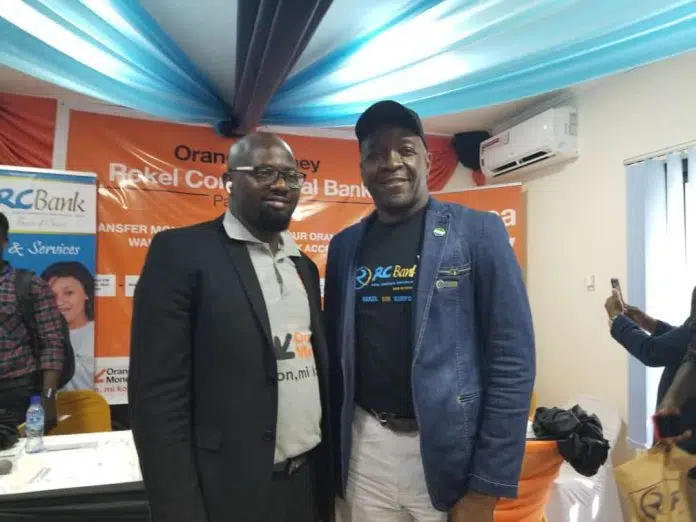
Chief Executive Officer Orange Money, David Mansaray & the Managing Director of Rokel Commercial Bank, Dr Walter Gilpin

By Foday Moria Conteh

Orange Money Sierra Leone and Rokel Commercial Bank (RCB) have established a new partnership to ease Orange Money and banking transactions. The partnership will facilitate the transfer of money from Orange Money Wallet to Rokel Bank Account.

According to the new partnership, a customer who owns and operates an Orange Money and a Rokel Bank Account would find it easy to transfer and save money in either of the two.

The event for the establishment of the new partnership took place at the RCB new branch in Juba community, West End of Freetown.

Before the new partnership was officially launched, an official of Orange Sierra Leone, Abibatu Baxter explains the process a customer has to go through to enjoy the service.

She explained that the service could be accessed through the USSD Code #144#.

A customer can select 1 to link with the bank account and 2 to see the list of bank partners and subscribe, select the bank among partners and then enter the Orange Money Code which should not exceed four digits.

After such steps, she said, the customer would receive the activation key by SMS. Pressing 6 would confirm that the Orange Money would have been received.

“A customer has 30 minutes to complete the process,” she said.

A customer, she says, who owns an Orange Money and RCB accounts could transfer as low as Le 10, 000 (Ten Thousand Leones) and as much as Le15, 000, 000 (Fifteen Million Leones). She also told the audience that the linkage is free of cost adding that there must be no inconsistency in a customer’s personal details especially the name of a customer.

“If a customer gives a name that is different from the original name in the bank account, there will be no linkage,” she said.

The new service, she says, makes it possible to pay services where RCB does not own and operate a branch. She however says the service is not free, but reasonable.

“A price of Le550 for Le15, 000 and Le15, 000 for Le150, 000, could be charged,” the official said. The new service has made RCB not having queues and the country cashless as a customer does not need to carry bulky sum of money where ever he or she goes.

Speaking during the ceremony, Chief Executive Officer (CEO) for Orange Money, David Mansaray expressed excitement for celebrating the new partnership adding that it is a “win-win situation.”

He said the new service would impact customers in diverse ways, ensure quality service, improve the bottom line [profit] and enhance access to more customers.

David continued that the new partnership between the two institutions is about financial inclusion noting that it would not be the only service.

“The two institutions will explore avenues for digital lending, investment opportunities and other services in the future,” he assured. The Orange Money CEO made reference to a recently published report that labelled Orange Sierra Leone and RCB as the top two institutions in the country.

“Orange Sierra Leone is the leading company in the telecoms industry and Rokel Commercial Bank the first bank in the banking industry,” he said.

Mansaray also touched on the benefits the two institutions stand to derive from the new partnership. Out of the partnership, the Orange Money CEO went on, Rokel Bank stands to benefit greatly especially in terms of liquidity.

“Where a customer needs money from the bank at a time the bank does not have the money, the customer can easily place the amount in his Orange Money wallet and cash it out with any Orange Money agent,” he explained.

The Orange Money CEO also told journalists that in December last year, the Orange Money service recorded 1, 000, 000 (one million) customers noting that those customers would add to the customer base of Rokel Bank.

Apart from RCB’s tremendous increase in its number of customers, the banks, he said, would be free from the long queues.

Orange Sierra Leone as well as the agents operating Orange Money service benefit from the new partnership. He said Orange Sierra Leone had 9, 000 agents working in the most remote end of the country.

The Orange Money CEO also does not lose sight of how the new partnership would benefit the country in terms of financial inclusion. He said Sierra Leone had been rated as the least in terms of financial inclusion in Sub-Saharan Africa,

“The Country has been rated at 42%,” he revealed. He however disclosed that Sierra Leone had recently recorded a 30% improvement in financial inclusion. While commending the technical staff for for their commitment and hard work that made the partnership possible, he also assured Sierra Leoneans that the two institutions would ensure a continuity of the service.

He described the journey for the realisation of the new partnership as a tough and rugged one but added that all is well that ended well. He however noted that it marked the beginning of a long and prosperous journey with opportunities for expansion.

In his contribution, the Managing Director of Rokel Commercial Bank, Dr Walter Gilpin said the new partnership was a fundamental step towards digital banking. The Managing director believes that through hard work and perseverance, they would surely reach their destination.

Managing Director of Rokel Commercial Bank, Dr Walter Gilpin

“A 1, 000-mile journey begins with a step. We are moving and as long as we don’t stop moving, we will get there,” the RCB Managing Director expressed hope.

Mr Gilpin also saw the establishment of the new partnership as an era of digitalisation adding that there would be more funds and revenue for government. He also believes that with the new partnership, the vicious cycle of debts and deficit banking would be a thing of the past.

He said the new partnership would trigger other important sectors of the economy especially SME financing, Agriculture, Insurance among others. He also believed that the new partnership would bring about a positive turn around in the financial inclusion rating for Sierra Leone.

“We can change the financial statistics for Sierra Leone’s financial inclusion. It is time for Sierra Leone to move from being the low among the lowest countries in terms of financial inclusion,” the Managing Director expressed determination.

Gilpin also re-echoed the recent standardisation and perception rating that categorised Rokel Bank and Orange Sierra Leone as the two leading institutions in the telecoms and banking industries. In his keynote address, Chairman for RCB Board of Directors, Buffy Bailor says Rokel Bank is on the trajectory of  being number one in the banking industry.

The RCB Chairman reminded the audience that today’s world is one of innovation, a statement that further espoused the importance of digital banking.

He assured the public that the marriage between Orange Sierra Leone and Rokel Bank would work.


Society for Democratic Initiatives Challenges New NGO Policy

By Amin Kef Sesay

The Society for Democratic Initiatives (SDI) has challenged a Ministry of Planning and Economic Development Press Release dated 15th March 2021 in which it was stated: “The Gazette Number 2, Vol. CL VIII has published list of NGOs that are legally registered with the Ministry of Planning and Economic Development for the period 2020-2021. The public is accordingly informed that the NGOs listed in the said Gazette are considered legitimate to operate in Sierra Leone for the period indicated. The public is advised not to deal with any NGO that is not included in this Gazette.”

SDI stated that it considers that statement as misleading and erroneous.

It continued that the State appears to be restricting and limiting CSO’s, NGO’s, CBO’s, faith-based organization and the civic space and furthered how it wishes to remind the Ministry of Planning and Economic Development that there are National and International principles that protect and defend civil society and Sierra Leone is no exception.

According to the SDI, Sierra Leone is a signatory to a number of International treaties, which promote democracy and the involvement of people in governance (Civil Society).

Section 26(1) of the Sierra Leone Constitution of 1991,it was pointed out, highlights the protection of civil society:

“Except with his own consent no person shall be hindered in the enjoyment of his freedom of assembly and association, that is to say his right to assemble freely and associate with other persons and particular to form or belong to any political party, trade unions or other economic, social, or professional association, national or international for the protection in his interest.”

The SDI said it wants to reiterate the right to operate from unwarranted State interference, which prescribes that International Law creates a presumption against any regulation or restriction that will amount to interference of a recognized right, unless where it has to deal with national security or public safety.

“CSO’s are protected against unwarranted State intrusion in their internal governance affairs,” SDI underscored maintaining that the African Charter on Human and People’s Rights, the United Nations Convention on Civil and Political Rights, Freedom of Association and Protection of the Right to Organize Convention are all treaties and conventions that guarantees and forms part of the seven (7) international principles for the protection of civil society.

According to the SDI, the new, draconian NGO policy reflects a worrying trend of encroaching on civic space.

It says the Government is using such excuses as “counter terrorism” and “greater regulations for CSO’s and NGO’s to improve accountability”, to restrict the ability of CSOs to form, operate and receive funding and to transfer ideas and information between citizens, members and State.

“This is despite the remarkable contribution and progress NGOs and CSOs have made towards promoting democracy and human rights in Sierra Leone,” it stated saying the new NGO policy exposes NGOs to serious challenges in terms of autonomy, governance and accountability.

Over the years, the SDI revealed, CSOs operating in Sierra Leone have taken significant steps to confront the worrying trend.

The Release concluded with SDI reminding the State that they have a duty to promote and respect human rights and fundamental freedoms as well as the State also having the obligation to protect the rights of civil society.

“The State duty is both negative (i.e. to refrain from interfering with human rights and fundamental freedoms) and positive (i.e. to ensure respect for human rights and fundamental freedoms),” it averred.