Home Blog Page 956

Ombudsman Hands Over Annual Report to President Bio

By Theresa Kef Sesay

At State House on Thursday 4 February 2021 President Julius Maada Bio received the 2019-2020 annual report from the Ombudsman, Leon Jenkins-Johnston Esq and assured of his support to the institution’s independence and operations.

“My Government has supported the legal rights to Government information, repealed obnoxious laws that proscribe free speech, and made transparency an administrative norm. These and my Government’s support for the work of the Ombudsman clearly serve the public interest, strengthen our public institutions, and further consolidate a more inclusive democracy,” he said.

President Bio also noted the challenges highlighted by the Ombudsman, including the issues of capacity, financial, logistical and other needs contained in the report, and assured him that Government would address them because the institution is invaluable to the country’s development.

He said, he was further gratified at the restatement by Mr. Jenkins-Johnston Esq of their values of being independent, collaborative, accessible, fair, impartial, just, transparent, reliable, and effective in resolving disputes as well as identifying and addressing attendant structural problems in public administration.

“So, I see the Office of the Ombudsman as a key institution for strengthening and reinvigorating our democracy. Along with the other institutions like the Ministry of Justice, the Anti-Corruption Commission (ACC), the Human Rights Commission (HRCSL), I see the Office of the Ombudsman as a bulwark for institutional integrity and accountability.

“Be reminded that there may be overlaps in mandate every so often. A complaint against an MDA may constitute an offence in the ACC act or an abuse of rights for the HRCSL. So, map out areas of cooperation and work closely for the good of our citizens and our democracy,” he emphasised.

According to the report, from 1 July 2019 to 30 June 2020, 484 complaints were lodged with the Office of the Ombudsman against various Ministries, Departments and Agencies, with 246 lodged at the Head Office in Freetown, 121 in Bo, 71 in Kenema, 16 in Makeni and 30 in Port Loko. 329 have been concluded so far.

The Office of the Ombudsman receives, investigates, mediates and resolves complaints laid against administrative decisions, malpractices of the public sector, institutions of higher learning set entirely or partly out of public funds.

Chief Justice Highlights Need to Review The Gambia Court ADR System

Chief Justice of Sierra Leone, Justice Desmond Babatunde Edwards

By Elkass Sannoh

His Lordship, the Chief Justice of Sierra Leone, Justice Desmond Babatunde Edwards on the 4th February 2021 disclosed that the commencement of the Court connected Alternative Dispute Resolution (ADR) in 2010 has helped in reducing the time taken to complete commercial disputes in the country.

The Chief Justice was addressing a virtual conference on reviewing the Gambia Court connected ADR System. The virtual conference was held at the Ocean Bay Hotel and brought together twenty four (24) eminent Justices across Africa; the Gambia Bar Association President; six (6) Principal Magistrates in Gambia and the Resident Representatives of the World Bank and UNDP in The Gambia and host of other senior State functionaries.

Speaking on the theme, “The Reviewing of the Gambia Court Connected Alternate Dispute Resolution System,” the Chief Justice said the holding of the conference, as part of the opening of the Judicial Year of The Gambia, was most laudable.

He said the relationship between The Gambia and Sierra Leone had been a fruitful one ever since the 1980s with lawyers and Judges serving time in each other’s arena.

He mentioned Justice Nicholas Browne-Marke (JSC), a member of the current Supreme Court of The Gambia while Justice Semega Janneh was also a Justice of the Supreme Court of Sierra Leone before now.

Justice Mary Sey, a member of the current Supreme Court of The Gambia was a High Court Judge in Sierra Leone before now.

Whilst thanking his colleague Chief Justice of The Gambia, His Lordship Hon. Justice Hassan B Jallow and the Gambian Judiciary for creating the platform for Sierra Leone to participate in reviewing The Gambia Court connected ADR System, he said gone are the days when the opening of the Judicial year of  Sierra Leone or the Gambia was just an occasion of just pomp and pageantry with just the inspection of the guard of honour mounted for the Chief Justice and the usual call over of cases without any other meaningful Justice transforming event.

Highlighting the importance of the Fast Track Commercial and Admiralty Court, the Chief Justice said the Court was established as one of the divisions of the High Court firstly under the Constitutional Instrument No. 1 of 2007 and most recently under the High Court Divisional Order Constitutional Instrument No 4 of 2019 under which its current rules Constitutional Instrument No 2 of 2020 are made.

“The court by the said rules is mandated to hear every commercial claim reference to disputes in trade or commerce where the claim is Le50,000,000,00 (Fifty million Leones) or more,” he said.

He stated that the objective for establishing The Fast Track Commercial Court was to expedite the effective, efficient and just disposal of claims in trade or commerce in order to promote trade investments and other economic activities in the country.

Central to this objective, the Chief Justice continued, “is a mandatory pre-settlement hearing or conference which means that every case brought to the Fast Track Commercial Court must commence with a Court connected ADR process which would last only for 14 days or by extension, where the prospects look good that the parties would settle the dispute, not more than 21 days.” According to him, this means that an action brought by a litigant under the Commercial Court, Court Connected ADR system can be completed within 21days.

He went on further to say that during a connected ADR, otherwise called mandatory pre-trial settlement conference the pre-trial judge transforms from the usual adjudicator to a mediator wherein he should be able to assist and guide the parties towards an amicable settlement/agreement on the case after pleadings are closed as the first step in any litigation brought before the fast track commercial court.

“The agreed solution or consent proposal is then adopted by the court carrying with it it’s coercive powers in case any of the parties renege on the agreement,” the Chief Justice said, stressing that, “where settlement fails the usual court processes will follow but this time the file being transferred to a trial judge who must complete the case before 6 months.”

Like Ebola…   Mitigating COVID-19 Financial Effect Calls For Tight Public Expenditure Controls

By Amin Kef Sesay

Principally due to the adverse financial effects of the Ebola disease outbreak of 2014 to 2015, the former Government was forced to embark on tight budgetary controls aimed at curtailing Government expenditures in order to keep both local and international debts within bounds.

Given that the country’s debts keep mounting, there is a need for Government to control its expenditure.

In that regard, what the Auditor General picks up in her annual reports over the past ten years is that many Ministries, Departments and Agencies overspend beyond their budgetary approved by Parliament.

What this point to is that the budget is not been efficiently managed to implement policies incorporated in the budget.

Budget execution processes are not simply mechanisms for ensuring compliance with the initial programming.  Even with good forecasting systems, unexpected macroeconomic developments may occur during the year, and need to be reflected in the budget – Such as has happened with the COVID crisis.

In such case, budgetary adjustments should be accommodated in a way that is consistent with the initial policy objectives so as to avoid disrupting the activities of agencies and project management. Successful budget execution depends on numerous other factors as well, such as the ability to deal with changes in the macroeconomic environment and the implementation capacities of the agencies concerned.

Because budget execution involves a greater number of players than budget preparation, this calls both for assuring that the “signals” given in the budget are correctly transmitted, and for taking into account feedback from actual experience in implementing the budget.

Hence, efficient budget execution calls for:

  • ensuring that  the  budget  will  be  implemented  inconformity with the authorizations granted in the law, both in relation to the financial and policy aspects;
  • adapting the  execution  of  the  budget  to  significant  changes  in  the  macroeconomic  environment;
  • resolving problems  arising  during  implementation;  and,
  • Managing the purchase and use of resources efficiently and effectively.

From what the Auditor General observes about uncontrolled procurement excesses, it goes without saying that, systems for budget execution system should ensure rigorous aggregate expenditure control, but also effective and efficient uses of resources in accordance with budget priorities.

Aggregate expenditure control  requires  defining  fiscal  targets which is  largely  concerned  with  budget  preparation. Budget execution procedures must ensure that fiscal targets are effectively enforced and that managers comply with the budget authorized by the legislature.

However,  this  should  not  consist  of replicating  the  “traditional”  budget execution  systems,  which  focus  on  detailed input  controls, often performed by the ministry of finance. Such an approach is aimed at assuring fiscal discipline, but generally poses two different sorts of problems.

On the one hand, excessively detailed controls are time-consuming, making  the  budget  rigid,  and  do  not  give  managers  the  flexibility  in  the  allocation  of  inputs  needed  to implement their budgets efficiently.

Traditional compliance controls are not sufficient to ensure fiscal  discipline.  They  tend  to  focus  on  cash  payments  for  supplies,  while  the  most  crucial problems are often found elsewhere (overstaffing, entitlements, arrears, etc.).

Keeping budget execution under control requires effective management control systems, not excessively detailed compliance controls.

The general features of the budget execution cycle, including the issues related to compliance controls, with the specific methods and systems that are required for effective budgetary control that the Auditor General finds are generally lacking in the MDAs include:

  • Payables and public procurement
  • Cash management and the treasury function
  • Internal (management) controls and internal audit
  • Accounting and financial reporting systems
  • External audit
  • Overspending and under-spending

As such, Parliament and the Executive can better deal with this lack of compliance by MDAs through strengthening the audit system, the reporting system, and ensuring the effectiveness of the basic budget execution controls.

Petroleum Regulatory Agency Justifies Increase in Fuel Prices

Executive Chairman of the Petroleum Regulatory Agency (PRA), Brima Baluwa Koroma

By Amin Kef Sesay

In a Public Announcement dated 3rd February 2021 signed by the Chief Executive Officer of NP (SL) Ltd, Kobi Walker, the Executive Chairman of the Petroleum Regulatory Agency (PRA), Brima Baluwa Koroma, the Managing Director of TOTAL Sierra Leone, the Senior Permanent Secretary of the Ministry of Trade and Industry, the Financial Secretary, Sahr Jusu, the Managing Director of Leonoil it was categorically stated that following recent developments in the international market of petroleum products, the Petroleum Regulatory Agency, Ministry of Finance, Ministry of Trade & Industry and the Oil Marketing Companies (OMCs), have jointly reviewed the pump prices of petroleum products as at 29th January 2021.

It continued that the Petroleum Regulatory Agency hereby announces the following pump prices for the month of February 2021:

Petrol: from Le 7,000 per litre to Le 8,500 per litre, Diesel from

Le 7,000 per litre to Le 8,500 per litre, Kerosene from Le 7,000 per litre to Le 8,500 per litre and Fuel Oil from Le 7,000 per litre to Le 8,500 per litre.

The Public Announced furthered that Government and its valued Oil Operators continue to reform the downstream petroleum sector in a transparent way including regular monthly review of pump prices based on the movements in the Platts and exchange rates.

It was categorically pointed out that all OMCs and Fuel Dealers are urged to adhere to the above pump price adjustment ach

In another development, the Petroleum Regulatory Agency (PRA) has on the 4th February 2021 released what it refers to as the February 2021 Pricing Review Basic Industry Facts.

According to the PRA, the petroleum sector remains very critical contributing about 15% to domestic revenue adding that it has recorded consistent revenue growth since 2018.

It further revealed that Sierra Leone consumes about 1.1 million liters of petroleum products per day and at the moment there are only two petroleum importers in the country, two large storage companies
and one petroleum Jetty.

“Operational storage is currently less than 200,000 metric tons, this is 40% of the national target and Government is addressing this,” it was also divulged.
The PRA stated that the Oil Marketing Companies do not benefit from economies of scale because of  the small size of petroleum imports maintaining that the current average replenishment period for fuel in Sierra Leone is two weeks and such  has a tendency for frequent replenishment that poses risk of stock-out, hoarding and
speculative buying.

In terms of fuel pricing for February 2021 the PRA said Sierra Leone like most African countries uses a pre-defined petroleum price structure.

According to the institution, the pump price in Sierra Leone is efficiently determined by a +/-5% trigger mechanism of the landed cost which is mostly driven by the combined effect of the
international Oil reference price (Platts) and foreign exchange.

It stated that the Sierra Leone pricing regime is well structured, transparent and is reviewed monthly.
Based on what the PRA revealed, Pump prices have been changed six (6) times since 2018, and it has been reduced three (3) times during that period.

It said though there were situations when the landed cost of all petroleum products were in excess of 10% month-on-month and such was largely impacted by an uncontrolled rebound in Oil Prices in the Global Markets warranting sharp increase in pump price, however, Government kept the pump prices unchanged at Le 7,000 per liter which was below market price of Le 9,000.

The PRA furthered that Global Oil prices are exogenous and were affected by sharp volatility between May and December 2020, but Government did not allow the high costs to be passed on to the poor consumers and hence it suspended the automatic pricing
adjustment mechanism since May 2020 to date.

It added that the Government has intervened by injecting about Le 66 bn during that period and Le 17.43bn in January 2021 to support the pump price stabilization.

Notwithstanding, according to the PRA, the increases in the international Oil prices on the February 2021pump price such a prevailing pump price still remains the cheapest within the Region

Dilating on the issue of smuggling, the PRA stated that a significant portion of benefits from fuel subsidies are not received by
the intended beneficiaries in Sierra Leone, but instead are captured by smugglers and black-marketers, stating that it is profitable to buy subsidized fuel domestically on the black market and then smuggle it and sell at market rates in neighboring countries.

According to the petroleum regulatory entity such has led to a depletion of stock balances making the country vulnerable to
shortages and panic buying

On the issue of frequent stock replenishment the PRA reveals that because of lower fuel prices in the country, relatively below regional average, it is clear that the Government is currently subsidizing neighboring countries because of the reported huge volume carried out of the country hence putting pressure on the available stock.
Giving a run-down  on a comparative basis of former  regional fuel price converted in Le/Litre-as at 27th January, 2021 taking into consideration Sierra Leone, Guinea, Liberia, Ivory Coast, Ghana and The Gambia, the PRA disclosed the following: Petrol– Sierra Leone Le 7,000.00, Guinea Le 9,180.00,  Liberia Le 7,936.08, Ivory Coast Le 11,376.00 , Ghana Le 9,156.98, The Gambia Le 9,133.55.

For Diesel the comparison are as follows:
Sierra Leone Le 7,000.00, Guinea Le 9,180.00, Liberia Le 9, 258.70,
Ivory Coast Le 11, 376.00, Ghana Le 9, 204.92, The Gambia Le9,053.56.

In terms of Kerosene the comparison is as such
Sierra Leone Le 7, 000.00, Guinea Le 13, 374.90, Liberia Le10, 522.80, Ivory Coast Le7, 711.60, Ghana Le7, 486.52, The Gambia Le 7,486.52.

The PRA also stated that Exchange Rate source is the Bank of Sierra Leone as at January, 27th 2021.


Mines Minister Commission 1st Gold Processing Plant in the Country

By Amin Kef Sesay

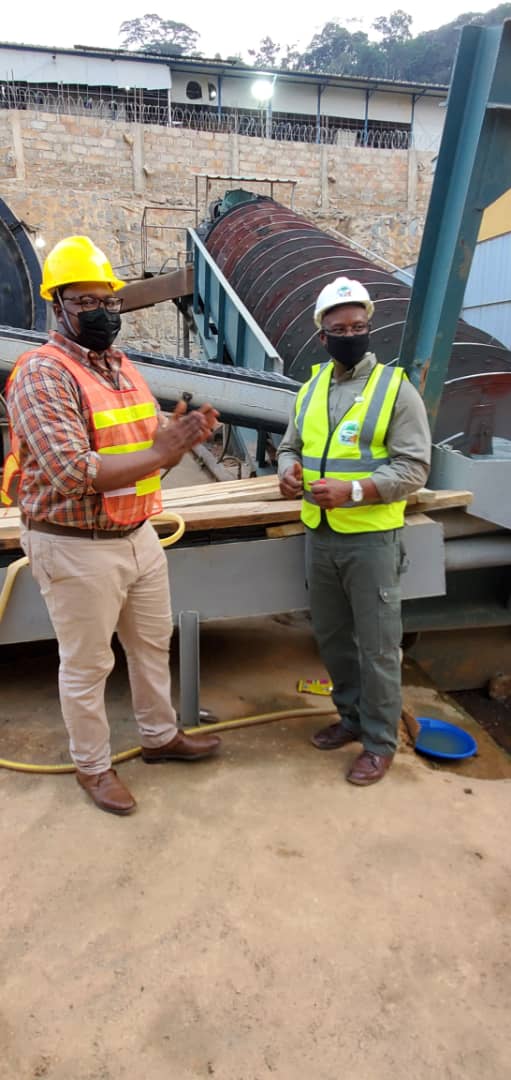
The Minister of Mines and Mineral Resources, Musa Timothy Kabbah, on the 3rd February 2021 launched the Komahun Gold Processing Plant, in Nimikoro Chiefdom, Kono district, as part of the ceremony marking the start of full-scale gold mining and processing operations by Wongor Investment Mining Company.

The plant, which happens to be the biggest gold processing plant ever to be operated in the country, symbolizes a transition from the predominantly illicit artisanal mining of gold in Nimikoro chiefdom, to an industrialised, well regulated, large-scale mining operation that will benefit the country and its people.

Welcoming participants to the ceremony, host Paramount Chief of Nimikoro chiefdom, Aiah Denton Bona Foamansa III, and the Chiefdom Speaker of Nimiyama chiefdom, Philip Koroma, maintained that they were excited to have such a large-scale gold mining operation in their chiefdoms, as it would not only increase revenue for Government, but will also bring benefits to the local community.

They informed the gathering that Wongor Investment and Mining Corporation has already proved to be a good corporate citizen, as they have met all their statutory and other obligations to the community, including the prompt payment of surface rent, the signing of a Community Development Agreement with the host community, and provision of assistance under CSR. The above, they noted, was testament to the fact that the operations of a recognized and legal entity, such as Wongor Limited, brings benefits to the community, unlike illegal mining, which only benefits few individuals. They both assured the Minister and his delegation that Wongor was welcome to operate in their chiefdoms.

In his keynote address, the Minister of Mines and Mineral Resources, Musa Timothy Kabba, stated that he was honoured to be launching the largest ever industrial gold mining operation in the country, noting that the aim of the current Government, under the dynamic leadership of Rtd Brigadier Dr Julius Maada Bio, is to attract credible investors into the minerals sector. He lamented the fact that after over ninety years of mining in Sierra Leone, the country as a whole, and the mining communities in particular, have nothing to show in terms of development. This, he said, warranted the transformative measures that Government, through the Ministry of Mines and Mineral Resources (MMMR) and the National Minerals Agency (NMA), is pursuing to ensure that the country and its people benefit from the mineral wealth.

He explained that, under his leadership as Minister of Mines and Mineral Resources, the MMMR and the NMA are reviewing the Mines and Minerals Act of 2009 and the NMA Act of 2012 to improve on the governance and management of the minerals sector, maximise benefits for the country and improve on mining contribution to local development. Notable changes that would benefit the community, he went on, are the proposals for 70% of surface rent to go directly to land owners, and for mining companies’ contribution to the Community Development Fund to be increased from 0.01% to 2.5%. Minister Kabba assured the people of Government’s commitment to reversing the resource curse, and ensuring that the mineral wealth of the country benefits its people.

Earlier in his statement, the Director General of the NMA, Julius Mattai, noted that the launch of the processing plant, at this time, by Wongor Limited, which acquired its licences just before the outbreak of the COVID 19 pandemic, is a strong indication of the resilience of the company. He noted that these are the types of investors that Government wants to attract to the country; credible investors who can withstand shocks, not the fly-by-night investors who will disappear after the slightest challenge.

He welcomed the news that Wongor was supporting the local community, and encouraged them to respect the rights, customs and traditions of the local people. He assured the company that, as a regulator, the NMA will continue to work with them, and ensure that they “do the right things right” so that the mining would be done in a responsible and sustainable manner, and would benefit the country, the local community and the company.

In his statement, the CEO of Wongor Investment and Mining Company, Mr. Shao, said that the company was happy to be operating in Sierra Leone, and that they will continue to be good corporate citizens. He said that they have been, and will always be, fully compliant with all laws and regulations, and will continue to assist the local community.

Other speakers included the Member of Parliament for Constituency 023, Hon. Musa Fofanah, who is also a Member of the Parliamentary Committee on Mineral Resources, and the Chairman of Kono District Council, Sahr Solomon Gbondo, both of whom expressed delight over the launch of the processing plant and the operations of the company, noting that it marks another chapter in the history of the constituency, the district and mining in the country. They acknowledged that the granting of the large-scale mining licence to Wongor for them to mine gold in Komahun was a step in the right direction, as it puts an end to illicit mining, which brings no benefits to Government or the community.

The ceremony, which attracted stakeholders from the district and Government regulatory agencies, climaxed with a tour of the processing plant by the Minister and his delegation, and the production of the first gold ore from the plant.

For the 1st Time Gold Bullions Produced in Sierra Leone

By Amin Kef Sesay

Wongor Investment and Mining Corporation, or simply called Wongor Mining, has launched its state-of-the-art gold processing plant in Nimikoro, Kono District, the first in the history of Sierra Leone that produces gold bullions.

Wongor mining was one of the first large scale mining companies to get a license to mine under the new Government of President Bio.

It started mine development activities towards the end of 2019 and despite the odds of a global pandemic, the very resilient company had its processing plant launched by the Hon. Minister of Mines and Mineral Resources, Tim Kabbah, together with his Deputy Minister, Ann Marie Harding, and other dignitaries that included the DG of the NMA, Mr. Mattai, the Executive Chairman of the EPA, Dr. Gevao, the host MP of the area, Hon. Fofanah, traditional leaders and chiefs.

Tim Kabbah expressed  great delight at the tremendous progress made by the company and the history the company has made under the leadership of President Bio as the first large scale company to actually process its gold in Sierra Leone and adding value to it as opposed to others who ship concentrates to other countries. “These are the kinds of investors President Bio has often reminded us to have in the industry,” he added.

In his remarks, the head of the National Minerals Agency, Mattai, opined that Wongor Mining has proven its resilience by refusing to pack and leave the country because of the global pandemic.

“Some companies would leave by officials catching just fresh cold, but despite all the challenges Wongor has proven itself as serious investors.

“Based on feedback from what all the chiefs have said about their satisfaction with the company, and also based on what we in EPA have observed since the start of the company’s operations, we cannot help but add words of admiration in the way the company has been managed,” says the Executive Chairman of the EPA.

Murtada Tunis, the Manager for the company, buttressed some opening remarks of his CEO, by saying that the Government has been extremely helpful in making sure that the company succeed.

The regulators have all been very professional and resourceful and have also demonstrated lots of understanding during the pandemic, he added. Mr. Tunis added that Wongor is not the typical Chinese company that people are used to. “We have used best international management practices to get to where we are today despite all the enormous challenges,” he added.

The chiefs, including Paramount Chief Fomasa Denton Bonah of Nimikoro Chiefdom, were full of superlatives in the manner the company has been managed. “We will continue to support and stand by this type of company which has done so much for our people even before they started production of gold,” the chief said. And by the time they construct the proposed Community Health Clinic in the very near future, our people would further validate that they made no mistake in welcoming the company to the chiefdom for operation, ends P.C. Bonah.

To facilitate Heart Surgery of 6 Month Old Baby in India…   Sick Pikin Project Appeals to the Public for Financial Support

Baby Mamadu

By Amin Kef Sesay

A six year old baby boy, Mamadu was born with a congenital heart complication. Since birth to date he has been in and out of Ola During Hospital at the PCMH Hospital. He was born with this difficult condition that makes him to Cyanosed, making him depending on oxygen for weeks and months and such has been happening since he was born.

Baby Mamadu is currently at home where he is being monitored as the Sick Pikin Project is reaching out to raise funds for his surgery.

His poor mother is a student and the father is a waiter and with this economic reality the parents of Baby Mamadu are unable to meet the financial demands to carry out his surgery.

Keeping these realities, backed with the excruciating pain that Baby Mamadu is going through day and night, the Sick Pikin Project is therefore reaching out to members of the public asking for their support so that the organization could give Baby Mamadu another chance in life.

The Sick Pikin Project says they are currently fundraising and their target is $ 5,865 which is estimated to cover the flight of the Nurse who will accompany him and to pay for Oxygen on the flight from Freetown to New Delhi. 250 USD per bottle for the oxygen and we will need 15 bottles for him.

It was revealed that they have raised the funds for His surgery, accommodation, feeding and flight from the Government of Sierra Leone, but are still in need of $ 5,865 for which they are pleading to all every goodwill person to please help save the life of Baby Mamadu.

According to them nothing is too small as a collection of little resources will make a pool that will end up saving lives.

Call or whatsapp +23276722763

Visit www. sickpikin.org or follow on facebook The Sick Pikin Project.

ACC Prosecutes Two for Examination Malpractice

By Foday Moriba Conteh

The Anti-Corruption Commission (ACC) on 25th January, 2021, filed an indictment against Foday Sulaiman Bangura, a Private Security Guard of the Lion Rock Security Agency and of 16 Maguidi Street, Makeni and Abu Bakarr Sankoh, of an unknown address, on Two Counts of Conspiracy to Commit a Corruption Offence, contrary to Section 128 (1), and Engaging in Academic Malpractice, contrary to Section 128(3), of the Anti-Corruption Act No. 12 of 2008 (as Amended by the Anti-Corruption Act No. 9 of 2019).

According to the particulars of offence, on the 27th November, 2020, Foday Sulaiman Bangura and Abu Bakarr Sankoh, at Makeni, conspired with other persons unknown to commit a corruption offence to wit: that the said Foday Sulaiman Bangura would impersonate the said Abu Bakarr Sankoh, a candidate in the November/December 2020 private West African Senior Secondary Certificate Examination (WASSCE) conducted by the West African Examinations Council Sierra Leone (WAEC SL) and write the Business Management paper for the said Abu Bakarr Sankoh.

Similarly, on the 28th November, 2020, Foday Sulaiman Bangura, at Makeni, engaged in academic malpractice to wit: by impersonating the said Abu Bakarr Sankoh, and writing the Business Management paper for the said Abu Bakarr Sankoh during the November/December 2020 private WASSCE conducted by WAEC SL.

Meanwhile, the indictees made their first appearance in the High Court Holden at Makeni on Wednesday 3rd February, 2021.

The Commission said it wishes to reassure the general public of its determination to curb examination malpractices as it is critical to the successful implementation of the Free Quality Education, and all levels of corruption throughout Sierra Leone.

Information Minister Launches A-Z Multimedia Corporation

By Foday Moriba Conteh

The Minister of Information and Communications, Mohamed Rahman Swaray, has on Thursday 4th February, 2021 launched the A-Z Multimedia Corporation. The launch took place at the A-Z Multimedia Corporation Head Office on Robert Street in Freetown.

In his welcome address, the Chief Executive Officer of the  A-Z Multimedia Corporation revealed that the launch of the media entity was conceived from a burning desire to invest in media
development in Sierra Leone furthering that he is pretty convinced that they all share the spirit behind their desire to respond to the need for media professionalism that is responsive to the evolving trends and that is why they are convinced about the possibility of contributing to the development of a healthy media landscape in the country.

He noted that Sierra Leone has been a trailblazer of media excellence on the continent and that this dates back to the 1800s when they had the first printing press, the Sierra Leone Advertisers, after which the African Standard and the Royal Gazette evolved to attract professional journalists who came to the country to practice.

The CEO pointed out that as they consider the fact that we have formal media training schools and are exposed to technological tools to aid us in sustaining the rich media history, the socio-economic forces that explain why Etchings are going downhill are reasons for us to wake-up and make up for the lapses saying that they are venturing with a redemptive passion.

“We see the environment even ripe to invest in the media for professional excellence. The reforms introduced by this Government to expunge anti media provisions in the organic law puts us under the obligation to be responsible. As we thank the Bio Government for that epoch making reform we are making a commitment to contribute to good governance and human rights,” he disclosed.

He said his team has been schooled in ethical sensitivity as a rule to match their editorial standpoint of being the game changer saying that is not a bogus branding thing, but a profound commitment to win public trust and confidence.

The CEO further maintained that they doff their hearts to colleagues who have been striving under a challenging market reality to make a difference and inspire others in believing in professional journalism, adding that they don’t see them as rivals but colleagues that are to be mutually supportive even as they might be preaching the same sermon from different pulpits.

“Make no mistakes we will from time to time come knocking on your doors to compare notes and share. That should be the spirit! Let me conclude by reassuring the wider public of fairness in deepening local content and promoting diversity as a necessary ingredient for strengthening democracy, national stability and sustainable development. May God bless our collective efforts!” he concluded.

Giving a keynote address, the Minister of Information and Communications, Mohamed Rahman Swaray, congratulated the Chief Executive Officer of A-Z Multimedia Corporation and team for envisioning  such an  investment in the media landscape in the country.

He said as a Government they made their committment in repealing Part V of the Public Order Act of 1965 which deals with criminal libel and also enacted the Independent Media Commission (IMC) Act 2020 which, he said, will enhance the professionalization of journalism and make investments in media more attractive describing the launch as a clear manifestation of making the media better forever.

He encouraged practicing journalists to opt for media professionalism, work with the Independent Media Commission (IMC) to enhance its regulatory powers.

Deputy Speaker of Parliament, Hon. Solomon Sengepoh Thomas expressed appreciation to the Chief Executive Officer of A-Z Multimedia Corporation and team for such an investment in the Media landscape of the country, furthering that Parliament will continue to support such an investment of this nature.

He noted that investment in the media has not properly been explored in Sierra Leone adding that it has even become worst with the advent of the social media underscoring that those who are to invest in the media are now saying the information or news is all over the place and they do not need to invest anymore to which he said he holds a contrary view.

The CEO said that there are several aspects that can be explored using the media and then called on others to see the need to invest in the media.

Chief Justice Promises Human Rights Commission to Curtail Overcrowding in Prison

By Elkass Sannoh

Hon. Justice Desmond Babatunde Edwards, the Chief Justice of Sierra Leone, on the 1st February, 2021 assured representatives of the Human Rights Commission of Sierra Leone that the issue of overcrowding at the Male Correctional Centre would be addressed expeditiously.

The team from the Human Rights Commission comprised of the Oversight Commissioner for the Directorate of Complaint and Legal Service, Simitie Lavaly and Oversight Commissioner for the Directorate of Monitoring and Research, Dr. Gassan Abess and the Deputy Director of Monitoring and Research Directorate Mr. Brima Kelson Sesay.

In his presentation on the Commission’s findings on the status of inmates at the Male Correctional Centre, Brima Kelson Sesay said two hundred and fifty (250) inmates who are currently incarcerated at the Male Correctional Centre are without indictments. He went on to say that four (4) inmates who had completed their respective sentences are still being incarcerated because committal warrants couldn’t be produced after the burning of Pademba road correctional center with corresponding copies from the Judiciary not produced.

He attributed those anomalies as a key factor responsible for overcrowding at the Male Correctional Centre in the country. He said the centre is currently housing One Thousand Four Hundred (1,400) plus inmates for various offences including murder and robbery with aggravation among others.

The team from the Human Rights Commission said they were impressed at the massive transformation at the Judiciary. They unanimously commended the Hon. Chief Justice for his judicial reforms including the decentralization drive, expeditious and fair trials at all levels.

The Hon. Chief Justice, His Lordship Justice Desmond Babatunde Edwards appreciated the Commission’s visit to bring forward what he called ‘genuine concerns in the administration of justice.’

He pointed out that addressing the issue of overcrowding nationwide has been at the hallmark of his administration through the Outdoor Prison Court that was held in September, 2019. He said forty-seven (47) inmates including the longest serving inmates were released on habeas corpus applications, and discharged for want of prosecution, while some were discharged because of the time spent relative to the offence charged with.

“If there is overcrowding at the Male Correctional Centre, it would have been recent but not within the timeframe as stated in your findings,” the Hon. Chief Justice said, whilst calling for the list of the two hundred and fifty reported inmates without indictment to be formally brought to the Judiciary.

He assured that, “I will ensure that those not yet served with their indictments are served with it without any further delay.”

The Hon. Chief Justice revealed that the Judiciary under his leadership ensured that the inmate population reduced from over two thousand to under two thousand. He said the deadly COVID 19 pandemic and the recent burning at the correctional center must have been leading factors for the increase in number of inmates as His Excellency the President, Dr. Julius Maada Bio too had graciously pardoned a good many.

“In May 2020, I had wanted to concentrate on remand prisoners because I discovered that some Magistrates were not granting bail for even minor offences but COVID 19 placed restriction on this plan,” the Chief Justice said.

In reaffirming his commitment to addressing the concerns raised by the Human Rights Commission, the Hon. Chief Justice urgently called for a meeting with the relevant stakeholders in the justice sector especially the head of the Correctional Centre, the Director of Public Prosecution (DPP) and the Executive Director of Legal Aid Board.