Home Blog Page 958

SLRCS Provides Additional Support to Combat COVID-19

By Theresa Kef Sesay

According to the according to National Covid-19 Emergency Response Center (NaCOVERC) the influx of people in the country from the diaspora during the holiday season to spend time with their families and loved ones and the festive season celebrations in the country has resulted to a rise of corona virus cases from December 2020 to January 2021.

This second wave of the disease has caused a wide spread fear as most people are attributing these new cases to the new strain of the virus that’s affecting the wider world. For that reason, the Government of Sierra Leone has reinstated stricter measures in order to mitigate the continuous spread of the virus especially in the capital city; Freetown.

These measures include; two weeks curfew starting from 10:00pm – 5:00am, restricted movement of people to and from the city, ban on night clubs and closure of bars and restaurants during the weekend. NaCOVERC will review the restrictions at the end of the 2 weeks.

Sierra Leone Red Cross Society (SLRCS) having been at the forefront of the fight against COVID-19, supporting the Government in the areas of psychosocial support, social mobilization, community engagements and sensitization, safe and dignified burials, and many more.

With support from the International Federation of Red Cross and Red Crescent Societies (IFRC), SLRCS HQ has distributed Infection, Prevention and Control (IPC) and Information, Education and Communication Materials (IEC) on the 22nd – 26th January, 2021 to the 8 IFRC supported branches; Kambia, Port Loko, Bombali, Kailahun, Koinadugu, Tonkolili, Western Area Urban and West Area Rural through District Covid-19 Emergency Response Centers (DiCOVERC) for onward distribution to community people.

These materials included; veronica buckets, hand washing stations, liquid soaps, hand sanitizers, chlorine, gloves, aprons, flyers and posters, facemasks and thermometers.  With these, branches will continue to enhance adherence to covid-19 preventive measures as they carry on their sensitization in those communities.

HRCSL Proffers Recommendations to Resolve Impasse with Guinea

By Foday Moriba Conteh

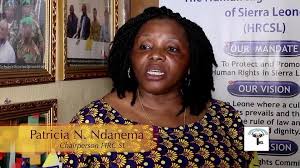
In a Press Statement dated 2nd February, 2021 issued by the Human Rights Commission-Sierra Leone (HRCSL) and signed by its Chairperson, Patricia Narsu Ndanema, the institution revealed its findings on the Yenga Border Conflict and the closure of the Guinean border and at the end proffered recommendations as to how to resolve the impasse.

It stated that in 2004, Government, through an Act of Parliament accordingly enacted the Human Rights Commission of Sierra Leone Act which gives HRCSL the primary responsibility to protect and promote human rights of all in the country devoid of region, ethnicity, sex, religion, association etc.

According to the Statement, it was maintained that in that vein HRCSL is also serving as a peace building infrastructure which identifies early warning signs of conflict, documents them and make appropriate recommendations to Government and its partners for prevention of any potential conflict.

HRCSL said about two weeks ago while monitoring the media it noted that some people who said they are residents of Yenga, a small village in the Kissi Teng Chiefdom in Kailahun District alleged through a voice message sent on WHATSAPP that Guinean soldiers had crossed over to their town laying claims to it.

It continued that the aforementioned people  therefore gave Government through the same voice message an ultimatum to act fast and stop the Guineans otherwise they would take the law into their hands.

“That reopened fresh discussions in the media over the Yenga Border conflict which many Sierra Leoneans had thought it had long been resolved,” the Press Statement highlighted.

HRCSL says it viewed such threats as an early warning sign for conflict and therefore on the 28th of January 2021 dispatched a team to undertake a fact-finding mission led by the Vice Chairperson, Victor I. Lansana Esq. and Commissioner Hassan Samba Yarjah to Yenga and also had to cross over to Nongowa the border axis of Guinea by means of a canoe.

It was further revealed that with the Guinea Border remaining closed, the Team also investigated the impact of the continuous closure adding how HRCSL engaged stakeholders separately on both sides of the border and did a conducted tour of the border area, the Yenga Community and the Pengu Bengu check point.

According to the HRCSL those engagements and conducted tour were aimed at identifying the human rights issues prevailing in that part of the country in a bid to advise Government appropriately.

It also disclosed that from those engagements and conducted tour, HRCSL documented the following findings:

  1.     Security
  •       There is no security presence at the Sierra Leone border along the Makona/ Moa river as opposed to the Guinean counterpart who have a huge military presence at the foot of the border (Moa River).
  •       Security presence on the Sierra Leone part is only found at the Pengu Bengu Check Point, which is about 5 miles away from the actual border crossing point.
  •       Even at the Pengu Bengu Check Point, security presence is very low.
  •       Residents of Yenga community complained of intimidation and harassment from Guinean security personnel.
  •       There is no Guinean military occupation of Yenga, the Guineans only crossed the border to come and erect a beacon that was destroyed as a result of the road construction
  •       The Guinean personnel consider the area where the beacon is erected as a buffer zone and are determined to prevent anyone from meddling in that area.
  1.     Economic and Social Rights
  •       There is no presence of any school, health and market facilities in the Yenga border axis;
  •       Residents complained that sometimes they are prevented by the Guinean security personnel from using their land for farming and other agricultural purposes;
  •       Residents complained that they are normally asked to pay dues by the Guinean authorities to enable them undertake cross-border trade;
  •       Residents complained of extortion by the Guinean security personnel during this period of restriction of movement of people across the border
  •       Residents complained that the Guinean security personnel demolished the only primary school serving the Yenga Village.
  1.     Development Rights
  •       GoSL has commenced road construction from Kailahun town to the Yenga border axis.
  •       Residents complained that Guinean security personnel did not allow the erection of street Solar poles, which had been brought by GoSL and Partners to provide light to the community and its environs.

Recommendations

HRCSL notes that these infringements contradict both national and international laws, for instance, Section 1 of the Constitution of Sierra Leone 1991, provides that “Sierra Leone is a Sovereign Republic …”, which means that any encroachment or interference into its territory is an act of aggression and it negates the enjoyment of fundamental human rights and freedoms.

Also, Part two of the Constitution and other relevant statutes and policies guarantee the enjoyments of Economic, Social and Cultural Rights.

Additionally, Article 1(1) & (2) of the ICESCR provides that:

All peoples have the right of self-determination. By virtue of that right they freely determine their political status and freely pursue their economic, social and cultural development.

That all peoples may, for their own ends, freely dispose of their natural wealth and resources without prejudice to any obligations arising out of international economic co-operation, based upon the principle of mutual benefit, and international law. In no case may a people be deprived of its own means of subsistence”.

Based on the above the HRCSL came up with the following specific recommendations:

That GoSL should employ with utmost urgency diplomatic channels to resolve the Yenga border conflict once and for all.

It also suggested that there must be an increase security personnel at the Pengu Bengu Checkpoint, deploy security personnel at the mouth of the Makona/Moa river, which is the colonial boundary between Sierra Leone and Guinea from that end.

Another suggestion is that in the long term to erect permanent structures around the border axis in a bid to make it an economic hub.

It was stated that as a matter of urgency provide social amenities including school, health centre, market and a community centre in Yenga.

Furthermore the HRCSL is calling on the Yengah community, especially the youth, to desist from using any violent means to claim their rights over the Yengah territory.

It ended up by assuring that it remains committed to the protection and promotion of human rights of all throughout Sierra Leone.

Secret chams inheritance… Isatu Bangura Chased Out

20 year old Isatu Bangura of Matotoka town

By Abdulrahman Kamara

20 year old Isatu Bangura of Matotoka town, Tonkolili district is reported to have been chased out by angry secret society women, for allegedly refusing to inherit her late mother’s traditional chams.

According to sources within the Matotoka township, Ya Koloneh  before her demise, she had informed her junior society women that when she passes away, the only person she would like to take over the society shrine and the chams is her only daughter, Isatu Bangura.
Our sources further revealed that Ya Koloneh before she passed away, she also discussed the issue with Isatu, that when she died she would like her to take over, but Isatu didn’t take it seriously.

They narrated that few months after the death of Ya Koloneh, dozens of society women visited Isatu to formally inform her about the promise her mother made, which is to take over the society shrine and the chams.
Isatu, according to eyewitnesses, no sooner she saw those society women coming towards their house, than she ran away.

The eyewitnesses said that, the society women delivered their message to one of Isatu’s uncles that she should be ready to take over the society shrine in the next couple days, and that nothing absolutely will stop that.
The eyewitnesses maintained that, when Isatu returned home, her uncle explained what those society women told him, but Isatu didn’t listen to her uncle, instead trivialized the issue.

Our sources say, on the 3rd February 2021, dozens of society women were reportedly stormed the premises of Isatu unannounced, but fortunately, Isatu was at  her friend’s house when she was informed that, those society women had stormed her house.
Isatu, according to the eyewitnesses, wasted no time but to dash into the nearby bushes for safety.

The society women, having searched the entire house and could not set eyes on Isatu, they looted almost everything in the house with threats to abduct any member of her family.
Our sources say, Isatu went to Magburaka town to seek refuge but unfortunately, she was also chased their by those society women, a move that force Isatu to flew to Freetown.
While staying in Freetown, Isatu received several phone calls from the village that if she does not return home and take her late mother’s traditional chams they will use their powers to return her either dead or insane.

Our source stated that Isatu, knowing full well what those society women are capable of doing, she feared for her life and escaped to an unknown destination.
As at time for us to go to press last night, the whereabouts of Isatu is still sketchy.
We are monitoring the situation.

Guinean President Assures Sierra Leone Delegation of Continuing Cooperation

By Amin Kef Sesay

Following a letter from His Excellency President Julius Maada Bio to President Alpha Conde, on Wednesday 27th, 2021 the President dispatched a high level delegation to Guinea to engage the Guinean Government on the incursion into Yengah by the Guinean military and the closure of the main Sierra Leone – Guinea land border.

The delegation met with His Excellency President Alpha Conde at the Sekhou Toure Presidential Palace in Conakry on Thursday 28th January, to discuss the issues highlighted above with a view to amicably resolving them and to emphasise the need to strengthen bilateral ties between the two countries.

During his presentation, the leader of delegation, the Right Honourable Dr. Abass Chernor Bundu (Speaker of Sierra Leone’s Parliament) started by introducing members of his delegation and continued by congratulating President Conde on his recent re-election victory.  He furthered that they were sent by his counterpart, His Excellency President Julius Maada Bio to hear from him the reason(s) for the unilateral closure of the main land border between the two countries and the incursion into Yengah by Guinean forces.

Dr. Abass Bundu also highlighted the ramifications the closure of the border has on both countries by saying, “we met more than 200 vehicles carrying essential commodities stranded on both sides at Gbalamuya checkpoint. Sierra Leone and Guinea share so much commonalities ranging from tradition, ethnicity, culture etc.” He emphasised the need for the two countries to strengthen the strong bilateral ties that have existed for centuries, based on mutual respect for the independence, sovereignty and territorial integrity of both countries.

Dr. Abass Bundu also raised the issue of some Sierra Leoneans based in Guinea that are currently in custody in Guinea for alleged interference into  the politics of that country, to which some have been released through the intervention of the Sierra Leone Embassy in Guinea while others are still in custody.

In his response, His Excellency President Alpha Conde said he is happy to receive the delegation from Sierra Leone and buttressed the points made by Dr. Abass Bundu saying Sierra Leone and Guinea have maintained long standing and historical relationships, that the peace and stability of both countries should be of paramount interest to all.

However, in pointing out some of the concerns he had that led to the closure of the border, President Alpha Conde catalogued several allegations that hinge on their just concluded elections.

He presented controvertible evidence that some Sierra Leoneans in Sierra Leone used unregistered SIM cards to cause disaffection in Guinea during their elections. He also claimed that a very large number of Sierra Leoneans used to have meetings in Kambia in a bid to mobilize support for the main opposition in Guinea.

He continued that there was no way they could have access to Sierra Leonean authorities in the form of intelligence sharing to enable them track those they perceived to have been causing problems in Guinea from Sierra Leone.

In a joint communique that was signed by both parties, it was agreed as follows:

That during the discussions the two sides agreed on a framework to resolve the issues of concern within the shortest possible time;

Both sides reaffirmed their commitment towards strengthening the bilateral relations between the two countries and further highlighted the importance of the free movement of people and goods as critical to the development of both countries;

As part of the immediate actions to be undertaken, it was agreed that a Guinean delegation will visit Sierra Leone in February 2021 to work with their Sierra Leone counterparts to agree on a common ground for deeper cooperation;

This will provide the basis upon which the two Heads of States will meet to conclude the issues raised;

Both parties emphasized their commitment to upholding the historic friendship and cooperation that has bound the two peoples as families for generations;

His Excellency Professor Alpha Conde, President of the Republic of Guinea extended his warmest regards and assurances of continuing cooperation to his brother and colleague, His Excellency Dr. Julius Maada Bio, President of the Republic of Sierra Leone and expressed his wish to receive him in Conakry at his earliest convenience.

Effective Enforcement of the Local Content Act Comes with Enormous Benefits

By Brima Sannoh

One of the underlying reasons which economists have cited for the poor performance of the country’s economy is our inability to expand the export base and the contributions of local producers as opposed to the quantum of what we are currently importing, material as well as human resource-wise.

Indisputably, a key militating factor towards expansion of our export base is that for quite a considerable period of time, least moves were taken to make the Local Content Policy take firm root and become meaningful to provide the requisite space for competent Sierra Leoneans with the required skills, know-how to gain employment in foreign companies and as well empower local producers or manufacturers to effectively make significant inputs towards the production chain that will impact positively on the economy.

Years back, the then Government came to the reawakening as well as realization that if we are to revamp the country’s economy then one major thing we must do is to make the Local Content Policy become effectively workable. The Local Content Act was launched by former President Dr. Ernest Bai Koroma on March 17th, 2016 and as had been highlighted it was enacted in order to bolster the socio-economic development of the country.

Under that Act, industrial, manufacturing, mining, petroleum, services (legal, financial and insurance), agriculture and agro-business, transportation (road, maritime and aviation), hotel and tourism, public work/construction, energy and health have been identified as key areas covered by the Act to enhance sustainable socio-economic growth. Investors are supposed to be employing Sierra Leoneans in managerial and lower level positions as required by the Act thereby increasing job opportunities in the country.

The Local Content Policy contextually is now providing the enabling environment for local manufacturers to operate and compete with other viable and bigger manufacturers by ensuring that they enjoy certain concessions. It is believed that granting such concessions is helping local companies or manufacturers to formidably grow.

Another good thing about the Act is that which relates to job training which is described in the Act as ‘Technology Transfer.’ Accordingly, this will give Sierra Leoneans the opportunity to understudy foreign expatriates in positions where the country could not provide workers for a period of five years so that with time Sierra Leoneans would have acquired the advanced skills to fill in expatriate positions. With time, the notion that there are no Sierra Leoneans to occupy the positions of expatriates will be a thing of the past.

As an example of how the implementation of the Local Content Act is contributing to national development can be related to how Sorghum farmers in the country are now supplying the Sierra Leone Brewery Limited Company the ingredient, which is sorghum, for the production of certain beverages instead of importing them from overseas. This is helping in providing employment opportunities for many Sierra Leoneans or otherwise would have been rendered redundant if the Act did not come into being.

Although the Act has the potential to reduce expenditure on investors because they would be employing more Sierra Leoneans than experts, yet much need to be done by the Ministry of Trade and other relevant stakeholders to ensure that the Local Content Act is implemented to the letter for it to become more and more beneficial to the citizenry.

Time To Robustly Address The Challenges Facing Our Universities

President of the Republic of Sierra Leone Dr. Julius Maada Bio

By Amin Kef Sesay

The 1960s and to some extent the 1970s were the heydays of the University of Sierra Leone which then included only Njala University College and Fourah Bay College.

Those were the days when the name “Athens of West Africa” reverberated far and wide beyond the shores of Sierra Leone to Liberia, Gambia, Ghana, Nigeria, Zimbabwe, South Africa and leading higher learning institutions in Europe and USA.

By the time we entered the 1980s, the University, because of political and administrative reasons, started losing both its ethos and mission of serving as the shining intellectual and moral beacon that the rest of society should look up to for guidance and inspiration.

The challenges since then facing our University have been not the lack of funding, as many would want us to believe, but lack of vision, drive, initiative and transparency and accountability in the use of its subventions from the central Government  by University administrators and managers.

Halt before you objection and answer when last was the University of Sierra Leone subjected to a forensic audit of its accounts and systems of learning in order to ensure that the University functions effectively and efficiently?

The University since the 1980s has become moribund in the sense that it is no longer a seat of learning excellence but a place where all kinds of mundane human vices thrive, including corruption and widespread exam malpractices.

This failings, no doubt have had very adverse effects on the University’s mission, mandate, character, and its proper place in society and the caliber of its products.

The World Bank, which puts education at the forefront of any nation’s socioeconomic transformation, maintains that the above is true to the extent that while the general agenda for higher education is to serve as the hub for knowledge production; and the university system are meant to teach, research and produce different aspects of knowledge (World Bank, 2004), higher education in Sierra Leone specifically has to a large extent not been able to achieve this critical agenda.

Knowledge production, research and teaching continue to dwindle due to human and infrastructural challenges such as poor funding, bad leadership, increasing rate of enrolment without corresponding improvement in infrastructure and man power, brain drain, among others.

The leadership challenge in our Universities poses one of the biggest threats to quality management. Looking at the broad canvas, the country’s University since the 1980s has been characterized by insufficient teaching and learning resources, inadequate capacity and a history of neglect – a situation which has had grave consequences on quality management.

Because of inadequate funding, leadership/governance challenges and lack of academic freedom, the best brains needed to impart quality knowledge/teaching, mentoring and research are continually being drained away.

How many professors, researchers, research facilities and published academic authors can our universities boast of?

So while the Universities are worried about savings and raising funds, their learners demand more flexibility and a quality higher education. Lecturers are also demanding better wages and reduced workloads.

The World Bank, in a report done in 2015, recommended that long-term sustainability is important if the education sector is to move forward, noting that policy choices for development targets need to consider both fiscal affordability and implementation capacity.

It further recommended that to facilitate discussions about policy choices, a policy simulation model be used to examine the relationship between higher education targets and financial implications, which in turn will help in the formulation of achievable and sustainable education goals.

This should include evaluating trade-offs among the targets, estimating the size of financing gaps, and assess the sustainability of the financial framework; that is costs, revenues and financing gaps in dealing with the myriad human and infrastructural challenges our Universities face, including the thorny one of lecturers salaries.

$50 Million Windfall for Ministry of Energy

By Amin Kef Sesay

In a dated 29th January 2021, Press Release the Ministry of Energy says it is pleased to inform the General Public that it has received the news of a $50 million grant approved by the World Bank Board of Executive Directors as contained in another Press Release dated January 28, 2021.

The Ministry continued that the grant, which is from the International Development Association (IDA), will be used by the Government of Sierra Leone through the Ministry of Energy to improve access to energy and to enhance institutional capacity and commercial management of the energy sector.

The Ministry notes with delight and appreciation the role the World Bank and other partners continue to play in Sierra Leone in helping the New Direction administration achieve its overall national development policy objectives with specific reference to the energy sector .

According to the Release, the project, dubbed ‘The Sierra Leone Energy Access Project’, and which will be co-financed with a $2.7 million grant by the Japan Policy and Human Resources Development, seeks to support the country’s COVID-19 economic recovery through the provision of electricity to households, businesses, health clinics and schools.

The Ministry said its want to inform all that the said project will cater for an estimated 276,000 Sierra Leoneans, 700 health centers and schools and will help cut an average 15.135 tons Greenhouse emission per year.

It furthered how it  is worthy of note that the said project is consistent or aligned with the outcomes of two multi-stakeholder energy sector roundtables   respectively held in October and November 2019 and represents the commitment of the Government of Sierra Leone in increasing access to reliable and affordable energy.

The Ministry, highlighted that it finally wishes to inform all that that approval was borne out of a series of negotiations between the Ministry of Energy, EDSA and EGTC and the World Bank and is indicative of the many positive strides the Ministry, and by extension the Government of Sierra Leone, has made in the energy sector and in continuing to attract international donor confidence and support .

Isha Johansen Passes Eligibility Test to Compete for Member of FIFA Council

Isha Johansen, President of the Sierra Leone Football Association (SLFA)

By Esther Wright

Isha Johansen, President of the Sierra Leone Football Association (SLFA), has been declared eligible to stand for the position of member of the FIFA Council, according to an official FIFA correspondence to Madam Johansen on Tuesday 26th January 2021.

FIFA confirmed that the incumbent SLFA President, Madam Isha Johansen, who will also be standing for a second term mandate for SLFA presidency had passed integrity test and eligible to stand for the position of member of the FIFA Council .

Madam Johansen reportedly went through a very stringent eligibility and integrity test by the independent FIFA Review Committee.

Upon receipt of the results of the integrity checks, Madam Isha Johansen, who spoke via an international media interview when asked about her reaction towards the news, said:

“I am truly humbled and excited about what the future may have in store for me and my continent in terms of global football governance.

My desire is to play a role in ensuring that our womenfolk are empowered as a force for good governance and football development,” Madam Johansen said.

Word from football stakeholders is that Madam Johansen appears confident and fit for the top international job. “This is, shall we say, a big news for Sierra Leone, a big news for Africa. It demonstrates Madam Johansen’s track record and integrity in the game. This now gives her a clear path and a chance of actually winning both in Sierra Leone and internationally,” said a football analyst.

Potential candidates for FIFA Council must pass a vetting and eligibility check by a review committee appointed by the world football body.

The FIFA Council (formerly the FIFA Executive Committee) is an institution of FIFA (the governing body of association football). It is the main decision-making body of the organisation in the intervals of FIFA Congress. The Council is a strategic body that sets the vision for FIFA and global football. The Council is led by the President of FIFA.

Judiciary Capacitates Magistrates During 3 Days Orientation

By Elkass Sannoh

The Judiciary of Sierra Leone on the 28th January, 2021 commenced three (3) days orientation and capacity building training for Magistrates. The official opening took place at the High Court No.1, Main Law Courts building on Siaka Stevens Street in Freetown.

It was the first time under the leadership of His Lordship Justice Desmond Babatunde Edwards that the Judiciary through the Judicial and Legal Training Institute (JLTI) is providing training for all Magistrates in the country covering all aspect of Magistrates Courts Jurisdiction; Preliminary Investigations; Environmental Law; Prosecution of Social Security cases in Magistrate Courts  Coroner’s Inquest and Inquiry: practice and procedure; Small claims Court: rules and procedure; the Magistrates and the public, the press and social media; Anti-Corruption laws and the Magistrate; Execution of the Bail regulations; Sentencing; Taking of evidence; Adjournments; Management, attendance and oath of witnesses; Treatment of children and other vulnerable persons etc.

In his opening remarks, the Chief Justice said some Magistrates are having issues when it comes to sentencing, noting that some Magistrates were sentencing convicts far above their powers of sentencing. According to him, such action is always unfair and an injustice.

The Hon. Chief Justice made this discovery when he personally visited the Male Correctional Center after the Gaol Delivery in 2019 and had one on one welfare conversation with inmates and the correctional services authority. He disclosed that the findings from his visit prompted him to begin Summary Review of cases pursuant to Cap 17 of the Laws of Sierra Leone. He assured that he was going to designate Judges specifically for that purpose.

“After this training, I will be observing your work to ensure that justice is dispensed without fear or favour and according to law at all times,” said the Hon. Chief Justice.

The Judiciary through the Judicial and Legal Training Institute is well equipped with experienced tutors to handle all of the challenges facing Magistrate Courts in the country.

The training started with a paper presentation on the Jurisdiction of Magistrates in Magistrates Courts by the Hon. Justice Browne Marke JSC.

The faculty of trainers included Browne Marke JSC; Eku Roberts JSC; Justice Alusine Sesay JSC; Justice Sengu Koroma JSC; Justice Reginald S. Fynn JA; Justice Fatmata Bintu Alhadi JA; Justice Komba Kamanda JA; Justice Bosco Allieu JA and Justice Hannah

Ambassador Yongawo Strengthens Ties Between Sierra Leone &Russia

By Festus J. Lahai

Sierra Leone is one of the first African countries to have established bilateral relations with the Soviet Union in 1962 post-independence, and for 58 years now, both countries have benefited from a variety of diplomatic opportunities and trade, including Sierra Leone’s support to the Russian Federation at international organisations. Both countries have been supporting each other in various sectors: Mining, Trade, Energy, Transportation and Human Capital Development.

Both Sierra Leone and Russia share similar rebranding values. While the Government of Sierra Leone aims at rebranding the image of the country through economic growth and development, the Government of Russia is strengthening its relationship with Africa through partnerships and investment opportunities.

Sierra Leone has provided an opportunity for Russian Mining Companies to operate in the West African country. It is significant to note that Russian Mining Companies has played a significant role in creating jobs for young people and adhering to their Corporate Social Responsibility to communities where they operate, as well as fulfilling their tax obligations to the Government.

On 16th September 2020, the Ministry of Trade and Industry in collaboration with the Ministry of Foreign Affairs and International Cooperation hosted an “Accelerated Growth and Investment Summit in Freetown”. The two-day summit was conducted as a result of Ambassador Yongawo’s strategic engagement in the Russian Federation. The meeting brought together a Consortium of Major International Investors, including Inova Capital and Allied Identity.

These investors proposed $3.7 billion as ‘direct foreign investment’ into the Sierra Leone economy: Energy, E-Health, E-Education and infrastructure were identified as key areas for investment.

During the Russia-Africa Summit, His Excellency President Julius Maada Bio discussed with his counterpart President Vladimir Putin on multiple business opportunities from which both sides can benefit and among those opportunities discussed was Energy reformation. A committee was set up immediately and on the 25th August 2020 the first joint meeting was organised by the Minister of Energy Alhaji Kanja Sesay, who doubled as Team Lead, and the Deputy Minister of the Russian Federation, Mr. Sorokin Pavel Yurievich headed the Russian team.

During the meeting, the two countries discussed the present state of their cooperation and discussed further on the possibilities of deepening it in the spheres of Fuel and Energy. The sides exchanged views on the promising projects that were discussed during the Working-Group meeting. Both countries also discussed Oil and Gas projects.

At the end of the Russia-Africa Leaders’ Summit in Sochi, Russia, President Bio discussed with his Russian counterpart on how Russia can be of help in the Transportation Sector in Sierra Leone.

President Putin immediately promised to send 200 Garbage Trucks to strengthen Sierra Leone’s Waste Management Sector, and 50 of those trucks were commissioned by President Julius Maada Bio on 1st December 2020 in Freetown.

To further strengthen the transportation sector, Ambassador Mohamed Yongawo is also in talks with the GAZ Manufacturing Company to help Sierra Leone with busses.

Over 2000 Sierra Leoneans have benefited from Russian scholarship both Undergraduates and Post-Graduates over the years.

Upon his appointment as Ambassador to the Federation, HE Yongawo renegotiated with RUDEN and other Universities for more slots to be awarded to deserving Sierra Leonean students to be trained in the field of Medicine, Security, Engineering, etc.

In 2018, 14 scholarships were awarded and 40 in 2020. However, Coronavirus halted students to travel to Russia but they are in Sierra Leone taking online lectures.

A letter has been sent to the Students’ Desk at the Ministry of Technical and Higher Education for admission into the 2021-2022 Academic Year.