

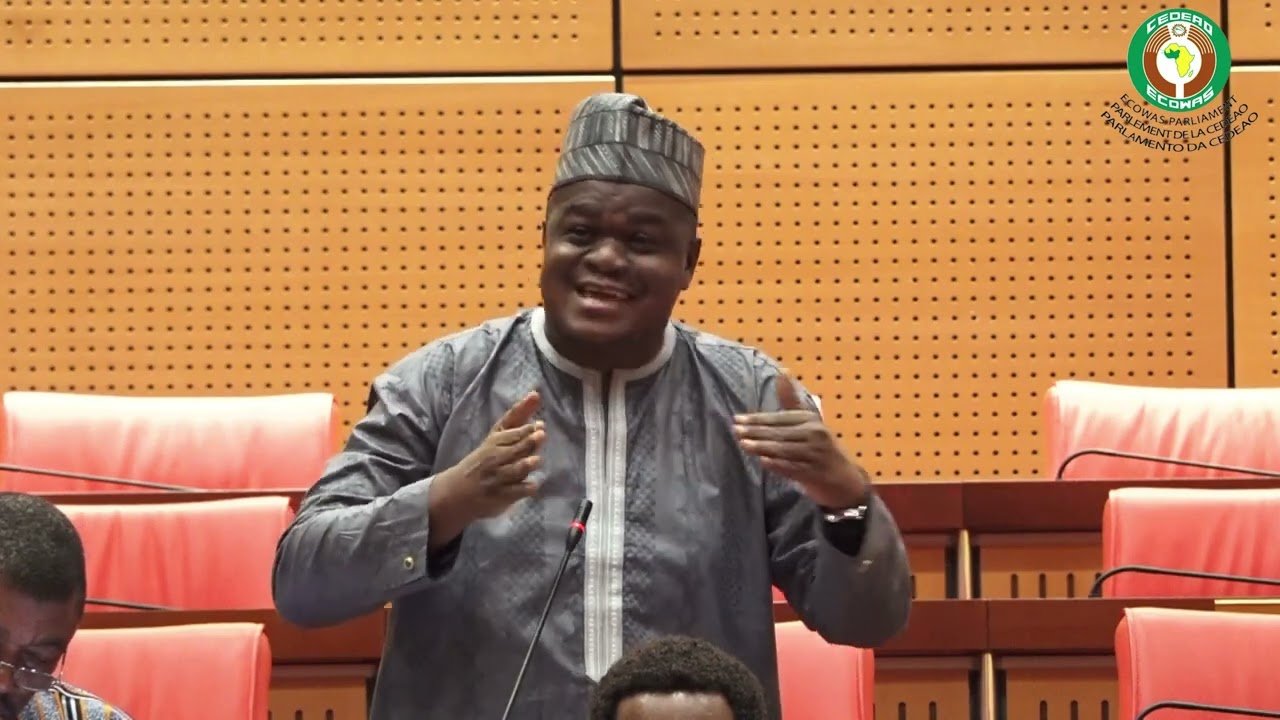
By Melvin Tejan Mansaray
A Sierra Leonean lawmaker and Member of the ECOWAS Parliament, Hon. Saa Emerson Lamina, has expressed concern over attempts by some West African leaders to seek extended stay in power, warning that altering term-limit arrangements after assuming office poses a threat to democracy and regional stability.
Hon. Saa Emerson Lamina, who also serves as Leader of Government Business Two in Sierra Leone’s Parliament, made the remarks on Tuesday, May 5, 2026, during the ongoing 2026 First Ordinary Session of the ECOWAS Parliament taking place in Abuja, Nigeria, from May 4 to 17.
Speaking exclusively to the Press following the presentation of country reports by Côte d’Ivoire, Ghana and The Gambia, the Sierra Leonean legislator praised the detailed nature of the reports, particularly on governance, peace, security, democracy, environmental challenges and the implementation of ECOWAS community initiatives.
“I should commend the presenters for giving comprehensive details on their political situation, democracy, peace, security and human rights, environmental situation including the effects of climate change and the status of implementation of Community texts, initiatives and programmes within member states,” Hon. Saa Emerson Lamina stated.
While acknowledging The Gambia’s strides in strengthening its Early Warning mechanisms and democratic participation, Hon. Saa Emerson Lamina said he remained skeptical about developments surrounding presidential term limits in the country.
“I expressed concern about the presidency and entrance legitimacy which seem to change from what they promised to the reality on the ground,” he said. “For example, there is a term limit debate, but at the time the President came to power, it turned out that there is no term limit now. That is surprising.”
The outspoken parliamentarian stressed that leaders across West Africa should avoid changing constitutional or political arrangements after gaining power, describing such actions as dangerous precedents capable of undermining democratic gains across the region.
“Technically, I am saying that leaders in West Africa must not shift the goalpost in the middle of the game. That is a red flag,” Hon. Saa Emerson Lamina emphasized.
According to him, prolonging presidential tenure beyond originally agreed democratic frameworks often creates political tension that can encourage unconstitutional changes of Government, including military interventions.
“The danger in the prolongation of term limits and shifting from campaign promises is that it attracts military intervention,” he warned.
However, Hon. Saa Emerson Lamina firmly stated that he does not support military takeovers, noting that juntas often suppress democratic institutions, restrict press freedom, dissolve parliament and suspend constitutions.
The Sierra Leonean MP further disclosed that he was uncomfortable that discussions surrounding the extension of presidential tenure were not explicitly highlighted in The Gambia’s Country Report presented before the ECOWAS Parliament.
He also questioned the proliferation of political parties in The Gambia, arguing that stronger eligibility standards should exist before political organizations are allowed to contest national elections.
“It is difficult to reconcile how a small country with a small population is having over twenty-two political parties,” he said. “There should be a stronger threshold in which individuals and political parties should fulfill before having the real opportunity to contest. That is very important.”
The Gambia is currently preparing for its December 2026 Presidential Elections, with the Independent Electoral Commission already publishing the official electoral timetable and key milestones for the process.
Hon. Saa Emerson Lamina observed that many leaders across Africa often begin their political journeys by promising reforms and democratic change, only to later seek prolonged rule.
“Fathers of democracy like the United States or even Nigeria have a two-term limit. I actually detest and do not admire leaders that campaign on the rules of two terms but turn out to be different with third-term ambitions and others becoming termless. It is not good for democracy and I think ECOWAS must act,” he declared.
Citing Article 40.2 of ECOWAS democratic principles, Hon. Saa Emerson Lamina argued that member states should work toward adopting more uniform democratic laws across the sub-region.
“It is possible for countries in ECOWAS to have uniform laws,” he explained. “For example, almost every country now adheres to the ECOWAS Protocol that says electoral laws cannot be changed six months before elections. Uniform laws will bring out the real tenets of democratic principles.”
The Gambia’s report to the ECOWAS Parliament highlighted that the country’s political environment remains “largely open and participatory,” while noting that Early Warning mechanisms continue monitoring emerging tensions and localized political disputes requiring timely intervention.
The debate over presidential tenure in The Gambia remains sensitive following the failure of constitutional reform efforts in 2020. Under the 1997 Constitution introduced during former President Yahya Jammeh’s administration, Presidents are permitted unlimited five-year terms.
As a result, no constitutional barriers currently prevent President Adama Barrow from seeking a third term in the 2026 elections, despite earlier political promises relating to constitutional reforms and governance changes.
In an interview with QTV on January 31, 2025, President Barrow openly confirmed his intention to seek re-election, stating: “Let me provide you with a direct answer: Yes, I will be contesting in the next presidential election.”
The Gambia, often referred to as the “Smiling Coast of West Africa,” has a population of over 2.4 million people and is known for its rich cultural heritage, Islamic traditions, kora music and griot storytelling.