

By Alvin Lansana Kargbo
The Government of Sierra Leone has announced encouraging progress in the country’s agricultural sector following the release of the 2025 Sierra Leone Crop Production Survey, which shows increased rice production, improved crop yields and steady advancement toward national food self-sufficiency under the Feed Salone programme.
Published by the Ministry of Agriculture and Food Security (MAFS) on 26 June 2026, the survey was conducted in partnership with the Planning, Evaluation, Monitoring and Statistics Division (PEMSD) and Statistics Sierra Leone. It provides comprehensive data on the country’s agricultural performance during the 2025/2026 cropping season and highlights positive trends across both food and cash crops.
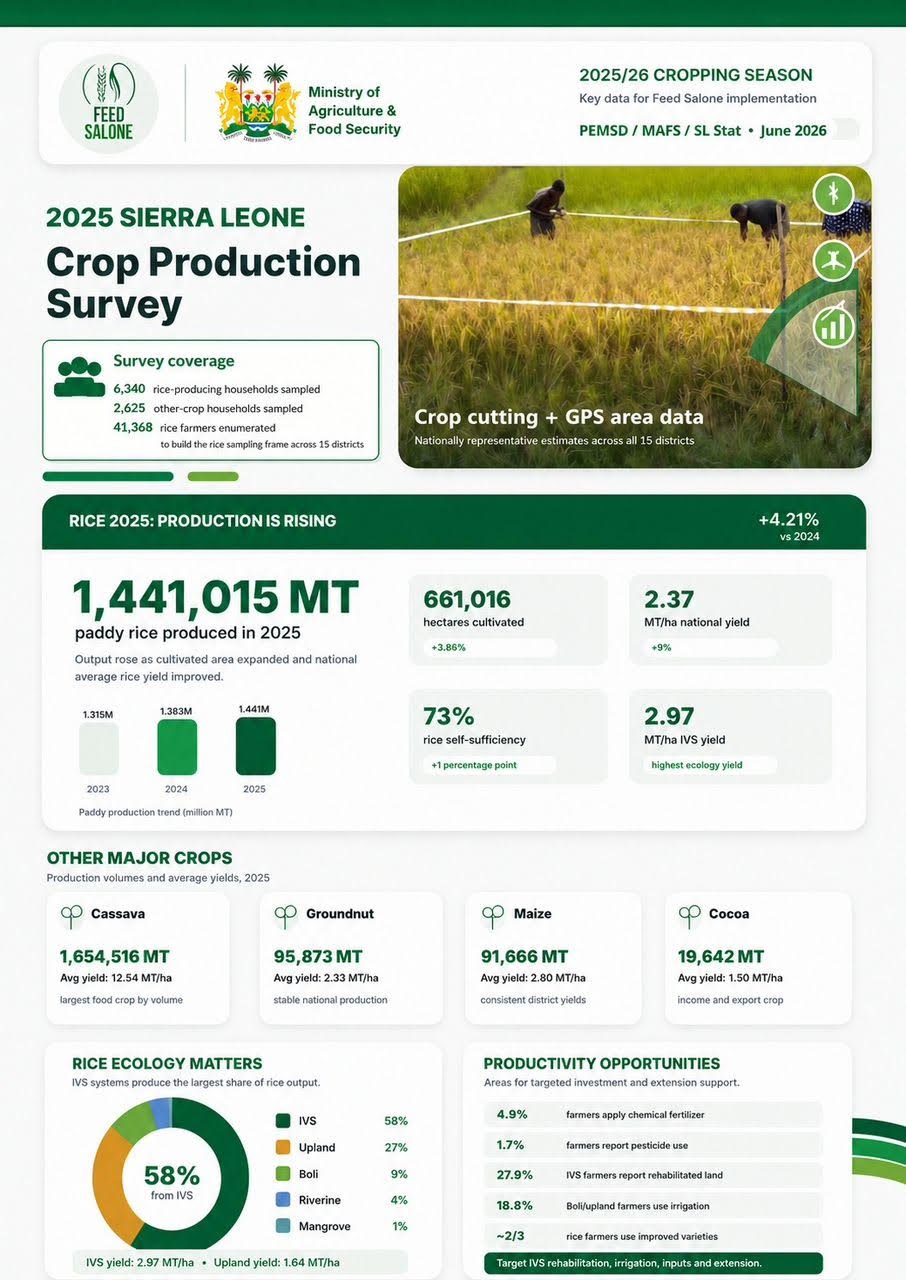
According to the report, Sierra Leone produced 1,441,015 metric tonnes of paddy rice in 2025, representing a 4.21 percent increase over the previous year’s production. The report attributes the increase to the expansion of cultivated farmland and improved productivity among farmers nationwide.
The survey shows that farmers cultivated approximately 661,016 hectares of rice during the year, reflecting a 3.86 percent increase compared to 2024. National average rice yield also improved significantly, rising by 9 percent to 2.37 metric tonnes per hectare. Rice self-sufficiency increased to 73 percent, up from 72 percent recorded the previous year, demonstrating continued progress toward reducing dependence on imported rice.
Officials noted that Inland Valley Swamp (IVS) farming remains the country’s most productive rice-growing ecology, contributing 58 percent of national rice production while recording the highest average yield of 2.97 metric tonnes per hectare. Upland farming accounted for 27 percent of total production, followed by boli lands with 9 percent, riverine areas with 4 percent and mangrove ecologies contributing 1 percent.
The nationwide survey covered all 15 districts using crop-cutting techniques supported by GPS-based area measurements to produce nationally representative estimates. A total of 6,340 rice-producing households and 2,625 households cultivating other crops were sampled, while 41,368 rice farmers were enumerated to establish the national rice sampling framework.
Beyond rice, the survey recorded encouraging performances in other major crops. Cassava remained the country’s largest food crop, with production reaching 1,654,516 metric tonnes at an average yield of 12.54 metric tonnes per hectare. Groundnut production stood at 95,873 metric tonnes with an average yield of 2.33 metric tonnes per hectare, while maize production reached 91,666 metric tonnes at an average yield of 2.80 metric tonnes per hectare. Cocoa production totalled 19,642 metric tonnes with an average yield of 1.50 metric tonnes per hectare, reaffirming its importance as a major export commodity.
Despite those gains, the survey identified several challenges limiting agricultural productivity. Only 4.9 percent of farmers reported using chemical fertilizers, while pesticide use remained low at 1.7 percent. Irrigation access also remains limited, with only 18.8 percent of farmers in boli and upland ecologies benefiting from irrigation systems. Additionally, 27.9 percent of IVS farmers reported cultivating rehabilitated swamp land.
The report recommends increased investment in Inland Valley Swamp rehabilitation, expansion of irrigation infrastructure, improved access to agricultural inputs and strengthened extension services. It concludes that continued implementation of the Feed Salone initiative will be critical to sustaining agricultural growth, improving farmers’ livelihoods and accelerating Sierra Leone’s journey toward achieving full national food security.