

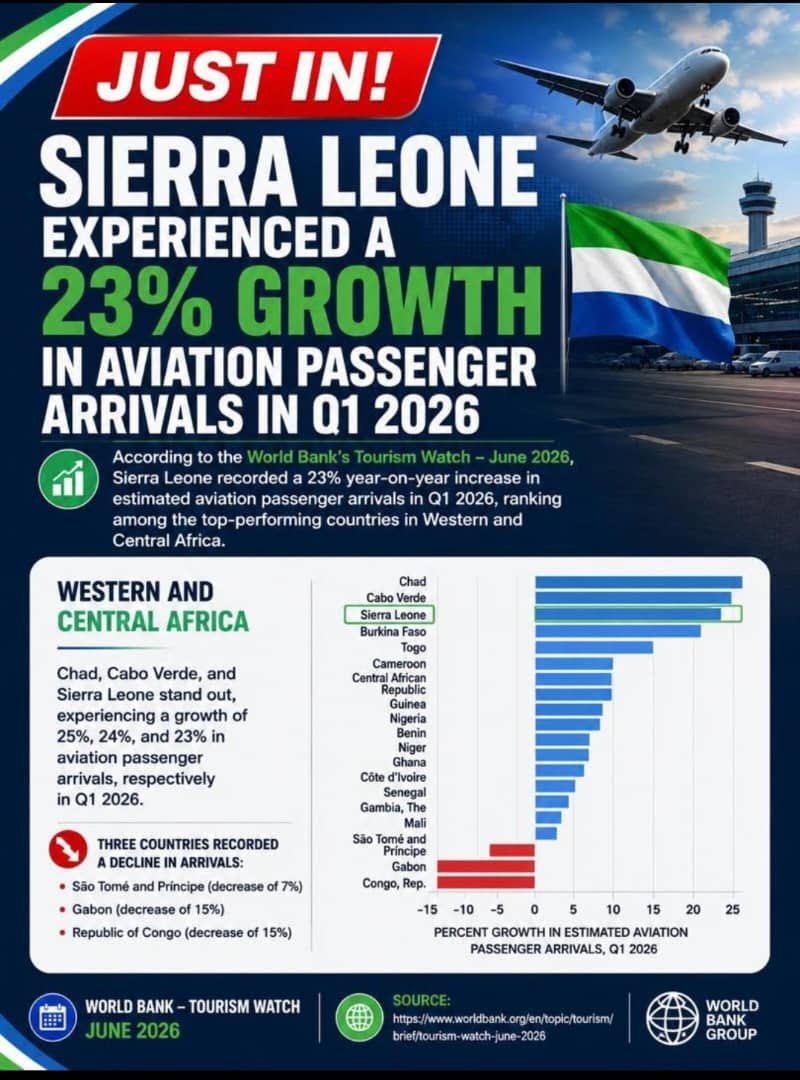
Sierra Leone has emerged as one of Africa’s strongest-performing tourism destinations after recording a remarkable 23 percent increase in aviation passenger arrivals during the first quarter of 2026, according to the latest World Bank Tourism Watch: June 2026 report.
The report ranks Sierra Leone among the top three performers in Western and Central Africa, behind Chad, which recorded a 25 percent increase, and Cabo Verde with 24 percent. Sierra Leone’s performance reflects growing international confidence in the country’s tourism sector and improving air connectivity.
The World Bank noted that while international tourism continues to recover globally, growth has become increasingly uneven due to geopolitical tensions, rising travel costs, air connectivity disruptions and economic uncertainty. Despite those global challenges, Sierra Leone maintained one of the region’s strongest growth rates in aviation passenger arrivals.
According to the report, Western and Central Africa produced some of the continent’s most encouraging tourism figures during the first quarter of 2026. Chad, Cabo Verde and Sierra Leone led the region with aviation passenger arrival growth of 25 percent, 24 percent and 23 percent respectively.
In contrast, São Tomé and Príncipe recorded a seven percent decline in passenger arrivals, while Gabon and the Republic of Congo each experienced a 15 percent decrease, highlighting the growing disparity in tourism performance across the region.
The World Bank’s analysis uses aviation passenger arrivals as a key indicator of tourism activity, providing insight into international travel demand and destination competitiveness.
Globally, international tourism remained resilient during the first quarter of 2026 despite mounting geopolitical and economic pressures. Approximately 307 million international tourists travelled worldwide during the period, representing a two percent increase compared to the same period in 2025.
However, the report notes that growth slowed toward the end of the quarter following escalating conflict in the Middle East, which disrupted air connectivity, pushed up oil prices and increased transportation costs. Those factors are expected to reduce overall global tourism growth below earlier projections for 2026.
The World Bank observed that travellers are increasingly choosing shorter regional trips over long-haul destinations as uncertainty and higher travel expenses reshape global tourism patterns.
Africa continued to demonstrate resilience, recording an overall four percent increase in international arrivals during the first quarter. North African destinations experienced particularly strong momentum, while Sub-Saharan Africa maintained steady growth throughout the period.
Complementary aviation data cited by the World Bank showed that global passenger traffic increased by approximately five percent year-on-year during the first quarter of 2026, with several African markets, particularly those in West Africa, recording some of the strongest performances worldwide.
The report suggests that Sierra Leone’s strong showing places the country among a growing group of destinations benefiting from increased international travel demand and improved regional connectivity.
While mature tourism markets in Europe and North America continue to dominate global tourism revenues, the World Bank notes that emerging destinations such as Sierra Leone are demonstrating significant potential for sustained growth if supported by continued investment in infrastructure, air transport, hospitality and destination marketing.
The findings provide further evidence that Sierra Leone’s tourism sector is steadily gaining international attention despite global economic headwinds. The country’s 23 percent growth in aviation passenger arrivals positions it as one of the leading tourism growth stories in West and Central Africa during the opening months of 2026 and reflects increasing confidence among international travellers choosing Sierra Leone as a destination.