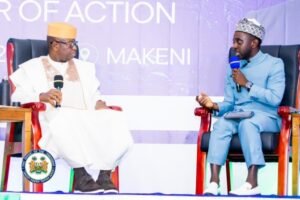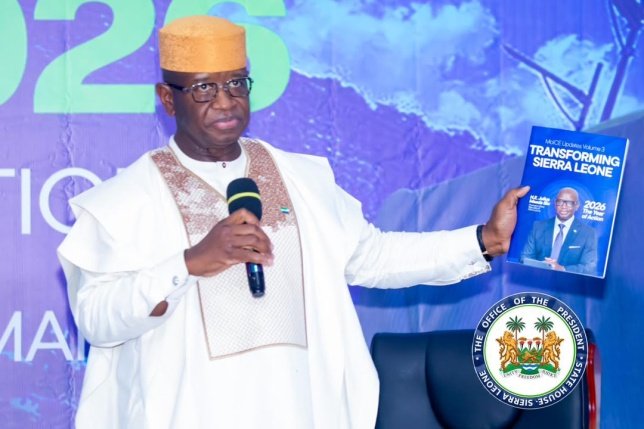
President Julius Maada Bio’s Third Presidential Town Hall Meeting at the University of Makeni (UNIMAK) Hall, on Tuesday, 30 June 2026 was more than another public engagement. It was a carefully orchestrated opportunity for the Head of State to present his administration’s achievements, defend its record and reassure Sierra Leoneans that his Government remains committed to inclusive governance, constitutional democracy and national development. However, beyond the speeches, applause and official statistics lies a broader question that deserves continued public scrutiny: how do Government’s claims compare with the everyday realities experienced by citizens?
Held under the theme, “Year of Action”, the forum attracted Cabinet Ministers, local authorities, Paramount Chiefs, Civil Society representatives, students, youth groups, development partners and ordinary residents. The event reflected Government’s increasing reliance on public dialogue as a governance tool. While such engagements promote transparency and accountability in principle, they also provide an opportunity for investigative examination of official claims against measurable outcomes.
Throughout the meeting, President Bio outlined what he described as significant national achievements. He cited expanded educational access for approximately two million children, increased electricity coverage to 36 percent, reductions in maternal and child mortality, declining food inflation, improved road infrastructure and greater investment in human capital development.
Those figures undoubtedly present a picture of progress. Yet they also raise important questions requiring independent verification. Development indicators are meaningful only when supported by accessible data, institutional transparency and measurable improvements in citizens’ daily lives. Many Sierra Leoneans continue to face high living costs, irregular electricity supply, limited employment opportunities and challenges accessing quality healthcare despite Government’s reported investments.
One of the most politically sensitive moments came when President Bio addressed concerns surrounding the constitutional review process. Rejecting allegations that constitutional reforms are intended to extend his tenure, he maintained that the review began under previous administrations and is simply following an established democratic process now before Parliament.
His clarification attempts to counter growing public speculation. However, constitutional reforms in any democracy require not only parliamentary approval but broad public confidence. The credibility of the process will ultimately depend on transparency, extensive public consultation and whether the final document reflects national consensus rather than political interests.
Similarly, the President’s announcement that the long-delayed national population and housing census will finally take place later this year carries significant political and economic implications. Census data influence constituency boundaries, public resource allocation, infrastructure planning and future elections. Given previous controversies surrounding demographic statistics, ensuring an independent, transparent and internationally credible process will be essential in maintaining public trust.
Perhaps the strongest political message delivered during the Town Hall focused on national unity. President Bio repeatedly rejected tribalism and regionalism, insisting that development remains the only language capable of uniting Sierra Leoneans. He defended the inclusiveness of his administration by pointing to appointments made across regional lines and highlighting his long-standing professional relationships with individuals from northern Sierra Leone.
While these statements seek to bridge longstanding political divisions, perceptions of regional imbalance continue to feature prominently in public discourse. Investigative reporting into appointments across Ministries, Agencies and state institutions remains necessary to determine whether recruitment consistently reflects merit, regional balance and constitutional principles.
The economy also featured prominently during the engagement. President Bio acknowledged persistent electricity challenges, attributing them largely to decades of underinvestment, infrastructure vandalism and widespread electricity theft. His Government’s plans to expand Bumbuna’s generation capacity and strengthen transmission infrastructure signal long-term ambitions.
Yet for many businesses and households experiencing daily power outages, the central concern is not future projections but immediate service delivery. Reliable electricity remains fundamental to economic productivity, industrial growth and job creation. Continued monitoring of energy sector investments, project implementation timelines and budget utilization will determine whether these commitments translate into tangible improvements.
Agriculture received renewed attention through the Feed Salone initiative. Government maintains that improving mechanization, research, feeder roads and agricultural subsidies will strengthen food security and reduce import dependence. Those objectives align with national priorities, but questions remain regarding implementation, funding efficiency and measurable impact on domestic food production. Independent assessment of agricultural outputs and rural livelihoods will be necessary to evaluate whether policy ambitions produce lasting results.
On youth empowerment, President Bio acknowledged that Government alone cannot provide employment for every graduate, emphasizing instead the importance of private sector investment and entrepreneurship. While that reflects economic reality, unemployment among young people remains one of Sierra Leone’s most pressing social challenges. Future assessments should examine whether investment policies are generating sufficient quality jobs and whether entrepreneurship programmes produce sustainable businesses rather than short-term interventions.
Healthcare achievements also featured prominently. The President highlighted reductions in maternal and infant mortality, recruitment of healthcare professionals and expanded disease surveillance against the Ebola outbreak affecting parts of the region. Those are encouraging indicators, yet healthcare delivery continues to face shortages of medicines, equipment and qualified personnel in several districts. Measuring health sector performance therefore requires balancing official statistics against conditions experienced in hospitals and community health centres nationwide.
Perhaps the most controversial subject discussed involved drug trafficking and substance abuse. President Bio revealed that over 120 drug-related convictions have been secured, five rehabilitation centres established and stronger international cooperation initiated to combat narcotics trafficking. At the same time, he cautioned against narratives portraying Sierra Leone as a narcotic state, arguing that such perceptions damage investment and the country’s international reputation.
While protecting national image is important, investigative journalism has an equally important responsibility to expose organized crime, examine institutional weaknesses and demand accountability wherever evidence exists. Public confidence is strengthened not by dismissing concerns but by ensuring transparent investigations, effective prosecutions and independent oversight of anti-drug efforts.
The Town Hall concluded with symbolic grants for youth entrepreneurs, the launch of the Ministry of Information and Civic Education’s Update Magazine and renewed appeals for unity, transparency and citizen participation.
Ultimately, the Makeni Town Hall demonstrated Government’s willingness to engage directly with citizens. It also reinforced an equally important democratic principle: official statements should not represent the final word on governance. They should instead mark the beginning of deeper public inquiry. In any functioning democracy, development is measured not only by announcements, statistics or political speeches, but by independently verifiable evidence, institutional accountability and the lived experiences of ordinary citizens. The real test of the “Year of Action” will therefore not be the promises made during the Town Hall, but whether those promises withstand public scrutiny in the months and years ahead.