

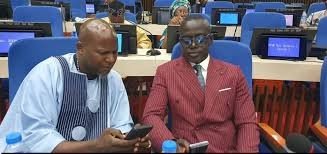
Two Members of Parliament from the main opposition All People’s Congress (APC), Hon. Mohamed Bangura and Hon. Alfred Ayodele Thompson, remained in the Chamber on Monday, August 10, 2026, as their fellow APC lawmakers staged a walkout during proceedings on the Constitution of Sierra Leone (Amendment) Bill, 2025.
The decision by the two parliamentarians not to join their colleagues immediately attracted political attention, highlighting differences within the opposition over how its MPs should respond to contentious constitutional and governance matters.
While other APC lawmakers left the Chamber to demonstrate their objection to the constitutional amendment process, Hon. Mohamed Bangura and Hon. Alfred Ayodele Thompson stayed behind and continued participating in the parliamentary proceedings.
Their decision was particularly significant because both MPs have previously differed with their party over its positions and approaches to certain political and governance issues.
The development is expected to renew debate over party discipline and the extent to which elected parliamentarians should follow collective party decisions when considering major national legislation.
For supporters of strict party discipline, remaining in the Chamber could be viewed as a departure from the collective position adopted by the APC parliamentary caucus. Others may argue that MPs have an individual responsibility to exercise their judgment and participate in parliamentary proceedings, particularly when legislation with far-reaching national consequences is under consideration.
The walkout came against the backdrop of intense political debate over the Constitutional Amendment Bill and disagreements surrounding some of its provisions and the procedure for approving them.
Following the action, Leader of the Opposition in Parliament, Hon. Abdul Kargbo, commended opposition lawmakers for what he described as their courage and commitment to defending the Constitution.
Hon. Abdul Kargbo described the occasion as one of the most important opportunities MPs have had to stand for the people and defend Sierra Leone’s supreme law.
“To all Honourable Members of Parliament, particularly Members on the Opposition side, I want to commend you for demonstrating that you stand with the people and that you stand for the Constitution,” he stated.
According to the Opposition Leader, democracy comes with challenges, but elected representatives must be prepared to take difficult positions when they believe the interests of citizens and constitutional governance are at stake.
He argued that where the Constitution requires a two-thirds majority for an amendment, parliamentarians have a responsibility to ensure that such a requirement is respected.
Hon. Abdul Kargbo also rejected suggestions that the opposition’s action amounted to a boycott of Parliament, describing it instead as a principled response to what the opposition believed was a procedurally unconstitutional attempt to amend the Constitution.
“We did not boycott Parliament,” he stressed, maintaining that the opposition acted to defend the integrity of Parliament and the Constitution from which the institution derives its authority.
He thanked MPs who supported the opposition’s position and called for continued unity when Parliament resumes its work.
The controversy surrounding the parliamentary proceedings comes just a day after the APC publicly outlined its position on the proposed constitutional reforms.
In a statement dated August 9, 2026 and signed by APC National Secretary General Lansana Dumbuya, Esq., the party made clear that it was not opposed to constitutional reform or rejecting the Amendment Bill in its entirety.
Instead, the APC expressed support for several provisions it believes could strengthen democracy, expand political participation and promote greater inclusion.
Among them is the proposed constitutional guarantee of at least 30 percent representation for women in political nominations. The APC said women constitute a significant proportion of Sierra Leone’s population and have contributed immensely to the country’s political, social and economic development.
The party also backed proposals to expand opportunities for Sierra Leoneans holding dual citizenship by allowing them to contest parliamentary elections and qualify for ministerial and other public appointments, subject to applicable constitutional and legal requirements.
However, it supports retaining the existing citizenship requirements for the offices of President and Vice-President.
Despite backing those reforms, the APC maintained strong opposition to replacing constituency-based First-Past-the-Post (FPTP) elections with Proportional Representation as the country’s regular electoral system.
The party argued that FPTP maintains a direct relationship between constituents and their elected representatives, allowing communities to identify and hold their MPs accountable.
It also cited positions expressed by Paramount Chiefs, Civil Society Organisations, religious leaders and citizens during constitutional consultations as supporting constituency-based representation.
The APC similarly called for retention of the existing 55 percent threshold required for a presidential candidate to win an election.
According to the opposition party, the threshold encourages presidential candidates to build support beyond their traditional political strongholds and promotes broader national consensus.
Where no candidate reaches 55 percent in the first round, the APC argued, parties and candidates must engage other communities, negotiate alliances and broaden their national appeal ahead of a runoff.
The party therefore appealed to lawmakers from both the APC and governing Sierra Leone People’s Party (SLPP) to consider the long-term national implications of constitutional amendments rather than temporary partisan interests.
It maintained that constitutional reform should not be reduced to an APC-versus-SLPP political contest, stressing that the Constitution ultimately belongs to the people of Sierra Leone.
Against that backdrop, Monday’s walkout and the decision of Hon. Mohamed Bangura and Hon. Alfred Ayodele Thompson to remain in the Chamber have introduced another dimension to the debate, raising questions about party unity, parliamentary independence and the responsibilities of individual MPs during major constitutional decisions.
The APC has reaffirmed its support for constitutional reform, increased women’s representation, expanded opportunities for dual citizens and stronger democratic institutions, while maintaining its demand for FPTP elections and the 55 percent presidential threshold.
“Country first. Democracy always. The people must have the final say,” the APC statement concluded.