

By Amin Kef Sesay
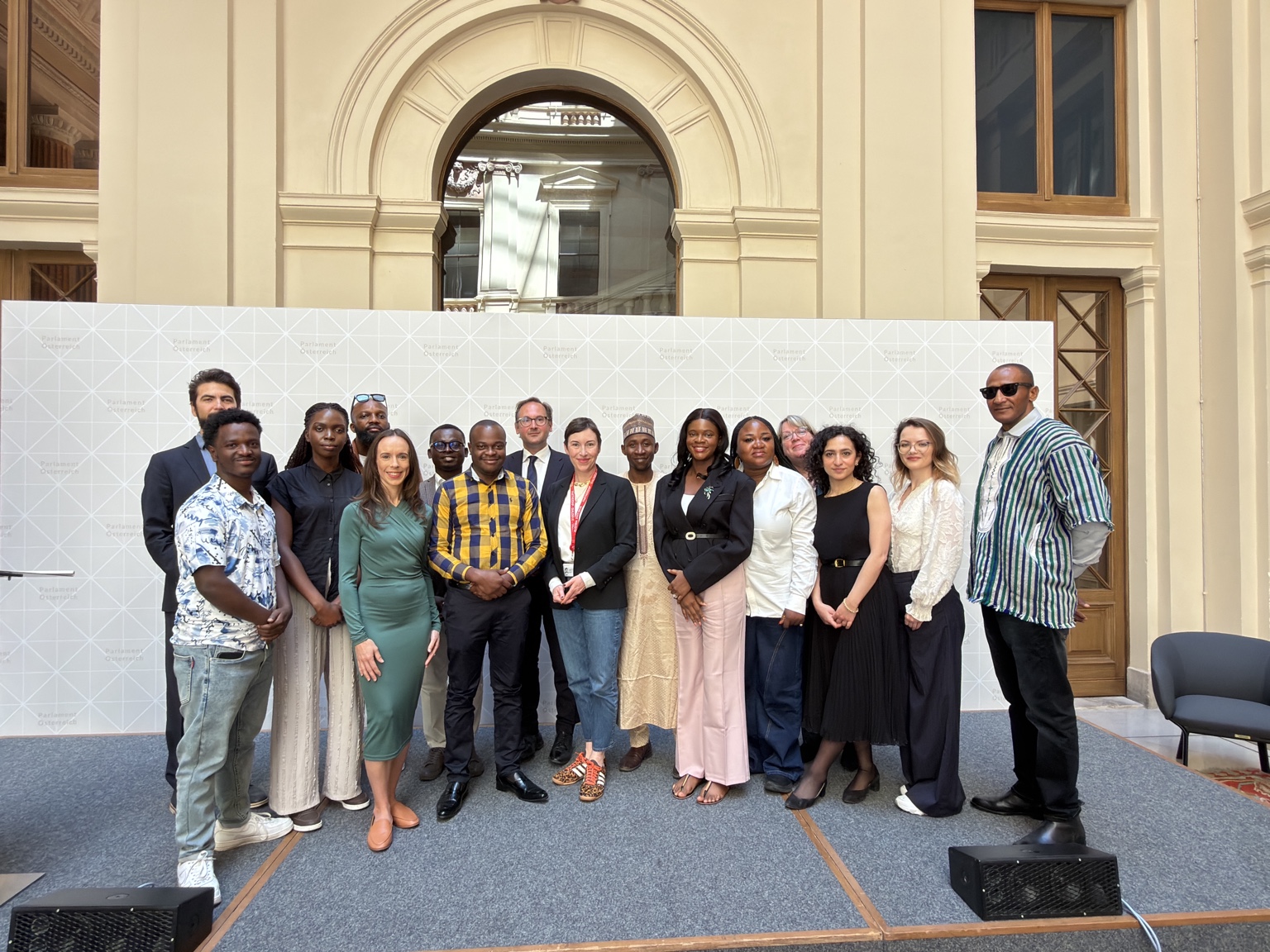
Ten journalists from different African countries participating in the Austria-Africa Media Fellowship Programme in Vienna, Austria, on Tuesday, 19 May 2026, engaged senior Members of the Austrian Parliament in an insightful and wide-ranging discussion on democracy, media literacy, misinformation, Austria–Africa relations and the growing threat of foreign disinformation campaigns on democratic institutions and societies.
The engagement, held as part of the Austria-Africa Media Fellowship Programme, brought together journalists from Sierra Leone, Nigeria, Ghana, South Africa, Kenya, Ethiopia and Zimbabwe with Austrian lawmakers for an exchange of ideas on governance, digital security, media responsibility and the future of international partnerships between Africa and Europe.
The meeting featured Member of the Austrian National Council and Vice-Chair of the Foreign Affairs Committee, Andreas Minnich, alongside Member of the Austrian National Council, Henrike Brandstötter, who both shared perspectives on Austria’s democratic system, geopolitical realities and the country’s growing concern over the spread of fake news and digital manipulation.
The African journalists participating in the fellowship included Favour Ulebor-Emmanuel of Vanguard Newspaper, Nigeria; Alhassan Bala, Founder and Editor of Alkalanci (The Arbiter), Nigeria; Albert Oppong-Ansah, Editor and Desk Head for Environment, Science and Energy at the Ghana News Agency; Amin Kef Sesay, Managing Editor of The Calabash Newspaper, Sierra Leone; Miriam Angil, Head of Communications at Swahilipot Hub Foundation, Kenya; Clement Manyathela, Host of The Clement Manyathela Show on Radio 702, South Africa; Erin Marisa Bates, Anchor and Presenter at Carte Blanche, South Africa; Eyasu Zekarias Tadesse, Reporter and Fact Checker at Capital Ethiopia/FM 97.7, Ethiopia; Ernestina Serwaa Asante, Multimedia Journalist at GhanaWeb; and Farai Shawn Matiashe, International Journalist from Zimbabwe.
The engagement provided participants with a firsthand understanding of Austria’s parliamentary system, political dynamics and democratic governance, while also allowing room for meaningful dialogue on global issues affecting both continents.
Speaking during the session, Henrike Brandstötter gave a detailed overview of Austria’s current political structure, explaining that the country operates under a five-year parliamentary term and is presently governed through a three-party coalition arrangement.
According to Henrike Brandstötter, Austria’s National Council consists of 183 members, while the Federal Council represents the country’s federal system and regional interests.
She explained that Austria’s political environment, like many democracies around the world, is increasingly shaped by economic pressure, geopolitical instability and political polarization.
Henrike Brandstötter noted that the Russia–Ukraine war, instability in the Middle East, inflation and economic challenges continue to influence policymaking and political discourse in Austria and across Europe.
She further highlighted concerns over the growing influence of far-right political movements, warning that democratic institutions must continue to evolve to remain resilient in increasingly polarized environments.
According to Henrike Brandstötter, Austria’s coalition government is a necessary democratic arrangement designed to maintain stability despite ideological differences among the governing parties.
She acknowledged that governance in such circumstances can be challenging but stressed the importance of dialogue, compromise and shared responsibility in protecting democratic systems.
Turning to Austria’s engagement with Africa, Henrike Brandstötter disclosed that Austria is repositioning its approach toward African partnerships through a renewed Africa Strategy focused more on trade, investment, innovation and equal cooperation rather than limiting relations to development assistance and humanitarian support.
She emphasised that Austria increasingly views Africa as a continent of opportunity and long-term partnership.
“The future is in Africa,” Henrike Brandstötter stated, stressing that Europe must rethink its approach and begin engaging African countries more as strategic partners capable of driving global economic growth and innovation.
She maintained that Austria seeks stronger cooperation with African countries through parliamentary exchanges, development programmes, diplomatic engagement and mutually beneficial economic partnerships.
A major focus of the discussions centered on misinformation, disinformation and foreign propaganda, particularly the impact of Russian misinformation campaigns in Europe and Africa.
Andreas Minnich and Henrike Brandstötter both acknowledged that disinformation has emerged as a major threat to democracy, national security and public trust across Europe.
According to Andreas Minnich, misinformation campaigns often exploit social tensions, target vulnerable populations and seek to weaken confidence in democratic institutions and traditional journalism.
He stressed that misinformation, particularly online disinformation, spreads rapidly and cheaply, making it increasingly difficult for governments, institutions and journalists to respond effectively.
The Austrian lawmakers noted that fake news and manipulated content continue to shape political narratives, influence public opinion and deepen societal divisions, especially through digital platforms and social media.
They explained that Austria is increasingly treating misinformation not only as a media challenge but also as a national security issue requiring coordinated responses.
The African journalists also shared experiences from their respective countries, providing practical examples of how misinformation and propaganda have influenced political discourse, elections and public perception across the continent.
Journalists from Nigeria, South Africa and Ghana described how social media manipulation, false narratives, fake job opportunities and foreign propaganda increasingly target young people and communities with low media literacy.
Some participants explained that misinformation spreads rapidly through WhatsApp, Facebook, radio stations, influencers and online platforms where fact-checking mechanisms are often weak or nonexistent.
They observed that misleading narratives frequently gain traction during elections, protests and periods of political uncertainty, increasing the risk of instability and mistrust among citizens.
Amin Kef Sesay, Managing Editor of The Calabash Newspaper in Sierra Leone, raised questions regarding Austria’s parliamentary cooperation with African countries, particularly Sierra Leone.
He sought to understand how Austria intends to deepen partnerships with African countries in areas such as democratic governance, education, youth empowerment, media development, investment and diplomatic cooperation.
Amin Kef Sesay also inquired about opportunities for parliamentary exchanges, scholarships and institutional partnerships that could directly benefit Sierra Leone and other African countries.
In response, the Austrian parliamentarians reaffirmed Austria’s commitment to strengthening relations with African countries through dialogue, diplomacy and mutually beneficial engagement.
Henrike Brandstötter emphasized the importance of strengthening media literacy, especially among young people and citizens in rural communities, as one of the most effective ways to combat misinformation.
She explained that Austria is increasingly introducing educational programmes aimed at helping young people identify fake news, verify information and better understand responsible digital behaviour.
According to her, schools are gradually incorporating media literacy and digital awareness programmes to equip students with skills to navigate online content responsibly.
She further revealed that discussions are ongoing in Austria about strengthening safeguards for children and young people against harmful online content and excessive social media influence.
The parliamentarians also underscored the importance of trusted journalism, ethical reporting and professional fact-checking in defending democracy against misinformation.
They encouraged journalists to prioritize accuracy, verification and balanced reporting in order to maintain public confidence in traditional media.
The engagement climaxed with an interactive question-and-answer session where participants exchanged experiences, discussed practical strategies to counter misinformation and explored opportunities for stronger Austria–Africa cooperation.
The discussions highlighted the urgent need for governments, journalists, educators and civil society organizations to work collaboratively in promoting media literacy, protecting democratic values and combating the increasing spread of false information.
For the participating African journalists, the meeting offered valuable insight into Austria’s parliamentary system, democratic processes and policy approaches to addressing global challenges, while also strengthening dialogue on future partnerships between Africa and Europe based on trust, cooperation and shared interests.