

By Alvin Lansana Kargbo
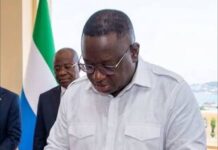
Sierra Leone once again took a prominent place on the global stage as President Dr. Julius Maada Bio officially opened the 2025 Climate Resilience and Energy Transition Dialogue (CRET 2025) on Monday, October 20, 2025, at the Freetown International Conference Centre.
The two-day conference, themed: “Mobilizing Investments for Climate Action, Food Security, Clean Cooking and a Just Energy Transition for All,” brought together world leaders, policymakers, development partners, private investors and civil society organizations to explore strategies for building a greener and more sustainable energy future for Sierra Leone and the African continent. Vice President Dr. Mohamed Juldeh Jalloh also graced the event, reaffirming the Government’s collective commitment to accelerating the country’s green transformation agenda.
In his keynote address, President Julius Maada Bio emphasized his administration’s unwavering dedication to ensuring nationwide energy access and sustainability. He described Sierra Leone’s energy transition as a practical, deliberate and people-centered process grounded in transparency, reform and inclusivity. Reflecting on the achievements of previous editions of CRET, he pointed to tangible results from international partnerships, including a $260 million funding package from the OPEC Fund for International Development and the establishment of a Climate Finance and Energy Innovation Hub. These milestones, he noted, align with Sierra Leone’s Medium-Term National Development Plan (2024–2030) and the United Nations Sustainable Development Goals.
“CRET 2025 consolidates those gains to operationalize our Just Energy Transition and Green Growth Plan,” President Bio stated. “It brings together national and international stakeholders to accelerate Sierra Leone’s energy transformation.”
A major highlight of the dialogue was Mission 300, an ambitious Africa-led initiative aimed at connecting 300 million people to electricity by 2030. President Bio revealed that Sierra Leone’s contribution targets an increase in electricity access from 36 percent to nearly 78 percent by 2030, translating into over 720,000 new household connections through grid expansion, off-grid solutions and renewable mini-grids. He cited ongoing projects such as the 40MW Scatec Solar Plant in Kamakwie, the 40MW RESPITE Solar Project in Newton and Lungi and the 50MW Africa50 Power Project in Kono as key examples of the nation’s determination to achieve energy sovereignty. “Our goal is to ensure that as we expand access to energy, no one is left behind,” he affirmed.
President Bio praised the leadership of Hon. Dr. Kandeh Kolleh Yumkella, Chairman of the Presidential Initiative on Climate Change, Renewable Energy and Food Security (PI-CREF), whose strategic coordination has been pivotal in steering national energy reforms and fostering partnerships. “Dr. Yumkella’s stewardship has been instrumental in fast-tracking our transition agenda,” he remarked.
Hon. Dr. Kandeh Kolleh Yumkella, in his remarks, highlighted the importance of continuity and collaboration in sustaining progress. Demonstrating inclusive leadership, he invited his predecessor, former Energy Minister Alhaji Kanja Sesay, to participate in the dialogue; an act widely applauded as a gesture of unity and respect for institutional legacy. “To reach energy sovereignty, we must continue to build upon the successes of those who came before us,” he said, emphasizing that the energy transition transcends political boundaries and depends on collective national effort.
Development partners, including representatives from the World Bank, African Development Bank (AfDB), the United Nations and the Millennium Challenge Corporation (MCC), reiterated their support for Sierra Leone’s clean energy drive.
World Bank Representative, Daniel James, described CRET 2025 as “a testament to Sierra Leone’s strong commitment to sustainable economic growth through energy transformation.”
AfDB Country Manager, Dr. Dymphana Van der Lans, commended the Government’s visionary leadership, while UN Resident Coordinator, Seraphine Wakana, reaffirmed the UN’s ongoing collaboration in advancing climate resilience and energy access.
Deputy Minister of Finance I, Kadiatu Alie, noted that CRET serves as a critical platform for aligning climate financing with national investment priorities.
Chief Minister Dr. Moinina David Sengeh echoed that sentiment, urging all stakeholders to “stick to the plan and follow the leader,” as he highlighted the Government’s success in doubling electricity access from 18 percent in 2018 to 36 percent in 2025. He disclosed that Sierra Leone is investing $480 million in transmission lines under the MCC Compact, $450 million in the LNG energy plant at Kissy and over $500 million in projects funded through partnerships with British International Investment (BII), the World Bank and the private sector.
The conclusion of CRET 2025 underscored that Sierra Leone’s leadership is not merely engaging in policy discussions but driving tangible action toward a sustainable future. President Bio’s closing declaration, “Our national vision for energy security is achievable”, captured the spirit of determination shaping the nation’s development trajectory. Through steadfast governance, innovation and global collaboration, Sierra Leone is positioning itself not just as a participant but as a trailblazer in Africa’s green growth and just energy transition.