


By Foday Moriba Conteh
The Mayor of Freetown, Yvonne Aki-Sawyerr OBE, has sounded the alarm over what she described as an “unprecedented and totally unacceptable situation”; the growing number of corpses found on the streets of the capital, which are widely believed to be linked to the consumption of the dangerous substance Kush.
In an official letter dated on September 17, 2025 addressed to the Minister of Internal Affairs, Hon. AIG (Rtd) Morie Lengor, the Mayor revealed that the Freetown City Council (FCC) has been overwhelmed by the frequency of body collections in recent years. While historically the Council has provided pauper burials for destitute individuals, the surge since 2022 has escalated to almost daily collections.
According to FCC records, between January and August 13, 2025, a total of 142 corpses were collected; 136 male and 6 female. Disturbingly, in less than a month after that date, an additional 32 bodies were retrieved, including 31 males and 1 female. Most of the deceased are young people, a reality the Mayor described as “deeply troubling.”
“This phenomenon cannot be met with silence,” Mayor Aki-Sawyerr stressed, urging urgent Government intervention to investigate the root causes and curb the rising loss of young lives. She warned that without immediate action, FCC may be forced to suspend collections, as continuing under silence and strained finances is unsustainable.
The Mayor explained that the increasing collections have forced FCC to set up a special burial team, which requires gloves, disinfectants, masks, body bags and fuel, creating an unbudgeted financial strain on the Council’s already limited resources.
Beyond the financial burden, the Mayor emphasized the moral and societal imperative:
“While the financial implications of this situation are unwelcome, of far greater concern to me is that there is a moral and societal imperative to address this unprecedented and totally unacceptable situation.”
The letter was copied to the Minister of Health, the Inspector General of Police, the Deputy Mayor of Freetown, the Chief Councillor and the Chief Administrator of FCC, signaling the seriousness of the issue.
With drug abuse, especially Kush, increasingly devastating Sierra Leone’s youth, the Mayor’s call adds urgency to growing public concern. She appealed for a coordinated and decisive Government response to protect the city’s young population and restore dignity to the streets of Freetown.
The Ministry of Basic and Senior Secondary Education (MBSSE) has announced that the online registration portal for the November 2025 Private West African Senior School Certificate Examination (WASSCE) has been officially reopened.
In a public notice issued on Tuesday 23rd September, 2025, the Ministry confirmed that all verified candidates who have received their Personal Identification Number (PIN) and Serial Number from MBSSE are now eligible to register free of charge at designated registration cafés across the country.
The Ministry strongly emphasized that:
To guarantee transparency and efficiency, officials from MBSSE have been deployed to various centers to monitor activities and provide necessary support to both candidates and operators.
The Ministry has therefore urged parents, candidates and school heads to take full advantage of the opportunity and complete the registration process well ahead of the deadline, which has been set for Saturday, 27th September 2025.
The Ministry of Basic and Senior Secondary Education (MBSSE) has announced that the online registration portal for the November 2025 Private West African Senior School Certificate Examination (WASSCE) has been officially reopened.
In a public notice issued on Tuesday 23rd September, 2025, the Ministry confirmed that all verified candidates who have received their Personal Identification Number (PIN) and Serial Number from MBSSE are now eligible to register free of charge at designated registration cafés across the country.
The Ministry strongly emphasized that:
To guarantee transparency and efficiency, officials from MBSSE have been deployed to various centers to monitor activities and provide necessary support to both candidates and operators.
The Ministry has therefore urged parents, candidates and school heads to take full advantage of the opportunity and complete the registration process well ahead of the deadline, which has been set for Saturday, 27th September 2025.
By Foday Moriba Conteh
One of Sierra Leone’s leading oil marketing companies, NP Sierra Leone Limited, has officially handed over a newly constructed ultra-modern squash facility to the Republic of Sierra Leone Armed Forces (RSLAF). The state-of-the-art sports facility, located at the Myohuang Officers’ Mess in Wilberforce, was formally commissioned and handed over during a ceremony held on Wednesday, 24th September 2025.
The project, funded and executed by NP Sierra Leone, is part of the company’s continued commitment to supporting national development and promoting the welfare of institutions across the country.
Delivering an overview of the project on behalf of his ailing Commander, Colonel Edward Mark Rogers, Deputy Commander of the Engineer Regiment, Republic of Sierra Leone Armed Forces (RSLAF) described the facility as a “significant milestone” in enhancing the welfare, fitness and morale of RSLAF officers.
He explained that the project was initiated in October 2024 following the poor state of the old squash court at the 34 Military Hospital. The Chief of Defence Staff subsequently engaged NP Sierra Leone for support, leading to the construction of the state-of-the-art facility, strategically located near the Mess gym for easy access.
The dual-court squash complex includes a reception, bar area, changing rooms and toilet facilities, all designed to meet international standards. According to Colonel Edward Mark Rogers, the facility will not only serve as a sporting arena but also as a tool for strengthening discipline, teamwork and mental alertness among officers.
“This intervention is a clear demonstration of NP’s commitment to contribute to the development of our beloved Armed Forces,” Colonel Edward Mark Rogers noted, adding that the facility will also benefit retired officers and foster healthy competition through tournaments and recreational matches.
Edward Kargbo, Vice President of the Sierra Leone Squash Association, expressed gratitude to NP Sierra Leone for investing in sports development. He noted that squash, once considered an elite game limited to Sierra Leone’s wealthiest citizens, is now becoming more accessible thanks to the support of NP Sierra Leone and the Association’s efforts.
“Squash used to be a game only the rich could afford, but today it is gradually becoming a sport for all,” Edward Kargbo said. “This facility provides an opportunity for the military, students and the wider community to embrace squash as a partner in fitness and strength development.”
Highlighting its health benefits, Edward Kargbo stressed that squash enhances cardiovascular fitness, promotes discipline and can help prolong active service for military officers. He recalled the sport’s resilience during Sierra Leone’s civil conflict, when enthusiasts risked their lives to continue playing at Wilberforce.
Edward Kargbo urged the RSLAF to integrate squash into its regular fitness routines, drawing comparisons with military institutions in Ghana and Nigeria where squash courts are central to training facilities. He also suggested the posting of a resident coach at the new complex to support officers’ participation and improve standards.
On behalf of the Squash Association, Edward Kargbo pledged continued partnership with NP Sierra Leone and other stakeholders to expand the game across the country, particularly within military barracks and schools.
“This facility is not just about sport,” he concluded. “It is about discipline, camaraderie and the health of those who dedicate their lives to serving Sierra Leone.”
Delivering his statement at the event, Dr. Mohamed S. Kanu, Chief Executive Officer of NP Sierra Leone, expressed pride in the company’s role in strengthening national institutions through Corporate Social Responsibility (CSR).
“Today’s ceremony marks not just the completion of a project, but the strengthening of a partnership,” Dr. Mohamed S. Kanu said. “It underscores NP’s enduring commitment to the welfare, development and well-being of our nation’s institutions, particularly those who safeguard our peace and security.”
The facility, which houses two squash courts, a reception area, a bar, changing rooms and toilets, was designed to meet international standards. It is intended to enhance the welfare, fitness and morale of RSLAF officers and will also be accessible to retired personnel.
Dr. Mohamed S. Kanu highlighted NP’s long-standing CSR interventions, noting that the company has previously constructed squash courts at several educational institutions, sponsored inter-secondary school squash tournaments, refurbished schools and provided solar-powered water facilities.
“The private sector has a vital role to play in national development,” Dr. Mohamed S. Kanu added. “At NP Sierra Leone, we believe corporate success is measured not only by financial performance but by the positive and lasting impact we make on society.”
He reaffirmed the company’s commitment to continue supporting initiatives that improve the lives of Sierra Leoneans, while urging the Armed Forces to make maximum use of the new facility.
Delivering the keynote address, Gilbert Cooper, Director General of the Ministry of Defence, described the project as a milestone that reflects both corporate partnership and the Government’s commitment to enhancing the welfare of the military.
“Physical fitness through sport remains integral to maintaining healthy, resilient and ready Armed Forces,” Gilbert Cooper said. “This facility is more than just a squash court. It is a space that fosters teamwork, perseverance and excellence among our personnel, while also symbolizing our commitment to their well-being, discipline and morale.”
The Director General commended NP Sierra Leone for its dedication and professionalism in delivering the project. “Your efforts reflect our shared commitment to creating a conducive environment for our troops to thrive both on and off duty,” he said, urging the Armed Forces to make full use of the facility for fitness, camaraderie and healthy competitions.
He also expressed appreciation to the Chief of Defence Staff, the Engineer Regiment and all those who contributed to the successful completion of the project further encouraging NP Sierra Leone to continue supporting initiatives that promote national development and strengthen military welfare.
The ceremony concluded with the official ribbon-cutting by Gilbert Cooper followed by a guided tour of the facility for attendees.

By Amin Kef-Ranger
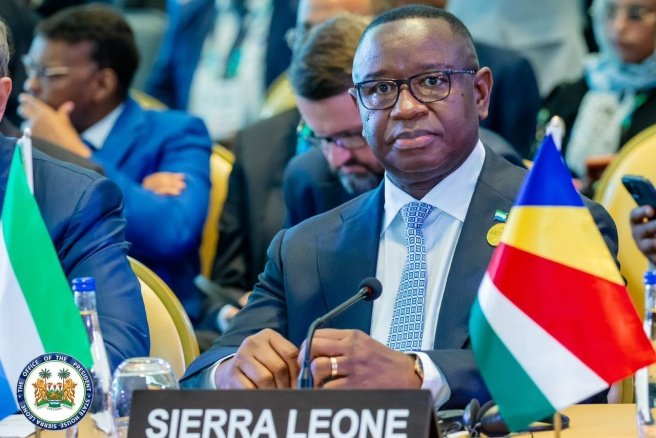
Sierra Leone has crossed a historic threshold with the endorsement of its Mission 300 Energy Compact, a USD 2.2 billion energy infrastructure plan described as the most ambitious in the nation’s history. The announcement, made during the Bloomberg Global Forum 2025 on Wednesday 24 September 2025 in New York, signals the beginning of a transformative journey to expand energy access, promote renewable power and accelerate sustainable development.
The endorsement comes with the full backing of the World Bank Group (WBG), the African Development Bank (AfDB) and other international partners. It also places Sierra Leone among a select group of African nations committing to the Africa-wide Mission 300 initiative, which seeks to connect 300 million people to reliable electricity by 2030.
Mission 300 will directly address Sierra Leone’s long-standing electricity deficit, which has constrained economic growth, industrialization and social development for decades. Currently, only about 36 percent of the country’s population has access to electricity, a figure that the compact intends to raise to 78 percent within the next few years.
The plan focuses on four pillars: expanding renewable power generation, modernizing transmission and distribution networks, promoting clean cooking solutions and creating a stronger environment for private sector participation through reforms in governance and regulation.
For President Julius Maada Bio, who also serves as Sierra Leone’s Minister of Energy, this is more than an infrastructure project; it is a statement of national ambition.
“Our Mission 300 Energy Compact is the most ambitious and comprehensive energy infrastructure initiative ever developed for Sierra Leone. Powered by evidence-based solutions and data, this single plan for Sierra Leone’s energy transformation holds the greatest promise for unlocking sustainable and inclusive development for our people,” President Bio told global leaders at the forum.
The compact was developed in record time under the leadership of the Inter-Ministerial Coordination Group, co-chaired by Minister of Finance Sheku A.F. Bangura and Dr. Kandeh K. Yumkella. Dr. Kandeh K. Yumkella, a seasoned energy and climate change expert, also chairs the Presidential Initiative on Climate Change, Renewable Energy and Food Security, as well as the Energy Governance Coordination Group (EGCG).
Their leadership helped align Ministries, Agencies and partners around a single framework; a significant departure from previous fragmented energy projects. According to officials, this integrated approach ensures that investments are not only large in scale but also coherent, sustainable and capable of driving long-term impact.
Sierra Leone’s endorsement is part of a broader Africa-wide momentum. Mission 300, spearheaded by the World Bank and AfDB, is designed to support African nations in meeting Sustainable Development Goal 7; universal access to affordable, reliable and sustainable energy.
The program builds on lessons from decades of under-investment in energy and the urgent need to power Africa’s growing population and industries. Alongside Sierra Leone, 17 other countries presented their national energy compacts at the Bloomberg Global Forum, joining a coalition of states determined to expand electricity access while promoting renewable energy and climate resilience.
Earlier this year, at the Mission 300 Africa Energy Summit in January 2025, countries such as Nigeria, Tanzania, Zambia and Côte d’Ivoire showcased their commitments. Now, Sierra Leone has positioned itself at the heart of this continental transformation.
At its core, Mission 300 is about more than lights in homes. Reliable electricity is the backbone of modern economies. For Sierra Leone, this compact promises:
For households, particularly in rural areas, the promise of reliable electricity means better quality of life, longer productive hours and safer, healthier cooking solutions. For businesses, it represents stability, competitiveness and the opportunity to scale operations.
A central element of the compact is the emphasis on private sector participation. Historically, Sierra Leone’s energy sector has struggled with weak utilities, limited capital and inefficiencies in distribution. By embedding governance reforms and opening space for private investment, the compact seeks to attract new resources and expertise.
The strategy also includes strengthening the Electricity Distribution and Supply Authority (EDSA) and enhancing regional integration by linking Sierra Leone’s grid with the West African Power Pool. This will allow the country to import cheaper power during shortages and export excess energy when supply is high.
The World Bank notes that the National Energy Compacts are designed to be country-led, with each nation tailoring its targets to its specific context. The approach emphasizes competitive costs, renewable integration and civil society involvement to ensure inclusive solutions.
Sierra Leone’s compact, worth USD 2.2 billion, is not only the largest infrastructure plan in its history but also one of the most comprehensive among African peers. It reflects both urgency and innovation, combining national ambition with global partnerships.
As the compact moves from endorsement to implementation, the real challenge will be delivery. Past projects in Sierra Leone’s energy sector have often stalled due to funding delays, weak institutional capacity and technical setbacks. However, with strong political leadership, coordinated governance and robust international backing, Mission 300 has a stronger foundation than previous efforts.
For President Bio’s administration, this achievement could define his legacy. For ordinary Sierra Leoneans, it could transform daily life; from studying under streetlights to accessing modern healthcare facilities, from running small businesses with diesel generators to plugging into a stable national grid.
The endorsement of the Mission 300 Energy Compact is not just a ceremonial milestone; it is the beginning of a new chapter in Sierra Leone’s development story. If delivered with determination and accountability, it has the potential to light up the nation’s future, literally and figuratively.
The International Finance Corporation (IFC) has on Tuesday September 23, 2025 signed a landmark US$24 million loan agreement with MACCEM Industries Limited to finance the construction of a modern cement grinding plant in Sierra Leone. The agreement, formalized at the World Bank Country Office in Freetown, marks a major step toward strengthening local manufacturing and reducing the nation’s dependence on imported cement.
The new grinding facility, to be situated in Freetown, is designed with an annual capacity of 657,000 tons; sufficient to meet up to 65 percent of Sierra Leone’s domestic cement demand. Once operational, it is projected to generate over 4,000 direct and indirect jobs while also helping stabilize cement prices in the country’s growing construction sector.
Speaking during the signing ceremony, IFC’s Joint Country Representative, Abdu Muwonge, described the partnership as a strategic investment that aligns with Sierra Leone’s economic transformation agenda.
“This investment promotes local production, supports the Government’s job creation agenda and aligns with our strategy to foster private sector-led growth and economic diversification,” Abdu Muwonge said.
He further explained that the financing package comprises a US$12 million loan from IFC’s own account and an additional US$12 million from the IDA20 IFC-MIGA Private Sector Window Blended Finance Facility. According to him, the project will also integrate solar energy solutions, reducing production costs while advancing Sierra Leone’s low-carbon development ambitions.
Abdu Muwonge highlighted that IFC’s total investment portfolio in Sierra Leone currently stands at US$35.5 million, spanning agribusiness, energy, telecommunications and financial inclusion sectors.
MACCEM Industries Limited, a Sierra Leonean-owned company established in 2019, is spearheading the development of what will be the country’s first cement grinding plant in four decades.
“We are building Sierra Leone’s first cement grinding plant in forty years; a project that will not only reduce import dependency but also generate thousands of jobs, empower small businesses and contribute to national development,” said Ahmed Mackie, Chief Executive Officer of MACCEM.
He emphasized the company’s commitment to clean energy integration, community empowerment and the transfer of technical skills to Sierra Leoneans across the value chain.
Representing the Government of Sierra Leone, Deputy Minister of Finance II, Jenneh Jabati, described the signing as a milestone for the country’s construction and industrial sectors.
“This project will promote job creation, stabilize cement prices and boost the economy. The Government remains fully committed to supporting initiatives that promote local production,” she affirmed.
The establishment of the plant at Hastings is expected to reshape Sierra Leone’s construction and manufacturing landscape. By cutting import reliance, enhancing local supply and supporting sustainable growth practices, the project positions Sierra Leone as a hub for industrial self-reliance in West Africa.
With IFC’s financial backing and MACCEM’s vision, the initiative not only underscores confidence in Sierra Leone’s private sector but also signals a transformative chapter in the country’s journey toward industrialization and economic resilience.