Home Blog Page 130

NCRA DG Honoured as Disability Ambassador for Championing Free National IDs for PWDs

By Amin Kef (Ranger)

In a historic recognition of his unwavering commitment to inclusivity and equality, the National Commission for Persons with Disabilities (NCPD) has appointed the Director General of the National Civil Registration Authority (NCRA), Mohamed Mubashir Massaquoi, as Disability and Inclusion Ambassador.

The appointment, formally conveyed in a letter dated October 21, 2025, celebrates Mohamed Mubashir Massaquoi’s exceptional leadership in providing free National Identification Cards (National IDs) to Persons with Disabilities (PWDs) across Sierra Leone, particularly in the Western Area. That initiative, which waived all fees and utilized mobile registration units, has significantly enhanced accessibility and promoted dignity for citizens with disabilities.

According to NCPD’s Executive Secretary, Saa Lamin Kortequee, the NCRA’s actions reflect exemplary inclusivity. “Your work enhances the legal identities of our compatriots with disabilities,” he wrote, commending the Director General’s pioneering role in removing barriers that hinder PWDs from accessing vital services.

The recognition followed a landmark event at the NCRA Headquarters on King Harman Road in Freetown, where the institution handed over National ID cards to 120 PWDs drawn from Pademba Road, Wilberforce Street and the House of Jesus communities. The ceremony was graced by representatives from UNICEF, the Ministry of Social Welfare, Gender and Children’s Affairs and the NCPD.

The initiative, aligned with President Dr. Julius Maada Bio’s New Direction Agenda, underscores the Government’s ongoing commitment to inclusive national development and equitable access to social and economic opportunities.

During the handover, DG Mohamed Mubashir Massaquoi reaffirmed NCRA’s dedication to ensuring no Sierra Leonean is left behind in the country’s progress. “This appointment reinforces our shared commitment to equity. National IDs are essential for PWDs to access banking, healthcare, education and other public services,” he said. “These IDs are vital tools for empowerment and inclusion.”

NCPD Chairman, Brima Abdulai Sheriff, extended profound gratitude on behalf of the Commission and the disability community to President Dr. Julius Maada Bio and the NCRA Management. He hailed the initiative as a bold step in restoring dignity and expanding opportunities for PWDs nationwide.

“Restoring the dignity of persons with disabilities is not just a human rights issue; it is a matter of national development and governance,” Chairman Brima Abdulai Sheriff remarked. “Any Government truly committed to development must address the needs and welfare of its disability community.”

He added that the initiative aligns with NCPD’s PRIDE Strategy — a guiding framework designed to advance empowerment, inclusion and representation of PWDs. Commending DG Mohamed Mubashir Massaquoi’s proactive leadership, he declared him Disability and Inclusion Ambassador, acknowledging his consistent advocacy for equal opportunity.

Recipients of the National IDs expressed deep appreciation to the Government, NCPD and NCRA for the life-changing initiative. A member of the House of Jesus community said, “These ID cards open doors to services we have long struggled to access. We feel valued and included in our nation’s development.”

The event concluded with renewed commitments from all stakeholders to extend the initiative nationwide, ensuring that PWDs across Sierra Leone enjoy equal access to identification and public services.

The NCRA’s continued collaboration with partners such as UNICEF and the Ministry of Social Welfare reflects its strategic vision to achieve universal ID coverage; a cornerstone of the Medium-Term National Development Plan (2024–2030).

Mohamed Mubashir Massaquoi reaffirmed his institution’s mission: “Through partnerships and innovation we are building a system that guarantees every Sierra Leonean’s right to identity, dignity and inclusion.”

This appointment not only honors DG Mohamed Mubashir Massaquoi’s dedication but also symbolizes Sierra Leone’s collective progress toward an inclusive society where every citizen, regardless of ability, is recognized, respected and empowered.

Africell Rewards Top Fantasy League Managers for August and September

Africell Sierra Leone has celebrated the winners of its ongoing Africell Fantasy League for the months of August and September, during a colorful award ceremony held at the company’s headquarters in Freetown.

The Africell Fantasy League, an exciting digital competition, allows English Premier League (EPL) fans across Sierra Leone to test their football knowledge and management skills while competing for attractive prizes. The competition has quickly gained popularity, attracting over 6,000 active participants since its launch.

During the event, Abdul Aziz Kamara, Assistant Media Manager at Africell Sierra Leone, congratulated the winners and expressed appreciation to all participants for their enthusiasm and continued engagement.

“The Africell Fantasy League is not just about winning prizes; it’s about connecting our customers through a shared passion for football while creating fun and excitement,” he said.

He further encouraged football fans across the country to join the competition by visiting fantasy.aplfantasy.com, creating an account and joining the official Africell League using the code 7UVM7D.

The prize categories include:

  • Monthly Winners: Africell-branded T-shirt and NLe 3,500 cash prize
  • Weekly Winners: One-month StarTimes subscription and Africell app support

At the ceremony, Amadu Massaquoi, Manager of Vitoma FC, was announced as the August Manager of the Month, while Kal Thomson, Manager of Akondya FC, emerged as the September Manager of the Month. Both winners received cash rewards and Africell-branded gifts in recognition of their outstanding performance.

Abdul Aziz emphasized that it’s not too late for new participants to join, as registration remains open until December, with points starting to count immediately upon signing up.

“We want every football fan in Sierra Leone to experience the thrill of managing their own fantasy team. You could be the next winner,” he added.

He also commended Africell’s Management and staff for supporting the initiative and confirmed that another award presentation will be organized soon to honor upcoming monthly winners.

The Africell Fantasy League continues to bring football lovers together, combining entertainment, competition and rewards; showing once again why Africell remains the people’s network for innovation and engagement.

Tech4Teachers Project Empowers Educators at Vibrant Closing Ceremony in Mile 91

By Ibrahim John Sesay

A colorful and inspiring ceremony on Saturday, 18th October 2025, marked the official close of the Tech4Teachers Project at Central University, Mile 91 in Tonkolili District. Held under the theme: “Bridging the Digital Divide Among Secondary Schools in Mile 91,” the event celebrated the success of a transformative digital literacy initiative designed to strengthen teaching capacity across rural Sierra Leone.

The program, which trained forty (40) teachers from various secondary schools in the Yoni/Mile 91 axis, equipped participants with essential technological skills for modern classroom delivery. From 20th to 24th September 2025, teachers underwent intensive hands-on sessions in computer literacy, smartphone proficiency and the use of Artificial Intelligence (AI) tools in education.

Speaking at the event, Executive Director, Ibrahim Abdulai Kargbo, described the project as “a major step towards bridging the digital divide between urban and rural schools,” emphasizing that technology has become a vital tool for effective and inclusive education.

The ceremony attracted key education stakeholders, including representatives from the Ministry of Basic and Senior Secondary Education (MBSSE) Tonkolili District, the Sierra Leone Teachers Union (SLTU) Yoni/Mile 91 Branch, Tonkolili District Council, Central University, Concern Worldwide and local media outlets such as Radio Gbafeth and News Journal.

Delivering the keynote address, Lansana Amara, Assistant Director of MBSSE Tonkolili, commended the initiative for complementing Government efforts to enhance teacher development through digital learning. He stated that projects like Tech4Teachers are “vital to improving the teaching profession and ensuring equitable access to quality education across the country.”

Also addressing participants, Sheku Putka Kamara, lecturer at Fourah Bay College, University of Sierra Leone, underscored the importance of continuous professional development, urging teachers to apply their new skills to inspire students and promote innovation in schools.

SLTU Yoni/Mile 91 Chairman, David S. Kamara, praised the participants for their dedication and reaffirmed the Union’s commitment to promoting teacher empowerment through strategic partnerships.

The event climaxed with the presentation of Certificates of Participation to all 40 teachers who successfully completed the training. Participants expressed gratitude to the organizers and pledged to put their newly acquired skills into practice to enhance learning outcomes.

The organizers extended appreciation to Global Change-makers, sponsors of the project, for their unwavering support and to Central University for hosting the training.

With the ceremony coming to an end, the organizers reaffirmed their commitment to sustaining similar programs that advance digital inclusion in education. The Tech4Teachers Project remains a shining example of how collaboration, innovation and dedication can transform Sierra Leone’s educational landscape.

Orange Sierra Leone Launches “Be a Soba Kaiba” Promotion with Over Le 5 Million in Prizes

Orange Sierra Leone has rolled out an exciting new promotion titled “Be a Soba Kaiba,” giving customers a chance to win incredible prizes, including brand-new kekehs, motorbikes, generators, and solar kits. The campaign, which runs nationwide, is designed to reward loyal Orange customers who continue to use the network’s services and Orange Money platform.

To qualify, subscribers simply need to dial *500# to activate the Soba Kaiba offer or dial *144# to pay with Orange Money via Max it. Participants stand a chance to win from a prize pool worth over Le 5 million, with several grand prizes including kekehs and solar energy kits aimed at supporting livelihoods and promoting sustainable energy use.

The Soba Kaiba campaign reflects Orange’s ongoing commitment to empowering Sierra Leoneans through innovative products and rewarding experiences that improve lives and strengthen communities.

Vice President Commits to Implementing Outcomes of CRET 2025

Vice President Dr. Mohamed Juldeh Jalloh

By Alvin Lansana Kargbo

Vice President Dr. Mohamed Juldeh Jalloh has, on Tuesday October 21, 2025, pledged decisive Government action to implement the recommendations emerging from the third Climate Resilience and Energy Transition Dialogue (CRET 2025), describing the event as a pivotal moment in Sierra Leone’s journey toward sustainable energy and economic transformation. Speaking at the close of the two-day dialogue in Freetown, Dr. Mohamed Juldeh Jalloh, said he would present the full set of recommendations to President Dr. Julius Maada Bio, assuring participants that a comprehensive framework would be developed to track and enforce implementation. He commended organizers, development partners and private sector stakeholders for their strong engagement, singling out Big Prep and the PPEP team for their leadership in advancing the country’s energy reform agenda.

The Vice President said the third edition of the dialogue reaffirmed his confidence that Sierra Leone’s energy transformation is well within reach.

He noted that the country now has a credible, data-driven and nationally endorsed energy plan designed to expand access through infrastructure investment, improve utility performance, boost renewable energy generation and increase private sector participation across the energy value chain. Reliable and affordable energy, he emphasized, lies at the heart of Sierra Leone’s national development strategy and is vital to achieving the targets outlined in the government’s Medium-Term National Development Plan.

Dr. Mohamed Juldeh Jalloh recalled that since 2018, the Bio administration has prioritized human capital development through free quality education and healthcare reforms, achievements that have expanded access for girls, increased female enrollment in tertiary institutions and reduced maternal and infant mortality rates.

However, he observed that those social gains have raised citizens’ expectations for job creation and economic empowerment. The Government’s second term, he explained, is focused on revitalizing the productive sectors, with agriculture at the forefront as both an engine for food security and a foundation for industrialization, job creation and export diversification.

Linking those national objectives to President Bio’s “Big Five” game changers, the Vice President reaffirmed Government’s commitment to creating 500,000 jobs for young people while aligning development policies with global efforts to reduce carbon emissions. He identified limited access to affordable and reliable energy as one of the greatest obstacles to national growth, emphasizing that modernizing infrastructure, reducing technical and commercial losses, improving the financial viability of the energy sector and scaling up renewable investments are essential steps toward overcoming this challenge.

Highlighting progress made so far, Dr. Mohamed Juldeh Jalloh reported that national energy access has risen from 16 percent in 2018 to 36 percent in 2025—nearly halfway to the Government’s target of 78 percent by 2030. He underscored that this growth must be inclusive, ensuring electricity access for both households and enterprises, particularly in rural and hard-to-reach areas. Sustainable access to energy, he said, is indispensable to translating progress in education, health and agriculture into real social equity.

Drawing from his academic and professional experience, the Vice President warned that overly centralized, state-dominated models of power generation and distribution have historically slowed development across Africa. He stressed the importance of enabling the private sector to lead in innovation, generation and distribution while the state focuses on regulation and accountability. He welcomed the dialogue’s emphasis on private sector participation as a cornerstone of Sierra Leone’s energy transition strategy, explaining that transparent governance and adherence to the rule of law are key to attracting investor confidence.

Dr. Mohamed Juldeh Jalloh also extended gratitude to international development partners, multilateral institutions and private investors for their continued collaboration and technical support. He reaffirmed that the Government remains committed to translating the recommendations from CRET 2025 into concrete policy actions that will drive inclusive growth, strengthen climate resilience and secure Sierra Leone’s clean energy future.

He concluded that the country’s progress toward sustainable energy and climate adaptation will depend on transparent governance, private sector innovation and the collective determination of all Sierra Leoneans. Through that commitment, the Vice President asserted, Sierra Leone is firmly on course to achieve its energy goals; targeting 78 percent national access, stronger private sector participation, and a greener, more resilient economy by 2030.

UNGA Resolution 2758 and the One-China Principle Brooks No Challenge

H.E. Wang Qing, Chinese Ambassador to Sierra Leone

By H.E. Wang Qing, Chinese Ambassador to Sierra Leone

The one-China principle, enshrined in the UNGA Resolution 2758, is a basic norm in international relations and a prevailing international consensus. It is where the arc of history bends and global opinion trends. However, recently some certain countries have colluded with the authorities in Taiwan, maliciously misinterpreting UNGA Resolution 2758 and spread fallacies such as ‘Taiwan’s status is undetermined’, which is a blatant challenge to the principles and purposes of the United Nations Charter and the post-WWII international order. To clarify historical facts and set the record straight, I wish to share the truths concerning the Taiwan question with our Sierra Leonean friends.

Taiwan has belonged to China since ancient times. In 1894, Japan launched a war of aggression against China and forced the Qing Dynasty to cede Taiwan to Japan, which resulting in the Japanese occupation of Taiwan for half a century. In the World War II, the Cairo Declaration issued in 1943 and Potsdam Proclamation published in 1945, both explicitly stipulated that territories stolen by Japan, including Taiwan and the Penghu Islands, should be restored to China. In September 1945, Japan signed the instrument of surrender and then China resumed the exercise of sovereignty over Taiwan. Taiwan’s restoration to China is the outcome of the victory of WWII and an integral part of the post-war international order.

On October 1, 1949, the People’s Republic of China (PRC) was founded, becoming the successor to the Republic of China (1912-1949). The new Government of PRC replaced the previous KMT regime in a situation where China, as a subject under international law, did not change. As a result of the civil war and the interference of external forces, the two sides of the Taiwan Straits have fallen into a state of protracted political confrontation. But the sovereignty and territory of China have never been divided and will never be divided and Taiwan’s status as part of China’s territory has never changed and will never be allowed to change.

In October 1971, at the 26th session of the U.N. General Assembly, UNGA Resolution 2758 was adopted, which “decides to restore all its rights to the People’s Republic of China and to recognize the representatives of its Government as the only legitimate representatives of China to the United Nations and to expel forthwith the representatives of Chiang Kai-shek from the place where they unlawfully occupy at the United Nations and in all the organizations related to it.”  Once and for all, UNGA Resolution 2758 resolved, politically, legally and procedurally, the issue of the representation of the whole of China, including Taiwan, at the UN. It also made it clear that there can only be one seat representing China at the UN. No issues exist about so-called “two Chinas” or “one China, one Taiwan”. After the adoption of UNGA Resolution 2758, all official U.N. documents referred to Taiwan as “Taiwan, Province of China.” It was clearly stated in the official legal opinions of the Office of Legal Affairs of the U.N. Secretariat that “the United Nations considers ‘Taiwan’ as a province of China with no separate status” and the “‘authorities’ in ‘Taipei’ are not considered to enjoy any form of government status.”

UNGA Resolution 2758 stands as a testament to the authority and impartiality of the United Nations and represents the prevailing international consensus on the Taiwan question. Observing the UNGA resolution and adhering to the one-China principle is the serious political commitment and obligation under international law that all UN members must follow. However, some certain countries recently have been blatantly turning back the wheel of history by deliberately distorting UNGA Resolution 2758, emboldening and supporting “Taiwan independence” separatist activities, spreading fallacies such as ‘Taiwan’s status is undetermined’, to serve its pernicious purpose of containing China. These actions undermine China’s sovereignty and territorial integrity, as well as international justice and rule of law. Their attempts will lead nowhere.

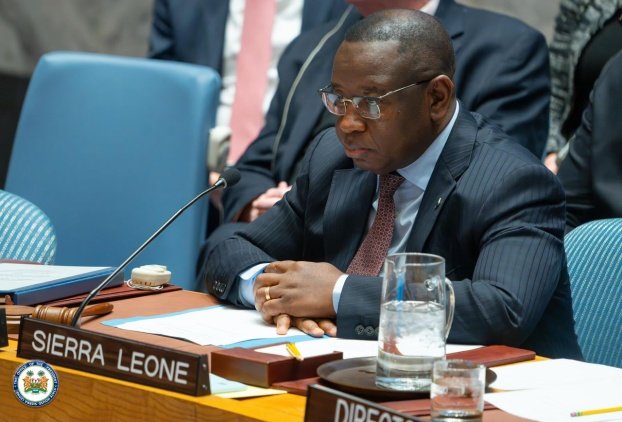
Sierra Leone is one of the co-sponsor countries of UNGA Resolution 2758 and made special contributions to its adoption. Over the 54 years since the establishment of diplomatic ties between China and Sierra Leone, the Sierra Leonean side has consistently and resolutely upheld the one-China principle and supported China in its just cause of national reunification. I would like to express great appreciation. Currently, both China and Sierra Leone serve as members of the UN Security Council, bearing important responsibilities of upholding international peace and security, as well as safeguarding the authority of United Nations and General Assembly resolutions. China stands ready to work with Sierra Leone to uphold the purposes and principles of the UN Charter, defend international equity and justice and jointly promote global peace, security and prosperity.

Peace Commission, UN Hold Dialogue on Strengthening Sierra Leone’s Peace Gains

By Ibrahim Sesay 

The Independent Commission for Peace and National Cohesion (ICPNC), in collaboration with the United Nations, on Monday, October 20, 2025, held a one-day dialogue with Civil Society Organizations to reflect on the impact of the United Nations Peacebuilding Fund (PBF) investments in Sierra Leone. The engagement, held at the ICPNC office in Freetown, brought together representatives from Government institutions, development partners and Civil Society groups to share lessons learned, celebrate success stories and identify challenges in the implementation of peacebuilding initiatives across the country.

In her opening statement, Executive Secretary of the ICPNC, Hawa Samai, emphasized that the dialogue was intended to evaluate ongoing peace efforts and strengthen collaboration among stakeholders. “We’re here to see what issues are going on in Sierra Leone in terms of peace and social cohesion and how we could work together better to complement not just our work but yours,” she said. She added that Sierra Leone could learn from the experiences of neighboring countries such as Ghana while showcasing its own achievements and identifying areas that require improvement.

Hawa Samai underscored that peacebuilding is a continuous process requiring the collective effort of all Sierra Leoneans. “Peacebuilding is an everyday issue,” she stated. “We want to move Sierra Leone from negative peace to positive peace, where citizens can sleep and wake up knowing they live in a peaceful country. That journey starts with each of us.” She also called for stronger coordination among partners to prevent duplication of efforts and ensure equitable distribution of peacebuilding resources nationwide.

The Deputy Head of the UN Peacebuilding Support Office, Awa Dabo, praised Sierra Leone’s Civil Society groups for their contribution to sustaining peace, describing them as vital partners in the country’s stability. “No matter how much the UN or Government does, the frontline actors are Civil Society. They know the communities and the issues,” she remarked. “Peacebuilding is not just about funding; it’s about partnerships and shared responsibility.” She also warned about emerging threats to peace, including misinformation, disinformation and growing youth frustrations, urging stakeholders to prioritize youth inclusion and collaboration among Government, Civil Society and the private sector.

Civil Society representatives shared notable achievements made possible through PBF-funded projects. Umu Kamara, representing the Prevention First Initiative, highlighted her organization’s work with commercial motorbike riders to transform them from “agents of violence” into “agents of peace.” “Between August and September this year alone, we trained over 1,600 bike riders across five districts,” she said, explaining that participants received training in advocacy, negotiation and conflict resolution. She added that riders learned to understand the consequences of violence and adopt peaceful methods of settling disputes.

Echoing this success, Patrick Batilo Kpaka, Public Relations Officer of the Bike Riders Union, said the training had significantly improved public perception of riders. “People used to see us as lawless and uneducated,” he noted. “But through these trainings, the narrative has changed. We now see ourselves as peace ambassadors.” He urged that the program be extended to all districts, stressing that Sierra Leone’s 1.5 million riders play a key role in maintaining community stability.

Abu Bakarr Jalloh, Head of Programs at Focus 1000, shared how community dialogues and parenting education have reduced violence in communities. “We engaged over 2,400 parents and caregivers on positive parenting,” he said. “When dialogue starts in the home, it spreads to the community.” He added that the organization also trained adolescents and facilitated dialogues between youth and the police to promote mutual understanding.

From Caritas Freetown, Eliza Sillah, Head of Programs, discussed lessons from the Youth in Politics and Peacebuilding project, which involved persons with disabilities. “We engaged over 2,000 persons with disabilities in five districts through civic education, community dialogues and skills training,” she said, noting that their participation proved their ability to contribute meaningfully to peace and development when given the opportunity. She further highlighted the need for deeper engagement of persons with disabilities in rural areas to ensure that peacebuilding efforts address their specific needs.

Participants identified several emerging risks to peace, including drug abuse, hate speech, youth unemployment, mental health challenges and delays in funding project implementation. The dialogue concluded with a strong call for sustained collaboration among Government, Civil Society and international partners to strengthen social cohesion and ensure long-term peace across Sierra Leone.

Just 4 Days Left to Vote for Your Favorite Housemates Salone Season 4 Contestant!

Housemates Salone Season 4

The clock is ticking fast and the competition is heating up as the countdown to Housemates Salone Season 4, “Clean Game”, reaches its final stretch. With only four days left before the voting closes, fans across Sierra Leone and beyond are being urged to cast their votes now and keep their favorite contestants in the race for fame, fortune and destiny.

Voting is open exclusively via Afrimoney at a cost of just NLe2 per vote. Supporters can vote by simply dialing 16111# on their mobile phones. Every second counts and every vote could determine who secures a coveted spot in the House.

“The competition is now more intense than ever,” organizers confirmed. “We are down to the final week and every single vote can make a huge difference. This is the time for fans to stand by their favorite contestants.”

The Top 42 qualifiers are currently battling for limited places in the House ahead of the official launch slated for Sunday, 26th October 2025. This year’s edition, themed: “Clean Game,” promises to be the most electrifying yet blending entertainment, creativity and youth empowerment in a way that celebrates Sierra Leone’s vibrant young talent.

The grand prize of One Billion Old Leones awaits the ultimate winner, along with life-changing opportunities, career exposure and national recognition. Since its inception, Housemates Salone has become one of the country’s most-watched and celebrated Reality Television Shows; providing a powerful platform for young Sierra Leoneans to showcase their potential, leadership and resilience.

Audiences can follow all the drama, emotion and triumphs live on AYV Television and online via the show’s official YouTube channel, ensuring fans at home and abroad stay connected to every exciting moment.

In a show of strong local partnership, Barmoi Hotel and Fabulous Hotel have joined as official hospitality sponsors for this year’s edition. The hotels will provide free accommodation for international contestants throughout their stay and during the eviction stages of the show.

Organizers expressed deep appreciation for the support, noting that such collaboration reflects the growing synergy between Sierra Leone’s private sector and creative industry in driving youth development and promoting national entertainment.

“We sincerely appreciate the support from our hospitality partners,” organizers stated. “Their contribution ensures comfort for our guests and reinforces the unity that keeps the Housemates Salone brand strong.”

As the final countdown continues, fans are reminded that time is of the essence.
Dial 16111# and vote for your favorite contestant for just NLe2 via Afrimoney ONLY.

Every vote brings your contestant closer to the spotlight and closer to the dream. The Clean Game is on and your vote could make all the difference!

The Development and Subsequent Closure of the Colonial Era National Railway

Ing. Dr. Albert Forde

By Ing. Dr. Albert Forde

Director-General, Sierra Leone Railways Development and Regulatory Authority

In February 2025, the Government of Sierra Leone, through Parliament enacted the Sierra Leone Railways Development and Regulatory Authority Act, 2025. The Act established the Sierra Leone Railways Development and Regulatory Authority, with key mandates to develop and regulate a national railway system and cable car transport. In August, I was appointed as the Director-General by His Excellency the President and approved by Parliament on Wednesday, 15th October. To understand the rationale behind His Excellency`s vision of reintroducing a national railway system, it is important to look back on history. A booklet authored by Anthony Coulls, entitled: “Sierra Leone Railway Adventure”, which is published by Holne Publishing, provides detailed information on the planning and development of our colonial era national railway system. Extracts from that booklet are shared in this article.

According to Coulls, in the British Colonial period, there were a number of early proposals for a railway. The first of these, dated from 1872 and including a proposed trans-Sahara railway never came to fruition. However, in 1893 a proposal for a line from Freetown promoted by the Liverpool Chamber of Commerce, was accepted and work began. But the tropical climate among other obstacles, caused many difficulties which needed to be overcome before the initial surveys could be completed. Unusually for such a long length of railway, it was constructed to 2 feet 6-inch gauge and never varied from that throughout its operation. In the Railway industry, a gauge is the distance between the inner faces of the two rails of a train track, with the most common standard being 1,435 mm (or 4ft and 8.5 inches), also known as “Standard Gauge”. The gauge of 2 feet 6 inches was chosen in order to keep construction costs to an absolute minimum, limiting the need for major civil works.

Construction of the colonial era railway network commenced from Water Street (now Wallace-Johnson Street), Freetown, in 1896 and the first section of railway was opened to Wellington, seven miles away, by March 1897 with much ceremony and decorated trains. Subsequent openings, were: Waterloo, about 15 miles out in April 1898; Songo 32 miles in 1899; Rotifunk at 56 miles in1900; Bo in 103 miles out in 1903, and Baima 220 miles distant from Freetown in 1905. In 1907, the final destination of Pendembu was reached at 227 miles from Water Street and there the main line stopped, despite aspirations of carrying on over to the border into neighboring Liberia. A branch was built between 1914 and 1916 from Bauya Junction to Makeni and Kamabai, with a length of 104 miles, bringing the total route mileage to 331 miles. This was later cut back to Makeni in 1930. A comparative report showed that among the West African states, the railway in Sierra Leone was the cheapest. Some features of the railway’s construction was over 130 viaducts across rivers and gorges, with one, the Orugu bridge, outside Freetown being a steel trestle built on a curve. A further line of 5 and half miles length was built in 1903, known as the Mountain railway, connected by rail from the docks and Water Street Station, this climbed from a station at Cotton Tree, Freetown to Hill Station, at 748 ft above sea level. This line allowed Europeans to live on the more rarified air above Freetown heading towards Leicester Peak, but it was closed in 1929 as surveys in the late 20s had already shown it to be losing money against road competition. The Sierra Leone government railway settled down to a steady existence throughout the first part of the 20th century, bringing goods, minerals and produce down from upcountry to the markets of Freetown and taking other materials and imports up country from the docks of the city. There was even a travelling post office service. In 1930, the Sierra Leone Development Company (DELCO) started work on a 3ft 6 in gauge line from the coast at Pepel to the Marampa iron ore mines, a distance of 52 miles. This railway was invented for only goods traffic and never operated a passenger service. It was also geographically isolated from the Government lines and a different gauge.

The railways assumed increased importance in World War 2. Apart from moving food and resources from the interior to the coast, the railway was also important in supporting fighting in North Africa. Fighter aircrafts were transported in kit form to Pendembu, where they were assembled and flown on to Egypt. Freetown was an important deep-water harbour and bunkering station for both military and civilian ships.. Additional photos of the railway infrastructure (tracks, viaducts, stations) and rolling stock/trains are available in the Old Photos of Sierra Leone Page on Facebook. According to Coulls, an arguably misguided Government policy, allied to the conditions associated with investment by World Bank saw the staged closure of the railway from 1968 onwards with formal complete closure in 1974, although trains continued to operate on an unofficial basis so long as the tracked existed, until mid-1975. The loss of the railway had an immediate effect on the national economy given the poor condition of the road network- a poor substitute in moving people, goods and products around the country. It is interesting to note that on his retirement in 1985, the then president of Sierra Leone, Siaka Stevens declared in a BBC interview his greatest regret in office was the closure of the railway. My next article will focus on the strategic relevance and urgency, and the benefits of reintroducing a national railway system for the transport of both people and goods.

Solidaridad West Africa Wins 2025 Excellence in Service Award from SLANGO

Solidaridad West Africa has been honoured with the prestigious 2025 Award for Excellence in Service by the Sierra Leone Association of Non-Governmental Organizations (SLANGO). The recognition was presented during SLANGO’s Annual Fundraising and Awards Night held at the New Brookfields Hotel in Freetown.

According to SLANGO’s National Coordinator, Alice N. James, the award celebrates Solidaridad’s exceptional contribution to food security, agricultural productivity and rural livelihood transformation in Sierra Leone. She commended the organization for its consistent support to farmers through training in sustainable agricultural practices, market linkages and gender empowerment initiatives that target women and youth.

Alice N. James explained that Solidaridad emerged as Best NGO in Agriculture for its work under the Resilient Food and Nutrition Security (RFANS) project, implemented in partnership with the Nutrition Unit of the Ministry of Health and Sanitation. The project focuses on improving rice and vegetable production while enhancing nutrition and infant feeding among farming families, lactating mothers and caregivers of children under five.

Another major initiative acknowledged was the Boosting Agriculture and Food Security (BAFS) project, through which Solidaridad has empowered 7,818 smallholder farmers across 16 districts. The project has led to the establishment of cashew processing facilities for the Waterloo Women Cashew Processors in the Western Rural District. In addition, farmers have benefited from the cultivation of improved cashew, cocoa and coffee varieties on more than 5,182 hectares nationwide.

The organization has also supported the creation of over 200 Farmer Field Schools to enhance knowledge in farm management and 280 Village Savings and Loans Associations (VSLAs) to improve access to rural finance.

SLANGO further highlighted Solidaridad’s Responsible Agriculture Initiative (RAI) programme, implemented in partnership with the Food and Agriculture Organization (FAO), which empowers women in agriculture and promotes their participation in land governance. The initiative aims to build resilient food systems and support national agricultural policy frameworks.

“Through their efforts in Sierra Leone, Solidaridad has significantly advanced food security, improved livelihoods and promoted environmental sustainability,” SLANGO noted in its citation. “Their work goes beyond immediate agricultural support to address long-term poverty reduction and national development goals.”

Receiving the award, Andrew, Country Representative of Solidaridad Sierra Leone, expressed gratitude to SLANGO for recognizing the organization’s continued efforts to complement Government priorities in agriculture and rural development.

“On behalf of the entire Solidaridad team, I am deeply honored to receive this Award for Excellence in Service,” he said. “This recognition belongs to the smallholder farmers who adopt innovative practices, our dedicated staff working in rural communities and our partners who share our vision of inclusive and sustainable agricultural development.”

He reaffirmed Solidaridad’s commitment to empowering farmers and supporting Sierra Leone’s journey toward achieving Sustainable Development Goal 1 – No Poverty.

“Together, we will continue to cultivate a brighter, more sustainable future for Sierra Leone,” Andrew concluded.

The RFANS project is supported by the Church of Jesus Christ of Latter-day Saints, while the Developing an Inclusive and Sustainable Cashew Agroforestry Value Chain (DISCA-VC) and BAFS projects are funded by the European Union in Sierra Leone.

Other organizations recognized at the event included the Rainbow Initiative, SEND Sierra Leone and BRAC, for their outstanding contributions to national development and humanitarian service.