Home Blog Page 251

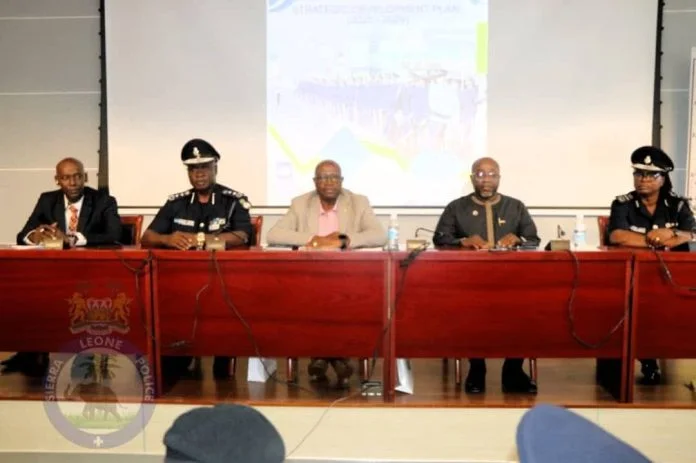
Sierra Leone Police Unveils Strategic Development Plan 2025-2029

#image_title

By Amin Kef (Ranger)

The Sierra Leone Police (SLP) officially launched its Strategic Development Plan (SDP) for 2025-2029, unveiling a comprehensive blueprint to guide its operations over the next four years. The event, held on Thursday, January 30, 2025, at the Foreign Service Academy in Tower Hill, Freetown, marked a significant shift in the SLP’s approach to law enforcement, with a focus on community-oriented service.

In his keynote address, Minister of Internal Affairs, Rtd. AIG Morie Lengor (Esq.), commended Inspector General of Police Mr. William Fayia Sellu for his transformative leadership in enhancing the effectiveness and productivity of the Police Force. The Minister  expressed strong support for the SLP’s move towards a more participatory, service-driven model of policing, which prioritizes the needs of the community.

Inspector General William Fayia Sellu, in his remarks, detailed the SDP’s key objectives, which align with five strategic goals aimed at reshaping the SLP from a traditional force to a community-centered service. He highlighted the collaborative efforts with stakeholders such as the Government of Sierra Leone, the United Nations Development Programme (UNDP), UNFPA, Embassies and local communities. William Fayia Sellu also expressed gratitude to all parties involved in the plan’s development and reaffirmed the SLP’s commitment to community policing. He urged officers to continue their vital role in maintaining peace and stability across the nation.

UNDP Resident Representative, Frederick Hans Ampiah, spoke at the event, reiterating the UNDP’s ongoing support for the SLP in enhancing its security efforts. Frederick Hans Ampiah stressed the importance of policing in national development and applauded the leadership of Inspector General William Fayia Sellu for fostering effective partnerships. He confirmed that the UNDP would continue to assist the SLP in improving its operational standards and productivity.

AIG Esther Mary Kaintor-Dukuray, Director of Corporate Affairs, provided further insight into the SDP’s development process, noting that it was crafted with input from within the SLP and received financial support from UNDP.

The launch of the Strategic Development Plan 2025-2029 underscores the SLP’s vision for a more efficient, community-focused Police Force dedicated to ensuring peace, security, and progress for Sierra Leone.

Rokel Commercial Bank Empowers FBC Chemistry Students with Lab Coat Donation

#image_title

In a noteworthy boost to science education in Sierra Leone, Rokel Commercial Bank (RCBank) has donated over 200 customized laboratory coats to students of the Chemistry Department at Fourah Bay College (FBC), University of Sierra Leone. The donation, made on Friday, January 31, 2025, is valued at thousands of Leones and is set to enhance the students’ practical training and professional development.

The branded RCBank/FBC lab coats, according to the department’s leadership, will not only restore the pride and confidence of aspiring chemists at Sub-Saharan Africa’s oldest university but also instill a culture of ethics and professionalism among students.

Speaking at the donation ceremony, Rokel Commercial Bank’s Managing Director, Dr. Walton Ekundayo Gilpin, underscored the importance of supporting the Government’s human capital development efforts, highlighting that science education is the foundation for human advancement and global progress.

“Today, we see in you the ability to invent or create something for the global good. You have the potential to rise beyond Sierra Leone and become renowned scientists. Most importantly, we want you to contribute meaningfully to the field of science on a global scale,” Dr. Walton Ekundayo Gilpin stated, encouraging students to remain dedicated to their studies and seize available opportunities for success.

Expressing their appreciation, a student from the Chemistry Department described the donation as a powerful motivation in their pursuit of excellence in the field of science.

“These beautifully branded lab coats will not only give us a sense of identity but also encourage us to work harder in our studies. We are grateful to Rokel Commercial Bank for this generous support,” the student remarked.

This latest philanthropic gesture further solidifies Rokel Commercial Bank’s reputation as a leader in corporate social responsibility in Sierra Leone, demonstrating its unwavering commitment to the advancement of education and professional development in the country.

Jennifer Thompson Declares Candidacy for SLPP Secretary General

#image_title

By Foday Moriba Conteh

Jennifer Thompson, a renowned philanthropist and Chief Executive Officer of The Jennifer Thompson Foundation, who also doubles as the Public Relations Officer SLPP Northern California Chapter has officially announced her candidacy for the position of Secretary General of the Sierra Leone People’s Party (SLPP) in the party’s upcoming national executive elections.

In her declaration, Jennifer Thompson emphasized her deep-rooted commitment to the SLPP, highlighting her extensive experience within the party, including previous roles as Secretary General, Young Generation Leader and Public Relations Officer. She expressed her vision of strengthening grassroots engagement, empowering youth participation and uniting the party for a successful campaign ahead of the 2028 General Elections.

“If elected, I will ensure that our grassroots structures are not only activated but strengthened through direct engagement, town halls and community-driven initiatives,” she stated. “The youth, as the future of our party, will not be sidelined but actively involved in leadership, policy and discussions that shape the direction of SLPP.”

Jennifer Thompson also underscored the importance of unity and strategic mobilization in securing victory in 2028, pledging to lead with action, inclusivity and dedication. She described her campaign as a movement for a “stronger, more connected and victorious SLPP,” calling on party members to rally behind her vision.

With the SLPP’s National Executive elections approaching, Jennifer Thompson’s candidacy is expected to shape discussions on the party’s future direction and strategy.


CCSL Rejects Claims of Extremism, Calls for Holistic Maternal Health Solutions

#image_title

By Foday Moriba Conteh

The Council of Churches in Sierra Leone (CCSL) has issued a strong response to an article titled “Handmaidens of the Western Religious Extremists,” authored by A. Kamara and N. Assad of Purposeful and published in The Calabash on January 31, 2024. The article accused the Inter-Religious Council of opposing the Safe Motherhood Bill based on far-right religious extremism, a claim CCSL has refuted, emphasizing instead a commitment to cultural values and maternal health solutions.

In its statement, CCSL underscored the sensitivity of the Safe Motherhood Bill debate, highlighting that it extends beyond reproductive rights to include deeply rooted societal values, governance and health concerns. While acknowledging the urgent need to address maternal health issues in Sierra Leone, the Council stressed that any legislative solution must align with the nation’s cultural and religious heritage.

CCSL reaffirmed that Sierra Leone’s foundation is built upon strong cultural and religious principles that have guided the nation for generations. These values, it noted, emphasize the sanctity of life; not as remnants of colonial influence but as integral aspects of national identity reinforced by Christian and Islamic teachings.

“Protecting life from conception is not an act of oppression; it is an expression of compassion and respect for human dignity,” CCSL stated.

While maternal mortality remains a pressing concern in Sierra Leone, the Council argued that the legalization of abortion is not the appropriate solution. Instead, it advocated for a more holistic and compassionate approach; one that safeguards both mother and child.

CCSL proposed significant investments in maternal healthcare services, ensuring that women across the country, especially in rural and underserved areas, have access to quality prenatal, childbirth and postnatal care. The Council emphasized the need to strengthen healthcare facilities and expand maternal health programs to reduce mortality rates effectively.

Additionally, it called for comprehensive sex education programs rooted in moral and religious principles to equip young people with the necessary knowledge and ethical guidance for responsible reproductive health decisions.

The Council dismissed claims that opposition to the Safe Motherhood Bill was influenced by external religious extremism. Instead, it framed its stance as a reaffirmation of Sierra Leone’s national sovereignty, cultural identity and moral agency.

“Rejecting the Safe Motherhood Bill is not about yielding to external influences, as critics suggest. Rather, it is a reaffirmation of our national sovereignty, cultural identity and moral agency as Sierra Leoneans,” CCSL asserted.

The Council argued that framing the issue as a binary choice, supporting women or protecting the unborn, is misleading. Instead, it urged for balanced, ethical solutions that value both lives.

CCSL further highlighted the longstanding role of Christianity and Islam in providing maternal healthcare, counseling and women’s empowerment initiatives. It encouraged the Government and community stakeholders to build upon those efforts through collaborative partnerships aimed at improving maternal health services.

“We invite Purposeful and other proponents of the Safe Motherhood Bill to engage in meaningful, compassionate dialogue, one that prioritizes health, dignity and the value of life,” CCSL stated.

The Council urged all parties involved to work toward culturally respectful and sustainable solutions that address Sierra Leone’s maternal health challenges without compromising its core values.

As the debate over the Safe Motherhood Bill continues, CCSL remains steadfast in advocating for an approach that upholds both the sanctity of life and the well-being of women. The organization reaffirmed its commitment to working with all stakeholders to develop solutions that reflect the nation’s values while effectively addressing maternal health concerns.

Professor Rashid Ansumana’s Rise to Academic Excellence Strengthens Global Health Research

#image_title

Professor Rashid Ansumana, Njala University’s Dean of the School of Community Health Sciences has been promoted to Full Professor of Tropical Health Sciences at Njala University, marking a significant milestone in his distinguished career. His appointment highlights the University’s commitment to academic excellence and strengthens its position as a leader in public health research.

The Professor ’s work in infectious disease surveillance, One Health research and global health security has had a profound impact. His research has shaped policies on Lassa fever, Ebola and antimicrobial resistance, influencing pandemic preparedness efforts worldwide.

Born in Koindu, Kailahun District, Dr. Rashid Ansumana’s academic journey began with a B.Sc. in Biology from the University of Sierra Leone. He later obtained a Master’s from Njala University and a Ph.D. in Tropical Medicine from the Liverpool School of Tropical Medicine. His career has been defined by his dedication to public health and disease control.

During the 2014-2016 Ebola outbreak, he played a key role in Sierra Leone’s response, enhancing diagnostics and surveillance. His expertise was again instrumental during the COVID-19 pandemic, providing critical guidance for research and policy decisions.

Beyond outbreak response, he was instrumental in setting up Sierra Leone’s first nationally representative Sample Registration System (SRS), which has provided six years of continuous mortality surveillance. This system has been essential for understanding causes of death and shaping public health policies.

His contributions extend beyond Sierra Leone. As Principal Investigator for the West African One Health Consortium, he has fostered collaboration across multiple countries, integrating human, animal and environmental health for more effective disease surveillance.

Professor Rashid Ansumana has also been a strong advocate for research capacity-building in Africa. He has supervised postgraduate and doctoral researchers, secured funding for laboratory expansion and strengthened scientific training at Njala University.

His career progression at Njala University reflects his growing impact, from Lecturer II in 2007 to Senior Lecturer, Associate Professor and now Full Professor. His appointment is a recognition of his outstanding contributions to research, teaching and service to the University.

As the world faces increasing public health challenges, Professor Rashid Ansumana’s promotion reinforces Njala University’s role in global health leadership. His work continues to bridge the gap between African public health realities and international policy efforts.

Njala University celebrates this achievement as a testament to its commitment to nurturing world-class researchers. Professor Ansumana’s promotion is not just a personal milestone but a step forward in advancing public health research and innovation in Africa.

The Exploitation of Passengers by Police and Poda-Poda Drivers Must End

#image_title

By Brima Sannoh

Public transportation in Sierra Leone plays a critical role in the daily lives of its citizens, facilitating movement for schoolchildren, workers and businesspeople alike. However, a concerning trend has emerged along the Bombay Street-Waterloo route, where some Poda-Poda drivers have developed the detestable habit of abandoning passengers halfway through their journeys. This practice, particularly prevalent during morning rush hours, leaves passengers stranded at locations such as Rokupa and Portee, forcing them to scramble for alternative transportation under difficult and chaotic conditions.

The consequences of this exploitation are manifold. Passengers experience delays, causing schoolchildren to miss valuable class time, workers to arrive late and traders to lose business opportunities. In addition to the obvious inconvenience, this practice imposes significant mental and physical stress on already burdened commuters.

Equally troubling is the apparent indifference of law enforcement officers, who seem to turn a blind eye to these injustices. There are widespread allegations that “bookings” have become a routine practice, where apprentices aboard these vehicles reportedly pay “mandatory” sums to representatives allegedly acting on behalf of police officers. This system, it is argued, compromises the integrity of enforcement, allowing exploitative practices to continue unchecked.

Some have defended the drivers, suggesting that as operators of commercial vehicles, they have the prerogative to determine their stopping points. However, this argument fails to hold water when these vehicles are licensed to ply government-approved routes with designated destinations. Reneging on these responsibilities for personal gain is not only unprofessional but also exploitative.

Despite previous commitments by the police to address this issue, tangible actions remain elusive. This inertia perpetuates the suffering of residents in the Western Rural District, who rely heavily on transportation between Waterloo and the Western Urban Area. Compounding the problem, overcrowding in Poda-Podas has become a norm, with drivers cramming five passengers into rows designed for four. This practice not only causes significant discomfort but also raises safety concerns.

Where are the voices of advocacy in all this? The once-active Passengers Welfare Organization appears to have gone silent, leaving a vacuum in the representation of passenger interests. Similarly, the Motor Drivers Union has failed to address the root causes of this ongoing exploitation, further eroding trust in systems meant to protect the public.

Caritas Malaga Strengthens Healthcare Ties with Sister Organization

#image_title

By Millicent Senava Mannah

In a remarkable demonstration of solidarity and commitment to healthcare, Caritas Malaga has extended its love and compassion to its sister organization, Caritas Freetown, through a recent initiative aimed at improving healthcare services in Sierra Leone.

In October 2024, Ishmeal Alfred Charles, the Programs Manager of Caritas Freetown, visited Caritas Malaga. This visit facilitated engaging discussions on the impactful work both organizations are undertaking under the auspices of the Catholic Church, which remains dedicated to serving communities through faith-driven humanitarian efforts.

A key highlight of this collaboration was the generous provision of thermometers by Caritas Malaga to Caritas Freetown. These thermometers were subsequently transported to Sierra Leone and distributed across six healthcare facilities in both urban and rural areas of the Western region. Additionally, some were sent to provincial districts outside of Freetown, further broadening the reach of this crucial support.

The healthcare facilities that benefited from this initiative include:

  • Holy Spirit Hospital in Makeni
  • Loretta Clinic in Makeni
  • Christ the King Hospital in Waterloo
  • Saint Anthony’s Clinic in Freetown
  • Stella Marie’s Clinic in Juba
  • Dan Sullivan Clinic in Newton

Healthcare workers at these facilities expressed deep gratitude for the thermometers, emphasizing their significance in patient care, particularly in monitoring the health of pregnant women and children. Given the considerable challenges facing Sierra Leone’s healthcare system, every piece of medical equipment plays a vital role in enhancing patient outcomes and reducing maternal and infant mortality rates.

As primary healthcare providers, these facilities are committed to delivering quality healthcare services to their communities. The thermometers have become an indispensable tool in improving patient care, with healthcare workers praising their effectiveness in ensuring better monitoring and treatment of vulnerable populations.

This collaboration between Caritas Freetown and Caritas Malaga exemplifies the power of international partnerships in addressing healthcare challenges. The benefiting facilities have expressed their desire for continued engagement and support, acknowledging the importance of such alliances in enhancing healthcare delivery in Sierra Leone.

Caritas Freetown extends its sincere appreciation to Caritas Malaga for their generosity and commitment to improving healthcare services. The impact of this initiative is profound, and the partnership sets a strong foundation for future collaborative efforts to strengthen healthcare systems in underserved communities.

The success of this initiative is captured in a series of images from the distribution exercise, showcasing the gratitude of the healthcare workers and the tangible difference this collaboration is making.

Together, through compassion and partnership, Caritas Freetown and Caritas Malaga continue to make a meaningful impact in the lives of those they serve.

Celebrating Community Heroes: Kadiatu A Mother’s Love Foundation Honors Volunteers and Leaders

#image_title

By Millicent Senava Mannah

In a remarkable ceremony aimed at celebrating selflessness and dedication, Kadiatu A Mother’s Love Foundation, under the leadership of its CEO Mariatu Sesay, honored volunteers and leaders from two distinguished charity organizations in Sierra Leone. The event recognized the invaluable contributions of the Sick Pikin Project and Social Workers Sierra Leone, highlighting their unwavering commitment to supporting vulnerable communities.

The ceremony served as a platform to appreciate the tireless efforts of Ishmeal Alfred Charles and Hassan Koroma, the driving forces behind the Sick Pikin Project and Social Workers Sierra Leone, respectively. Expressing her admiration for their relentless dedication, Mariatu Sesay remarked, “I am truly impressed with the passion and commitment these gentlemen bring to their work. Their dedication not only advances their own missions but also provides immense support to our foundation.”

Beyond acknowledging leadership, the event also celebrated the volunteers who devote their time and energy to serving those in need. Mariatu Sesay underscored the significance of their contributions, emphasizing that, “Since I am not always on the ground, these organizations have been instrumental in extending the reach of our efforts. The collaboration we share is invaluable and I am honored to be a part of it.”

Kadiatu A Mother’s Love Foundation is committed to creating lasting change in the community and Mariatu Sesay believes that recognizing the leadership and contributions of Ishmeal Alfred Charles and Hassan Koroma is crucial. “Their incredible leadership has made a profound impact and it is essential to acknowledge their hard work and dedication in this special way,” she noted.

The event not only celebrated the achievements of these organizations but also underscored the importance of community collaboration in addressing the pressing challenges faced by Sierra Leone’s vulnerable populations. Mariatu Sesay concluded the ceremony with a heartfelt expression of gratitude, stating, “Our foundation deeply appreciates their service. Together, we can continue making a meaningful difference in the lives of those we serve.”

As Kadiatu A Mother’s Love Foundation continues its mission, the recognition of these community heroes stands as a testament to the power of unity and collective effort in uplifting those most in need.

Act Now to Secure Your Biometric ID Card and Safeguard Your Daily Transactions

#image_title

By Amin Kef (Ranger

The National Civil Registration Authority (NCRA) continues to spearhead the issuance of Securitized and Multi-purpose Biometric Identity Cards across Sierra Leone, a significant step in modernizing national identification. These ID cards are classified into three distinct categories: National Identity Cards, available to Sierra Leonean citizens aged 12 and above; ECOWAS ID Cards, which can be obtained upon request by both Sierra Leoneans and ECOWAS citizens; and Non-National ID Cards, which are mandatory for all foreign residents living in the country. These identity documents are not only essential for confirming one’s legal status but also serve as a gateway to accessing numerous services in both the public and private sectors.

The necessity of securing a Biometric ID Card has been strongly underscored, particularly following the parliamentary ratification of an agreement that makes the National Identification Number (NIN) a prerequisite for obtaining key services. One major implication of this regulation is that foreign nationals applying for work or residence permits must present their Non-National ID Cards, complete with their assigned NIN, to the relevant Ministry or Department for processing. This new requirement aligns with efforts to standardize identity verification across various sectors.

For Sierra Leonean citizens, obtaining a Biometric ID Card is a critical step in safeguarding their identity and ensuring smooth access to essential services. The card acts as verifiable proof of citizenship and is indispensable for various financial and administrative transactions, including opening bank accounts, making withdrawals and engaging in foreign exchange transactions. Without it, individuals may face unnecessary obstacles and inconvenience. Therefore, it is prudent for all citizens to visit the nearest NCRA office and secure their Biometric ID Cards without delay.

This nationwide registration campaign is not only about identification but also about strengthening personal security and facilitating easier access to Government and corporate services. To streamline the application process, the NCRA has expanded its presence by establishing multiple offices and designated registration centers across the country, making it convenient for applicants to acquire their Biometric ID Cards.

Beyond serving as identification, the Biometric ID Cards are integral to Sierra Leone’s security framework. They are embedded with advanced chips that store biometric data, ensuring reliable authentication. Each cardholder is assigned a unique 11-digit National Identification Number (NIN), linking them to the national registry. The significance of this number extends to the education sector, where it is now a mandatory requirement for primary school students preparing for public examinations. This underscores the broader impact of these identity cards in standardizing identification across multiple sectors.

In an effort to enhance national security, possession of a Biometric ID Card is also required at checkpoints for those traveling within the country. This initiative is geared towards strengthening national monitoring systems and ensuring that both citizens and foreign residents can be properly identified at all times. The cards not only enhance personal security but also contribute to a more organized and regulated identification system, reducing fraud and identity-related crimes.

To facilitate accessibility, the NCRA has set up multiple service points across the country where applicants can process their Biometric ID Cards. These include:

  • NCRA Headquarters: 2 Walpole Street, Freetown
  • NCRA Office: 23B Off Kingharman Road, Freetown
  • NCRA Office: Kennedy Street, Freetown
  • NCRA Branch Office: 230 Lumley Road, Freetown (Near the Roundabout)
  • NCRA Office: Waterloo, along the Freetown Highway (Opposite the Police Station)
  • Regional NCRA Offices in Bo, Kenema, Makeni, and Port Loko

To further enhance efficiency, the NCRA has introduced corporate services tailored for organizations and institutions seeking to register employees or members. Entities requiring assistance can reach out to the NCRA through the following contact details: +232-33-433-333, +232-30-500-000, +232-60-000, +232-78-221-812, or via email at idverification@ncra.gov.

The Biometric ID Cards issued by the NCRA are more than just identification tools—they are a critical asset in facilitating service access, strengthening security, and contributing to national development. Citizens and residents alike are urged to obtain their ID Cards as soon as possible to prevent disruptions in their daily engagements and to support the nation’s ongoing commitment to establishing a secure and efficient identification system for the future.

NP (SL): A Trailblazer in Innovation & Customer Focused Petroleum Services

#image_title

By Amin Kef (Ranger)

NP (SL) stands as an outstanding force in the country’s petroleum marketing industry, distinguished by its commitment to excellence in the importation and distribution of various petroleum products, including petrol, diesel, gas and lubricants of which Castrol Oil has emerged as one of the standout offerings. This fully indigenous company has firmly established its presence in Sierra Leone’s business landscape, earning widespread recognition for its consistent delivery of high-quality petroleum products, ensuring a steady supply that reaches dealers at Filling Stations nationwide and meets the needs of its loyal customers.

In the rare instances when delays occur, typically due to unforeseen circumstances beyond the company’s control, NP (SL) swiftly takes corrective action, restoring normalcy and maintaining the reliability its customers have come to expect. This ability to respond effectively underscores the company’s robust business management practices, which have been instrumental in transforming NP (SL) from a modest enterprise into a major player in Sierra Leone’s petroleum sector.

The company’s success can be attributed to the visionary efforts of its founders. Their selflessness and determination laid the foundation for policies that have guided NP (SL) through its journey of growth. Central to these policies is a strong emphasis on customer care, ensuring that each customer experiences satisfaction and value. Recognizing that exceptional customer service fosters loyalty and attracts new clientele, the company has made concerted efforts to elevate the experience at its Filling Stations.

NP (SL) has invested heavily in enhancing the aesthetic appeal and functionality of its Filling Stations. These modern, spacious stations are adorned in the company’s signature yellow and green colors, making them visually striking. In some locations, customers can even find shopping marts, where they can purchase essentials or relax in a welcoming environment. These efforts are part of the company’s broader strategy to create a positive, customer-friendly experience that encourages repeat business.

Moreover, in line with its commitment to transparency and customer trust, NP (SL) has invested in advanced, calibrated pumping machines. These machines ensure that customers receive the exact amount of fuel they pay for, a feature that is particularly appreciated by users. As one customer, a local banker, expressed, “I always feel satisfied whenever I purchase petrol at any NP Filling Station because I know I am getting my money’s worth.” The impeccable cleanliness of the stations and the efficiency of the service further enhance the company’s reputation.

One of the most notable aspects of NP (SL)’s operations is its adherence to Sierra Leone’s Local Content Policy. The company has made it a priority to hire Sierra Leoneans, contributing to the country’s economic development by reducing unemployment and keeping wages within the local economy. This commitment to local employment is an important factor in the company’s ongoing success, as it not only bolsters the national economy but also helps to reduce poverty in the country.

In addition to its success in the fuel sector, NP (SL) has also seen impressive growth in the sale of NP Gas. Recognized for its efficiency, environmental friendliness and ease of use, NP Gas has become a popular choice for households across the country. It is available in various cylinder sizes and is marketed alongside the company’s other products, making it easily accessible to consumers. As one satisfied customer from Makeni, Mariatu Sesay, noted, “NP Gas is my kitchen partner. It is easy to handle, safe and reliable.”

Perhaps one of the most exciting innovations introduced by NP (SL) is the NP Smart Card. This advanced card offers convenience and security for customers who wish to purchase fuel. Once loaded with funds, it can be used at NP Filling Stations to purchase petrol or diesel, with the machine displaying the exact amount and price. This cashless system has garnered significant praise, with users highlighting its efficiency and the numerous benefits it offers.

Building on the success of the NP Smart Card, NP (SL) has further advanced its push for digital innovation with the launch of the NP Energy Pass Card. This state-of-the-art card facilitates both online and offline transactions and provides real-time SMS notifications. With added security features like One-Time Passwords (OTPs), the NP Energy Pass Card offers a secure and seamless fueling experience. The card also helps streamline operations for station owners, who benefit from direct bank credits and improved financial management. This initiative aligns with NP (SL)’s “FUBU” (For Us, By Us) philosophy, reinforcing the company’s dedication to homegrown solutions.

NP (SL) is also committed to its Corporate Social Responsibility (CSR) initiatives, regularly contributing to national development by supporting certain private and Government-led projects and programs aimed at improving living standards. The company’s efforts in this regard demonstrate its commitment to not only business success but also societal progress.

With a presence that extends beyond Sierra Leone, NP (SL) operates in Guinea, Liberia, Ivory Coast and The Gambia, where it continues to thrive, providing jobs and contributing to the local economies. As the company expands its reach and solidifies its position as a key player in the petroleum industry, NP (SL) remains a force to be reckoned with, poised for continued growth and success in the years to come.