
Home Blog Page 339

Orange Africa and Middle East Unveils “Seeds of Change” 2023 CSR Report

Orange Africa and Middle East (OMEA).jpg

By Foday Moriba Conteh

Orange Africa and Middle East (OMEA) has on Thursday July 18, 2024 unveiled its 2023 Corporate Social Responsibility (CSR) report, titled “Seeds of Change,” highlighting the company’s deep commitment to the regions it serves. The report underscores OMEA’s dedication to ethical corporate governance, innovative practices and sustainable infrastructure.

Driven by a vision of responsible growth, OMEA leverages reliable infrastructure to develop value-creating technologies and services, all while adhering to a low-carbon and solar energy model. The company invests over one billion euros annually in these efforts, which support a wide array of social, digital, financial and energy inclusion initiatives across its 17-country footprint.

With 18,000 employees serving 149 million customers, OMEA’s services are integral to fostering inclusive development. The company’s initiatives offer millions of opportunities to young people, women and entrepreneurs through digital literacy programs, job training and startup support. This is exemplified by the more than one million beneficiaries of the Orange Digital Center programs, 604,000 students in digital schools and thousands of women assisted annually by the Orange Foundation’s Digital Centers.

OMEA’s commitment extends to local communities, contributing significantly to national GDPs and emphasizing environmental sustainability. The company’s subsidiaries engage in reforestation projects, improve living conditions and enhance access to healthcare, sports and cultural activities. In Sierra Leone, for example, 100 employees planted 3,000 trees over three hectares as part of a reforestation effort following a natural disaster in 2017. Additionally, their breast cancer awareness and screening program has benefited over 5,000 people, detecting 840 abnormalities and promoting early detection and treatment.

Jérôme Hénique, CEO of Orange Middle East and Africa, commented, “Seeds of Change reflects our long-term commitment to inclusive and sustainable development in Africa and the Middle East. We are grateful to our teams for their dedication and hard work, which have driven these remarkable results.”

Sokou Amadou Bah, CEO of Orange Sierra Leone, added, “Our corporate social responsibility is not a choice but a necessity. By embracing collective efforts, we not only fulfill our obligations but also create a positive and lasting impact on society. I extend my thanks to all employees for making these achievements possible.”

Saifer, CSR, ODC, and Communications Director, concluded, “The initiatives and projects highlighted in this report are the result of collective effort and the unwavering determination of our employees. Their commitment has made a tangible and lasting difference in the lives of the communities we serve.”
Orange Sierra Leone Announces Network Modernization Efforts

Orange Sierra Leone

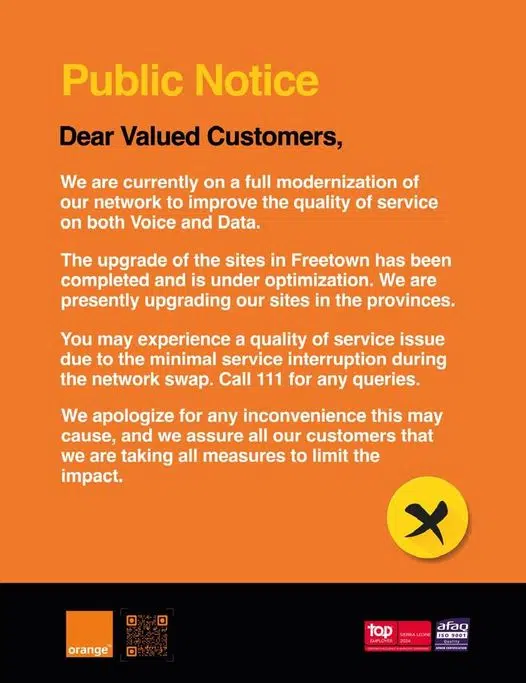
Orange Sierra Leone has issued a public notice to inform its valued customers about ongoing efforts to enhance the quality of service on both Voice and Data platforms. The company has completed the upgrade of sites in Freetown and is now focusing on optimizing these facilities.

As part of the modernization process, network sites in the provinces are currently being upgraded, which may result in minimal service interruptions. Customers are advised to contact 111 for any queries or concerns they may have during this period.

“We apologize for any inconvenience this may cause and want to assure all our customers that we are actively working to minimize the impact of these changes,” stated Orange Sierra Leone in their announcement.

Stay tuned for more updates on this developing story.

Orange Sierra Leone

Kadiru Kai Kai’s Threat of War Sparks Nationwide Outrage, Calls for Legal Action

Abdul Kadiru Kai Kai.jpg

By Amin Kef (Ranger)

In a strikingly aggressive declaration, Abdul Kadiru Kai Kai has threatened war if not granted the presidency, a statement that has been met with widespread condemnation. The reckless nature of his threat has sparked calls for censure and penalties to prevent incitement of violence against the state.

President Dr. Julius Maada Bio, committed to maintaining peace and stability in Sierra Leone, faces a direct challenge from Abdul Kadiru’s belligerent rhetoric. Citizens across the nation have voiced their unequivocal disapproval of such aggression and lawlessness, urging President Bio to swiftly address this alarming provocation.

“Sierra Leoneans deserve a future free from conflict, not one marred by warfare,” said a prominent community leader. “If one aspires to lead, it must be through democratic means. Any attempt to resort to war will be met with staunch resistance.”

As the nation stands united in rejecting the path of violence, the call for a peaceful, democratic process remains stronger than ever. The citizens of Sierra Leone remain hopeful for a future defined by stability and prosperity, underpinned by the rule of law and democratic principles.

The Sierra Leone Police (SLP) on Friday, July 19, 2024, issued a notice about a video clip circulating on social media. In the video, Abdul Kadiru Kai Kai threatens, “If I do not become president of Sierra Leone in 2028, I will bring a war worse than anyone expects. I am well prepared and have budgeted 3.3 million dollars to start the conflict in Masiaka.”

Given the gravity of the statement, the Sierra Leone Police, through the Criminal Investigations Department, has launched an investigation and arrested Kadiru. The investigation aims to verify the authenticity and intent of the statement, with updates to be provided to the public.

The Sierra Leone People’s Party (SLPP) has also condemned Kadiru’s threats. The party emphasized that such reckless statements do not represent their views and aspirations. The SLPP says it remains committed to upholding the rule of law and ensuring national security. They have suspended Kadiru’s membership and urged party members to dissociate from him.

The Independent Commission for Peace and National Cohesion (ICPNC) expressed deep concern over Abdul Kadiru’s remarks, highlighting the threat they pose to national stability. The ICPNC praised the Police for their swift action and called on all citizens to reject hate speech and violence, advocating for a peaceful and cohesive society.

Peace Ambassador, Alhaji Amadu Bah, known as Boss LAJ, also condemned Kadiru’s threats. He emphasized the importance of maintaining peace and respecting the democratic process. Ambassador Bah called on political leaders to avoid inflammatory language and promote unity, reminding the nation of the devastating effects of the 11-year civil war.

Sierra Leoneans are urged to prioritize peace and stability, working together to build a prosperous and harmonious future. The collective efforts of all citizens are crucial to ensuring that Sierra Leone remains a beacon of peace, unity and democracy.

SLAJ and MRCG Drive Forward with Comprehensive Media Policy Draft

National Media and Information Policy.jpg

By Amin Kef (Ranger)

The Ministry of Information and Civic Education (MoICE), with support from the United Nations Development Programme (UNDP), Plan International and New York University, organized a two-day regional consultation for the Western Area on July 17th-18th, 2024. Held at the New Brookfields Hotel Conference Hall on Jomo Kenyatta Road in Freetown, the event focused on discussions about the National Civic Education Policy & Strategy, National Media and Information Policy, National Film Policy and National Records and Archives Policy.

In his address, the Minister of Information and Civic Education, Chernor Bah, called for collaboration among media stakeholders to develop a national media policy that is aimed at addressing media development issues in Sierra Leone. He emphasized the need for sector transformation and reaffirmed his commitment to advancing press freedom and creating a free media space, in alignment with President Bio’s vision and the Ministry’s mandate. “We are committed to advancing press freedom, creating a free media space and transforming the media sector in Sierra Leone in alignment with President Bio’s vision,” he stated.

The Minister pointed out that the policy initiative was crafted by the Media Reform Coordinating Group (MRCG), the Sierra Leone Association of Journalists (SLAJ), and other media professionals. He assured that the policy would be handed back to these groups after the consultation and urged journalists to ensure the policy’s longevity and hold the Ministry accountable.

Ahmed Sahid Nasralla, President of SLAJ, expressed his satisfaction with the progress in formulating a national policy on information and media. He highlighted that the policy would consolidate media development gains in Sierra Leone and provide a framework for an inclusive and professional media ecosystem. “A national policy on information and media will consolidate the many gains we have made in media development in Sierra Leone. It will provide a framework for an inclusive and professional media ecosystem,” he remarked. He also mentioned the development of a National Coordination Committee for the safety and sustainability of journalists, emphasizing that freedom of expression and press freedom are fundamental rights.

Francis Sowa, Head of the MRCG and a policy consultant to the process, underscored the extensive consultations undertaken nationwide and expressed confidence in presenting a comprehensive policy draft for stakeholder review.

Aminata Wurie, a representative from the UNDP, assured close collaboration between UNDP and MoICE. She expressed excitement about the partnership and anticipated future collaborative programs following the completion of current initiatives. “UNDP is very excited to have a partnership with the Ministry of Information and Civic Education on a number of programs for 2024. When these programs are completed, they will be able to partner on more,” she said.

Edward Kargbo, Country Director of the BBC Media Action Group, described the policy as a blueprint for media development in Sierra Leone. He congratulated the Information Minister and his team on their progress and expressed his organization’s enthusiasm for the ongoing policy work.

The collaborative efforts and extensive consultations highlight a collective dedication to creating policies that will stand the test of time and foster a more inclusive and professional media environment in Sierra Leone.

Chief Minister Launches Steering Committee for Tripartite Report Implementation

By Amin Kef Sesay

Chief Minister, Dr. David Moinina Sengeh, inaugurated the Steering Committee tasked with overseeing the implementation of the recommendations from the Cross-Party on Electoral Systems and Management Bodies Review Report, commonly known as the ‘tripartite report’. The meeting took place on Friday, July 19, 2024 at State House in Freetown.

The primary goal of the newly established Steering Committee is to ensure the comprehensive execution of the tripartite report’s recommendations. The Committee includes a diverse group of members, comprising both Government Ministers and representatives from Civil Society Organizations (CSOs).

In his address, Dr. David Sengeh explained that following a cabinet decision to proceed with the tripartite report’s recommendations, President Julius Maada Bio endorsed the formation of this Steering Committee. The inaugural meeting was convened to define the Committee’s structure, mandate and operational guidelines.

“This meeting marks the beginning of our journey to implement the recommendations of the tripartite report,” said Dr.David Sengeh. “Our objective is to establish a clear framework for the Committee, including its duration, terms of reference and rules of engagement. It is crucial that we understand our immediate deliverables.”

The Chief Minister emphasized the importance of familiarizing themselves with the tripartite report and integrating its recommendations into ongoing national reforms, such as the constitutional review process.

Plans include setting up a Secretariat staffed by experts in legal, financial and communications fields, as well as institutional development and public sector analysis.

The Committee members voiced their commitment to making the report accessible and user-friendly, proposing initiatives like school debates, letter-writing campaigns and concerts to engage the public with the report’s recommendations.

The Chief Minister concluded the meeting by highlighting the President’s clear directive to ensure the effective implementation of the reforms, which are intended to fortify Sierra Leone’s democratic processes.

Sierra Leone Government Destroys Over $94 Million Worth of Illicit Drugs

National Drug Law Enforcement Agency (NDLEA) in collaboration with the Office of National Security (ONS), Transnational Organized Crime Unit (TOCU), Pharmacy Board, and the National Task Force on Drugs and Substance Abuse

In a significant blow to the drug trade, the Government of Sierra Leone has destroyed more than $94 million worth of illicit drugs. The operation, conducted by the National Drug Law Enforcement Agency (NDLEA) in collaboration with the Office of National Security (ONS), Transnational Organized Crime Unit (TOCU), Pharmacy Board, and the National Task Force on Drugs and Substance Abuse, took place on Friday July 19, 2024 at the TOCU headquarters in Hastings.

Among the drugs destroyed were those seized by the Pharmacy Board and Captagon pills intercepted by Sierra Leone’s intelligence officials. Some drugs were retained as exhibits for ongoing court cases involving suspects yet to be charged.

NDLEA Executive Director Andrew Jaiah Kaikai Esq. delivered a stern warning to drug traffickers, cautioning them against using Sierra Leone as a hub for their illegal activities. He reiterated President Dr. Julius Maada Bio’s commitment to cracking down on anyone attempting to smuggle drugs into the country. Kaikai assured that his agency, along with its partners, is diligently working to disrupt the supply chain, emphasizing that Sierra Leone will not be a safe haven for drug traffickers. He also highlighted his dedication to protecting the nation’s youth by supporting President Bio’s Feed Salone Project and noted a decrease in the demand and use of kush.

Chief Superintendent of Police (CSP) Mohamed Kugba Allieu, head of TOCU, revealed that this marks the fourth destruction of narcotics and contraband drugs in the past six months. He noted that suspects are in custody and cooperating with the investigation, while others remain at large. Allieu urged citizens to support security forces by providing vital information to combat illicit drug activities.

Shek Ahmed Bah, Director of Serious Organized Crime Coordination and Counter Terrorism, called for continued collaboration within the security sector to dismantle organized criminal organizations. He emphasized the robust mechanisms in place to prevent drug trafficking, asserting that traffickers might bypass a few checkpoints but cannot evade the intelligence system entirely.

Prof. Foday Sahr, Coordinator of the National Task Force on Drugs and Substance Abuse, praised the coordination between law enforcement agencies that led to this unprecedented destruction of illicit drugs. He emphasized the Task Force’s role in uniting efforts across ministries, departments, and agencies to combat the drug menace.

Dr. Momoh from the Pharmacy Board urged citizens to purchase drugs only from recognized and approved pharmacies and to avoid buying from street peddlers. He reported that the destroyed drugs seized by the Pharmacy Board were worth NLe 2.5 million and affirmed the Board’s ongoing commitment to seizing and destroying unsafe drugs.

The Security Sector assured the public of their effective management of the situation, noting that they receive intelligence both locally and internationally. They encouraged the public to provide any information that could help maintain peace and security in the country.

This coordinated effort underscores Sierra Leone’s unwavering resolve to combat drug trafficking and safeguard the well-being of its citizens.

Chief Abdul Kadiru Kaikai Issues Apology for Controversial 2028 Election Remarks

Chief Abdul Kadiru Kaikai

As He Reaffirms Commitment to Peace and Democracy…

By Amin Kef (Ranger)

In a recent press release dated July 21, 2024 and signed by Chief Abdul Kadiru Kaikai, the prominent figure expressed deep regret over his previous comments regarding the 2028 presidential elections. Reflecting on his statement, Chief Kaikai acknowledged the gravity of his words, admitting they were dangerous, irresponsible, and inappropriate in a democratic society.

“Upon reflection on the statement I made regarding the 2028 presidential elections, I have come to terms with the fact that it was dangerous, irresponsible, and had no place in our society,” Chief Kaikai stated. “From the bottom of my heart, I tender my profound apology to the entire nation for that unfortunate incident.”

Emphasizing his commitment to peace and democracy, Chief Kaikai reassured the public of his dedication to these principles. “As a responsible and peaceful citizen, and as a husband and father, I hereby recommit myself to ensuring that, going forward, my words and actions will consistently respect our democratic principles, consolidate our peace, and embrace national unity.”

Chief Kaikai also recognized the significant public reaction to his previous statement, commending citizens for their unity and commitment to peace. “I have also taken note of the significant public reaction to the statement and wish to commend the public for demonstrating that, regardless of our divisions, we continue to stand together for peace. I could not be prouder of my fellow citizens.”

In his heartfelt apology, Chief Kaikai hoped that his experience would serve as a lesson for all. “Once again, my sincere apologies, and I hope that this serves as a lesson for all of us to maintain peace in our words and actions. May Allah bless us all, and may Allah bless Sierra Leone.”

In a separate note, Chief Kaikai addressed the Sierra Leone People’s Party (SLPP), highlighting the internal struggles and urging members to refrain from betrayal. “The SLPP has long been recognized for its significant contributions to our nation. However, it has also been marred by instances of betrayal, particularly towards those who have made substantial sacrifices for the party.”

Chief Kaikai’s controversial statement about initiating war if not elected president in 2028 has sparked widespread condemnation, including from members within the SLPP. Despite the inflammatory nature of his remarks, Chief Kaikai has stressed the context in which they were made, highlighting the threats of war and death directed at those who oppose peace.

“Rather than crucifying Chief Kaikai, the state should request that he tender a formal apology and ensure he refrains from making such inflammatory statements in the future. This approach would not only uphold our democratic values but also promote reconciliation and peace.”

Expressing concern over internal political conflicts, Chief Kaikai called for unity within the SLPP. “It is disheartening to witness senior politicians within the SLPP viewing Chief Kaikai as a threat and using this incident to undermine him. The internal political struggles should not result in the prolonged detention of a party member, especially when reconciliation is possible. Today, it is Kadiru Kaikai facing this plight; tomorrow, it could be any one of you.”

In conclusion, Chief Kaikai urged the SLPP and the nation to stand together, emphasizing the importance of unity, mutual respect, and cooperation. “The SLPP has the potential to lead Sierra Leone towards a brighter future. To achieve this, we must uphold our principles, support one another, and work together to maintain the peace and democracy that we have fought so hard to establish.”

Save the Children Addresses Trespassing Incident, Reassures Adherence to High Standards

Save the Children.jpg

By Esther Wright

In a press release on Wednesday, June 17, 2024, Save the Children announced it is aware of recent actions by UK national Sam Walker, who trespassed on the organization’s office premises in Aberdeen, Sierra Leone, on July 9. The incident has been reported to the relevant authorities.

During the incident, Mr. Walker accused Save the Children of malpractice, harassed staff, and published their images on his social media platforms. These actions disrupted the organization’s work, exploited vulnerable children and raised concerns about the safety and well-being of both staff and the children served by the organization.

Save the Children emphasized its commitment to operating with the highest standards, prioritizing the safety and well-being of children. The organization is registered in Sierra Leone and adheres to all national regulations and standards, with a robust grievance mechanism in place to address any concerns or complaints.

The organization is registered with the Ministry of Planning and Economic Development (MOPED), which provides oversight for all NGO operations and is subject to the Parliamentary Oversight Committee. Save the Children is also affiliated with the Sierra Leone Association of Non-Governmental Organizations (SLANGO), which coordinates NGO activities and ensures adherence to best practices in the humanitarian sector.

Operating in Sierra Leone since 1999, Save the Children focuses on children’s rights and protection, education, and health. For any inquiries, contact Esther Elliot Nyuma, Advocacy and Campaign Director.

Turn of the Tide: What Can American Multi-Racial Democracy Learn from Africa

By Alhaji U. N’jai

I first wrote this piece after the January 6, 2020 insurrection in the US and now in the wake of July 13, 2024 assassination attempt on President Trump, American democracy needs introspection.

America now needs to learn as much from Africa’ s rich experience with multi-ethnic and pluralistic democracy. American democracy has worked politically well in the past in a largely homogenous white dominated environment. It now must deal with an increasingly complex multi-racial, conscious and pluralistic political economy for which it lacks the requisite experience to handle.

Four years of Trump, its handling of Covid-19 pandemic, race relations, post-US 2020 elections violence, Russia-Ukraine conflict, and Biden’s handling of the Israel-Palestine Gaza conflict have all severely damaged US global standing. It is time for America to deconstruct and decolonize its existing democratic model locally and in relation to the rest of the world.

On multi-racial democracy, America must now learn from the rest of the world rather than focus on being conveyors of it. For this, I believe, Africa’s rich pluralistic democratic experience structured on multiple layers of ethnicities, class, religions, western education and traditionalist, urban and rural dichotomies, and colonial experience offers a good starting point. African political economies have displayed remarkable resilience despite years of slavery, colonialism, bad governance, wars, turmoil, disease and environmental strife. African multi-ethnic democracies have been portrayed as weak, fragile, and instable, but have largely been that way because of colonial disruptions and current neocolonial influence, that ensures unfettered access to it resources.

Mediocrity on the part of the African elites or leaderships is yet to allow total liberation and the development of sound ideologies for political, social, and economic organization of its people. Four years of Trump and emergence of multi-racial democracy is pushing America to the brink of chaos. Essentially, America is now where Africa was post-independence, when it comes to it young and fragile multi-racial democracy. The challenge as in Africa is how to build national cohesion along a strong positive sense of national identity in a multi-ethnic environment.

The African culture of ubuntu, collectivism, communal belonging, social justice and tolerance have been the foundational underpinnings of both the African resilience and success with pluralistic democracy. America must grapple with its individualism values and capitalism in an increasingly multi-racial and pluralistic political economy
——
About the author: Alhaji Umar N’jai is a Senior Scientist, Professor, Panafrican Scholar, Founder & Chief Strategist of Project 1808, Inc., and Freelance writer ‘Roaming in the Mountains of Kabala Republic’. #Jata #Meejoh #ThePeoplesScientist


Supreme Court Dismisses Challenge Against Chief Electoral Commissioner Mohamed Konneh

Supreme Court of Sierra Leone.jpg

By Amin Kef Sesay

In a landmark decision, the Supreme Court of Sierra Leone, led by Acting Chief Justice Hon. Justice Nicholas C. Browne-Marke, ruled on Wednesday, July 17, 2024, that the appointment of  Mohamed Konneh as Chief Electoral Commissioner of the Electoral Commission of Sierra Leone (ECSL) is constitutional and does not violate any provisions of the 1991 Constitution.

The ruling, delivered by a unanimous panel of four justices, emphasized the importance of interpreting the Constitution in its entirety rather than selectively. “The Constitution must be read as a whole, and not in bits, cherry-picking provisions which, on their own, may appear to support one view or the other. To do so would result in absurdity,” stated Acting Chief Justice Browne-Marke.

The Justices on the panel included Hon. Chief Justice Nicholas C. Browne-Marke (JSC), Hon. Justice M. F. Deen-Tarawally (JSC), Hon. Justice Alusine S. Sesay (JSC), and Hon. Justice Ansumana Ivan Sesay (JA). They dismissed the case brought by plaintiffs, Charles Francis Margai, representing Patrick John and the People’s Movement for Democratic Change (PMDC), against Mohamed Konneh, the ECSL, and the Attorney General and Minister of Justice.

The plaintiffs argued that Mohamed Konneh’s appointment while serving as the Director of the Financial Intelligence Unit (FIU) violated Sections 32(3) and (4), 75(c), 76(1)(b), and 171(1) and (4) of the 1991 Constitution. Additionally, they claimed that the ECSL failed to allocate campaign dates for all presidential candidates, including the PMDC candidate, as required by Sections 154 and 155 of Act No. 17 of 2022, thereby infringing on the party’s campaign rights.

In addressing the legitimacy of Mohamed  Konneh’s appointment, the court clarified that Section 32(4) of the 1991 Constitution pertains to the qualifications for Electoral Commissioners, Members of Parliament or Ministers. The Acting Chief Justice pointed out that Mohamed Konneh was not a Member of Parliament at the time of his appointment and would have been required to resign 12 months before an election had he intended to contest for a parliamentary seat. However, this requirement does not apply to his role as Director of the FIU.

Another key aspect of the case involved an application by Charles  Margai requesting the recusal of Chief Justice Edwards and Justice Ansumana Ivan Sesay (JA) due to their involvement in administering the presidential oath and their positions within the judiciary. The court found no legal basis for these recusal requests, citing specific constitutional provisions that authorize the Chief Justice to administer the presidential oath and confirm the participation of Supreme Court Justices in such matters.

Counsel for the Defense, including B. E. Cummings, Dr. E. S. Abdulai, T. J. Mansaray and A. B. Mansaray, argued for the dismissal of the plaintiffs’ case, describing it as fundamentally flawed and lacking factual particulars as required by the Supreme Court Rules of 1982. The court concurred, affirming the legality of Mohamed Konneh’s appointment and upholding the integrity of the electoral process in Sierra Leone.