
Home Blog Page 379

UN-Nutrition Network Validates 2022 Stakeholders and Nutrition Action Mapping Results

UN Nutrition.jpg

By Foday Moriba Conteh

In order to enhance nutrition coordination and scale-up actions by providing a comprehensive overview of nutrition stakeholders, their geographical coverage, and the beneficiaries of core nutrition actions in the country, the UN Nutrition Network comprising of FAO, UNICEF, WHO and WEF, in collaboration with the Scaling Up Nutrition Movement has on Thursday 18th April 2024 concluded a one-day validation workshop on the 2022 Stakeholders and Nutrition Action Mapping Results. The event was held at the Family Kingdom Resort on Aberdeen in Freetown.

Addressing the gathering on behalf of the UN Family, Hannah Yankson, the National Professional Officer for Nutrition and Food Safety and Acting Team Lead Healthier Population Cluster at the World Health Organization (WHO), said that the objective of the exercise is to enhance nutrition coordination and scale-up actions by providing a comprehensive overview of nutrition stakeholders, their geographical coverage and the beneficiaries of core nutrition actions.

Enumerating the anticipated outcomes, Yankson outlined six key areas where the findings from the mapping exercise are expected to make a significant impact. These include guiding nutrition planning, budgeting, and prioritization at national and sub-national levels, informing advocacy efforts to attract increased investment in nutrition, and enhancing stakeholder involvement across sectors to support positive nutrition outcomes.

Furthermore, she emphasized the importance of tracking and coordinating the implementation status of the national nutrition plan, strengthening nutrition information systems, and documenting the landscape of key nutrition actors and actions across multiple sectors.

Concluding her address, Hannah Yankson reiterated the UN family’s commitment to supporting the Government in strengthening advocacy, coordination and nutrition governance. She emphasized the goal of bringing together key Government sectors and stakeholders to accelerate evidence-based actions aimed at improving nutrition outcomes in the country.

She expressed hopes for a successful validation process and highlighted the exercise’s contribution to achieving Sustainable Development Goal 2 (Zero Hunger) and SDG 3 (Improving the Health and Well-being of the Population) by 2030.

On her part, Aminata Shamit Koroma, the Chief Nutritionist/Director of Nutrition at the Ministry of Health, commended the UN Nutrition Network and the Scaling Up Nutrition Movement for their initiative in conducting the 2022 Stakeholders and Nutrition Action Mapping. She emphasized the significance and timeliness of those results.

Aminata Koroma highlighted the importance of the mapping exercise, noting that there are nutrition stakeholders whose work the Directorate on Nutrition is unaware of, which has negatively impacted their outcomes, activities and resource allocation.

She expressed optimism that the validation of the 2022 Stakeholders and Nutrition Action Mapping Results will improve nutrition coordination and scale-up actions. This, she believes, will offer a comprehensive overview of nutrition stakeholders, their geographical coverage, and the beneficiaries of core nutrition actions in the country.

Representing the Minister of State Office of the Vice President, Nenebah Jalloh, the National Coordinator of the Scaling Up Nutrition Office of the Vice President, highlighted Sierra Leone’s steadfast commitment to combat malnutrition.

She emphasized Sierra Leone’s unwavering dedication to combat malnutrition, deeply ingrained in the nation’s agenda. Since 2012, Sierra Leone has actively participated in the Scaling Up Nutrition (SUN) Movement, a global initiative addressing under nutrition and promoting sustainable food security.

Nenebah Jalloh added that central to Sierra Leone’s efforts is the Scaling-Up Nutrition Secretariat, operating under the Office of the Vice-President, tasked with coordinating Government initiatives and engaging stakeholders across sectors. Through the Multi-Sector Strategic Plan to Reduce Malnutrition, Sierra Leone aims to comprehensively address malnutrition challenges.

She highlighted the urgency of this endeavour, noting that one in three children in Sierra Leone suffers from stunting, compromising both physical growth and cognitive development. Recognizing the complexity of malnutrition, Sierra Leone embraces collaboration, partnering with UN Nutrition to map nutrition actions and stakeholders’ engagement.

According to her the mapping exercise aimed to identify key actors, assess ongoing initiatives, and illuminate the role of nutrition-related information in shaping policy formulation, by equipping policymakers with evidence-based insights, prioritization of interventions with the greatest impact potential becomes feasible.

Furthermore, Nenebah Jalloh said enhanced data collection facilitates monitoring and evaluation mechanisms, ensuring transparency and accountability in nutrition program implementation, furthering that the mapping exercise serves as a catalyst for advocacy, fostering a sense of shared responsibility and mobilizing support from diverse stakeholders.

In conclusion, she revealed that Sierra Leone’s commitment to addressing malnutrition remains steadfast, prioritizing collaboration, evidence-based decision-making, and accountability of she urged stakeholders to remain resolute in their efforts, leveraging partnerships and innovative approaches to realize a healthier, more prosperous future for all Sierra Leoneans.

The opening ceremony was succeeded by a comprehensive presentation of the mapping exercise, which included an outline of its objectives, methodology, anticipated outcomes, along with illustrative examples from other countries. The presentation delved into the roles of various stakeholders in nutrition, the geographic scope of their activities, an analysis of delivery mechanisms employed, and a summary of key findings regarding core nutrition actions and challenges.

This session was led by both the national consultant, Thomas Bockarie, and the international consultant, William Zachariah Knechtel. Subsequently, there was a review of core nutrition actions, followed by a participatory plenary session aimed at reaching a consensus and charting a way forward.

As Chief Minister Promises to Deliver…   Government to Focus on Addressing Energy Challenges Instead of Making Unfulfilled Promises

Chief Minister, Dr.David Moinina Sengeh.jpg

By Foday Moriba Conteh

An illustrious Political Analyst recently averred that the current ruling SLPP Government, headed by President Julius Maada Bio, is unconsciously digging its own political grave by seemingly trivializing addressing an essential service that is so dear to many Sierra Leoneans: Electricity Supply. He underscored that the Laissez Faire and lackadaisical way in which the Government is responding to the energy challenges, which many are currently disgusted with, could be politically suicidal having the tendency to paint it negatively and reinforce emerging criticisms of not being fit for purpose or not equal to its mandate. The Political Analyst stressed that reliable energy supply is one thing that should not be joked with by any political establishment.

What, in the estimation of this medium, is crystal clear is that most of the citizenry, especially residents of Freetown, are not inclined to presently believe any political promise of any improvement within the energy sector so very pretty soon. From what was also learnt, past promises made by the Minister of Energy, Alhaji Kanja Sesay, the Electricity Distribution and Supply Authority (EDSA), to a very large extent, turned out to be unfulfilled.

Of late, another promise has emanated from the Chief Minister, Dr.David Moinina Sengeh that the SLPP Led Government will deliver on its energy access promise to the citizenry.

In his usual Diary Updates, the Chief Minister stated that one of the first papers that the Minister of Energy, Alhaji Kanja Sesay, brought to Cabinet during President Bio’s second term in office was a 108MW Western Area Power Generation Project. He continued that as recent as on the 17th April, 2024, the project has secured an additional $292M from the US Government’s DFC.

Dr. Sengeh also revealed that recently, while in Togo, they also pushed the ECOWAS Bank for Investment and Development to finalize a $40M financing adding that the landmark investment by Milele Energy & TCQ Power will help to solve the country’s electricity challenges. He also maintained that within the next two years, close to 150 communities will have solar energy.

While Dr. Sengeh’s optimism may offer a glimmer of hope, doubts persist regarding the Government’s ability to translate promises into meaningful action. Many are wondering if the funds he cited will make any significant impact. Such a doubt, laced in pessimism, could be expressed against the backdrop that research has so far disclosed that, between 2016 and 2019, the Government of Sierra Leone received up to US$230 Million from the World Bank to improve electricity supply in Freetown (worldbank.org/en/news/press-…).

US $12,345,000 was for electricity sector reform support as part of the US$44 Million Millennium Challenge Corporation (MCC) and the Government of Sierra Leone Threshold Program that ended in 2021(mcc.gov/where-we-work/…).

The point being made here is that, if previous funding of such magnitude were secured and there was not much improvement what is the assurance that the ones the Chief Minister is now talking about will make any significant difference in the Energy Sector, with particular reference to avail Freetown reliable and dependable electricity supply.

For now what is known is that many residents of Freetown are calling on the SLPP Led Government, particularly the Ministry of Finance, to do all within its reach to honour its debt to Karpowership instead of continuing making promises that are yet to materialize or felt. Residents are demanding concrete solutions over rhetoric and according to a cross section of them, a bird in the hand is worth two in the bush.

Others have blasted that instead of Government officials misplacing State Resources on things that are not much of priorities, like frequent overseas travelling, bloated wage bills and for some to display opulent lifestyles in a poverty ridden nation, prudently it is a basic thing like seriously trying to address the energy problem that should be given due and primary consideration and one way is for the Ministry of Finance to find ways of settling the outstanding payment to Karpowership while pursuing other alternatives.

For now what is certain is that Freetown has been plunged into darkness as EDSA has recently indicated that because of teething challenges that it is undergoing and trying to address, it has reduced the amount of electricity it has been supplying to residents of Freetown.

Lamentably, this despondent information came in the heels of a reduction of electricity supply by Karpowership from 65MW to 5MW over Government, through the Ministry of Finance’s unfulfilled promise to honour an outstanding debt to the service provider totaling $40 Million.

Kambia District Council Unveils EU-Funded Infrastructure: Bamoi Luma Market Stalls, Guest House & Conference Centre

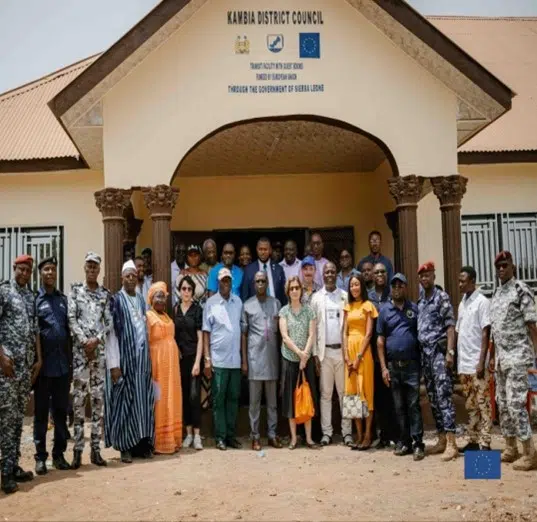
In the esteemed presence of the Minister of Local Government and Community Affairs, Amb Tamba Lamina, the European Union External Action Service (EEAS) Managing Director for Africa, Rita Laranjinha, EEAS Desk Officer for Sierra Leone Hana Missaoui, and EU Ambassador to Sierra Leone Manuel Muller, alongside various government officials and stakeholders of Kambia District Council, vital infrastructure projects were inaugurated in Kambia district on the 17th April,2024.

The recent commissioning ceremony marked a significant stride in the district’s development journey, spotlighting the pivotal role of infrastructure projects in fostering growth and prosperity.

Constructed with funding from the European Union, the state-of-the-art Conference Centre and Guest House at the Gbalamuya border town between Sierra Leone and Guinea, stand as a testament to the district’s progress, underscoring the importance of strategic infrastructure investments.


The projects also include a shopping center comprising 55 shops and stores at the Kambia Lorry Park, alongside a market center featuring numerous stalls at the Barmoi Luma Market trade zone. These facilities serve as pivotal hub for trade and commerce, facilitating economic exchanges between Sierra Leone and Guinea, thereby bolstering socio-economic growth and empowering local businesses.

The revitalization of the Bamoi Luma market stores underscores the significance of vibrant marketplaces in fostering economic activity and community cohesion. These upgraded facilities offer traders enhanced security for their goods and platforms for entrepreneurship and livelihood development. Furthermore, the Transit Facility at Gbalamuya Crossing Point and the improved road network between the Guinean and Liberian borders facilitate cross-border trade, promote regional integration, and strengthen economic ties with neighboring countries.

The initiatives aim to enhance revenue generation for the district council while providing essential social services to the people of Kambia, aligning with the EU’s commitment to sustainable development and inclusive growth.

Rita Laranjinha, EEAS Managing Director for Africa, said, “The EU firmly believes that Sierra Leonean initiatives for local governance play a crucial role in promoting good governance and fostering inclusive economic development. Effective governance requires a system that acknowledges and values the unique needs, priorities and contributions of local actors…This aligns with the Government’s Big-5 initiative and the EU Global Gateway offer to Africa.”

Ambassador Manuel Muller said, “The EU has a long relationship with Local Councils like the Kambia Local Council and is proud to contribute sustainably to the district’s development. We believe decentralization helps bring development like good roads, culverts, water facilities, market stalls and many more to local communities. These investments will significantly help farmers and traders and increase the incomes of particularly market women.”

Testimonials from local stakeholders, including Ishiatu Kamara of the Kambia Petty Traders Association and Alpha Amadu Bah of the National President of Motor Drivers and General Workers Association, highlighted the transformative impact of these projects on local livelihoods and regional connectivity.

The Chief Administrator of Kambia District Council, Edward Alpha, says the EU Support to Civil Society and Local Authorities for Local Development in Sierra Leone Project has helped build the council’s staff capacity to deliver on its core mandate and increase its revenue generation capacity. Mr. Alpha continued that though there is room for improvement, the EU’s support to the Council has positively enhanced its service delivery capacity to people, who remain grateful to the EU.

The successful commissioning of these projects underscores the collaborative efforts of Government agencies, development partners and local communities in driving inclusive and sustainable development in the Kambia District. These initiatives will continue to catalyze growth, prosperity and progress in the district and beyond.

The EU-funded Support to Civil Society and Local Authorities for Local Development in Sierra Leone project aims to empower District Councils to drive good governance and sustainable development. By enhancing institutional capacity and local revenue generation, the program enables District Councils to expand access to essential services, promote sustainable practices and stimulate economic growth.

Implemented with technical assistance from DAI, this initiative is part of the European Union’s broader efforts to support Civil Society Organisations and District Councils in Kenema, Bombali, Falaba, Kambia, Karene and Pujehun.

As it Ends 2-Day Conference in Freetown… ECOWAS Adopts Communiqué on Use of Autonomous Weapons in Sub-Region

ECOWAS Regional Conference on the Peace and Security Aspect of Autonomous Weapons Systems.jpg

By Foday Moriba Conteh

A two-day ECOWAS Regional Conference on the Peace and Security Aspect of Autonomous Weapons Systems ended in Freetown on Thursday 18th April, 2024 in Freetown, Sierra Leone.

Under the theme: “Peace and Security Aspect of Autonomous Weapons System: an ECOWAS Perspective on a Path towards the Negotiation Process of a Legally Binding Instrument,” the regional conference was held at the Bintumani Conference Centre on Aberdeen, Freetown bringing together delegates from member states and climaxed with the adoption of a Communiqué detailing ECOWAS’s position on the use of Autonomous Weapons in the sub-region.

While addressing the gathering on the adoption of the Communiqué, the Deputy Minister of Foreign Affairs and International Cooperation, Francess Piagie Alghali, expressed gratitude to all participants for their engagement in discussions related to the peace and security aspects of weapon systems.

She commended the collaborative efforts of ECOWAS members, Civil Society Organizations and International NGOs in adopting a comprehensive Communiqué detailing ECOWAS’s position on the use of Autonomous Weapons in the sub-region.

The Deputy Minister emphasized the significance of hosting the conference as a demonstration of Sierra Leone’s commitment to joining the international community in advocating for a regulated and binding instrument on the use of autonomous weapons. She underscored the urgent need for such an instrument in light of complex geopolitical tensions and the evolving landscape of artificial intelligence technology.

Francess Piagie Alghali revealed that the adoption of the comprehensive Communiqué reflects ECOWAS’s shared mission and commitment to addressing the challenges posed by autonomous weapons, contributing to regional peace, security and stabilization.

She concluded by acknowledging the pivotal role played by the Center for Accountability and Rule Law and the Ministry of Foreign Affairs in organizing the event as well as extending her gratitude to the senior and junior staff involved in facilitating the conference’s success.

His Excellency Brigadier General (Retired) Dr. Julius Maada Bio, President of the Republic of Sierra Leone, while inaugurating the conference on Wednesday 17th April, 2024 highlighted Sierra Leone’s commitment to addressing the challenges posed by Autonomous Weapons Systems, emphasizing the urgent need for a legally binding instrument.

He noted that Sierra Leone played a pivotal role in drafting the UN General Assembly Resolution 78/241 on Autonomous Weapons and stressed the country’s dedication to upholding international agreements such as the Arms Trade Treaty.

Addressing the ethical, legal and security implications of Autonomous Weapons Systems, President Bio underscored the importance of ensuring that these technologies are developed and used in alignment with international law, human rights and humanitarian values.

He cautioned against the unchecked proliferation of such weapons, emphasizing the potential threats to global security and stability. President Bio called for proactive engagement in shaping global norms to address emerging challenges while harnessing the potential for positive change. He also urged delegates to engage in open, frank and constructive discussions during the conference, embracing diverse perspectives to shape ECOWAS’ collective future.

In conclusion, President Bio expressed gratitude to the Permanent Mission in Geneva and Civil Society partners for their efforts in organizing the conference.

Ms. Izumi Nakamitsu, Under-Secretary-General and High Representative for Disarmament Affairs, in her video message, began by expressing gratitude to the Government of the Republic of Sierra Leone for spearheading the organization of this crucial conference.

She highlighted the importance of deepening collective understanding regarding the implications of autonomous weapon systems on regional and global security, human rights and international humanitarian law. Sierra Leone was commended for its pivotal role in global discussions on disarmament and conflict prevention.

Ms. Nakamitsu emphasized the urgent need for new global governance regimes to effectively address the challenges posed by emerging technologies, particularly lethal autonomous weapon systems, underscoring the Secretary-General’s call for States to conclude negotiations on a legally binding instrument to regulate those systems by 2026, urging States to actively engage in discussions within the group of governmental experts of the Convention on Certain Conventional Weapons (CCW) and emphasized the importance of diverse voices in shaping multilateral responses.

Furthermore, Ms. Nakamitsu stressed that the issue of autonomous weapon systems is not exclusive to highly militarized States but concerns the entire international community. She called upon ECOWAS member States to align on the development of a shared vision regarding these systems and to heed the Secretary-General’s urgent call for new binding laws.

Ms. Nakamitsu ended highlighting the potential positive impact of the conference’s outcomes on current and future generations. She thanked participants for their attention and encouraged constructive engagement throughout the meeting.

Dr. Abdel-Fatau Musah, Commissioner of Political Affairs, Peace and Security at ECOWAS, emphasized the significant security implications associated with the development and deployment of autonomous weapon systems. He highlighted that similar weapons, capable of airborne attacks without human control, are already in use, underscoring the urgency of addressing that issue.

Dr. Musah stated that the conference is both timely and focused, stressing the importance for leaders in West Africa to implement regulations to discourage the use of such weapons in the region.

Other stakeholders including the Minister of Foreign Affairs and International Cooperation of the Republic of Sierra Leone, Timothy Kabba, the Minister of Foreign Affairs and International Cooperation of The Gambia, Hon. Dr Mamadou Tangara, also made statements at the opening of the conference.

RCB MD Delves into Inclusive Finance Technologies at George Washington University Symposium

Dr. Walton Ekundayo Gilpin.jpg

By Amin Kef Sesay

George Washington University School of Business welcomed esteemed figures in the realms of finance and business from across Africa, the USA and beyond. The distinguished gathering, titled: “Emerging Technologies for Inclusive Financial Services Delivery,” convened luminaries in global finance and business, with Sierra Leone’s Rokel Commercial Bank Managing Director, Dr. Walton Ekundayo Gilpin, prominently featured as a key panelist.

The event, held on Wednesday, April 17th, 2024 in Washington DC, saw the participation of Central Bank Governors from Nigeria, Kenya, Zimbabwe, South Africa, Rwanda, US lawmakers and finance experts from esteemed institutions like the Brookings Institute, Carnegie Endowment and the World Bank.

The primary focus of the conference was to address the hurdles confronting the African continent and explore policies and initiatives capable of catalyzing transformation within African financial systems. Dr. Gilpin and fellow experts engaged in lively discussions surrounding emerging technologies, artificial intelligence, Cybersecurity and climate finance, probing into innovative solutions that African banks can adopt to foster sustainable and inclusive economic growth. The overarching objective was to galvanize financial resources for the benefit of nations and their citizens.

Dr. Walton Gilpin contributed to a panel of experts examining the theme of Financial Innovations Driving Africa’s Growth. The deliberations illuminated innovative financial solutions, payment systems, mobile banking, and digital platforms poised to propel economic expansion across Africa. Moreover, experts elaborated on strategies to tailor these innovations to local contexts, fortify financial infrastructure, and cultivate collaboration among government entities, domestic enterprises, and foreign investors to advance financial inclusion, entrepreneurship, and economic advancement.

Sierra Leone Prioritizes Digital ID for National Transformation

By Amin Kef Sesay

In a bid to accelerate its digital transformation, Sierra Leone has placed    its digital identity (ID) system at the forefront of its agenda. According to an official from the country’s ID Authority, the National Civil Registration Authority (NCRA), the move is pivotal to the nation’s progress.

Speaking to Biometric Update at the MOSIP Connect event held in Addis Ababa last month, Moses T.F. Vibbie, Deputy Director of ICT at NCRA, highlighted the significance of Sierra Leone’s commitment to digital innovation. He credited the strong political will of President Julius Maada Bio and the dedication of NCRA’s Director General, Mohamed Mubashir Massaquoi, as key drivers behind the initiative.

Moses Vibbie emphasized the central role of the Foundational Digital ID managed by NCRA in Sierra Leone’s digital transformation strategy. He explained that the National ID Card or NIN (National Identification Number) is now mandatory for accessing a wide array of Government and private sector services, as mandated by the National Civil Registration Act of 2016.

Sierra Leone embarked on the journey to modernize its ID system in 2016/2017, later partnering with MOSIP to establish an open-source ID system tailored to the country’s needs. According to Moses Vibbie several reasons are responsible for opting for the MOSIP-based digital ID, including its open-source nature, absence of vendor lock-in and flexibility for customization.

Enrollment for the Digital ID is well underway, with over 90 percent of the population already registered. To further promote adoption, NCRA set a deadline for citizens and legal residents to acquire the new Digital ID card, initially set for March 31, 2024, later extended to June 28, 2024, to allow more time for compliance.

The NCRA Director General, Mohamed Massaquoi’s leadership, coupled with support from international partners such as ID4Africa, has been instrumental in driving the project forward. Moses Vibbie highlighted ongoing efforts in legal and institutional reforms, public awareness campaigns, and collaboration with stakeholders to advance civil registration and identity services.

Reflecting on their participation at MOSIP Connect 2024, he expressed gratitude for the learning opportunities the event provided further noting the valuable insights gained from sharing experiences with other countries and engaging with stakeholders from Government, the private sector and NGOs.

Sierra Leone’s comprehensive civil registration and identity system aligns with continental resolutions and international recommendations on civil registration and vital statistics systems.

As Sierra Leone continues to forge ahead with its digital transformation journey, collaboration and partnerships remain vital for ensuring the success and sustainability of its digital ID initiatives.

Designated Centers for Acquiring the Digital ID Cards are:

1. NCRA Headquarters: 2 Walpole Street, Freetown.
2. NCRA Office: 23B Off Kingharman Road, Freetown.
3. NCRA Office: Kennedy Street, Freetown.
4. NCRA Branch Office: 230 Lumley Road, Freetown (By the Roundabout).
5. NCRA Office: Waterloo along the Freetown Highway (Opposite the Police Station).
6. NCRA Offices: Regional Headquarter Towns of Bo, Kenema, Makeni, and Port Loko.

For detailed inquiries regarding these services, interested parties can contact the NCRA via the following phone numbers: +232-33-433-333, +232-30-500-000, +232-60-000, +232-78-221-812, or through email at idverification@ncra.gov.

Tax Burden Challenges Sierra Leone’s Economic Prospects

created by photogrid

By Jacob Macauley and Dr. Victor Moinina

In the vibrant streets of Freetown, where the hustle of daily life intertwines with the echoes of development, the paradoxes of Sierra Leone’s economy are starkly evident. Endowed with abundant natural resources, the nation grapples with entrenched poverty, deteriorating infrastructure, and a heavy reliance on taxation to fuel Governmental operations.

Sierra Leone’s economic narrative is one of missed opportunities. Despite the allure of its mineral wealth, including diamonds, iron ore, and rutile, mismanagement and corruption have hindered the transformation of resources into widespread prosperity. “Our natural endowments should be a blessing, but they’ve often turned into a curse,” laments Abdul Kamara, an Economics Professor at Fourah Bay College.

The crux of Sierra Leone’s economic dilemma lies in its tax-heavy revenue model. With tax revenues comprising nearly 16% of the GDP, the nation grapples with one of West Africa’s highest tax burdens. This dependency stems from a narrow economic base and limited avenues for income generation beyond taxation.

Critics argue that high taxes stifle entrepreneurship, discourage investment, and fuel the growth of an informal sector operating beyond the tax net.

Aminata Conteh, a local business owner, highlights the conundrum faced by small enterprises: “The tax rates are suffocating. It’s either evade taxes or face closure.”

However, proponents of robust taxation assert its necessity for funding vital public services and infrastructure development. Former Finance Minister, Jacob Saffa, underscored the indispensable role of taxes in nation-building, advocating for a balanced approach to revenue generation.

Despite efforts to broaden the tax base and enhance collection mechanisms, progress has been sluggish, marred by corruption and bureaucratic inefficiencies. The ongoing debate over taxation’s impact on economic growth underscores the complexity of Sierra Leone’s developmental challenges.

The recent inauguration of a $318 million airport terminal, funded through a public-private partnership, epitomizes both hope and controversy. While touted as a catalyst for economic advancement, critics question its affordability amid widespread poverty and fiscal strains.

The introduction of the Goods and Services Tax (G.S.T.) in 2010 further underscores Sierra Leone’s tax conundrum. Despite aiming to bolster domestic revenue, the G.S.T. has faced criticism for its burdensome impact on businesses and consumers alike. The National Revenue Authority’s enforcement tactics have drawn ire, exacerbating grievances against the tax regime.

Yet, defenders of the G.S.T. argue for its necessity in funding essential services and reducing reliance on foreign aid. Former NRA Commissioner-General, Dr. Samuel Jibao, supported the tax’s pivotal role in ensuring sustainable revenue streams for Governmental operations.

As Sierra Leone navigates the intricate interplay between taxation and economic growth, the path forward remains uncertain. A multi-faceted approach, encompassing tax reform, economic diversification, and governance enhancements, is imperative to surmounting the nation’s economic challenges.

Key Recommendations for Economic Revival:

1. Comprehensive Tax Reform: Review and simplify the tax system, considering reductions in the G.S.T. rate and exploring alternative revenue sources.

  1. Formalization of the Informal Sector: Incentivize informal businesses to formalize operations, expanding the tax base while providing support for compliance.
  2. Targeted Investment: Direct tax revenues towards strategic investments in infrastructure and critical industries to stimulate economic growth.
  3. Improvement of Public Services and Governance: Enhance service delivery and governance to foster public trust and ensure efficient utilization of tax revenues.
  4. Capacity Building and Taxpayer Education: Invest in training programs for tax officials and raise awareness among taxpayers to enhance compliance.
  5. Regional Cooperation: Collaborate with neighboring countries to harmonize tax policies and combat tax evasion.

Sierra Leone’s journey towards economic prosperity hinges on striking a delicate balance between revenue mobilization and fostering an environment conducive to business growth and citizen well-being. Through concerted efforts and prudent policies, the nation can harness its potential for sustainable, inclusive development.


NP (SL): Well Renowned for Customer Centric Approaches & Reliability  

NP-Sierra Leone Limited (NP-SL Ltd).jpg

By Amin Kef Sesay

In Sierra Leone’s dynamic petroleum industry, NP Sierra Leone Limited (NP-SL) emerges as a frontrunner, driving forward with significant contributions in the importation and marketing of diverse petroleum products. From gasoline and diesel to gas and lubricants, with the ever sought after, Castrol oil, NP-SL Ltd has solidified its position as a pivotal player in the nation’s energy arena.

Established in 1954, the company underwent privatization in 1996 and rebranded as NP (SL) Ltd in 2011, emphasizing its local ownership and operational framework. As a 100% indigenous company, NP-SL Ltd plays a crucial role in the supply chain, ensuring timely distribution of petroleum products across Sierra Leone.

The success of NP-SL Ltd is underpinned by its unwavering dedication to customer satisfaction and national development. With a mission to maintain a consistent supply of petroleum products throughout 2024, the company has become synonymous with reliability and efficiency.

At the core of NP-SL Ltd’s operations lies a customer-centric approach, offering a diverse array of high-quality petroleum products, including the coveted Castrol lubricant oil. Their Filling Stations, designed for customer comfort and accessibility, feature spacious layouts, attractive aesthetics, and integrated shopping marts for added convenience.

The company’s investment in calibrated pumping machines underscores its commitment to transparency and accurate fuel dispensation, earning praise and trust from its clientele.

NP-SL Ltd’s adherence to Sierra Leone’s Local Content Policy is commendable. By prioritizing the employment of Sierra Leoneans, the company actively contributes to poverty alleviation and economic growth, earning accolades from development economists as a model for leveraging indigenous resources effectively.

Among NP-SL Ltd’s flagship offerings, NP Gas stands out for its efficiency, environmental friendliness, and accessibility. The introduction of the NP Smart Card has revolutionized fuel transactions, providing customers with a secure and convenient cashless payment option.

A recent nationwide survey reaffirmed NP-SL Ltd’s exceptional reputation, dubbing it ‘1st For Customer Care.’ The company’s steadfast dedication to customer satisfaction has cemented its status as a paragon of exemplary service in Sierra Leone.

Expanding its reach beyond national borders, NP-SL Ltd has successfully established branches in Guinea, Liberia, Ivory Coast, and The Gambia, significantly contributing to local and regional socio-economic development.

In addition to its business accomplishments, NP-SL Ltd takes its Corporate Social Responsibility seriously, aligning with Government development initiatives and actively promoting societal well-being.

As NP-SL Ltd continues to thrive in the petroleum sector, it remains poised for further expansion and a continued positive impact on the communities it serves. With its rich history and unwavering commitment to excellence, NP-SL Ltd stands as a beacon of indigenous enterprise and a driving force for socio-economic progress in Sierra Leone’s energy landscape.

Caritas Freetown Empowers Youth to Train Peers in Civic Education & Peace Building

Caritas Freetown.png

By Millicent Senava Mannah

In a bid to put their newfound knowledge into action, young beneficiaries from Kolleh Town and Brookfields have taken up the mantle of training their peers following a rigorous two-day Training of Trainers (TOT) Workshop organized by Caritas Freetown. The workshop focused on Civic and Peace Education Training, aiming to equip participants with essential leadership skills and an understanding of civic responsibilities.

Eliza Sillah, in providing an overview of the workshop, highlighted that the training encompassed leadership, civic education and peace-building concepts. Participants were furnished with a comprehensive manual to aid them in effectively disseminating the acquired knowledge to others in their communities.

The primary objectives of the training included fostering an understanding of leadership dynamics, familiarizing participants with civic principles and elucidating the role of young people in democracy. She emphasized that the manual was meticulously crafted to guide Facilitators in conducting participatory workshops on leadership, civic education, and peace-building.

Alisha Dumbuya, a Facilitator from the Brookfields Community, underscored the significance of imparting knowledge gained from the workshop to fellow youth. She noted that while their community had maintained peace, many lacked awareness of their civic rights and responsibilities, as well as criteria for selecting capable leaders.

Similarly, Sama Pessima, another Facilitator from Kolleh Town, expressed optimism about spreading the acquired knowledge to a wider audience. He stressed the importance of empowering fellow youth with the skills necessary for constructive civic engagement.

Alhaji Yellow Mansaray, a stakeholder from Brookfields, lauded the workshop for enlightening participants on leadership qualities and selection criteria. He pledged to serve as an ambassador, sharing the insights gained with others in the community.

Mariatu Turay, a youth participant from Kolleh Town, expressed gratitude for the opportunity to learn about rights, responsibilities, and leadership criteria. She commended her peers for their dedication and thanked Caritas Freetown for facilitating the transformative training.

The training sessions culminated in group activities and presentations, demonstrating participants’ understanding and commitment. They lauded Caritas Freetown for the timely initiative and expressed hope for continued collaboration in the future.

BASE Consortium Unveils District Development Plan

Building Accountability Systems through Empowered Communities (BASE) Consortium.jpg

By Millicent Senava Mannah

In a significant stride towards local development, the Building Accountability Systems through Empowered Communities (BASE) Consortium, funded by USAID, has launched its District Development Plan. The plan aims to revitalize revenue generation and services across five districts in the country, with the unveiling taking place at the Institute of Governance & Reform Conference Room on Spur Road in Freetown.

Comprising five local organizations – IGR, CARL, IRN, BAN, and 50 50 Group – the BASE Consortium’s initiative targets five districts and six Local Councils. Its goal is to instill accountability within Local Councils by empowering both leadership and constituents through improved service delivery and revenue generation.

The selected districts and councils for the project include Kono District, Falaba District Council, Tonkolili District Council, Moyamba District Council, and Karene District Council.

Professor Fredline M’cormac Hale, Project Lead at the BASE Consortium, outlined the Project’s objectives, emphasizing gender mainstreaming and enhancing revenue generation and service delivery in key sectors such as Health, Education and Agriculture. These efforts aim to decentralize decision-making and foster community development.

Andrew Lavalie, Executive Director of IGR, highlighted the significance of increased revenue generation and effective service delivery in fostering community development and improving local residents’ livelihoods. He underscored the unprecedented involvement of Civil Society Organizations in drafting a national development plan emphasizing community ownership as crucial for the project’s success.

He detailed the information dissemination structure, revealing plans to establish a Technical Committee comprising local leaders and heads of pressure group. The Committee, he continued, will directly contribute to drafting the plan, ensuring community ownership and alignment with local needs.

Abdul Rahman Sesay, Senior Program Officer for Budget Advocacy Network (BAN), emphasized the disparity between service delivery and revenue generation in the districts. He noted citizens’ reluctance to pay taxes while expecting Government services, necessitating a more effective revenue collection approach.

To address outdated revenue collection methods, Abdul Rahman Sesay proposed modernizing strategies to enhance revenue generation. He highlighted the importance of utilizing generated funds for project sustainability rather than administrative expenses.

Eric Massally, Director of NGO Affairs in the Ministry of Planning and Economic Development, stressed the Project’s alignment with the Government’s development agenda. He commended the focus on revenue generation, acknowledging the Government’s financial constraints further urging vigilance against mismanagement, emphasizing the project’s potential to complement the national development plan.

The launch of the District Development Plan marks a pivotal moment in local development efforts, promising improved services and sustainable revenue generation across targeted districts.