
By Amin Kef (Ranger)
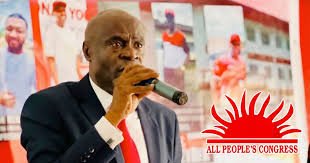
The Independent Commission for Peace and National Cohesion (ICPNC) on Thursday, 13th November 2025, convened a high-level engagement with the leadership of the Sierra Leone People’s Party (SLPP) as part of its ongoing national peacebuilding and political dialogue efforts. The meeting was held at the Ministry of Defence Conference Room at 1:00 p.m.
The SLPP delegation was led by National Chairman, Jimmy Batilo Songa and National Secretary General Paran Umar Tarawalie. The ICPNC team comprised Board Member Madam Nancy Smart, Executive Secretary Madam Hawa Sally Samai, Deputy Executive Secretary Moses M. Margao and Director of Conflict Prevention Salia Kpaka.
Opening the meeting, Executive Secretary, Madam Hawa Sally Samai, welcomed the SLPP delegation and described their swift response to the Commission’s invitation as a testament to the Party’s respect for national peace mechanisms. She reaffirmed the ICPNC’s commitment to collaborating closely with the new SLPP leadership, noting that political dialogue remains central to sustaining peace and cohesion.
Madam Hawa Sally Samai emphasized the Commission’s preference for mediation and constructive dialogue over press releases when addressing politically sensitive issues such as hate speech, incitement and inflammatory rhetoric. She cautioned that political statements, especially those made at public gatherings or circulated on social media, must be measured and responsible to avoid fueling instability.
“Words can heal and unify, but they can also destroy if misused,” she said, urging the ruling party to lead by example and refrain from actions or messages that could trigger political tension.
Also speaking, Board Member, Madam Nancy Smart, underscored the SLPP’s historical responsibility as Sierra Leone’s oldest political party. She reminded the leadership of its obligation to set the tone for national stability and guide its followers towards maintaining peaceful public conduct.
Responding, SLPP National Secretary General, Paran Umar Tarawalie, assured the Commission that the party remains committed to peaceful political engagement despite the challenges inherent in leadership. He noted that the SLPP continues to prepare for the 2028 electoral cycle and will maintain its focus on activities that promote stability.
Paran Umar Tarawalie clarified recent tensions surrounding a public statement by the National Chairman, stating that the remarks had been misinterpreted by the Opposition. He informed the meeting that the SLPP had already pledged to the Political Parties Regulation Commission (PPRC) that it would avoid any actions or utterances that could incite violence. He further recommended that the ICPNC establish a Quarterly National Political Dialogue Platform to sustain inter-party engagement.
SLPP National Chairman, Jimmy Batilo Songa, reiterated the party’s commitment to peace and the rule of law, noting that President Julius Maada Bio’s establishment of the Peace Commission underscores the importance the Government places on national cohesion. He maintained that his earlier comments had been taken out of context and accused the main opposition APC of engaging in acts that undermine state stability, including violent protests and tribal bigotry.
Jimmy Batilo Songa encouraged the ICPNC to also engage the opposition on their messaging and conduct, emphasizing the need for balanced interventions. He acknowledged existing gaps in the Party’s public relations strategy and committed to strengthening outreach, including broader dissemination of the PPRC Peace Agreement.
He called on state institutions including the ICPNC, ECSL, PPRC, ONS and the Human Rights Commission to take stronger action against political violence, warning that the SLPP may pursue legal steps if provocations persist. He concluded with a pledge to enhance responsible communication through coordinated media and social-media engagement.
The meeting closed with several recommendations aimed at promoting sustainable political cooperation and minimizing nationwide tensions:
- Establishment of a regular inter-party dialogue platform facilitated by the ICPNC.
- Holding similar engagements with the APC and all other registered political parties.
- Strengthened engagement with bloggers, digital platforms and social media outlets to amplify peacebuilding messages.
- Organization of inter-party exchange visits by the ICPNC and PPRC to enhance trust and collaboration.
The ICPNC affirmed that its engagements with political parties will continue as part of a broader national strategy to consolidate peace, promote responsible political behavior and safeguard Sierra Leone’s democratic stability.


COMMENTARY “A New Mineral Future”: Mines Minister Urges Sierra Leone to Embrace Simandou-Inspired Reforms
A Commentary By Amin Kef (Ranger)
The launch of Simandou 2040 in neighbouring Guinea has sent a strong signal across the West African sub-region: Africa’s mineral future is entering a new era; one defined not by dependency and extraction alone, but by sovereignty, value addition and long-term national wealth creation. Among the leaders most attuned to the weight of this moment is Sierra Leone’s Minister of Mines and Mineral Resources, Julius Daniel Mattai, whose reflections upon returning from the ceremony offer a powerful blueprint for Sierra Leone’s next steps in mineral governance and economic transformation.
For Minister Julius Daniel Mattai, the Simandou event was far more than a mining milestone. It was, as he described, “the rebirth of a continental vision”, a demonstration that African nations can build institutional strength, negotiate equitable partnerships and chart a future in which mineral wealth underpins national prosperity. Representing President Julius Maada Bio as part of a high-level delegation led by Chief Minister Dr. David Moinina Sengeh, Julius Daniel Mattai witnessed firsthand the scale and ambition of Guinea’s approach. That experience, he insists, should serve as a catalyst for Sierra Leone’s long-overdue mineral sector transformation.
Minister Julius Daniel Mattai’s admiration for the Simandou 2040 model is rooted in its deliberate planning and structural reforms. Guinea has not simply opened another mine; it has integrated Simandou into a national development architecture that includes:
Julius Daniel Mattai considers this a powerful demonstration of what African resource governance can achieve when leadership, vision and policy discipline converge. It is this alignment, he argues, that Sierra Leone must now replicate.
The Minister uses the Simandou launch as a mirror, forcing Sierra Leone to confront its own limitations and opportunities. He insists that the country cannot continue operating as a supplier of unprocessed, low-value minerals. Instead, Sierra Leone must pursue a new development philosophy anchored on beneficiation, value addition, infrastructure alignment and institutional reform.
He identifies several critical areas where Sierra Leone can learn from Guinea’s example:
Guinea’s 15% equity stake in the Simandou joint venture ensures national benefit far beyond taxes and royalties. Julius Daniel Mattai argues that Sierra Leone must begin negotiating similar arrangements to become a genuine co-owner in major extractive projects.
Simandou is governed by modern legal frameworks that align local interests with global standards. Sierra Leone, he notes, must review and strengthen its mining laws, regulatory systems and oversight mechanisms.
Guinea’s 640 km heavy-haul railway and new deep-water port reflect a long-term vision that integrates mining with national economic development. Sierra Leone, Julius Daniel Mattai insists, must think beyond rehabilitated rail lines and adopt infrastructure that supports scale, efficiency and multi-user access.
With Tonkolili’s iron ore averaging 30–35% Fe, Sierra Leone must invest in beneficiation technologies to create higher-value products capable of competing in global markets, especially now that Simandou’s 65–67% Fe ore is entering the market.
Minister Julius Daniel Mattai does not shy away from comparing Tonkolili and Simandou. He highlights that:
This level of clarity, he believes, is necessary if Sierra Leone is to avoid being left behind.
Beyond policy, the Minister calls for a national shift in mindset. He argues that Sierra Leone must adopt a modern, globally responsive mineral policy shaped by the realities of green energy transitions, critical mineral demand and transparent resource governance.
“Let us refine our mindsets, reform our mining laws and realign our national mineral policy,” he urges, a statement that doubles as both warning and encouragement.
Ultimately, Minister Julius Daniel Mattai’s reflections are not simply technical analyses; they are an expression of belief in Sierra Leone’s capacity to transform its mineral wealth into national prosperity. His concluding message captures that optimism: “Let the lessons from Simandou 2040 inspire us to build a stronger, self-reliant mineral economy; one that turns our natural wealth into lasting national prosperity.”
For Sierra Leone, the message is unmistakable: the future will favour nations that prepare, reform and innovate. Under Minister Julius Daniel Mattai’s guidance, Sierra Leone has both the insight and the urgency required to seize this defining moment.