
Home Blog Page 859

China’s Vice Foreign Minister Debunks US Intelligence Report on COVID-19 Origins

Amin Kef Sesay

The US intelligence community has recently compiled a report on the origins of COVID-19. In response to the US Intelligence Report on COVID-19, the Vice Foreign Minister of China, Ma Zhaoxu, stated that the report is mendacious and made up for political purposes.

He furthered that there is no scientific basis or credibility in it. Besides the report, the US also released a statement slandering and attacking China.

However, China has expressed its firm objection and has made strong representations with the US.

The Chinese stated how they have stressed on multiple occasions that origins tracing of COVID-19 is a complex issue of science which should and can only be undertaken by scientists around the world through joint research.

It continued that the US, however, disregards science and facts but instead is obsessed with political manipulation and origins tracing by the intelligence community.

“Without providing any evidence, the US has cooked up one story after another to defame and accuse China,” he lambasted maintaining that the aim is to use origins tracing to shift blame onto China and spread the political virus.

He underscored that the deployment of the intelligence community in origins tracing is in itself a compelling evidence of the politicization of the issue adding how the US accuses China of not being transparent or cooperative on origins tracing terming it as sheer nonsense.

According to him, China attaches great importance to international scientific cooperation on origins tracing, and has taken an active part in such cooperation.

Ma Zhaoxu said acting on the principles of science, openness and transparency, they have twice invited WHO experts to China for origins tracing research also intimating that  early this year, a WHO-China joint study team of leading international and Chinese experts conducted a 28-day research in China and released a Joint Report containing authoritative, professional and science-based conclusions.

He argued that such is a good foundation for international cooperation on origins tracing revealing how they have been supporting science-based efforts on origins tracing, and will continue to stay actively engaged maintaining how they firmly oppose attempts to politicize the issue.

“It is actually the US that is not being transparent, responsible and cooperative on this issue,” the Vice Foreign Minister of China pointed out disclosing how the US has been refusing to respond to the international community’s reasonable doubts on the Fort Detrick bio-lab and the over 200 overseas bases for biological experiments, trying to cover up the truth and avoid being held responsible. He said the onus is on the US to give the world an answer.

Ma Zhaoxu stated that the US attempts to politicize origins tracing have found no support and met widespread opposition from the international community.

He said  more than 80 countries have written to the WHO Director-General, issued statements, or sent diplomatic notes to voice their objection to the politicization attempts and call for the Joint Report by the WHO-China joint study team to be upheld; that over 300 political parties, social organizations and think tanks from more than 100 countries and regions have submitted a joint statement to the WHO Secretariat on opposing the politicization of origins tracing; and over 25 million Chinese netizens have signed an open letter asking for an inquiry into the Fort Detrick base.

He went on to state that the aforementioned are people’s calls for justice.

Ma Zhaoxu said as a Chinese saying goes, a just cause attracts abundant support, while an unjust one finds little.

“We want to once again warn the US side that politicizing origins tracing will lead nowhere,” he sternly admonished urging the US to immediately stop doing anything that poisons the atmosphere for international cooperation on origins tracing or undermines global solidarity against the pandemic, and return to the right track of science-based origins tracing and cooperation in the face of the pandemic.

21 Year Old Represents Sierra Leone at 1st Ever Africa Mega Reality TV Show in Ghana

By Sallu Kamuskay

With reality TV shows across the world, most especially the African continent, the image on how the African stories are changing positively, Africans from Africa are using the entertainment industry to project the positive image of their countries and Africa through reality TV shows.

The Africa Megastar is the new kid on the block when it comes into promoting the positive image of Africa and it history. The show is aimed at discovering and projecting African talents. The show is open to all talented individuals of African descent skilled in Arts, fashion, Music, Movies, writing, Poetry, Designers, and all areas of talent. Entries are open to all Africans to showcase their talents via an online process where finalists will be selected through a voting process.

While in the African House, finalists will engage in series of training from professionals to prove their eligibility of who becomes THE AFRICAN MEGA STAR .

The winner will enjoy a year of massive media publicity, juicy endorsement deals, a Car, and prize worth $10,000.

This is an opportunity and a Platform for all Africans to shine forth and breakthrough into the Global Market. The event is packaged by Trndi Afrique Media Networks in collaboration with Elite Afrique.

With hundreds of participants from Africa who applied for the first-ever Africa Mega Star reality TV show, 160 people were shortlisted from across Africa and 30 from the 160 will make it to the one-month reality TV show that will be in Ghana this year. Chrispine Hassan Kai Turay from Sierra Leone is among the 30 participants representing his country at this year’s reality TV show

Born in Rokupa Government hospital in Freetown, Chrispine Hassan Kai Turay is a Sierra Leonean entertainer, contestant for Mister Ocean 2019 and Ex Islander from the island of secret Reality TV show Season 1, Semi-finalist for the Voice of Democracy 2019- Mr. Ocean Sierra Leone 2021 among many others. Chrispin will be representing Sierra Leone at this year’s Africa Mega Reality TV show.

Chrispine Hassan Kai Turay did his primary school at the Church of Pentecostal pre-primary school. He later moved to Albert Academy where he completed his junior secondary school education and senior secondary school education. While in schools, Chrispine held several positions including Deputy Head-boy and school prefect respectively. Chrispin is currently studying software engineering at Bluecrest College and holds a certificate in web development in the same college.

Chrispine will be representing Sierra Leone at this year’s Africa Mega Reality TV show and hope to showcase the Sierra Leone culture, dress, food to Africa and the world.

During an interview, Chrispin disclosed that he is looking forward to working with Sierra Leonean brands and fashion designers to showcase their brands to the international level. He said,  “I am humbled and honoured to be representing my country at this year’s Africa Mega reality TV show, but this comes with great responsibility and support from my brothers, sisters, brands, fashion designers and the Government of Sierra Leone.

We have a lot of things to put together ahead of my travel, for example, I will be using my Sierra Leone national costume that symbolises Sierra Leone and that shows that you are from Sierra Leone and we also have the country native attire that they are requesting us to take to the house. The goal of the show is to showcase our country to the world. I am kindly requesting for designers to bring their work so I can use them to showcase what we have as a country at the international platform. In terms of voting, I am looking forward to Sierra Leoneans from across the world to vote and watch the show on the DSTV Platform, I need your love and support as I go into the house,” Chrispin also revealed.

Speaking about his greatest achievement, Chrispine admitted that the Africa Mega Star Reality TV show is his greatest achievement going as a participant and representing his country


CSOs Demand Government’s Intervention to Address Rise in the Price of Bread

By Amin Kef Sesay

In a Release dated the 27th August 2021 the Budget Advocacy Network (BAN) and Institute for Governance Reform (IGR) stated that they are alarmed at the sudden announcement that bread prices are increasing throughout Sierra Leone.

BAN continues that it is well known that inflation is a recognized challenge for any society stating how for a poor country like Sierra Leone where the vast majority of citizens eke out a living on low wages and regularly struggle with food insecurity, bread remains a single important food commodity in Sierra Leone.

Based on what this medium learnt, the problems and reasons for a price increase are rooted in a political and economic context that goes as far back to the civil conflict and its lingering economic and social impacts.

It was stated that the problems are threefold: A very high freight shipping costs due to the limited number of shipping companies,
the high cost of insurance for ships coming to Sierra Leone.

Sierra Leone is still considered a high-risk country for ships to travel to as the country has no ship under its name coming to Sierra Leone.
All three of these issues, it was mentioned, continue to plague Sierra Leone’s remoteness in a global economy that has been severely impacted by COVID-19 and from what was learnt it is obvious that those problems cannot be fixed overnight.

“We also understand that there had been ongoing efforts to address this challenge. Government has encouraged the production of flour products in Sierra Leone, including bread, to be a viable home-grown product, which could reduce the burden on Government and the price of flour, and therefore bread to local citizens. Government has also reduced the import duty rate on flour from 5% to 0%, and GST has been slashed from 15% to 0% in an attempt to keep prices stable.

External agencies have also floated ideas that could potentially help alleviate the high cost of the importation of flour,” it was stated.

In one of its recommendations Government needs to reach out to flour importers to negotiate a contractual agreement for an agreed- upon price for the bulk importation of flour.

Another recommendation has been to reach out to flour manufacturing companies to also see what possibilities exist around signing a contractual agreement for exclusive flour manufacturing that would then be shipped to Sierra Leone for a mutually agreed-upon price.

Two other options have also been floated, which is to reach out to a baking company as well as bread sellers to negotiate a contract for a mutually agreed-upon pricing structure. All of these options remain possibilities that could provide more economic certainty and stability to the ever-present threat of inflation and rising cost of bread.

Despite the possibilities available to the Government, there are concrete steps that should be taken immediately: First, Government through the Ministry of Foreign Affairs and international cooperation needs to push for the removal of Sierra Leone as a high-risk country for shipping companies. It’s been 20 years since the end of the war, and Sierra Leone has held four successful democratic elections, and according to the Global Peace Index (GPI) remains the 4th-most peaceful country on the African continent, and 46 amongst the other 195 countries of the world. Sierra Leone is a peaceful and welcoming country to all, and it shouldn’t continue to be punished for its past.

Secondly, SLNSA must continue to look for ships to come to Sierra Leone under the Sierra Leone name.
Finally, Government needs to continue the zero duty and GST for the production and importation of flour in Sierra Leone.
BAN says it stands ready to support ongoing efforts to ameliorate the suffering of Sierra Leoneans.


Bommeh Fire Victims Receive Nine Bundles of Roofing Zinc from SLPP Constituency Executive 

 By Alie Sonta Kamara 

In order to give solace to those who had their houses gutted down during the Genet Lane fire disaster, the Executive members of Constituency 125 representing the Sierra Leone People’s Party (SLPP) on Friday donated nine bundles of roofing zinc to the Kingtom Descendants Association for onward support to the ongoing reconstruction effort of shelters destroyed during the August unfortunate incident.

The kind donation was made after the SLPP Constituency Executive had led the Government Disaster Management Team and other goodwill agencies to providing first aid including food to over hundred fire victims currently homeless.

The donation was split into two; three bundles of zinc were given to victims of July 1 flooding on Cole Lane and the remaining six went to support the construction of a big makeshift structure to house the fire victims.

Speaking during the donation, the Chairman of SLPP Constituency 125, Alhaji Komba, said the donation visit marked their second attempt to reach the fire victims and to express how they felt sad about the misfortune that befell them.

“We led the Government disaster team to the fire scene during our first visit for their donation of emergency items. While the victims were thanking the donors, they asked for roofing zinc to support a plan to construct some shelters. So we have heeded to that call as a political party. The Government has always identified with people during disasters,” he said, adding that they are not happy seeing the victims homeless.

Receiving the donated items, Daniel Max Amara, Community Chairman, said they were happy seeing their plea  heard, reaching far and beyond. He thanked the Government through the SLPP Constituency Executive for the timely intervention. “The structure we are putting up is very big, so we need more roofing materials to finish the job,” he disclosed, calling on other donors and well-wishers to support the stride.

On her part, flood victim, Fatmata Kamara, said she lost properties amounting to millions of Leones when the July 1 flooding struck. “I was sleeping during that time. I got up naked with my children. We had to swim out,” she explained, thanking the SLPP Constituency Executive for the goodwill gesture.

Increasing National Debt Taking Money Away For Development & Social Programs

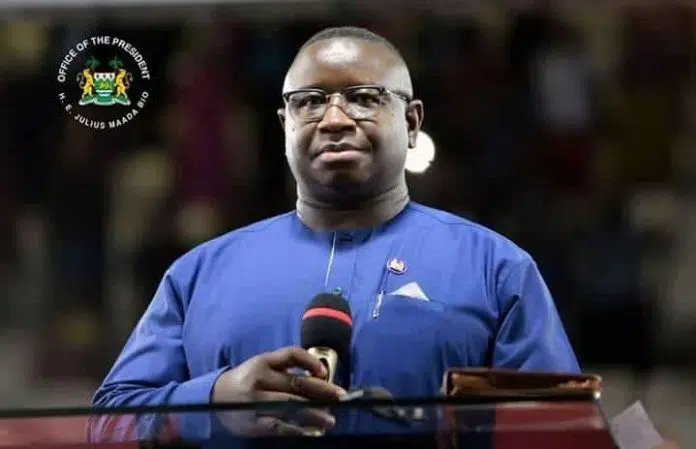
His Excellency, the President Dr. Julius Maada Bio

By Amin Kef Sesay

Sierra Leone’s debt as at 2020 stood at USD2.6 million. According to the International Monetary Fund, President Bio’s New Direction Government has incurred nearly USD1 billion debt from IMF and the World Bank.

What is worrying is that if the Government continues to borrow without the economy and revenue from earning foreign exchange growing enough to repay what is loaned, without it taking away from Government expenditures on development and social welfare programs, then the country and its people will fall deeper and deeper into a financial crisis of the kind that affected the country in the 1980s.

Debt in itself is not bad. Businesses run into debts to increase their capital and assets with a view to making profit and paying back. In the case of Governments, it is totally different.

The nature of the debt problem of poor developing countries like Sierra Leone may vary from acute balance-of-payments difficulties requiring immediate action to longer-term situations relating to structural, financial and transfer-of resources problems requiring appropriate longer-term measures.

The country’s external debt situation today remains a source of serious concern. The problems which are structurally rooted are far from being resolved whilst we face a mounting debt burden as a result of worsening global economic conditions and very low exports.

The decline in production and in commodity prices affects the country’s export growth prospects. If commodity prices remain depressed for several years and/or exports fail to grow in volume, the debt servicing capacity would deteriorate further over the medium term.

Beyond the immediate task of reducing the excessive debt burden, thought should be given to the adoption of preventive measures to avoid unsustainable public and private debt in the future. Those measures should perhaps be aiming at ensuring responsible lending and borrowing behavior, notably through increasing the accountability and transparency of borrowing and lending activities undertaken by public and private economic agents. The debt management capacity should also be strengthened.

In terms of taking away money for development and people’s welfare, the debt problem  has dragged on since much of our foreign debts were written off by the IMF, World Bank and the Paris Club in the early 2000s during the term of late President Kabbah.

Debt that is not utilized productively to create economic growth is unhealthy for a country and its people.

This is because the servicing of debt absorbs budgetary and foreign exchange resources. In the absence of any benefits accruing from the investment of the original loan it will have a net negative effect on a Government’s ability to fund its social expenditure programs.

In this situation, Government spending on health, education and social services will be reduced. If these services are efficiently organized, reduced expenditure on them will have an adverse social impact.

It can also interfere with the promotion and protection of human rights. According to Article 22 of the Universal Declaration of Human Rights, everyone is, “entitled to realization, through national effort and international co-operation, and in accordance with the organization and resources of each Sate, of the economic, social and cultural rights indispensable for his dignity…”.

It is therefore of critical importance that debt servicing requirements not be permitted to detract funds from necessary spending in areas relevant for sustainable human development and for the promotion and protection of human rights, as defined in the principal human rights treaties. In poor indebted countries, this condition is often not fulfilled.

Furthermore, for debtor countries which rely on one or a few agricultural or mineral exports, a high level of debt service will tend to accentuate monoculture based agriculture and increase the rate of depletion of national resources beyond the limits of sustainability.

A New CSO Focusing on Accountability Launched in Freetown

Executive Director and Founder, Marcus Bangura

By Foday Moriba Conteh

A new Civil Society Organisation, the Citizen’s Forum For Democratic Accountability, as well as a Civic Education project were launched at the Harry Yansaneh Hall on Campbell Street in Freetown. The occasion was graced by a barrage of journalists and Civil Society Organisation representatives.

In his statement, the Executive Director and Founder, Marcus Bangura, intimated that his organisation will work assiduously to sensitize residents across the country about the need for accountability maintaining that  in that respect they will be targeting the young, whom he described as the new generation of leaders, to imbibe the culture of accountability.

Dilating on the purpose of the gathering, Marcus Bangura stated that “the purpose of this august gathering is to officially launch Citizen’s F orum for Democratic Accountability (hereinafter referred to as C4D), with a civic education project.”

He defined Democratic Accountability as one that implies feedback, a learning experience and the consent of the governed. Marcus continued by stating that it offers citizens and their representatives the means to voice their concerns, demand explanations about, and, if need be, impose consequences for the performance of elected officials, and officials of public or private service providers.

He further highlighted that the means of democratic accountability include electoral processes and parliamentary oversight, as well as reviews by supreme audit institutions, investigative journalism and public demonstrations.”

Marcus Bangura put forward several objectives of the organisation, which are:

To embark on extensive civic education and increase public awareness about democracy and good governance practices, rights and responsibilities of citizens; to promote and defend internet data privacy and freedom of expression vis-à-vis free, open and accessible internet space as part of promoting freedom of expression in online and offline, digital rights, right to internet access, freedom from internet censorship and net neutrality, to promote and strengthen environmental and natural resources governance through consistent and constructive advocacy,  to promote and strengthen ICT, telecoms governance and rural connectivity through consistent engagement and constructive advocacy,  to promote elections, the spirit of political tolerance and mediate between political parties to ensure peace and non-violent free and fair elections and peaceful transfer of power,  to monitor and ensure effective service delivery in public institutions,  to promote the struggle for the rights of women, girls, children, youths, persons with disability, the aged, vulnerable and marginalized citizens.

He furthered that the official launch of C4D is accompanied by a civic education project initiative. The project title is: “Engaging Public Institutions and Citizens to Cultivate the Ideals of Democratic Accountability”.

He said the project will be implemented in phases. The first phase will be implemented in schools and the second phase in public institutions. The Founder disclosed that phase 1 will focus on “Nurturing the ideals of democratic accountability in the minds of school going pupils” with the objective to catch them young, as society and the present generation has failed for lack of accountability.

“This project will last for four months starting September within the Municipality of Freetown,” he disclosed adding how it will also run simultaneously with a participatory research where pupils will give account about themselves on accountability issues in their adolescent stage telling their stories. Phase II , he said, will focus on public institutions with focus on service delivery.

In his keynote address, Alhassan Kargbo, fondly called ‘ALASKA’, admonished the Executive Director of the new CSO to be steadfast, stressing that the organisation’s first step to engage schools in imbibing accountability, is a step in the right direction.

Alaska maintained that the current state of the country is as a result of the absence of accountability, as leaders in all the Government institution  have failed to account to the people on the use of their monies.

He noted that currently Sierra Leone has made some improvement in terms of accountability, but more needs to be done.

Earlier, Prince Jacob Macaulay, who served as Chairman of the event, in his welcome address said, “Advocacy is any action that speaks in favour of, recommends, argues for a cause, supports or defends, or pleads on behalf of the people”.

He stated that CSOs should be considered as a formidable pressure group that holds authorities to account in the interest of the nation, adding that they cannot do that alone without the support of the media.

Macaulay stated that the media is the weapon that makes the work of activism very much viable if they are to succeed in doing what they stand for.

He underscored that he believes in relationships, which should be the social capital of every human being and urged all civil society activists to work together instead of resorting to the pulling Down syndrome, which is very much common in Sierra Leone and suggested a monthly meeting among themselves, to better address issues of public interest.

He furthered that CSOs cannot protect themselves and would have to rely on the citizens for protection, but that it can only happen if they work in the interest of the nation. He commended Marcus Bangura for standing up to the task in defending his country at this difficult time.

Other CSOs present made short statements welcoming the newly born organisation and pledged to support and nurture it. They however, noted that its ED is no stranger to CSO, and has been in the CSO world for ages and knows what he is talking about, and they have no doubt that he will deliver on the organization’s aims and objectives. They all hoped for a better Sierra Leone with strong democratic credentials.

The ceremony was climaxed by a question and answer session.

2021 BECE Results Are Now Out With More Passes than Last Year

By Amin Kef Sesay

The 2021 Basic Education Certificate Examination (BECE) results have been released to the Ministry of Basic and Senior Secondary Education (MBSSE).  Out of 131,822 pupils that sat to the examination, 103,625 passed which nationally is a 79.89% pass rate, higher than last year.

The number of girls who passed is: 51,232 that is 79.01% and the number of boys is 52,393 which is 80.80%.

The best emerging candidate is Prince Ishmael Bayoh of Naiahcom High School with Aggregate-6 and the best girl that took the second position is Doris Ramatu Jah of Henritta UBC JSS with Aggregate-7.
For this year three (3) girls were on the top of the 4 best pupils that took the BECE.

The school that emerged top is the Modern Academy School of Excellence with a Pass Rate of 100% and an Average Grade of 1.84.
Greater percentage of candidates passed this year than last year.

This medium was intimated that this is a novelty all by itself.

Since 1996 when the 6334 system of Education was introduced in Sierra Leone, this is the first time ever the country is witnessing the release of BECE results before the reopening of school to mark the beginning of a new academic year. The earliest time it has happened was at the end of the first term of the academic year.

It must be noted that the Ministry of Basic and Senior Secondary Education is pioneering the development, deployment and use of technology for service delivery. In doing so, the Ministry is actively achieving two things: Systems reboot and strengthening: 8060 toll-free line allows citizens to give feedback to the Ministry to help them respond to issues.

In terms of the second which is Radical Inclusion: 468 and 8447 SMS and USSD solutions are helping citizens everywhere access the Ministry’s efficient service delivery like Results and Placement Checker.

As at present, Sierra Leone is experiencing a rebirth of Education. With the academic dinosaur at the helm of affairs at the Ministry of Basic and Senior Secondary Education, Dr. David Moinina Sengeh is passionate about repositioning Sierra Leone at the top of the academic league table.

NaCOVERC Intensifies COVID-19 Vaccination Countrywide

By Amin Kef Sesay

Having secured more improved supplies of COVID-19 vaccines, the country’s appropriate public officials have intensified the vaccination exercise countrywide to bolster protection among its eligible population against the virus.

It could be recalled that in March 2021, the COVID-19 vaccination was launched by President Julius Maada Bio who received the first jab alongside other prominent senior citizens, Government officials and partners as a high-level advocacy that aimed to garner public support for that component of the pandemic response. However, vaccination sites have largely been limited to the urban communities including the district headquarter towns.

On the 23rd August 2021, health authorities and the National COVID-19 Emergency Response Centre, deployed approximately 600 mobile and static teams of frontline personnel – health workers, community mobilizers and data clerks – to administer the vaccines in towns and villages throughout the country. The 10 days surge exercise aims to reach 18 years and older.

Sierra Leone’s revised COVID-19 response plan aims to reach 20% of the 4.2 million eligible population with the vaccine by the end of 2021. Before this surge vaccination exercise which started on 23 August, only about 165,000 and 35,000 persons had received their first and second doses respectively. This low coverage is set to improve significantly by the end of the 10 days intensified outreach and vaccination.

“Taking the COIVD-19 vaccination closer to the people in the communities at this critical moment is very impressive. The exercise is an opportunity to expand access for so many people to receive these lifesaving commodities, thus improving equity in the vaccination process,” said Dr Steven V. Shongwe, the World Health Organization (WHO) Country Representative in Sierra Leone.

“In addition to these vaccines it is still highly recommended that the other public health measures – correct use of facemask, frequent hand washing and avoiding crowded areas or maintaining physical distance – are adhered to at all time even after receiving the shots”.

Early this month, the country received consignments of the AstraZeneca-Oxford COVID-19 vaccine (96,000 doses) donated by the COVAX Facility partnership, and SinoPharm COVID-19 vaccine (200,000) through bilateral arrangement between the Sierra Leone and Chinese Governments.

Health authorities are using the opportunity to deliver the available doses of the two vaccines (AstraZeneca and SinoPharm) in the country’s stockpile to ensure more people are mobilized and vaccinated against the disease during this massive exercise.

“At the end of this intervention, at least one vaccination team would be maintained in every chiefdom and in all districts across the country”, said Dr Thompson Igbu, Immunization Expert at the WHO Country Office in Sierra Leone. “This new arrangement of static teams in the 190 chiefdoms would help to safeguard the population from adverse consequences of the virus and begin reducing barriers to COVID-19 services and information and would also help curb future upsurge of the virus in the communities”.

The national authorities and partners are making concerted engagements to accelerate availability of more vaccines in the country. Already, additional vaccines, including AstraZeneca, Sinopharm, Pfizer BioNtech and Johnson & Johnson are expected to arrive in the country in the coming weeks and months through multilateral and bilateral partnerships between the Government of Sierra Leone and its partners. When delivered, these additional vaccines would help to significantly improve the country’s COVID-19 vaccination coverage.

“I have received my first dose of the COVID-19 vaccine, and I am going to mobilise other adult members of my family to also get their shots. It is important that other families also get vaccinated to maximize the protection in our communities”, said Moses Kailie, a beneficiary in Njama Community, Kowa Chiefdom in Moyamba District.

Cumulatively, 6,358 persons have tested positive for COVID-19 infection in Sierra Leone, with 121 deaths directly attributed to the disease. Until third week August, the country grappled with an increase in cases or the third wave of the pandemic. Huge efforts and resources have been invested by the government and partners to mobilize communities for the surge vaccination and to promote the safety, efficacy and uptake of the vaccines.

The world Health Organization is supporting the national authorities to respond to the pandemic by mobilizing partners and resources, and by providing strategic technical expertise required for the response. The Organization has further helped strengthen key components of the response including laboratory, surveillance, data and information, training, logistics and supplies as well as demand creation through the financial support of its donors.


US Ambassador Assures Tourism Minister of Support to Boost the Sector

By Foday Moriba Conteh

During a courtesy visit to the Minister at the Ministry’s Head Office on Kingharman Road in Freetown, the US Ambassador to Sierra Leone, David Reimer has on the 26th August, 2021 assured the Minister of Tourism and Cultural Affairs, Dr. Memunatu Pratt of his country’s support to the sector.

He stated how he is impressed to finally visit the Ministry responsible for the hospitality received by him and displayed by the transformation of Bunce Island, especially the historical preservations.  He mentioned that though COVID-19 has had a devastating effect on Sierra Leone’s tourism hope is there that once the pandemic is under control, the sector would go back to normal.

Ambassador Reimer emphasized that there are lot of potentials in Sierra Leone’s tourism although more need to be done in marketing Sierra Leone to the US market starting with road shows and taking top officials to the US to let them know what Sierra Leone is all about.

To that end, he proposed a collaboration between the two countries in the area of culture and invited the Minister and team to an exhibition of American Art work at his residence in November and also lot of potentials of Sierra Leone in Art work and several other prospects that the two countries can explore.

Minister Pratt welcomed and thanked the Ambassador for the support his Embassy gave towards the development of Bunce Island which she said is now completed and ready to connect more African Americans to their ancestral home when they visit the country. She communicated the Ministry’s request for funding from the World Heritage Fund to the restoration of Old Fourah Bay College.

She explained that today tourism and culture is the third largest aspect of the world economy in creating jobs and improving foreign exchange reserves. She told the Ambassador that the President Bio led administration has prioritized tourism as one of the growth sectors in terms of the diversification of the economy with over 30,000 jobs in the formal sector and more jobs in the informal sectors.

The Minister intimated that before COVID, the tourism sector had contributed over 4.8% to the GDP in a very short period and now that C0VID is still around, they have been using this period to consolidate the internal and governance level structures and a number of initiatives in promoting domestic tourism.

She added that the relationship between Sierra Leone and the US in terms of tourism has been great and recalled that in 2019, they paid an exploratory visit to the US with support from the World Bank in order to track the US market and look at attractive investment to the sector and also popularizing Sierra Leone in terms of culture, promotions, exhibition and doing road shows by putting up cultural exhibitions in some states in the US where they would invite Mayors and Governors to see what Sierra Leone can offer.

She noted that she has given lectures in different universities in the US on tourism in Africa, thus deepening the ties between the two countries. She mentioned that Government have conferred up to 100 citizenships on African American that came to Sierra Leone and MOU was signed with African Ancestry. As a direct result three hundred (300) more African Americans would be coming to Sierra Leone in November this year to trace their DNA and a number of them have expressed interest in investing in education, agriculture, humanitarian support and art and culture.

She said the sector is interested in the promotion of the entertainment industry by doing tours and connecting with US entertainers, the establishment of US hotels in Sierra Leone with an already established interest by the Mariot Hotel in the US.

Information Minister impressed with Progress on NATCOM Building

By Theresa Kef Sesay

In order to see how far progress has gone on the ongoing construction work on the New National Telecommunications Commission (NATCOM) Building at Hill Station, the Minister of Information and Communications, Mohamed Rahman Swaray conducted an inspection tour on the 26th August 2021.

The Minister was accompanied by senior staff of the Ministry which includes the Permanent Secretary Kwame Yankson, Acting Director of Communications Mumini Jalloh and the Director General of NATCOM Daniel Kaitibi to inspect the progress of the building.

The visit, this medium understood, was primarily initiated by the Minister to see how far the work has gone as a supervisory Ministry and most importantly to provide a space in the building for the installation of the National Computer Security and Incidence Response Team (NCSIRT) to enable tracking down cyber-crimes.

It would be recalled that Parliament unanimously enacted the Cyber Security and Crime Act 2021 this year and one of the key components of the Act is to provide a National Computer Security and Incidence Response Team to track down cyber-crimes.

The NCSIRT will be supported by ECOWAS and EU to serve as the national infrastructure to strengthen the fight against cyber-crimes and related matters. The Government of Sierra Leone is expected to provide the office space for the installation of NCSIRT.

During the inspection tour the Director General of NATCOM identified a space to the Minister which was examined by the Acting Director of Communications and approved by him.

From what Minister Swaray stated there is an ongoing training for Judges and law enforcement officers on how to handle matters related to cyber-crime. The Minister added that, eight (8) Sierra Leoneans had been sent on training in Accra, Ghana on how to operate and handle the NCSIRT. “We are far ahead and ready as a nation to receive this installation,” the Minister asserted.

The Cyber Security and Crime Bill 2021 now await the assent of the President.