Home Blog Page 922

‘Tourism Is Backbone of Economic Diversification’ -Minister Memunatu Pratt Avows

By Amin Kef Sesay

Following a visit to the Old FBC Building and the National Railway Museum by President Julius Maada Bio, the Minister of Tourism and Cultural Affairs, Dr. Memunatu Pratt has stated that Tourism is now the backbone of development in Sierra Leone because the President when he assumed office put Tourism at the forefront of economic diversification.

She added that the Ministry has been crying for far too long for government attention to be focused on Tourism in terms of protecting and preserving national monuments which show the legacies of the country and tell people about its history.

Her statement came following President Julius Maada Bio’s visit on Thursday 22nd April, 2021, together with officials from the Ministry of Tourism and Cultural Affairs (MTCA) and its sub-vented agencies to the above-mentioned sites where they participated in a conducted tour and unveiled a plaque at the Old Fourah Bay College building. The President and his team also visited the National Railway Museum. Both historic sites are located at Cline Town in Freetown.

His visit follows a visit by Tourism Ministry officials few weeks ago to ascertain the status of the edifices.

The event is part of the package for the commemoration of the 60th Independence Anniversary and also historical, as President Bio becomes the first sitting president to visit the monument.

Articulating the purpose of the presidential tour of the edifice, the Minister of Tourism and Cultural Affairs, Dr. Memunatu Pratt maintained that Sierra Leone’s contribution to education in the sub-region is immense and that the Old FBC edifice that was established in 1827 played an important part in attaining the name “Athens of West Africa” before it was relocated because of the Second World War, bringing to an end its 112 years’ stay at Cline Town.

She continued to say that the old FBC monument is one of the first declared heritages by UNESCO, adding that in order to continue the legacy of the Free Quality Education they must transform this monument in its authenticity.

She revealed that government has committed funds to the restoration of the edifice.

Giving his address, President Bio said that the visit is to pay homage to the country’s history and draw the attention of Sierra Leoneans to what made us the Athens of West Africa.

Despite the challenges the country had faced over the years, the President assured that with his leadership and the resilience of the people, Sierra Leone will be a great nation one again. Because of the edifice, Sierra Leone led in education and attracted students from the sub-region, and to show their commitment to education, it is but prudent to pay homage to this great edifice, he maintained.

At the National Railway Museum, the President conducted a tour of the museum where he was shown historical artifacts that are important in terms of the colonial history of Sierra Leone.

Orange Provides ‘Sunakati’ for 800 Muslims at Dwarzark

By Edward Vamboi

As part of their continuous support in extending love to the people of Sierra Leone especially Muslims within this month of Ramadan, 800 Muslims in the Dwarzark community on Thursday 22nd April, 2021 benefitted from the provision of Sunakati by Orange Sierra Leone.

Mobile Telecommunication Company Orange Sierra Leone provided the food for at least 800 Muslims as support for this year’s Ramadan to Muslims residing in this area.

The company mobilized its staff and women in the community and funded them to prepare a delicious meal for Muslim worshippers.

The gesture is part of Orange’s Jama Sunakati initiative which targets communities across the country during this Ramadan and provides feeding for them. The occasion saw hundreds of people gathered at the Dwarzark playing field to participate in the Jama Sunakati.

Marketing and Communication Manager at Orange, Martha Sumaila said the company is doing this out of love and respect for subscribers, and also a way of giving back to communities across Sierra Leone.

“We are doing this out of love and we are doing this out of respect for the community,” she said.

The Jamah Sunakati saw community people, young and old bond together, while ending their fast after the evening prayers. Residents in the community said this is the first time any corporate body has done this for their community.

Martha Sumaila added that this will not be the end, “Dwarzark is just the first community,” Kallon said, adding that Orange has plans to replicate the donation to more communities across the country.

“We are a company that prides itself in giving back, and we will continue to do this in other communities in the coming weeks,” she said.

The Jama Sunakati is not the only initiative that is being rolled out by Orange during this Ramadan. Orange has set aside Le510 million in prizes as part of its Orange Special Sunakati, to be given away to customers throughout this Ramadan.

As part of this promotion, ten customers will win Le750,000 every day for the rest of the month and Saturday draws will see customers win as high as Le50 million during live draws.

“We want to offer prayers for Orange. This is what Islam teaches – to share. We are happy for this and it is the first time a mobile company has thought about doing this for us,” a community member said.

NP-SL’s Significance Attracting More Partners & Consumers

By Amin Kef Sesay

It is general knowledge that because of the significance of the National Petroleum Sierra Leone Ltd. (NP-SL Ltd.) with regards ambitiously striving towards reaching the pinnacle of not only the local business landscape but also in the sub-region, is the main reason why the company is attracting the confidence and respect of more partners to continue business relationships with the company as well as attracting more consumers to buy its quality products.

It is no secret that Sierra Leone’s leading oil marketing company, the National Petroleum (NP) Sierra Leone Limited, has been very steadfast in its service delivery of high standard petroleum products which it imports since Sierra Leone is not an oil producing nation.

Due to good managerial decisions, the company has been doing extremely and exemplary well in terms of always ensuring the availability of those products in a timely manner which makes it possible for individuals to have ready access to them. It is no secret that the seriousness of the company, with regards ambitiously striving towards reaching the pinnacle within the business landscape not only in this country but far beyond, has heightened the confidence of its business partners to continue business relationships.

It must be hammered home that NP-SL-Ltd is not extraordinary because like any business entity the company is susceptible to internal and external shocks that impact on its efficacy and sustainability. Currently, the high exchange rate of the dollar to the Leone, meaning the Leone has drastically depreciated, is affecting many entities, creating inflation (prices of basic commodities have skyrocketed) and impinging negatively on the overall standard of living. NP-SL –Ltd pays for petroleum products it imports and understandably whenever the price of the dollar goes up then it means the company is spending more Leones to buy dollars in order do so.

Accessing the very dollar has turned out to be a huge task as US Dollars are scarce which has created a situation whereby the company has to go the extra-mile to get the required amount of US Dollars it needs to import the products it markets.

For such a company to continue to thrive it is but prudent on the part of the Petroleum Regulatory Agency (PRA), the Bank of Sierra Leone (BSL) and other commercial banks to give NP SL Ltd. maximum attention and support in the area of provision of foreign exchange for its international transactions.

It has gone down the annals of history that the company is impressively one of the most successful indigenous entities that is sustainably forging ahead when others have collapsed for a variety of reasons.

A marked reality of the company’s viability is evident in its opening of branches in Guinea, Liberia, Ivory Coast, The Gambia and in all of those places it is providing qualitative customer care services to residents, making it a prime priority.

It has been established that NP has been meaningfully contributing to economic growth through payment of taxes and rolling out meaningful interventions in the discharge of its Corporate Social Responsibility which are transforming lives and improving communities.

The company has gained reputation for offering different jobs to Sierra Leoneans throughout the country where it is operating and this has helped in improving standards of living.

NP-SL gives preference to Sierra Leoneans with regards offering jobs, a clear indication that it is strictly poised towards adherence to the country’s Local Content Policy. Utilizing local talents makes it possible for indigenes to imbibe useful knowledge and skills through training exercises that could be applicable in other places.

The company has one of the best cooking gadgets, known as NP Gas that offers suitability for cooking purposes. There are different cylinder sizes and they could be located at all the filling stations of the company and also accessed from authorized agents or dealers.

In this digital age, moving away from the traditional way of transacting business has now become the norm. It is along such a line that it was thought wise on the part of the shareholders and Management to introduce the use of smart cards. With these cards, customers can procure petroleum products of whatever quantity they do desire.

“Using NP smart card always makes transactions very easy and convenient for me,” a prominent entrepreneur informed.

For its solid service delivery to its numerous and esteemed customers right across the country, the company over the years, has gained widespread recognition and admiration evident in bagging awards from different organizations.

NP is really promoting efficient service delivery, contributing positively to the socio-economic development of the country but it must be reiterated that contractual business agreements must be strictly adhered to by other parties so that such an important company will continue to operate unfettered.

QNET Receives Two Coveted International Business Awards for its Mobile App Innovation and CSR Initiatives

By QNET Communications 
QNET, one of the fastest growing e-commerce powered direct selling companies from Asia, recently received recognitions from the Middle East and North Africa Stevie® Awards and Communitas Awards.
The honours are: At the second annual Middle East and North Africa Stevie® Awards, QNET won a Gold Stevie® for its mobile application, QNET Mobile, in the Innovation in Shopping of E-Commerce Apps The award-winning app serves as a portable gateway for QNET’s international distributors to conduct and manage their direct selling business from the palm of their hand. The QNET Mobile app received high praise from the judging panel of Stevie Awards for its user-friendly interface and design, comprehensive library of features, and multi-language functionality.
At the Communitas Awards, QNET was named winner in the Leadership in Community Service and Corporate Social Responsibility category for its international CSR programmes which were showcased through a video titled: ‘QNET Gives Back to Communities Through RYTHM Foundation’. QNET works closely with RYTHM Foundation, the CSR arm of the company on community development projects around the world. The impact and effectiveness of QNET’s mission to bring sustainable change to communities worldwide resonated with the spirit of Communitas, a Latin word that means people coming together for the good of a community.
The Middle East & North Africa Stevie Awards are the only business awards program to recognise innovation in the workplace in 17 nations in the Middle East and North Africa region.  The Stevie® Awards are widely considered to be the world’s premier business awards, conferring recognition for achievement in programs such as The International Business Awards® for 19 years.
Nicknamed the ‘Stevies’ derived from the Greek word for “crowned,” the awards will be presented to winners during a virtual ceremony on 2 June 2021. Over 400 nominations from various organisations across the Middle East and North Africa were submitted for the award. Gold, Silver, and Bronze Stevie Award winners were determined by the average scores of more than 60 executives around the world acting as judges on six juries.
The Communitas Awards recognizes exceptional businesses, organizations and individuals that are unselfishly giving of themselves and their resources, and those that are changing how they do business to benefit their communities. Communitas Awards was started in 2010 as an outgrowth of the pro bono recognition program of the Association of Marketing and Communication Professionals, a several-thousand-member group that honors creative achievement and fosters partnerships with charities and community organizations.
Chief Executive Officer of QNET, Malou Caluza, says “One of QNET’s core values is centred on Service. Our aim is to serve our customers and our communities in the best way we can. The recognition from Stevie for our QNET Mobile App is testament to the fact that we’ve designed a product with the needs of our distributors at the forefront, to serve their business needs in the most effective way. And the recognition from Communitas goes further to showcase our commitment to serving the communities in which we do business.”
QNET was awarded two Stevie® awards the previous year. The company won a Bronze for the Best Use of Social Media for Covid-19 Related Information in the 17th Annual International Business Awards® for the campaign titled: ‘QNET Comes Together for Tomorrow’. The second Bronze Stevie® was awarded for the Innovation in Sponsorships category at the 7th Annual Asia-Pacific Stevie Awards through their collaboration with Manchester City Football Club (MCFC). Previously and in West Africa, QNET won CSR e-Commerce Company of the Year organised by the Centre for CSR, West Africa, for company’s various CSR initiatives across the region.
About QNET
QNET is one of Asia’s leading e-commerce based direct selling companies offering a wide range of health, wellness and lifestyle products that enable people to lead better lives. QNET’s grass-roots business model fuelled by the power of e-commerce has helped empower millions of entrepreneurs in more than 100 countries worldwide.
QNET is headquartered in Hong Kong and has a presence in more than 25 countries around the world through subsidiaries, branch offices, agency partnerships, and franchisees.
QNET is a member of the Direct Selling Association in several countries, as well as the Hong Kong Health Food Association and the Health Supplements Industry Association of Singapore, among others.
QNET is also active in sports sponsorships around the world. Some of the more prominent partnerships include being the Direct Selling Partner of Manchester City Football Club and the African Club League Championships of CAF.

MRCG & MFWA End National Forum on Safety of Journalists

By Amin Kef Sesay

In a move to put into perspective the safety of journalists in the country and chart the way forward, the Media Foundation for West Africa (MFWA) and the Media Reform Coordinating Group (MRCG), with funding support from the Embassy of the Kingdom of the Netherlands in Ghana has on Thursday 22nd April, 2021 convened a National Forum on the Safety of Journalists in the country, an event which took place at the Sierra Palms Hotel on Lumley Beach Road in Freetown.

The one-day event was graced by 60 participants from media outlets (editors, managers and reporters);the Ministry of Information and Communications; the Independent Media Commission (IMC), Right to Access Information Commission (RAIC), Journalists Union and other media associations (such as SLAJ, SLRU, IRN, GoE, WIMSAL, SLBC, SWASAL, etc.), security agencies (Sierra Leone Police, Republic of Sierra Leone Armed Forces (RSLAF) and Office of National Security (OSN)), Civil Society Organizations (Citizens Advocacy Network etc) and representatives of journalism training institutions (Mass comm. Fourah Bay College, LIMKOKWING etc).

The National Forum on Safety of Journalists in Sierra Leone is part of MFWA and MRCG’s advocacy on Safety of Journalists in Sierra Leone, an event which was aimed at highlighting issues relating to the safety of journalists issues in the country; building capacity of stakeholders on safety of journalists’ standards; fostering collaboration of stakeholders (media, security agencies, regulatory bodies, civil society etc.), to fight impunity for crimes against journalists and promote the safety of journalists and enhancing understanding of the role of the media, security agencies and how they can work together to promote peace.

Dr. Francis Sowa, National Coordinator of MRCG, in his statement, thanked the MFWA for the collaboration and the Embassy of the Kingdom of the Netherlands in Ghana for funding the program, emphasizing that such a forum will help in identifying, discussing and addressing issues of journalists’ safety and security in Sierra Leone.

He furthered that though the 1965 Public Order Act that criminalized libel has been repealed yet the safety of journalists still hangs in the balance as during instances of riot and other occasions journalists undergo varying forms of harassment either in the hands of security forces or leaders in the country.

“In 2020, with support from the MFWA, the MRCG trained 40 journalists on Safety and Security issues and also carried out a study on the safety of journalists in Sierra Leone. The MRCG, MFWA and partners will continue the training of more journalists and make use of the data from the study,” Dr. Francis Sowa disclosed as he presented findings from the Study on the State of Safety of Journalists, Policies and Practices in Media Houses in Sierra Leone.

In his statement, the President of the Sierra Leone Association of Journalists, Ahmed Sahid Nasralla expressed appreciation to MRCG and partners for what he termed as an important event describing it as very important for journalists in the country, adding that the safety of journalists is very key towards the development of the media landscape in the country.

He said SLAJ has been playing very pivotal roles in relation to the safety of journalists in the country, of which he said SLAJ in a press statement, at one point in time, reminded that a UN resolution urges the implementation of definitive measures to protect journalists and also called for the adoption of actions against perpetrators.

Ahmed Sahid Nasralla added that they also made mention of the 2020 Press Freedom Report that was put together by MRCG, with support from SLAJ, which highlighted about 26 cases of various attacks against journalists in their line of duty over a two year period furthering that with convening such an event, targeting journalists, it will surely help them towards upholding safety measures in the line of their duties.

The Minister of Information and Communications, Mohamed Rahman Swaray, in his keynote address, thanked the MRCG and partners for their quest and strides towards ensuring the safety and security of journalists are maintained as well as assuring journalists of Government’s commitment to press freedom and guaranteeing the safety and security of journalists.

The Minister emphasized that Government will not support any politician that attacks journalists before he launched a report put together by MRCG and MFWA titled: “Study on the State of Safety of Journalists, Policies and Practices in Media Houses in Sierra Leone”.

The MRCG and MFWA underscored the belief that an important step to protecting the safety of journalists is when journalists themselves become conscious of potentially dangerous situations and how they can protect themselves at all times in the line of duty.

The opening ceremony was followed by panel discussions one of which was on The Safety of Journalists which was facilitated by Ransford Wright, The Media and State Security Institutions facilitated by Dr. Williette James, Improving Safety of journalists in Sierra Leone facilitated by Commissioner Mustapha Sesay.

A question and answer session formed the highpoint of the program.

IPAM Sets the Record Straight on Riotous Conduct of Students on Campus

By Foday Moriba Conteh

The Management of the Institute of Public Administration and Management (IPAM) on Thursday 22nd April, 2021, during a Press Conference held at the college Conference Hall on Tower Hill in Freetown, made clear the college’s position relating to the riotous conduct of students on campus on Monday 12th April, 2021.

In his statement, Deputy Vice Chancellor of IPAM, Prof. Samuel Edmond Nonie, noted that the Management of the Institute of Public Administration and Management (IPAM) wishes to inform its students and the general public that it totally and strongly condemns the riotous conduct put up by some students on campus which occurred on the 12th April 2021.

He added that in respect of that unacceptable behaviour, the Administration has supported the timely investigation of the incident as a way to fight against impunity and lawlessness.

Prof. Samuel Edmond Nonie maintained that the Registry was informed that a class or group of students, who believed that they were to graduate this year ,on the 12th April 2021 at IPAM Tower Hill Campus in Freetown violently disrupted the process of distributing graduation regalia and invitation cards to students who had been cleared or deemed eligible to take part in the Congregation of the University of Sierra Leone scheduled for Wednesday 14th April 2021 and that those students violently interrupted the process by pelting stones across the entire campus destroying college properties.

He furthered that the information received from the Registry stated that the riotous students were among the students who had not been cleared for graduation because of outstanding academic matters, i.e., incomplete grades (references), exit verification queries and financial arrears to the college.

The Deputy Vice Chancellor pointed out that it is important to note that the grades for these graduating students were published in November 2020 for them to review and revert with issues, if any and that many of the students treated that process with levity. Therefore most of them could not complete the verification process.

“Furthermore, more than half of the graduating students are unregistered. To register, a student is required to settle all financial obligations. Unfortunately, some students are still in fees arrears which have delayed their registration. Thus the Examination office has a huge number of students whose results can’t be published until they complete the registration process,” he revealed.

He added that the Administration held discussions with the Students’ Union Government in respect of the case put forward by some of the affected students who claimed of  not having outstanding issues, saying assurance was given to the students that all concerns were being looked into with a view to expeditiously address the ‘genuine’ cases.

He said, however, instead of allowing the Administration and their leaders to conclude the process some of the affected students opted to violently disrupt the operations of the College, adding that the Police were called upon to restore order, which was achieved after over an hour as the riotous students were putting up stout resistance.

The Deputy Vice Chancellor assured all that the Administration remains committed to publishing the results of all students who had been cleared intimating that all genuine cases were taken into consideration and their names were included in the Programme.

“For those who very recently took the reference exams or have other outstanding requirement issues, their results would be published as soon as their grades are computed or their issues resolved; they would have access to Statements of Result and Attestations to indicate that they have completed their courses. They would also be included in the Programme for the next Graduation of the University,” Prof. Samuel Edmond Nonie concluded.

The Dean, Faculty of Management Sciences, Dr. Ezekiel Duramany Lakkoh, disclosed that IPAM is a very credible and highly regulated institution, adding that as an institution they strongly condemn the riotous conduct of some students on campus which took place on Monday 12th April 2021 of which he said most of these students who had not been cleared for graduation because of outstanding academic matters, i.e., incomplete grades reference(s), exit verification queries, and financial arrears to the College are the ones who decided to stage the said riot.

Dr. Ezekiel Duramany Lakkoh said that as a college they had evidences of students who had incomplete grades reference(s), exit verification queries, and financial arrears to the College but they wanted to graduate which is totally against the college procedures.

He said after the college has looked at all the requirements for these final year students to gradate only 976 were qualified to graduate while the others had issues with the college.

Deputy Registrar of IPAM, Brima Bah also noted that as a college they have requirements which qualifies  final students to graduate one of which he said they should be  fully paid students, they must not have references, must be disciplined and they must complete the exit verification exercises.

Brima Bah revealed that after all these requirements are looked into by the college some students were not qualified for graduation, adding that even during the eve of the graduation they were there to ensure that all genuine concerns  were addressed and those cleared had their  names added to the list of graduates.

NP-SL Ltd: Very Committed in Availing High Standard Petroleum Products

By Amin Kef Sesay

Sierra Leone’s leading oil marketing company, the National Petroleum (NP) Sierra Leone-Limited, has been very steadfast in its service delivery of high standard petroleum products which it imports since this country is not an oil producing nation.

Due to good managerial decisions, the company has been doing extremely and exemplary well in terms of always ensuring the availability of those products in a timely manner which makes it possible for individuals to have ready access to them. It is no secret that the seriousness of the company, with regards ambitiously striving towards reaching the pinnacle within the business landscape not only in this country but far beyond, has heightened the confidence of its business partners to continue business relationships.

It must be hammered that NP-SL-Ltd is not extraordinary because like any business entity the company is susceptible to internal and external shocks that impact on its efficacy and sustainability. Currently, the high exchange rate of the dollar to the Leone, meaning the Leone has drastically depreciated, is affecting many entities, creating inflation (prices of basic commodities have skyrocketed) and impinging negatively on the overall standard of living. NP-SL –Ltd pays for petroleum products it imports and understandably whenever the price of the dollar goes up then it means the company is spending more Leones to buy dollars in order do so.

Accessing the very dollar has turned out to be a huge task as it is scarce which has created a situation whereby the company has to go the extra-mile to get the required amount of dollars it needs from time to time to import the products it markets.

For such an important company to continue to thrive it is but very prudent on the part of the Petroleum Regulatory Agency, the Bank of Sierra Leone and other commercial banks to give it the maximum attention and support it needs in the company’s bid to do foreign exchange transactions.

It has gone down the annals of history that the company is impressively one of the most successful indigenous entities that is sustainably forging ahead when others have collapsed for a variety of reasons.

A marked reality of the company’s viability is evident in its opening of branches in Guinea, Liberia, Ivory Coast, The Gambia and in all of those places it is providing qualitative customer care services to residents, making it a prime priority.

It has been established that NP has been meaningfully contributing to economic growth through payment of taxes and rolling out meaningful interventions in the discharge of its Corporate Social Responsibility which are transforming lives and improving communities.

The company has gained reputation for offering different jobs to Sierra Leoneans throughout the country where it is operating and this has helped in improving standards of living.

NP-SL gives preference to Sierra Leoneans with regards offering jobs, a clear indication that it is strictly poised towards adherence to the country’s Local Content Policy. Utilizing local talents makes it possible for indigenes to imbibe useful knowledge and skills through training exercises that could be applicable in other places.

The company has one of the best cooking gadgets, known as NP Gas that offers suitability for cooking purposes. There are different cylinder sizes and they could be located at all the filling stations of the company and also accessed from authorized agents or dealers.

In this digital age, moving away from the traditional way of transacting business has now become the norm. It is along such a line that it was thought wise on the part of the shareholders and Management to introduce the use of smart cards. With these cards, customers can procure petroleum products of whatever quantity they do desire.

“Using NP smart card always makes transactions very easy and convenient for me,” a prominent entrepreneur informed.

For its solid service delivery to its numerous and esteemed customers right across the country, the company over the years, has gained widespread recognition and admiration evident in bagging awards from different organizations.

NP is really promoting efficient service delivery, contributing positively to the socio-economic development of the country but it must be reiterated that contractual business agreements must be strictly adhered to by other parties so that such an important company will continue to operate unfettered.

WHH completes Koidu Waste Management Project

By Tamba Borbor, PRO-WHH SLE1048

German International Non-Governmental Organisation- Welt Hunger Hilfe (WHH) has on Monday 29th March 2021 successful completed and officially handed over the Improved Waste Management in Cities Project to the Koidu New Sembehun City Council (KNSCC) in Koidu City.

At a well-attended occasion marking the official commissioning of the Waste Management Department (WMD) and Controlled Landfill Site signifying the official handing over of the project to the Koidu City Council, the Minister of Local Government and Rural Development- Tamba Lamina in his delivery of the keynote address stated that “me performing the groundbreaking of this vital waste management infrastructure today in my own backyard is something very satisfying and close to my heart.” He thanked WHH, DFID and the Government of Sierra Leone for the successful implementation of the project in Koidu municipality.

“This infrastructure built under the project is very impressive and done in record time,” the Local Government Minister stated.

Cities across the world he noted are challenged with the task of waste management and disposal.

“…and for a long time, we have not prioritized the issue of waste management in our communities,” Minister Lamina stated; adding that “we should challenge ourselves to make the needed change to make sure our communities are healthy and clean.”

He maintained that the youth involved in domestic waste collection in the Koidu municipality must be supported while the people have the responsibility to pay for their waste to make the service sustainable.

“We should also be willing to expose those who throw waste indiscriminately around the city so the law can be applied to them,” he urged.

Koidu City, the Minister stated “is one of the cleanest cities in Sierra Leone.” He urged all to be responsible citizens by supporting the Government to effectively manage waste around the country.

In her statement, Ursula Langkamp, one of Welthungerhilfe’s Country Directors recalled that her organisation started its operation in the country in 2004 in actively involved in agriculture, waste management, skills development, Water And Sanitation Health and Gender Equity as a cross-cutting issue.

She disclosed that the waste management project was rolled out in 2014 in Bo City which experience was later cascaded to Kenema, Makeni and eventually Koidu City.

“The Integrated Waste Management Project in Koidu includes provision of infrastructure for effective waste management and establishment of waste recycling entities and domestic waste collection,” Madam Langkamp stated.

She thanked the Mayor of Koidu for his unwavering support and close collaboration with WHH in successfully implementing the project even in the midst of a pandemic.

The WHH Country Director noted that the other cities like Makeni, Bo and Kenema where the project was implemented, are experiencing challenges with equipment and disposal after her organisation handed over the project to the City Councils.

“Celebrating the handing over this project today comes with a parcel of responsibility from the City Council to ensure the project’s gains are maintained and sustained. We really hope that in Koidu, there would be a huge commitment to keep things to the standard so that the vehicles supplied can serve the people for a very long years,” Ursula Langkamp stated.

She disclosed approval of a new project which aims at promoting sustainable waste management in Sierra Leone through policy formulation and implementation; enforcement of rules and regulations; scaling up recycling and rolling out new technology to enhance effective waste management. This would be implemented with the city councils of Bo, Kenema, Makeni and Koidu.

“So we are looking forward to continuing the good corporation that we had under this new project,” Lanka, as she is fondly called, expressed.

In his statement, the Mayor of Koidu City, Mathew Komba Sam acknowledged that the occasion of the official commissioning marks significant milestone in the history of the Koidu City; adding that without the political will of the Government of Sierra Leone, the project would have been challenged.

He highlighted the role of WHH in first identifying illegal dumpsites in the Koidu municipality and ensuring they were all cleared.

“Waste management is one of the issues you cannot politicise and that is why we made sure the youth selected to undertake effective door-to-door waste collection service in Koidu, were chosen based on merit,” Mayor Sam stated.

He urged the people of Koidu to be fully involved in ensuring the city remains clean and healthy always while committing to continuously collaborate with WHH on future projects including the one just approved and funded by the German government.

The Paramount Chief of Tankoro Chiefdom, PC Paul Ngagba Saquee IV thanked WHH and the Government of Sierra Leone for “addressing this felt need in the Koidu municipality.” He noted that the Koidu project is one of the best successfully implemented by WHH; urging the people of Koidu to fully support the domestic waste collection service for the good of the municipality.

“I would propose to my colleague Paramount Chief of Gbense Chiefdom, PC Fengai Kamachiande for us to reactivate the chiefdom sanitary officers to ensure every household is effectively monitored for waste,” PC Saquee informed.

Thomas Okara, WHH Head of Project in Koidu City gave a brief background of the project while thanking the Department For International Development (DFID) now Foreign Commonwealth Development Office FCDO) for providing the funds to undertake the project.

Okara urged the Council and the people of Koidu to ensure the gains of the project are not lost just after phasing out.

The Chief Administrator of the Koidu New Sembehun City Council (KNSCC), Francis Devoyama Tiffa sayd the event makes history for Koidu. He explained that his Council has successfully journeyed together with WHH in enhancing waste management and disposal in the municipality.

Environment and Social Officer, Nanah Jalloh-Conteh in her vote of thanks stated that the task of efficient waste management and disposal is daunting and thanked WHH for the timely intervention in the sector.

She urged the youth groups to be committed to waste collection as a profitable venture; promising to guide the youth along the way as they start out the door-to-door waste collection.

Symbolic cutting o the tape at the Waste Management Department (WMD) at D.O. Barracks in Koidu by the Minister of Local Government and Rural Development- Tamba Lamina formed highlight of the event after which a conducted tour of the Controlled Landfill Site by all stakeholders and WHH Management was undertaken.


Govt’s Biggest Challenge is lifting GDP from 2% to 10% and Spreading The Benefits

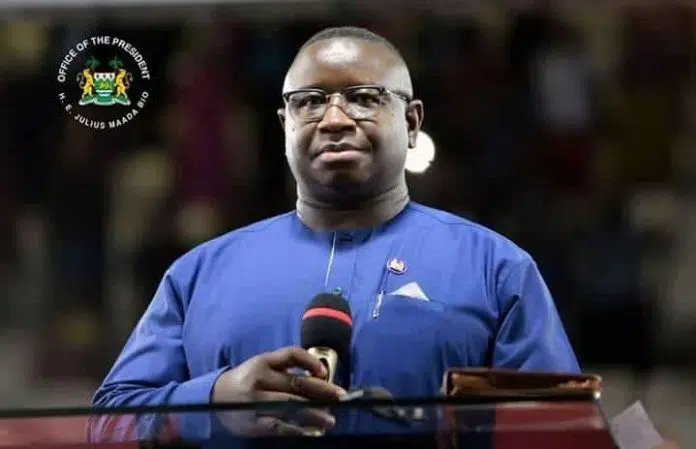
His Excellency, the President Dr. Julius Maada Bio

By Amin Kef Sesay

 The latest macroeconomics figures released by the Bank of Sierra Leone shows that the country would experience a low growth rate of about 2.2% this year – Not enough to address the many aspects of poverty in the country in any significant manner without huge external borrowing. The only medium to long term solution is how to increase GDP growth to 10% and above sustainably till the end of this decade.

Monetary economists hold the view that an increasing GDP is a measure of welfare and economic success. It was at the 1944 Bretton Woods Conference that GDP became the standard tool for measuring a country’s economy seen in the accumulation of wealth and production of goods and services.

Economic growth assesses the expansion of a country’s economy, measured by policymakers and development partners by increasing Gross Domestic Product or GDP. This indicator estimates the value added in a country which is the total value of all goods and services produced in a country minus the value of the goods and services needed to produce them. It is common to divide this indicator by a country’s population to better gauge how productive and developed an economy is – the GDP per capita.

However, let us hasten to state that GDP is not, on its own, an adequate gauge of a country’s development; as development is a multi-dimensional concept, which also includes social, environmental, and emotional dimensions. GDP growth is only beneficial to a country when it is inclusive and sustainable in the form of more and more people getting employed, incomes increasing, and more social welfare goods and services provided for the people by the Government.

When GDP grows, it becomes incumbent on the Government to distribute its gains equitably in the form of: Increasing the public provision of goods and services, a robust social safety net and progressive taxation of income and wealth.

If left unchecked, growing inequalities cannot only slow down growth, but also generate instability and disorder in society, posing a threat to the very foundation of democracy and human well-being. The consequence of the rich accumulating ever more capital and wealth is that economic and consequently political power becomes increasingly concentrated in the hands of a wealthy few.

The Human Development Index

Thus, on 11th October 2018, the World Bank launched the Human Capital Index (HCI) which ranks 157 countries’ performances on a set of four health and education indicators according to an estimate of the economic productivity lost due to poor social outcomes.

It is expected that mainly developing countries will make use of the HCI in order to quantify the results of social sector investments, thus increasing spending on human development (health, education, social security, etc.), which the World Bank argues have been forgotten at the expense of infrastructure and institutional development.

An expanded indicator, which attempts to measure the multi-dimensional aspect of development, is the Human Development Index (HDI), conceived by the United Nations Development Programme (UNDP). This is calculated through a geometric mean of GDP per capita, life expectancy at birth, and the average between mean years of schooling and expected years of schooling.

The SPI is a refinement of the HDI because it expands the number of composite indicators from only four to fifty-four in a wide array of areas, including basic human needs, foundations of well-being, and opportunities to progress.

For example, access to water and sanitation, educational and health outcomes, public criminality, housing, access to information, and communication.

The view underlying the SPI is its conceptualization of economic growth as not an end in itself, but rather, an effective means of expanding personal and societal freedoms – the impact it has on people’s lives. For example: Political liberties in the form of freedom of expression and free elections, Government transparency and accountability, Personal security/safety and Access to economic opportunities such as participation in trade and production.

In this light, development consists of the elimination of deprivations of liberty that limit the choices and opportunities of persons to live better lives.

UK Alongside Kenya to Co-host Global Education Summit -British High Commissioner Reveals

British High Commissioner Simon Mustard

Op-Ed By British High Commissioner Simon Mustard

Today marks the 100 days countdown to the Global Education Summit which will take place in London from 28-29 July 2021.

The UK Prime Minister, Boris Johnson, has long championed girls’ education and has put it at the heart of our G7 presidency, allowing the transformative power of girls’ education to get the profile it deserves.  In July, the UK, alongside Kenya, is co-hosting the Global Education Summit to urge world leaders to invest in getting children into school, and increasing access to quality education for girls.

Here in Sierra Leone, President Bio has been pivotal in placing human capital at the centre of the Government’s agenda, spreading a vision of inclusive national development through education. I am pleased that President Bio and Minister Sengeh will be attending the summit and Cabinet has recently approved the Radical Inclusion policy for schools. This policy will help remove the barriers that have prevented the most disadvantaged children from going to school, and support girls and children with disabilities to not only access learning, but to complete their education. Education can transform the fortunes of not just individual women and girls, but whole societies and nations.

A child whose mother can read is 50 per cent more likely to live past the age of five, twice as likely to attend school themselves, and 50 per cent more likely to get vital childhood vaccinations. If every girl in the world went to secondary school, infant mortality could be cut in half, saving three million lives every year.

Girls’ education enables women to choose if, when and how many children they want. If all girls had a secondary education, globally teenage pregnancy could fall by 60 per cent.

Girls with no education are three times as likely to marry by 18 as those with a secondary or higher education. With just one additional school year, a woman’s earnings can increase by a fifth.

We have been working in partnership with the Government of Sierra Leone to ensure success of the Government’s flagship programme of Free Quality School Education (FQSE), dedicated to increasing access to quality pre-primary, primary and secondary schooling so that all children can complete a basic education. The British High Commission supports this ambition through our national education programme, Leh Wi Lan, which supports secondary school students across Sierra Leone to be safe and learning in school.

With 100 days to go before the Global Education Summit. I am raising my hand for education because every girl deserves to decide her own future, and education is key to achieving that.

Minister for Basic and Senior Secondary Education David Sengeh:

I raise my hand for education. I raise my hand for inclusive education. I raise my hand so that every child – and in particular girls – can access, stay in, and complete their education in a safe and enabling environment.

As a Board Member of the Global Partnership for Education, Sierra Leone has been playing an important role in the build-up to the Girls Education Summit co-hosted by the UK and Kenya. We have led and participated in global discussions on girl’s education; and advocated for the need of continuous learning in the face of COVID-19 school closures and the ultimate safe school reopening. We do this because the country’s National Development Plan titled “Education for Development” places human capital development at its heart, central to which are the Sustainable Development Goals 4 (Quality Education) and 5 (Gender Equality and Women’s Empowerment).

We call on donor member countries to contribute generously in this GPE financing campaign. Sierra Leone is a country that leads by example – we have expanded our education budget and financing every year over the last three years. The increased financing targets expanding enrolment through our policy of universal and accessible education. Furthermore, we have invested in hiring more qualified and trained teachers, constructing safer classrooms and schools, are implementing school feeding programs, and are developing new curricular materials relevant for the 21st century.

Investments in non-formal and adult education have also expanded learning and literacy centers right across Sierra Leone. We believe that an investment in education now is our only guaranteed hope of addressing our most intractable global problems including climate change, terrorism, illegal migration, world poverty, and pandemics.

My Ministry of Basic and Senior Secondary Education has also championed several transformational policies. The recent Policy on Radical Inclusion in Schools guarantees education for all children specifically targeting four groups: i. girls, pregnant school girls and parent learners; ii. children from poor and vulnerable backgrounds; iii. children from rural and remote areas; and iv. children with disabilities. The Early Childhood Education and Development policy for the first time adds at least one year of formal preschool to the educational system in Sierra Leone.

Globally, Sierra Leone recently became the first country to start the implementation of the UN-led Education Plus Initiative, and is a member of the World Bank’s ‘Accelerator Program’ to improve global foundational learning. In addition, I Chair the UNESCO Global Education Monitoring Report who’s 2020 report focused on inclusion (#AllMeansAll).

These efforts are all part of our commitment to champion His Excellency President Bio’s flagship program of Free Quality School Education for all children in Sierra Leone. We believe more can always be done to support global education and as we start accelerating towards the SDG 4 goals. We can only reimagine education through better and effective global partnerships. This is our commitment to the Global Partnership for Education.

Minister for Basic and Senior Secondary Education David Sengeh