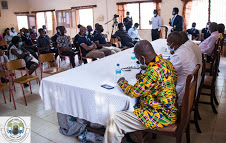
Leader of the main Opposition All People’s Congress Party (APC), Hon. Chernor Maju Bah and Leader of the National Grand Coalition (NGC) Party, Hon. Kandeh Kolleh Yumkella
By Foday Moriba Conteh
Leader of the main Opposition All People’s Congress Party (APC), Hon. Chernor Maju Bah and Leader of the National Grand Coalition (NGC) Party, Hon. Kandeh Kolleh Yumkella in a letter which they wrote dated 18th February 2021 and addressed to the Speaker of Parliament, Hon. Dr. Abass Chernor Bundu, the main thrust was a demand for a parliamentary investigation relating to alleged misappropriation of funds said to have been expended by the current Bio-led Government.
Part of the content of the letter states that in the past few weeks, Sierra Leoneans have been relentlessly bombarded with alarming revelations on the BBC, social media, local electronic and print media etc, purporting that billions of Leones have been inappropriately disbursed and expended by Government.
It was also indicated that such follows on the heels of allegations of serious negative findings within Government Ministries, Departments/Agencies and Parastatals in the 2018 and 2019 reports of the Auditor General.
Almost three months ago, it will be recalled, Hon. Kandeh Yumkella moved a motion, seconded by the Honourable Hassan Sesay (which was supported by the whole House) calling for a debate on the said reports. Repeated reminders about the need for the debate, as required under Sub-Section 5 of Section 119 of the Constitution of Sierra
Leone, have not yielded any fruit so far.
Sub-Section (5) states thus: “Parliament shall debate the report of the Auditor-General and appoint where necessary in the public interest a Committee to deal with any matter arising there from.”
It was stated that with reference to the ongoing serious allegations levelled against the Office of the President, amongst others, they as Parliament should: provide an opportunity for the Government to respond to the allegations with documentary evidence and specific facts and figures, and demonstrate to the citizens that as the arm of Government responsible for both appropriations and oversight, they have the responsibility to hold Government accountable for taxpayers’ money as and when the need arises.
Both Members of Parliament maintain that in pursuit of Section 93 (6) and Section 111 (3) and (4) of the 1991 Constitution, Parliament should request for all relevant information from the Minister of Finance.
They continued that they also believe that Parliament’s select Committees of Finance and Transparency must hold public hearings to address those allegations.
According to them, it is noteworthy that Section 93 of the Constitution of Sierra Leone fully empowers Parliament to carry out that great responsibility, at this critical moment, in the country’s history.
They expressed the view that the above provisions give Parliament the responsibility to investigate those serious allegations, including the interviewing of all those cited in the allegations and to examine all required documents.
Both Members of Parliament said they are urging the Speaker to schedule a debate as required under Sub-Section 5 of Section119 of the Constitution of Sierra Leone so Parliamentarians can pursue those issues transparently in fulfilment of their oath as Parliamentarians.
This medium was made to understand that the Sierra Leone Police (SLP) has observed with disdain in recent times that some political parties have been using their supporters as security apparatus (Marshals) whenever their parties have activities. Some Political parties have even gone as far as using these Marshals as personal security or body guards.
It is against this backdrop that the Inspector General of Police (IGP) Dr. Ambrose Michael Sovula on the 3rd March 2021 called on the leadership of the various political parties in his office at Police Headquarters to have a very frank discussion on the issue of marshals.
In a very assertive posture, the IGP openly and frankly admonished party representatives that the use of marshals in any shape or form is illegal and does not have any legal base.
He went further to say that; “we cannot have the SLP as the national law enforcement body and at the same time have another body or component seemingly to serve the same purpose”. The IGP categorically told them that the use of marshals by political parties is not allowed and will not be tolerated for as long as the SLP is in existence.
Several contributions were made by representatives of the Sierra Leone People’s Party (SLPP), the All People’s Congress (APC) party, the Coalition for Change (C4C) party and the National Grand Coalition (NGC) party. The Meeting ended in a very peaceful atmosphere with a concluding resolution that very few political party marshals could be allow to work alongside the Police but however insisted that it is the SLP that should always provide security for all Political parties in the country.
On the same issue, in a Security Sector media release dated 3rd March, 2021 and signed by Abdulai Caulker, Acting National Security Coordinator, for and on behalf of the Security Sector, it was clearly highlighted that the public is informed that the Sector is concerned about the growing trend amongst political parties in nurturing able-bodied party loyalists as marshals.
It underscored that the idea of organizing party stalwarts to serve as marshals for political party contenders has characterized the country’s political landscape spanning a decade.
Political parties, it stated, were allowed to organize marshals to complement the efforts of the security forces by maintaining decorum during political activities and campaigns.
“Indeed, the conduct of marshals used to be largely peaceful and unprovocative, but presently this is not the case,” the Release furthered adding that lately, the Security Sector has had to contend with violence incited or perpetrated by marshals set up by political parties across the country, clearly undermining peace, security and national development.
The Security Sector maintained that in consideration of the potential threat posed to national security by the continued use of marshals, a ban has been placed on the cultivation/grooming and use of marshals by all political parties with immediate effect.
The Sector is assuring political parties and the general public that it has the capacity to provide professional security services to all who are entitled and to maintain law and order in the country.
It continued by reminding the leadership of all political parties of their obligation to ensure that the conduct of their members is not inimical to national security.
“They are therefore encouraged to use their influence on their members in a positive way to foster peace and security in the country,” it admonished concluding that the law will frown at any political party, person or group of persons who attempt to contravene the ban on the use of marshals by political parties and/or under the guise of any other social grouping.
President of the Sierra Leone Football Association (SLFA) , Madam Isha Johansen
By Foday Moriba Conteh
In a Press Release dated 3rd March, 2021 and signed by, Ibrahim Kamara, Head of Media (SLFA) it was publicly revealed that the President of the Sierra Leone Football Association (SLFA) , Madam Isha Johansen has approved the sum of Five Hundred Thousand Dollars ($500,000) to be disbursed to the Premier League Board, Clubs, and other Member Associations with effect from the 3rd March, 2021.
The said amount, the Release continues, which is the second tranche of the FIFA COVID-19 Relief Funds has been disbursed to the following bodies; Sierra Leone Premier League Board-$200,000 , Premier League Clubs-$70,000, Regional Football Associations-$50,000, District Football Associations-$112,000, National Referees Association-$5,000 ,National Football Heroes-$15,000, National Coaches Association-$5,000 , Beach Football-$1,000.
It was further stated that Clubs, Associations and other SLFA affiliates are reminded to comply with the FIFA/SLFA Financial Regulations relating to retirements of previous funds from the first tranche of the COVID-19 Relief Funds disbursement.
It concluded with the SLFA President wishing the football family “continued good health and football spirits as we look forward to enjoying the beautiful game with safety and precaution”.
Representatives from the National COVID-19 Emergency Response Centre (NaCOVERC), Ministries of Health & Sanitation and Local Government have on 1st & 2nd March 2020 engaged Paramount Chiefs of Bombali & Port Loko District during a proactive move to discourage the Ebola Virus Disease that has surfaced in neighbouring Guinea from reaching Sierra Leone and to also reinforce precautionary messages on COVID-19.
Solomon Jamiru, Official Spokesperson of NaCOVERC in his statement pointed out that Paramount Chiefs deserve a resounding place in the history of the fight against the Ebola Virus and COVID-19.
He maintained that Sierra Leone, being a brilliant example other countries have referenced in dealing with the pandemic owes it accolades to not only the strong and decisive leadership of His Excellency Dr. Julius Maada Bio but also a scientific based national strategic plan from the outset and citizen’s ownership of the fight.
Brima Newman Combey, the Director of Local Government, established the authoritative influence Paramount Chiefs have on their communities and the pivotal role they play in achieving adherence. He informed Paramount Chiefs to reactivate, strengthen and where possible modify the existing by-laws that were used during the EVD outbreak in Sierra Leone. In the same regard, he urged them (through the National Council of Paramount Chiefs) to revisit and hasten implementation of those by-laws.
The Project Manager for Emergency Preparedness Response (EPR) Mukeh Fahnbulleh in his key messages on the Ebola Virus Disease made a vivid retrospective presentation that took the minds of his audience back to that very dark moment in the nation’s history and reasons why Paramount Chiefs in their respective communities and other stakeholders should prevent it from ever resurfacing.
The host Regent Chief of Pakeloko Chiefdom, Port Loko District, Abass Kanu, relayed his profound appreciation for the early recognition and pledged his unsparing support to the fight against Ebola and COVID-19.
However, series of concerns were put forward by other Chiefs for consideration with key emphasis revolving around political interference, National by-laws, undefined roles/mandates of local authorities, unmanned marine border crossing areas and logistical challenges.
Similar deliberations with Paramount Chiefs of the South Eastern province took place on the 3rd & 4th March 2020 in Bo & Kenema respectively.
One of the most topical issues that have dominated public discussions is the ongoing Castrol GTX Loyalty Lucky Dip Promotion which is proudly implemented by the National Petroleum Sierra Leone Limited (NP-SL Ltd).
Commencing on the 15th February 2021 this promotion will continue up to the 14th March 2021, meaning it will last for four weeks as part of the company’s annual activities.
From a thorough investigation mounted by this medium, it was reliably learnt that most of the company’s esteemed customers are sincerely heaping commendations on the petroleum marketing company for availing them the opportunity to win very attractive prizes noting that when it comes to enhancing customer care, the company is truly exceptional.
Within the context of the promotion, every time a NP-SL Ltd customer buys 5 Litre of Castrol GTX from any NP Dealer Stations, he or she automatically becomes eligible to be part of the promo and stands the chance of winning an attractive prize.
When the customer buys 5L Castrol GTX (20w50 or GTX Diesel) he or she has the opportunity to have one dip and for the GTX Ultraclean product he or she can have 3 dips.
There are two things to be discovered on the slip after any dip which are WINNER or Sorry! Buy More GTX.
The winner leaves his or her name and telephone number with the Station Manager of the Filling Station where the Castrol lubricant was bought and he or she will be later contacted by the Sales Supervisor.
As far as the promotion is tailored no customer goes empty handed as even losers will have some form of compensation at the end of the day.
Already there are flyers that provide information about the promotion and certain sales points have been activated in order to give the Promo wider coverage.
It must be noted that the Ultraclean 10w40 Castrol Oil is a multi-grade oil that can be used in hotter countries. GTX 20w50, though good for petrol engines, is also a multi-purpose oil.
It has been established that the Castrol oil in the white rubber is the one that is most often used as it maintains temperature and can be used on petrol engines.
This medium learnt that, NP-SL Ltd, from time to time conducts trainings for automobile mechanics and the company’s pump attendants in order for them to know the various specifications which could help them to guide customers on the actual type of Castrol GTX that will suit them.
It was also learnt that the Ultra-clean Castrol oil is going for Le250, 000 and the others (Castrol Oil) for Le200, 000.
What is certain is that Castrol GTX is more than just an ordinary oil as it is considered to be liquid engineering.
From an in-depth investigation conducted it was discovered that the Castrol GTX is less costly in the sense that it can last longer compared to other lubricants of inferior quality meaning that when consideration is taken of the amount of money spent on changing engine oil of inferior quality in comparison to Castrol GTX, then it discerns that indeed it is one that is cheaper because unconsciously much money is spent on procuring inferior engine oil of various variety than what is spent on Castrol GTX within the period of purchase under review.
Besides lasting longer, Castrol GTX lubricant enhances the good performance and efficiency of motor engines, minimizes hazardous gaseous emission and helps to properly clean motor engines or machines that may have been clogged by particles.
The National Petroleum –Sierra Leone Limited (NP-SL Ltd) is regarded as a well-positioned institution within the realm of being a very pro-active business entity that is always poised to pragmatically put concrete arrangements in place to ensure that the populace of this country gain access to qualitative petroleum products ranging from petrol, diesel, gas to lubricants, including the ever highly demanded Castrol lubricant oil that has been rated to be very good for the efficient lubrication of various engines.
The company has in its employ, a workforce as well as distributors that market its various petroleum products. As far as it has been established, this laid down policy which the company is implementing to the letter, is complementing the efforts of the Government to deepen development.
The company also markets NP Gas which is a standard cooker proven to be very environmental friendly. It is manufactured in different cylinder sizes and sold at various Filling Stations.
NP Smart Card is now in vogue and is used to purchase fuel at Filling Stations making it possible to do transactions without using physical cash.
NP-SL is indeed poised to continue to avail its numerous customers with qualitative products that the company markets.
In this regard the company has bagged the covetous commendation of, “1st For Customer Care”.
The result-oriented and indefatigable Director General of the National Telecommunications Commission (NATCOM) Daniel Kaitibi , has recently held two high profiled meetings or discussions virtually with the Secretary Generals of both the Commonwealth Telecommunications Organization (CTO) and the Africa Telecommunications Union (ATU), Ms Bernadette Lewis and John Omo respectively, both bordering on what to do in order to take the Commission to a higher pedestal.
His first engagement was with the newly appointed Secretary General of the Commonwealth Telecommunications Organization (CTO), Ms. Bernadette Lewis, during a Commonwealth Secretariat initiated meeting.
In that all-important meeting, the CTO Secretary General shared her vision of charting a new course for the CTO with Sierra Leone, especially with regards the process of restructuring NATCOM’s operations so as to enhance its value and as well support its journey towards achieving digital transformation.
She dilated also on the importance of enhancing cyber security, the essence of NATCOM encouraging telecommunications service providers to share infrastructure as well as requesting case studies to help regulate data.
The CTO Secretary General further assured the Director General of NATCOM of her organization’s preparedness to give support to different areas such as joint procurement of telecommunications equipment and tools between NATCOM and other regulators by using an economy of the scale model. To buttress her point, the Secretary General cited the Caribbean Authority which, she said, saved 50% on procurement of equipment and tools to enhance its work.
Part of the discussion also had to do with her encouraging the Director General to forge relationships with international partners on developing equipment and acquiring the latest ones for mutual benefits.
She suggested to Daniel Kaitibi to identify a project that relates to the radical transformation and do a joint proposal which he, as Director General, could submit to the CTO for due consideration.
Other areas that formed part of the discussion included the significance of enhancing rural connectivity and the UADF, the need to build on the Fund’s activities , the issue of online teaching in schools and Universities and how NATCOM can take the lead in “Preparing Sierra Leone for Increased ICT Uptake in Citizens Lives in the Wake & Aftermath of COVID-19”.
On his part, the Director General of NATCOM, Daniel B. Kaitibi, underscored the need for the CTO to work closely with NATCOM in order to make the Regulator an effective and transparent one, noting the need to look at the modern Regulatory framework and the significance of training opportunities for NATCOM staff, especially as NATCOM has been inducted into the CTO’s Program for Development and Training (PDT).
He further promised to make available the NATCOM Act to her, the Secretary General of CTO, for the perusal and possible input from the Secretariat.
The Director General also mentioned Government’s commitment towards the National Switch.
Based on the pertinent issues discussed and the suggestions made, the Secretary General proposed to do a presentation to the Minister of Information & Communications in order to deepen the discussions and move the relationship between the two bodies to the next level.
It was understood that the meeting was warmly welcomed and appreciated by both the Commonwealth Telecommunications Secretariat and NATCOM Senior Management. Both sides look forward to more engagements in the near future when COVID-19 would have been defeated.
Indeed, it is significant to note that the Commonwealth Telecommunications Organization (CTO) and the National Telecommunications Commission (NATCOM) have, over the years, established and maintained a very good relationship which culminated in the hosting of the Maiden International Conference “2019 Commonwealth ICT Forum” by the Government of Sierra Leone under the leadership of President Julius Maada Bio. The Commission was extremely grateful for the CTO’s kind consideration to host the ‘2019 Commonwealth ICT Forum’ in Sierra Leone.
In another engagement, the Secretary General of the Africa Telecommunications Union, John Omo met with the Director-General during a courtesy call virtual meeting.
John Omo, ATU’s Secretary General, Daniel B. Kaitibi, NATCOM’s Director-General, Amara Brewah – NATCOM’s Deputy Director-General, Sahr M. Sewah – NATCOM’s Director of Engineering & Infrastructure, Ibrahim Dumbuya – NATCOM’s Director of Finance, Braima Ronnie Kargbo – NATCOM’s Director of Admin & Human Resources, and Djibrilla Ball, Finance and Administration Director of the Africa Telecommunications Union (ATU) were all in attendance.
Various pertinent issues were discussed, including the nomination of Sierra Leone’s representatives to the ATU’s online Certificated Training Course in“Economic and Market-Based Methods of Radio Frequency Spectrum Management” for Spectrum Management Personnel.
It was further noted that the Commission has already designated Sierra Leone’s representatives. However, considering that some countries have not yet sent in the list of their representatives, Sierra Leone can nominate an additional candidate for the Secretariat’s approval.
Daniel Kaitibi gave a progress report on the Nethop Project, confirming that the work with Nethop Consultant has been successful and a draft report on the outcomes is already available which will be shared with ATU as soon as the internal review is completed in order to determine the deliverables.
In addition, the DG outlined that internet measurement is one of the Commission‘s priorities and therefore requested for ATU’s support in that regard. In relation to that, the Commission was informed that ATU and Afrinic signed a Memorandum of Understanding (MoU) in the area of internet development in Africa with a focus on internet measurements and capacity building.
The Secretary General expressed willingness to have Sierra Leone among the first countries to benefit from the initiative.
With regards the Sierra Leone Data Center Project, it was noted that the Commission is in the process of putting in place a National Data Center, which will shift Government and its entities’ data storage from simple server to a national Data Center.
After a brief introduction of the topic by the NATCOM Director General, his Deputy elaborated on it and a request was made to ATU to facilitate implementation of the project by organizing benchmarks with other Regulators on the continent and also in sourcing the necessary equipment for its operation. It was agreed that the Commission will work closely with ATU’s experts to facilitate the process since ATU is already undertaking a study on the regional framework on data center.
Other issues discussed included Human Capital Development. In that vein, the Commission agreed to work in concert with the ATU’s Secretariat to build capacity of the Commission’s experts and promised to share its Human Capital Development Plan with the ATU who will assist in its implementation.
The all-important issue of the settlement of arrears of Sierra Leone’s contribution was also put on the table. The Director General of NATCOM, Daniel Kaitibi informed the ATU’s Secretary General that a payment is planned shortly and reaffirmed his Commission’s and the country’s commitment to clear all arrears in accordance with the agreed plan.
The virtual meeting ended with the usual courtesies and a commitment for more such engagements until a time when COVID-19 will permit person-to-person interactions.
Newly appointed Secretary General of the Commonwealth Telecommunications Organization (CTO), Ms. Bernadette Lewis Director General of the National Telecommunications Commission (NATCOM): DanielSecretary General of the Africa Telecommunications Union, John Omo
Francis Ben Kaifala, Commissioner Of The Anti-Corruption Commission Of Sierra Leone
Public Lecture Delivered By Francis Ben Kaifala, The Commissioner Of The Anti-Corruption Commission Of Sierra Leone At The St. Paul’s Major Seminary, Regent, Freetown On Wednesday, 3rd March, 2021.
SALUTATIONS
The President of The Seminarians, the Rector, The Dean of Academics, Academic Staff, Brothers of the Seminary, Members of the Philosophy Club, interested members of the public here present, Distinguished Ladies and Gentlemen.
I feel profoundly indebted to the Leadership for the invite to speak on the topic: “How Corruption undermines the Development of a Nation”. The country stands to immensely benefit from such discourse given the fact that as a Commission, we believe the more enlightened the citizenry are on the corrosive effects of corruption on nation-building; the more effective and efficient the fight against corruption becomes. Countries that are successful in the fight against corruption have more educated and responsive citizenry. But first, let us remember that God hates corruption, that is why he said in Proverbs 15:27 “Whoever is greedy for unjust gain troubles his own household, but he who hates bribes will live.”
In Hosea 9:9 it is written, “They have sunk deep into corruption, as in the days of Gibeah. God will remember their wickedness and punish them for their sins.”
In Isaiah 1:4 it is declared, “Woe to the sinful nation, a people whose guilt is great, a brood of evildoers, children given to corruption! They have forsaken the LORD; they have spurned the Holy One of Israel and turned their backs on him.”
In order to fully grasp the topic, I shall introduce you to a few corruption issues that commonly undermine effective nation-building, particularly, but no limited to Sierra leone.
CONFLICT OF INTEREST
Conflict of interest is a situation in which an individual has competing interests or loyalties. Conflicts of interest involve a person who has two relationships that might compete with each other for the person’s loyalties.
Conflict of interest can exist in many different situations. The easiest way to explain the concept of conflict of interest is by using some examples:
with a public official whose personal interests’ conflict with his/her professional position.
with a person who has a position of authority in one organization that conflicts with his or her interests in another, particularly the state.
with a person who has conflicting responsibilities.
Types of activities that can create a possible conflict of interest include:
– Nepotism is the practice of giving favors to relatives and close friends, often by hiring them. The term comes from the word for “nephew,” it was common practice in ancient times to favour one’s nephews. Nepotism is considered a conflict of interest because the relative may not be the best person for the job.
– Self-dealing is a situation in which someone in a position of responsibility in an organization has outside conflicting interests and acts in their own interest rather than the interest of the organization. It often comes up in fiduciary situations, where someone is in a position of trust and violates that trust. An example might be a real estate agent who benefits from the sale of a property.
Like other types of illegal or unethical activities, conflict of interest activities, carry the risk of consequences. For example, Section 45 of the Anti-corruption Act 2008 punishes it with 5 years imprisonment minimum.
MISAPPROPRIATION
Another very common corruption offence is Misappropriation of Public funds; when resources meant for the benefit of the public or a section thereof is applied or redirected for personal gain or use.
ABUSE OF POSITION
Abuse of position is when you use your position or authority to confer undue advantage on oneself or others.
PROCUREMENT RELATED CORRUPTION
Corruption in public procurement takes many of the forms including bribery, embezzlement and abuse of functions. Procurement corruption may occur as a result of a conflict-of-interest situation where a public official wants to secure for him- or herself and related parties, the benefits which rightly belong to the public, by bypassing the formal requirements for the awarding of these privileges. Public procurement is particularly susceptible to corruption such as collusion to fix prices, maintenance of cartels, and other practices that thwart competition and mean that government does not receive value for money in the procurement process.
The magnitude of public procurement makes it a target: “both the overall amounts and individual contract amounts are huge, and they offer correspondingly large opportunities for bribes, kickbacks, and other payoffs”.
Transparency International has, based on a Bribe Payers Survey (Transparency International 1999), ranked sectors of the economy according to their vulnerability to corruption as follows (i) Public works contracts and construction; (ii) Arms and defense industry; (iii) Power (including petroleum and energy); (iv) Industry (including mining); (v) Healthcare/social work; (vi) Telecommunications, post (equipment and services); (vii) Civilian aerospace; (viii) Banking and finance; (ix) Agriculture. The effects of corruption in public procurement go beyond the margin: “Corruption increases the number of capital projects undertaken and tends to enlarge their size and complexity. The result is that, paradoxically, some public investment can end up reducing a country’s growth because, even though the share of public investment increases, corruption could make it not to be optimal for the public good due to practices such as over-pricing.
Therefore, prime target for corruption is public procurement, where corruption is most pervasive and also has more negative consequences. Corruption forms a driver for efforts to reform public procurement in numerous countries. Public procurement may account for 45% of government expenditure and up to 20% of the Gross Domestic Product for any country.
CORRUPTION OF AND POLITICAL INTERFERENCE IN OVERSIGHT AND PRICE-SETTING
There is a risk of regulatory authorities being affected by political or industry capture. Whenever a regulatory body submits to external pressure from other government entities or companies, it jeopardizes its independence as well as the integrity and objectivity of its decisions, and ultimately undermines its credibility as an institution. Bribery or abusively influencing the regulatory authorities undermines their functions and ultimately makes services less affordable.
BRIBERY, GIFTS AND ENTERTAINMENT
In Proverbs 29:4 it is said “A just king gives stability to his nation, but one who demands bribes destroys it.” Corruption, particularly bribery can be used to buy political influence, through donations to political parties and individuals in influential positions, as well as through donations to favoured charities, for example.
Business people recognise that companies often use improper contributions to high-ranking politicians or political parties to achieve influence.
The capture of state institutions and operators for political purposes is thus an extremely important issue with regard to corruption and abuse of power, be it for patronage, steering jobs to supporters or services being directed at and to geographical areas with political supporters.
CRONYISM AND NEPOTISM
Nepotism and cronyism are such widespread issues that are corrosively undermining the fight against corruption. It refers to situations in which public officials and decision-makers place their cronies and relatives in strategic positions in oversight and regulatory bodies, or favour companies owned by their allies and families.
THE SIERRA LEONE CORRUPTION CONUNDRUM
For me, Corruption is, quite simply, stealing from the poor. Generally, it is defined as “the abuse of public office for private gain.” But these forms of corruption described above are foundational and principal culprits to undermining nation-building in Sierra Leone.
In Sierra Leone, much of the development and significant portions of the resources allocated for public good are lost due to bribery and other related illegal and unethical activities driven mainly by Conflict of Interest and greed.
It is a widely held view that corruption in Sierra Leone had been widespread, systematic, and entrenched at all levels of government. We continued to lose huge percentage of our budget to corruption, especially in procurement; excluding the subsequent costs of corruption in the implementation and maintenance stages of projects.
Important business publications such as World Economic Forums Global Competitiveness Report had consistently pointed out that corruption hinders doing business in Sierra Leone. This reputational risk was driving away investors. The truth is, corruption is bound to flourish in a culture that encourages display of affluence without any regard as to how the wealth had been obtained. Lack of accountability plays a crucial role in the promotion of bribery and resistance to any form of reform.
When I became Commissioner in June 2018, I knew that the socio-economic revolution that Sierra Leone needed had to have the fight against corruption as its core. We therefore deployed rapid, but carefully planned engineering in the system to help ameliorate the situation and quickly reposition the image and respect of the country with a view to give it respectability and attract business and investment. We introduced legal radical reforms aimed at showing how serious we are about the need to effectively fight corruption. We also introduced approaches that were both commonsensical and practical within our social and political context. The returns were quick.
MEASURABLE GAINS MADE
Sierra leone has made incremental gains in all surveys, indexes and measurements of corruption in the last three years.
Sierra Leone has incrementally passed the control of corruption scorecard for three years back-to-back from 49% before President’s Bio’s assumption of office to 71% in 2018; then to 79% in 2019 and now to a Steller 81% in 2020; thereby playing a pivotal role in Sierra Leone’s selection for multi-million-dollar compact development by the Government of the United States Millennium Challenge Corporation. Before President Bio’s appointment, Sierra Leone had passed the scorecard only once and could not maintain it even the following year.
Sierra Leone has again progressed TWO (2) places upwards in Transparency International’s Global Corruption Ranking, moving from 119 in 2019 to 117 out of 180 countries surveyed in the 2020 Transparency International Corruption Perception Index (TI-CPI). The country also maintains its score of thirty-three (33), which is above the sub-Saharan average of 32, and the highest the country has ever recorded since the CPI rankings began. In two years, Sierra Leone has moved twelve (12) places upwards in the CPI, from 129 in 2018 to 117 in 2020. In 2017, before the election of President Bio, Sierra Leone was ranked at 130.
The 2020 CPI, released on Thursday, 29th January 2021, reveals that Sierra Leone continues to make remarkable progress in the world’s most respected corruption watchdog’s assessment and rankings and now leads sixty-three (63) countries in the global campaign against corruption, including 30 African countries, among which are; Guinea, Liberia, Mali, Malawi, Nigeria, Cameroon, Niger and Kenya and at par with Egypt.
Similar exponential jumps have been recorded in other respected global corruption measurement institutions like Afrobarometer which confirmed that corruption prevalence has massively reduced from 70% in 2015 – 2017 to a new lowest of 40% in 2020.
The Anti-Corruption Commission continues to pursue corruption investigations vigorously with only 6 acquittals out of 46 Judgments from 2018 to 2021 thereby ensuring a very high conviction rate.
Under President Bio, there has been far reaching reforms in ensuring accountability in Public Service than ever seen before. The new reforms promulgated and passed in Parliament is believed to be the strongest anti-corruption legislative reform ever in Africa.
The new progressive and very strong anti-corruption law increases the minimum punishment for major corruption offences to a minimum of five (5) years or a fine of not less than Le50,000,000.00 (Fifty Million Leones); strengthens protection of those who assist the Commission – witnesses, informants and whistle blowers; allows the Commission to either prosecute corrupt public officers or recover from them all monies they misappropriate plus a minimum of 10% interest and a mandatory exclusion from holding public office for not less than 3 years; allows the Commission to proceed with trial of accused persons and convict them in absentia; shifts the evidential burden for offences involving offering or receiving an advantage (bribery); and allows the Commission to appeal against sentences that are deemed lenient or disproportionate to the offence charged.
Additionally, The Anti-Corruption (Amendment Act), 2019 provides for administrative sanctions for Public Officers who fail to submit their Asset Declaration Forms as and within the time prescribed by the Act including withholding their salaries, suspension from public service after 3 months and removal from public service after 6 months etc.
Under the Non-Conviction Asset Based Asset Recovery, the Anti-Corruption Commission has recovered Le27, 000,000, 000.00 (Twenty-Seven Billion Leones) in the past three years. These total recoveries within the period of just over three years remain higher than all recoveries ever made by the ACC in its 18 years existence before the ascendency of President Bio into office.
The survey report titled “Actions, Hopes and Impediments in the fight against corruption in Sierra Leone”; was launched at the Commission’s 3 Gloucester StreetOffice in Freetown on Wednesday, 29th April 2020 shows as high as 92% confidence in the Commission and progress with the fight against corruption.
Successful implementation of the reform agenda would depend greatly on the support of political change agents, as well as strong legislative instruments. Although the distribution of power hegemonies, have been largely responsible for the dysfunctional nature of the Sierra Leonean political space, it is difficult to see how any meaningful change could be wrought without the cooperation of the political and higher administrative class. The probability is therefore very strong that some of the gains the reform programs in Sierra Leone have had could be attributed to the high-level leadership of the New Direction administration and the buy-in of the people.
THE WAR CRY
We all should know that we are in the midst of a crisis. Our nation is at war against corruption. Corruption has violently wrecked our economy; and has made Sierra Leone a reputational risk. This has effectively undermined FDI. Corruption led to war; as a consequence of greed and irresponsibility on the part of many politicians, but also our collective failure as a nation to make hard choices and prepare the country to succeed. Lives have been lost; limbs have been maimed, businesses have been shuttered; our healthcare system was failing; too many learning centers were failing; and each day brings further evidence to show that if we fail to tackle corruption; we have failed to position ourselves to join the rest of the world in the progress that the 21st century promises.
Nonetheless, there is a new feeling; profound levels of confidence, as evidenced in the MCC, and the recently released Afro-Barometer, that the country is turning things for the better. Today, I say to you, as a country and people, the challenges corruption poses are real. They are serious and many. They will not be met easily or in a short span of time. But know this, Sierra Leone must defeat corruption. For this country, we must choose hope over fear, unity of purpose over conflict; and concertedness over discord.
CONCLUSION
2 Peter 2:19 “They promise them freedom, but they themselves are slaves of corruption. For whatever overcomes a person, to that he is enslaved.” Our country is enslaved to corruption. It needs to be exorcised fast. You the religious leaders need to join us and make daily condemnations against corruption.
Corruption, a common danger in our life time, must be eliminated. With hope and virtue, let us brave the rains, the sun, and endure what storms may come, but we must fight corruption so that our grandchildren, and their children, shall know that when we were tested we refused to let this journey end, that we did not turn back nor did we falter. We shall carry forth the fight for future generations.
This is a watershed moment in our history. We should either get it right and prosper as a country or get it wrong and perish as a people. As a nation, our generation must take collective action against the cancer of corruption. Together, we can win. We should forget our differences and build on our uniting factors and commonality in the fight for our collective destiny. We should draw from the valour and courage of great forbearers like Sengbeh Pieh, Bai Bureh, ITA Wallace Johnson, Kai Londo, Lamina Sankoh, etc. and redirect our country’s destiny in the right direction. Now is the time to join the bandwagon of the informed and reject the chicanery of the uninformed and liberate our people from the mire of poverty mainly due to corruption! Because, if we do, as Romans 8:21 rightly says, “the creation itself will be set free from its bondage to corruption and obtain the freedom of the glory of the children of God.”
The National Social Security and Insurance Trust -NASSIT, on the 25th February 2021, donated a 500KVA Generator to Njala University during a ceremony held at the Torwamah campus of the university.
Formally donating the generator, the NASSIT Director General, Mohamed Fuaad Daboh said, “NASSIT is a statutory Public Trust charged with the responsibility of administering the Sierra Leone National Pension Scheme”. “The Scheme”, he went on “provides retirement and other benefits to meet the contingency needs of workers and their dependants”.
According to Mr. Daboh, the donation of the generator was borne out of the desire to fulfil the Trust’s responsibility to society and the need to support the strengthening of the education sector, consistent with President Bio’s New Direction Agenda that prioritizes education as its flagship programme to transform the nation.
The Director General said NASSIT is conscious of the fact that despite Government’s strides to provide universal access to energy, the Njala University is still experiencing a huge challenge – something that was brought to his attention during an engagement with the University authorities on NASSIT issues.
Daboh expressed the hope that the generator would be of immense benefit to not only the students who would increase their study time and graduate with good degrees, earn jobs and contribute to NASSIT, but also to the Njala University family that constituted both registered members and beneficiaries (pensioners) of the scheme.
He encouraged the University to consider the generator as a precious asset and make good use of it, and called on the public to support the Scheme in order for it to thrive and fulfill its mandate of providing social security protection for all it members.
Concluding, the Director General extended his appreciation to the Minister of Energy for his guidance in the process, and the Radisson Blu hotel Management for the transportation of the generator from Freetown to Bo and its installation.
In his address, the Minister of Tertiary and Higher Education, Professor Alpha Tejan Wurie, applauded NASSIT for “such a worthy consideration”, adding, “strengthening the capacity of tertiary education is the only way to build the human capital of the country”.
The Minister expressed his satisfaction over the level at which the university was progressing, and called on its Management to utilize the generator judiciously in order to sustain it.
Professor Wurie reminded the gathering about the pivotal role of the university in the development of the human resource capacity of the country, and called on Sierra Leoneans in the diaspora to come home and join the New Direction to improve the country.
On his part, the Minister of Labour and Social Security, Alpha Timbo, intimated the gathering that the move by NASSIT to solve the energy challenges at Njala is timely and in line with the Government’s desire to give energy access to the entire country. He called on the students to make the best use of the opportunity to make good grades and for their wellbeing.
Receiving the donation, the Acting Vice Chancellor and Principal of Njala University, Professor Osman Sankoh, expressed his delight and gratitude to NASSIT for the gesture, adding that energy had been one of the challenges of his administration and that since its creation in 1964, the University had never benefitted from the national grid.
He informed the audience that his administration is positioning the Njala University to an enviable pedestal that would attract private sector investment. “I have already met with a number of financial institutions on the proposal, and I call on NASSIT to join in the public-private partnership,” he said.
On the issue of accommodation, the Professor stated that the current student capacity surpasses the available space in the university, and reminded the Director General of NASSIT of their promise to construct hostels.
Concluding, the Vice-Chancellor called on Government and other private sector players to emulate NASSIT by supporting Njala University for the good of Sierra Leone.
The ceremony was climaxed by the pouring of libation by tribal authorities and the cutting of tapes by the Director General and the two Ministers, while the vote of thanks was given by the President of the Students Union.
President of the Republic of Sierra Leone Dr. Julius Maada Bio
By Amin Kef Sesay
Higher food prices are hurting the poor greatly. For example, The Calabash visited the market at Masiaka, 47 miles from Freetown to check what the prices of some basic essential foodstuffs that those living on less than Le20, 000 a day depend on.
A pint of oil was been sold at Le6, 000 although palm oil was sold at Le2, 5000.
Fish was sold at anything between Le5, 000 for 4 small ones and as much as Le10, 000 for a quantity that would suffice for a meal for a small family. Quality rice was sold at Le2, 000 per cup; whilst a cup of pepper was sold at Le4, 000.
If we add charcoal, magi, onions and all the other condiments needed to put together a nutritious square meal for a family of five, the least one would hope to spend in Masiaka would be Le30, 000 – Le10, 000 more that those living on less than Le20, 000 a day (that is the minimum wage) earn.
No one knows with certainty how to get the world out of its present economic muddle, centering on high unemployment, economic stagnation, and mounting debts for many of the world’s poorer lands.
Now let us think of how many Sierra Leoneans are gainfully employed. The unemployment rate in Sierra Leone is estimated at about 60 percent of the adult working population. This means that there is a sizeable chunk of the population that still continues to live hand to mouth.
So, in solving the bread and butter problems of having enough food on the table, being able to seek medical care when sick, affording to send your children to school, living in a decent accommodation has everything to do with being gainfully employed, how do you solve it?
We can only do so by putting more people to work. How do you do that? Only by expanding the economy to create hundreds of thousands of new jobs annually in the areas of let us say agriculture, construction, industry and international trade.
The main problem that we have is that we import nearly everything that we consume – even those for which we have great comparative advantages in producing them here. This naturally exacerbates the foreign exchange crisis leading to inflation and ever rising prices of commodities.
In Western Europe the role of foreign trade is central. Twenty-five percent of the gross national product (GNP) of Common Market nations derives from foreign trade, ranging from 18 percent in France to 52 percent in Ireland.
Even the United States is dependent on the flow of goods and services between Americans and peoples overseas.
‘In fact, ‘the deepening deficit in our trade has been by far the biggest factor pushing our economy into recession. ‘Weakness in international trade greatly hampers any economic buildup that we aim for as a country.
Borrowing to pay for imports, borrowing to buy oil, spare parts, foods, etc, has caused the country to if not fall deeper into debt continue to pay high interest to countries that we borrow from to cover out recurrent budget deficits.
Back in the 1960s after independence, the Bank of Sierra Leone records show that when Sierra Leone was a principal international trading nation (coffee, cocoa, piassava oil palm, palm kernels, gold, , iron ore, bauxite…), the currency was strong and our foreign healthy, making essential goods cheap and affordable inflation very negligible.
Because of the further deterioration of the trade balance over the coming year, we will need a substantial rise in the domestic components of the economy just to break even or get very modest growth.
Given the country’s overdependence on debt, it calls for everyone (public and the private sectors) to cooperate to expand the economy and trade, with ample evidence available to prove that more jobs are created through exports than are lost from imports.
That in turn will require President Bio and lawmakers to make painful choices – including real slashes in Government’s unnecessary expenditures including creation of many duplicating offices and functions that cost the country huge amounts in salaries and privileges.
If these things are not done quickly, consistently and robustly, the ground will continue to remain dry – very dry for the poor long suffering masses.
Chief Executive Officer of Audiofrica, Alhasan Bakarr Hafiz Kanu Sr
By Edward Vamboi
As part of their strides to give voice to African music, Audiofrica has on 27th February 2021, celebrated three (3) years of excellence service delivery in the entertainment industry. The celebration was held at the Sierra Leone Association of Journalists (SLAJ) Hall on Campbell Street in Freetown.
In his statement, the Chief Executive Officer of Audiofrica, Alhasan Bakarr Hafiz Kanu Sr. noted that they were very happy to celebrate three (3) years of excellence in service delivery, adding that inasmuch as they are celebrating 3 years of excellence they want to assure all that Audiofrica will continue to promote young entertainers across the country and give voice to African music.
He said that Audiofrica was built as a website and mobile application that enables artists to upload songs and for consumers to listen to them, while consumers have access to play and buy music on their platform.
African artists can get paid for their music being played or streamed on Audiofrica, according to Alhasan Bakarr Hafiz Kanu Sr further adding that Audiofrica is Africa’s number one Music & Entertainment Platform and Mobile App.
He noted that they are proud to say their platform has been used by many people across the country, Africa and the world as a whole divulging that they currently have over 2 Million Audios and Videos stream with over 200,000 combined followers on their social media pages, mainly on Facebook and 12,000 members/users with 8,200+who are active from 35 different countries.
Alhasan Bakarr Hafiz Kanu revealed that they have over 3000 Articles on the platform and about 275 who are active and that average age of listeners is between the ages of 17-45 years and members/users listen to music for 1 hour and 5 minutes respectively over Twenty Million paid to pay-per-stream subscribers.
He pointed out that at Audiofrica; they provide Entertainers the platform to make a living from their music and in that regard he called on all to join them by downloading the app www.audiofrica.com available on AppStore and Play Store and start making money without breaking any sweat of which he said this is something they need to celebrate in the entertainment industry furthering that Audiofrica is the future of Sierra Leone and Africa Entertainment industry.
Alhasan Bakarr Hafiz Kanu maintained that Audiofrica Stream music, videos anywhere, anytime, offline and artists can create account, upload, offer free downloads, sell, earn 70% -100% and in that regard he ended by encouraging young entertainers to join Audiofrica to take their music global and earn income through services offered.
Edward B. Conteh Manager of Audiofrica said that students can also benefit by downloading their apps saying the apps are meant for various levels of education.
In trying to identify them he said they have the Abcfrica+ which is meant for adult learners. He disclosed that Techfrica has a lot of goodies and services that they will render to the public,
He said Techfrica also provides services for entertainers who want trustworthy people to entrust their tickets. Based on what he said they
have partners in Calaba town and some parts of Freetown.
According to him, Techfrica also makes way for young entertainers to make money and also gain fame.