
By Foday Moriba Conteh
One Family People (OFP), in partnership with Liliane Fonds and the National Commission for Persons with Disabilities (NCPD), has presented a Community-Based Rehabilitation (CBR) Policy Brief to the Ministry of Social Welfare as part of efforts to strengthen disability inclusion in Sierra Leone.
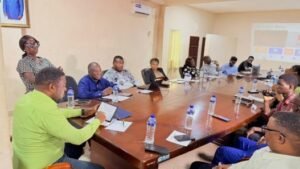
The strategic dialogue, held on Tuesday, 23 June 2026, at the Ministry of Social Welfare Conference Hall in New England, Freetown, brought together Government officials, disability advocates, Civil Society Organizations and development partners to discuss the importance of Community-Based Rehabilitation as a strategy for improving the lives of persons with disabilities.
Speaking at the event, Director of Operations and Programs at One Family People, Samuel P.O.V. Macauley, emphasized that disability inclusion requires collective action from Government, Civil Society, development partners, communities and organizations representing persons with disabilities.
He described Community-Based Rehabilitation as a community-driven development approach that promotes equal access to healthcare, education, livelihoods, social participation and empowerment for persons with disabilities. According to him, disability in Sierra Leone has been worsened by poverty, the civil war, disease outbreaks, accidents and natural disasters, making the adoption of CBR essential to ensuring inclusive national development.
Samuel P.O.V. Macauley stressed that Government alone cannot address the challenges faced by persons with disabilities. He called for stronger partnerships among Ministries, local councils, organizations of persons with disabilities, families and development partners to ensure that rehabilitation and support services reach communities across the country.
Drawing examples from countries such as Nepal, Bangladesh, Uganda, Kenya, Rwanda, Cameroon and India, he noted that Community-Based Rehabilitation has proven successful where disability services are delivered directly within communities rather than remaining limited to policy discussions.
He also highlighted the close relationship between disability and poverty, noting that many persons with disabilities continue to face discrimination in employment, business and financial services. He explained that the CBR model promotes vocational training, entrepreneurship, savings groups, financial inclusion and other livelihood opportunities that enable persons with disabilities to become economically independent and contribute to national development.
Samuel P.O.V. Macauley said disability inclusion extends beyond healthcare and should also focus on education, employment, social participation and community development. He urged greater investment in inclusive education, pointing out that despite Sierra Leone’s Radical Inclusion Policy, many children with disabilities still struggle to access quality education because of inaccessible infrastructure, stigma and inadequate learning support.
He further called for expanded rehabilitation services, improved access to assistive devices such as wheelchairs, crutches and prosthetic limbs, and increased investment in local production and maintenance of mobility aids. He also advocated stronger maternal and child healthcare services to prevent avoidable disabilities and urged greater public awareness on disability prevention.
According to Samuel P.O.V. Macauley, strengthening Organizations of Persons with Disabilities (OPDs) is essential for ensuring sustainable disability inclusion, while persons with disabilities must also be fully integrated into disaster preparedness and humanitarian response programmes.
He noted that Community-Based Rehabilitation directly contributes to several Sustainable Development Goals, including poverty reduction, quality education, improved health, gender equality, decent work, reduced inequalities and stronger institutions. He concluded that the approach represents a practical pathway toward building an inclusive Sierra Leone where no one is left behind.
Chair and Chief Commissioner of the National Commission for Persons with Disabilities, Brima A. Sheriff, described the proposed Community-Based Rehabilitation policy as a significant milestone in advancing disability rights and community empowerment.
Reflecting on his first year in office, Brima Sheriff said the Commission has focused on implementing his “PRIDE Vision,” aimed at strengthening disability inclusion through policy reforms, institutional development, community participation and restoring dignity for persons with disabilities.
He commended One Family People and its partners for championing the formalization of the Community-Based Rehabilitation model, noting that although various rehabilitation initiatives already exist, they have largely operated independently without a coordinated national framework.
Brima Sheriff explained that the proposed policy seeks to institutionalize Community-Based Rehabilitation by bringing together Government institutions, organizations of persons with disabilities, Civil Society Organizations, local communities and development partners under a unified national strategy.
He reaffirmed the Commission’s commitment to advancing the policy, noting that alongside the ongoing review of the Persons with Disabilities Act, the proposed policy would strengthen coordination, improve access to rehabilitation services and promote community ownership of disability programmes.
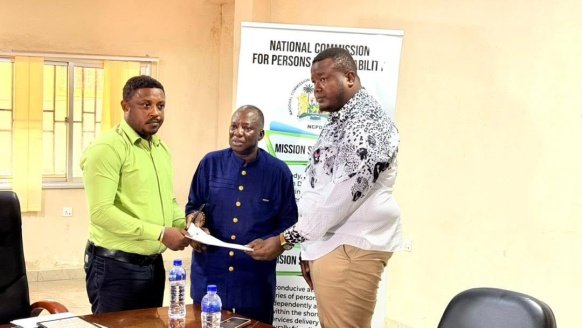
During the event, Brima Sheriff formally presented the Community-Based Rehabilitation Policy Brief to the Ministry of Social Welfare for onward submission to Cabinet.
He said the document outlines the challenges facing persons with disabilities, reviews existing legal and institutional frameworks and proposes practical measures to strengthen rehabilitation services, referral systems and livelihood opportunities while placing persons with disabilities at the centre of decision-making.
Brima Sheriff disclosed that future priorities include establishing Community-Based Rehabilitation committees at district and community levels, creating a national referral and case management system, expanding rehabilitation and livelihood programmes, promoting inclusive entrepreneurship and increasing nationwide public awareness on disability rights.
Representing the Minister of Social Welfare, Acting Director of Social and Religious Affairs, John Conteh, welcomed the presentation of the policy brief and reaffirmed the Ministry’s commitment to promoting disability-inclusive development.
He commended One Family People for its continued collaboration with the Ministry in strengthening community-based interventions and improving livelihood opportunities for persons with disabilities.
John Conteh described Community-Based Rehabilitation as one of the most effective approaches to bringing services closer to communities by strengthening families, expanding access to education and healthcare, promoting social inclusion and supporting economic empowerment.
He said disability is a cross-cutting development issue requiring coordinated interventions across health, education, livelihoods and social services.
Highlighting Government initiatives, John Conteh said the Ministry has been working with the National Commission for Persons with Disabilities to expand livelihood programmes, conduct nationwide disability assessments and verification exercises, improve rehabilitation services and strengthen vocational skills development.
He also referenced the implementation of vocational skills programmes under the Adaptation Fund project supported by the United Nations Development Programme (UNDP) and the Government of India. Four vocational training centres have already been rehabilitated, with plans to expand similar interventions to other districts, including Moyamba.
John Conteh identified the lack of reliable disability data as one of the region’s greatest challenges. He revealed that Sierra Leone is leading the development of a Disability Accountability Framework for ECOWAS, which aims to improve disability data collection across member states to support evidence-based planning and resource allocation.
He praised the leadership of the National Commission for Persons with Disabilities for advancing policy reforms and assured stakeholders that the Ministry would continue working with One Family People, development partners and other institutions to promote disability inclusion and Community-Based Rehabilitation nationwide.
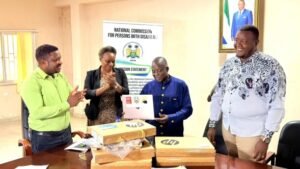
The strategic dialogue concluded with the official presentation of the Community-Based Rehabilitation Policy Brief to the Ministry of Social Welfare and the donation of five laptop computers by One Family People to the National Commission for Persons with Disabilities to support its operations.