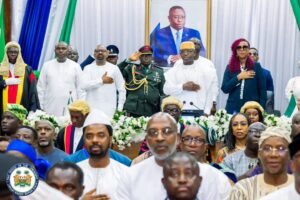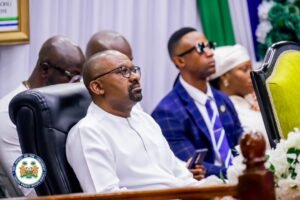

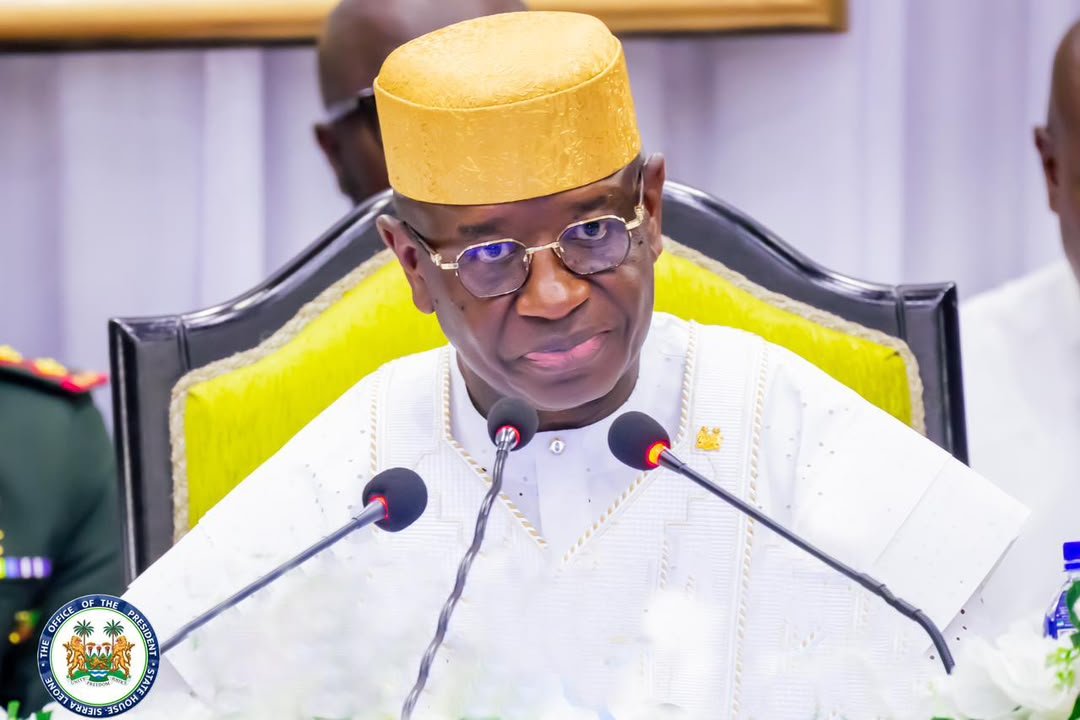
President Dr. Julius Maada Bio has officially opened the Fourth Session of the Sixth Parliament of the Second Republic of Sierra Leone, unveiling an ambitious national delivery agenda centred on economic stability, food security, youth employment, energy, infrastructure, healthcare, education and stronger public institutions.
Delivering his Presidential Address in the Chamber of Parliament at Tower Hill in Freetown on Friday, 7 August 2026, President Julius Maada Bio described the State Opening as a moment of national accountability, requiring Government to honestly assess progress, confront unfinished work and renew its responsibility to the people.
President Julius Maada Bio stressed that public office is a sacred trust and that Government policies, resources and reforms must ultimately be judged by whether they improve citizens’ lives. He acknowledged that Sierra Leoneans continue to face concerns over food prices, employment, electricity, water, healthcare, education and the quality of public services.
The President welcomed Members of Parliament from the main opposition All People’s Congress back to Parliament, maintaining that a strong democracy requires both an effective Government and responsible opposition. He called on political leaders to disagree responsibly, cooperate where possible and place Sierra Leone above partisan interests.
Declaring the Fourth Session part of the Government’s “Year of Action and Accelerated Delivery,” President Julius Maada Bio directed Ministries, Departments and Agencies to move beyond plans and demonstrate measurable progress against clearly defined national priorities.
On the economy, the President reported that real Gross Domestic Product grew by 4.6 percent in 2024 and 4.8 percent in 2025. Inflation declined to 4.4 percent by December 2025 before rising to 10.8 percent in April 2026 as global oil prices increased.
The trade deficit, according to the President, narrowed from US$1.60 billion in 2024 to US$1.07 billion in 2025, while domestic revenue increased from NLe14.6 billion to NLe18 billion. Public debt also declined from 50.8 percent to 49.3 percent of GDP.
Despite those improvements, President Julius Maada Bio acknowledged that favourable economic indicators alone cannot put food on people’s tables. He said economic recovery would become meaningful only when families can better afford food, transportation and electricity, businesses create jobs and public services improve.
Food security remains central to the Government’s development agenda through the Feed Salone Programme. Rice production reached 1,441,015 metric tonnes in 2025, representing a 4.2 percent increase over the previous year, while cultivated land expanded to 661,016 hectares.
Rice self-sufficiency increased from 68 percent in 2023 to 73 percent in 2025, with the rice import bill declining from US$177 million in 2022 to US$159 million. Cocoa, cashew and coffee exports also generated US$107.8 million in 2025.
More than US$45 million has been mobilised for agribusiness growth and commercialization, while local rice now accounts for 40 percent of supplies under the School Feeding Programme, compared with 10 percent in 2024. The programme provides meals to about 270,000 schoolchildren daily while creating a reliable market for local farmers.
President Julius Maada Bio pledged to expand irrigation, mechanization, processing and rural connectivity, stressing that Feed Salone would ultimately be judged by farmers’ earnings, household food costs and Sierra Leone’s ability to feed itself.
Education and healthcare also featured prominently in the address. School feeding currently reaches 1,016,191 pupils in 4,034 schools across all 15 districts. More than 26,000 primary teachers and 5,400 early-childhood teachers and supervisors have been trained.
The President strongly condemned examination malpractice, warning that public officials, principals, teachers, parents and pupils who facilitate malpractice must face the law.
In healthcare, President Julius Maada Bio reported that maternal mortality declined from 1,200 deaths per 100,000 live births in 2013 to 354 in 2023. Skilled birth attendance and institutional deliveries now exceed 95 percent, while childhood immunization has surpassed the national target of 90 percent.
Youth employment remains another major priority. Recalling his Government’s target of creating 500,000 jobs over five years, President Julius Maada Bio directed the publication of verified cumulative employment figures, including what qualifies as employment, the sectors involved and the duration of the jobs.
The Productive Social Safety Nets and Youth Employment Project is supporting 8,000 youth-led enterprises, while Government plans to further connect technical and vocational training, digital skills and apprenticeships with employment opportunities.
On electricity, the President highlighted the US$2.2 billion Mission 300 Energy Compact, which aims to increase electricity access from 36 percent in 2024 to nearly 80 percent by 2030 and expand generation capacity from 271 megawatts to 1.12 gigawatts.
Government has also secured a 60 percent financing commitment from the OPEC Fund to rehabilitate and expand the Bumbuna Hydroelectric Project from 50 to 100 megawatts. A 108-megawatt combined-cycle power plant currently under construction is expected to begin supplying electricity during the first quarter of 2027.
President Julius Maada Bio further disclosed that his administration had paved 474.46 kilometres of roads and constructed or reconstructed 23 bridges between 2018 and 2026, with another 26 major road projects underway.
On mining, the President said mineral exports reached US$1.3 billion in 2025, increasing by 16 percent over 2024 and generating US$55.8 million in non-tax revenue. The sector supported 15,543 formal jobs, with more than 92 percent held by Sierra Leoneans.
Planned mining expansions are expected to create another 4,500 jobs and increase annual mineral exports to between US$2 billion and US$2.5 billion by 2028.
President Julius Maada Bio also addressed national cohesion, welcoming the Attorney-General and Minister of Justice’s decision to discontinue criminal proceedings against former President Ernest Bai Koroma. He expressed hope that the development would reduce political tensions, promote reconciliation and enable the country to concentrate on pressing national challenges.
On electoral governance, the President reaffirmed Government’s commitment to implementing reforms arising from the Agreement for National Unity and recommendations of the Tripartite Committee, stressing that electoral reforms must strengthen institutions, transparency and public confidence.
Concluding his address, President Julius Maada Bio acknowledged that serious challenges remain, particularly the high cost of living, unemployment among young people, inadequate services and delays within public institutions.
He pledged that before the next State Opening, Government would concentrate on increasing food production, expanding electricity and clean water, completing priority roads and bridges, improving healthcare and education and creating more pathways to employment and entrepreneurship.
President Julius Maada Bio said Ministries, Departments and Agencies would be subjected to clear and measurable targets, with performance reviewed, progress published, delays explained and failures corrected.
He urged Parliament to remain connected to citizens, enact sound laws, exercise responsible oversight and protect public resources, stressing that the Executive, Legislature and Judiciary have distinct constitutional responsibilities but ultimately serve one Republic.
For the President, the true measure of national progress will be reflected in farmers producing and earning more, children remaining in school, mothers surviving childbirth, young people securing meaningful employment and citizens receiving fair and efficient treatment from public institutions.