

By Alvin Lansana Kargbo
The Sierra Leone Chamber for Agribusiness Development (SLeCAD) has intensified calls for stronger collaboration among Government, financiers, investors and agribusiness stakeholders to accelerate agricultural production and support Sierra Leone’s food security agenda under the Government’s flagship “Feed Salone” programme.
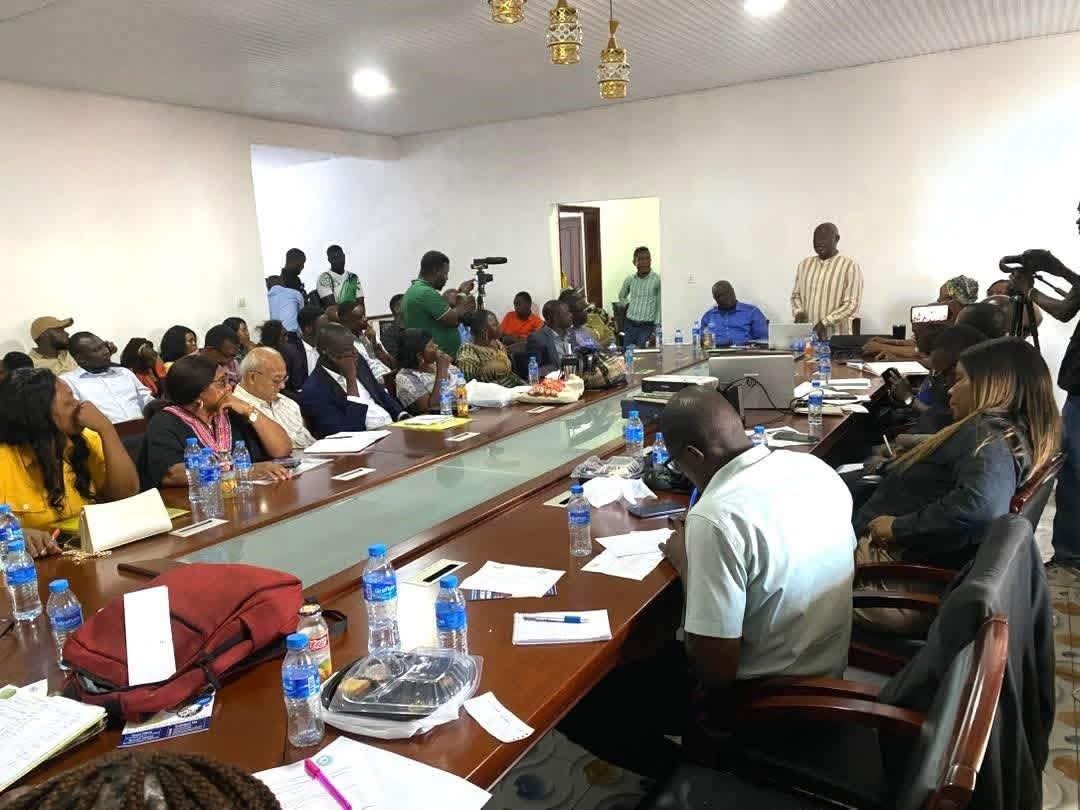
The call was made during a high-level engagement held on Tuesday, 26th May 2026, at the SLeCAD office on Beach Road in Freetown, bringing together officials from the Ministry of Agriculture, Forestry and Food Security, farmers, investors, insurers, agribusiness operators and development partners to discuss practical measures aimed at improving agricultural productivity, expanding investment opportunities and strengthening food security across the country.
Speaking during the engagement, Executive Chairman of the Sierra Leone Chamber for Agribusiness Development, Ahmed Nanoh, stressed the urgent need for Sierra Leone to move beyond subsistence farming and position itself as a competitive agribusiness destination capable of attracting large-scale local and international investment.
Ahmed Nanoh emphasized that while Government policies remain important, they alone cannot transform the agricultural sector without stronger financing mechanisms, increased private sector participation and effective implementation strategies.
“Our primary motive is how we can support the transformation of Sierra Leone through agriculture, industrialization and economic empowerment,” Ahmed Nanoh stated.
He explained that the Sierra Leone Chamber for Agribusiness Development, established in 2008, has consistently worked with farmers, Government institutions and development partners to strengthen agricultural value chains despite operating under limited resources.
Ahmed Nanoh disclosed that initiatives such as community banks, Apex Bank and several financial support programmes for the agricultural sector were developed through partnerships involving the Sierra Leone Chamber for Agribusiness Development and the Ministry of Agriculture. However, he maintained that significantly more investment remains necessary to improve access to finance for farmers and agribusiness entrepreneurs across the country.
He further revealed plans by the Chamber to revive its regular end-of-month engagement forums designed to connect farmers, buyers, donors and international investors with local agribusinesses in order to create stronger market linkages and business opportunities.
Drawing comparisons with successful agricultural models in countries including Nigeria, Ghana and Kenya, Ahmed Nanoh noted that major agribusiness companies in those countries often support farmers through financing arrangements, contractual agreements and guaranteed markets for produce.
“Finance is not only at the bank, it is also in the market,” Ahmed Nanoh remarked, explaining that large companies can support agricultural production once farmers demonstrate commitment and the ability to meet supply demands.
He also disclosed that the Sierra Leone Chamber for Agribusiness Development had previously engaged financiers from the Middle East and other international partners on potential investment packages for Sierra Leonean agribusinesses, with some proposals reportedly exceeding US$5 million before negotiations later stalled.
Ahmed Nanoh encouraged local businesses to take advantage of opportunities presented under the African Continental Free Trade Area, stressing that Sierra Leone has yet to fully benefit from regional and international agricultural markets.
Deputy Minister of Agriculture II, Sahr Hemore, reaffirmed Government’s commitment to working closely with private sector stakeholders to transform agriculture into a modern and commercially driven sector capable of boosting economic growth and reducing food insecurity.
Sahr Hemore emphasized that the objectives of President Julius Maada Bio’s “Feed Salone” initiative cannot be achieved without active private sector participation.
Launched in 2023, the “Feed Salone” programme aims to reduce hunger, improve food production and reduce Sierra Leone’s dependence on imported food commodities.
“We in the Ministry will not be able to achieve this goal alone,” Sahr Hemore stated. “It will only be possible with the support of the private sector.”
He disclosed that the Ministry of Agriculture is currently collaborating with banks and development partners to improve access to agricultural credit and insurance schemes, particularly for farmers affected by flooding and other climate-related challenges.
Sahr Hemore also highlighted ongoing Government investments in roads, bridges, storage facilities and energy infrastructure intended to support agricultural production and agro-processing activities nationwide.
Deputy Chief Agriculture Officer, Aiah J. Thollie, described the Sierra Leone Chamber for Agribusiness Development as a key partner in advancing the “Feed Salone” agenda, stressing that agriculture is no longer solely the responsibility of Government.
“The private sector must drive market aggregation, input supply, processing, packaging and commercial farming,” Aiah J. Thollie stated.
He explained that reforms introduced by the Ministry of Agriculture are aimed at attracting increased private investment while gradually moving Government away from directly distributing fertilizers and seeds.
Aiah J. Thollie added that private companies are increasingly supporting Government-backed agricultural initiatives through the supply of machinery, fertilizers, improved seedlings and other essential farming inputs.
He identified limited access to finance as one of the major obstacles confronting agribusinesses and called for improved loan facilities and investment support for farmers and agricultural entrepreneurs.
According to Aiah J. Thollie, Sierra Leone has made encouraging progress in the local production of onions, rice, eggs, and agro-processed products, contributing to a reduction in dependence on imported goods.
Agribusiness entrepreneur and Chief Executive Officer of Susue Chilli Coconut Oils, Naasu Fofanah, also highlighted challenges faced by women-led businesses, particularly in accessing finance and expanding market opportunities.
Naasu Fofanah criticized some supermarkets for placing locally produced goods on less visible shelves, thereby limiting their market reach, while also cautioning against political interference in the allocation of business financing opportunities.
Participants at the engagement further discussed several broader challenges affecting agricultural growth in Sierra Leone, including inadequate infrastructure, climate-related risks, the high cost of farming inputs, limited mechanization, insufficient storage facilities and weak market access for small and medium-scale farmers.
The engagement underscored the growing importance of stronger partnerships between Government, private sector stakeholders, financial institutions and development partners in driving sustainable agricultural transformation, creating employment opportunities, strengthening exports and achieving long-term food security in Sierra Leone.